
TikTok Ads for Real Estate: A Compliant Lead Guide

The most popular advice for TikTok ads for real estate is to narrow the audience until the cost per lead looks cheap. Target first-time buyers. Focus on affluent ZIP codes. Exclude older viewers. That playbook fails on this channel, and under U.S. and Canadian housing rules it can create a compliance problem before a single showing is booked.
Housing campaigns lose the shortcuts agents usually rely on. Age, gender, ZIP code, and family status come off the table. What still scales is broad, lawful geography, listing creative that qualifies itself, and a measurement system that counts booked appointments instead of form fills.
A cheap lead is not a client. I would judge every test by cost per qualified appointment, and by how many of those appointments move toward a showing or a prequalification, not by the form price the ad platform reports.
Real Estate TikTok Ads at a Glance
A workable account has four layers, each with its own job. Discovery finds new local demand. Retargeting brings back people who already watched. Lead capture collects contact details. Appointment campaigns push qualified prospects toward a showing or a call. Mixing those jobs in one ad group is how teams end up optimizing for the cheapest form instead of a conversation.
Layer | Goal | What to run | Judge it by |
|---|---|---|---|
Discovery | Reach local buyers, sellers and investors | Broad geo-targeted listing and neighborhood videos | Reach and video view rate |
Retargeting | Re-engage recent video viewers | Property-specific proof and short FAQ clips | Click-through to the listing or consultation page |
Lead capture | Collect contact details | Instant form or landing page with a clear offer | Cost per lead and qualified rate |
Appointment | Book viewings or calls | Consultation offer aimed at qualified prospects | Cost per booked appointment |
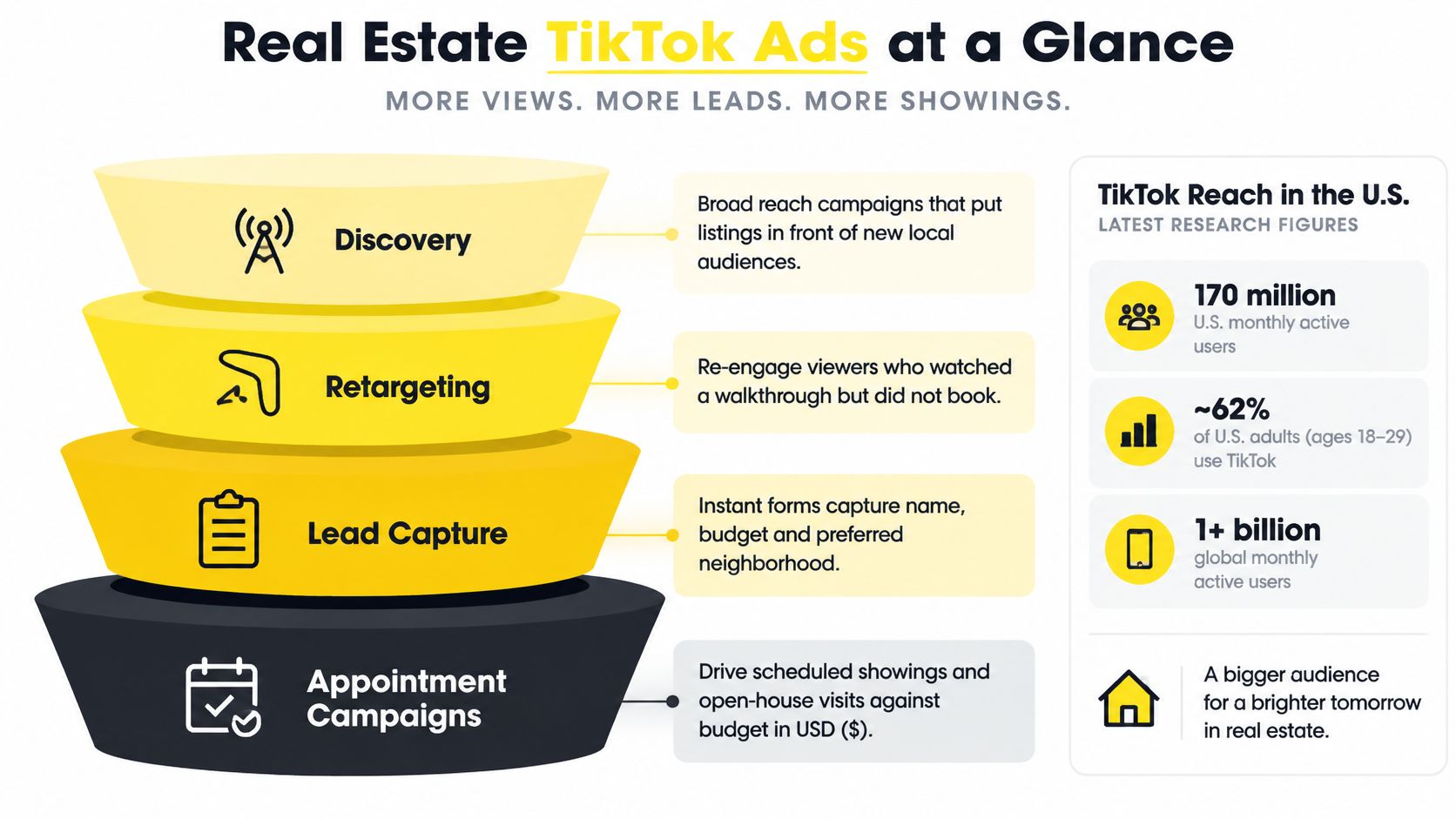
What the reach numbers are for
DataReportal's Digital 2025 United States report reported 136 million TikTok users aged 18 and above in the U.S. in January 2025. TikTok's advertising tools indicated ads could reach 49.6% of all U.S. adults, and the adult advertising audience was 52.9% male and 47.1% female.
Those figures are potential advertising reach, not verified monthly active users and not leads. Planning data can include duplicate, inauthentic, or non-human accounts. Use them to size a market and plan media. Don't forecast inquiries or closings from them. The gender split is a reason to test more than one creative theme, not a reason to build a narrow demographic buy.
A city-level example
Say a brokerage runs a city-level discovery campaign with three listing videos. Viewers who watch part of one enter a retargeting ad group and land on a consultation page that names the property, the price band, and the next step. Geography for that structure is country, state, city, or a radius around the market you can serve.
The structure is working when the share of qualified leads and booked appointments rises. A falling cost per form, on its own, doesn't prove it.
Compliant Targeting Under Housing Ad Rules
A cheap lead from a tight ZIP buy is the wrong scoreboard once housing rules strip the shortcuts agents usually rely on. In the U.S. and Canada, listings, realtor services, mortgages, homeowners insurance, and property appraisals sit inside Housing, Employment, and Credit (HEC) advertising. Turn on the Special Ad Category toggle before you set targeting. TikTok's HEC ad policy then removes age, gender, ZIP code, marital or parental status, and options that describe or correlate strongly with protected characteristics.
The campaign still has to scale. Lawful geography, property facts in the creative, and a conversion event tied to a showing or a valuation call are what remain. A falling cost per form can sit next to an empty calendar. I judge the buy on qualified appointments, not on how little the form cost.
Option | Status | Compliant substitute |
|---|---|---|
Age | Removed by TikTok | Property-focused creative about price range and space |
Gender | Removed by TikTok | Neutral household and lifestyle themes |
ZIP code | Removed by TikTok | City, state or radius geo-targeting |
Marital or parental status | Removed by TikTok | Family-neutral language about commute and layout |
Recent real estate video engagers | Check before use | Retarget viewers with a property proof asset |
CRM uploads and lookalike audiences | Discrimination review needed | Consented first-party data reviewed for composition |
Why the usual shortcuts fail
"Target first-time buyers," "focus on affluent ZIP codes," and "exclude older audiences" are unavailable or risky once the toggle is on. Build separate campaigns around lawful geographic eligibility, broad creative testing, and first-party conversion signals. Compliance belongs in campaign construction, not in a review after launch. If the ad group cannot legally narrow who sees the listing, the listing has to do that work in the first line.
Substitutes that still qualify demand
Deliver at country, state, city, or radius level, and let the listing filter demand the audience settings no longer can.
Price range: Put the band in the first line so browsers self-select.
Property type and layout: Name beds, lot, or condo rules without guessing who lives there.
Commute context: Describe drive time and transit in neutral terms.
Financing eligibility: State program rules and required documents, not who "should" apply.
Appointment intent: Ask for a showing or a valuation call, not a vague "learn more."
Custom and lookalike audiences built from CRM data should be reviewed for discriminatory composition before launch. Those uploads are a governance risk. Personalize the message a person sees after they engage. Keep people from being excluded because of a protected trait. Document every approval, including the Special Ad Category setting and the audience review, before you launch.
Broad delivery will waste some impressions. That is the trade for staying inside the policy while the account still has room to spend. Optimize toward the appointment once you have enough of them. Until then, read lead quality in the CRM, not only in the ad account.
Practical rule: If a targeting idea only works by inferring age, family status, or a ZIP code's demographics, drop the idea and qualify on the listing instead.
Creative That Makes Property Listings Stop Scrolling
TikTok rewards video that feels like a walkthrough or a neighborhood explainer, not a banner with a logo slam. Paid distribution won't rescue a clip that looks like a listing flyer.
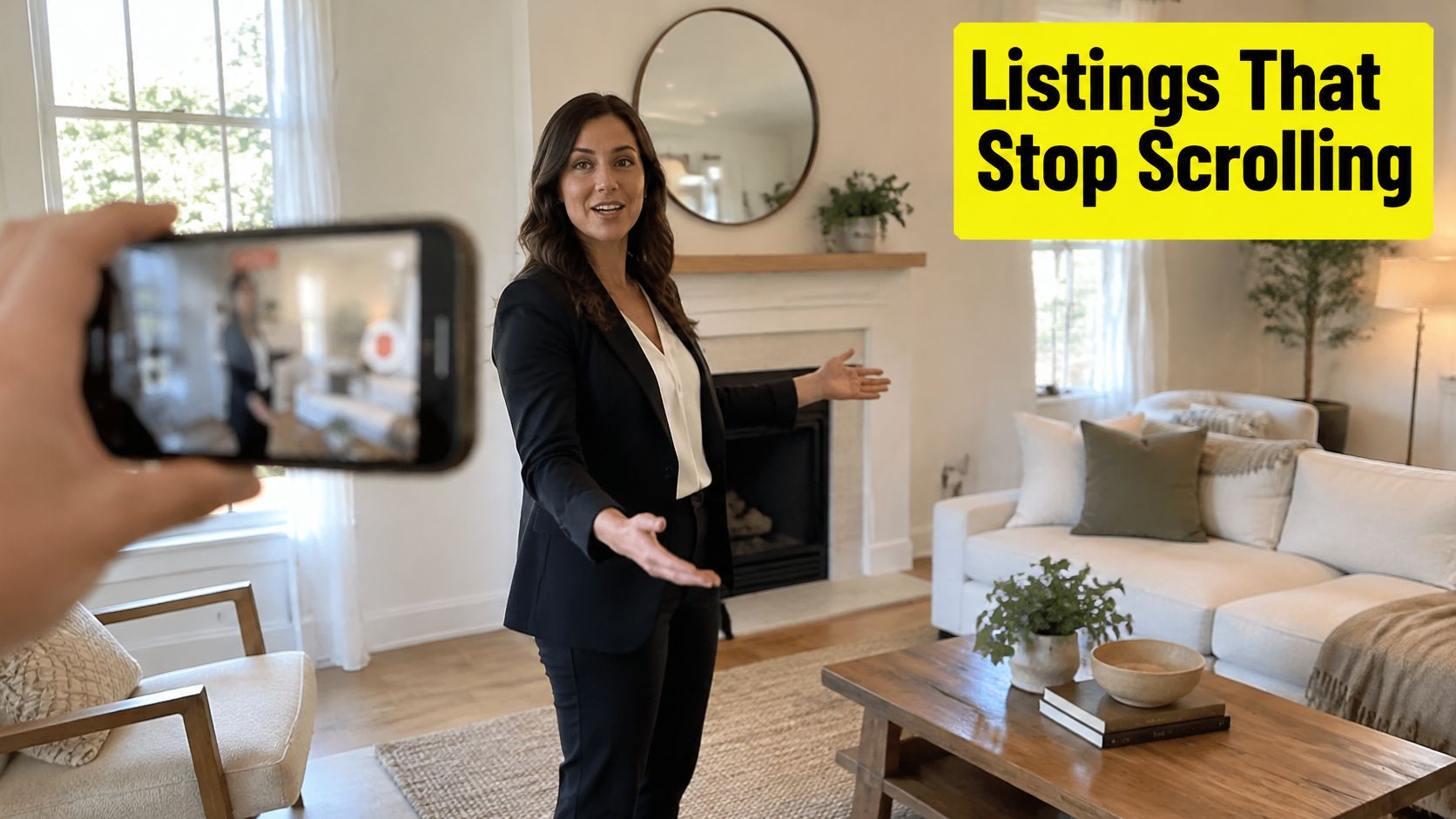
Four formats that earn the stop
Keep each clip in a 15-to-25-second window so there's room for a fact and a next step.
A listing tour puts the asking price and the key specs in the first on-screen line, then moves through the rooms that justify that price.
A neighborhood explainer covers commute, schools as public information, and amenities without steering language.
A renovation-economics clip shows purchase price, a realistic repair range, and what an investor should verify before an offer.
A mortgage-readiness explainer lists documents and timelines for buyers who aren't ready to tour yet.
Test organic, then pay to distribute
TikTok for Business reported that Spark Ads launched globally in July 2021, so an advertiser can promote an existing organic post and keep its native look and its engagement. Post from the agent's account, read the comments, and only then put spend behind the post that already holds attention. Teams that need to scale TikTok ad variations can cut several openings from one shoot instead of filming a new property for every test.
Say an agent films a 20-second tour of a three-bedroom home, puts the price on screen in the first second, and pins a comment that asks viewers to request a viewing. Film that listing in one session. Cut three versions that differ only in the first three seconds: price first, street first, or a blunt "what's included" line. Post the strongest cut organically. Promote it once the opening holds.
Good creative has three checks. The first three seconds hold attention. The call to action names one next step. Every price, bed count, and status line matches the live listing.
Tracking Leads Through to Appointments and Closings
Form volume misleads because a lot of TikTok demand is research, not a ready buyer. The Seattle Times, citing survey and NAR figures, noted that 41% of surveyed Gen Z and millennial buyers and sellers use social media to learn about real estate, while millennials represented 29% of buyers and Gen Z only 3% in a 2025 NAR report. Influence early in the search doesn't mean the person who taps "submit" can transact this month.
Event | What it signals | How to use it |
|---|---|---|
Form submission | Interest only | Track as top-of-funnel activity |
Verified phone or email | Contact is possible | Count as a lead and dedupe in the CRM |
Booked showing or call | Sales intent | Optimize campaigns toward this event |
Loan prequalification or completed application | Financial readiness | Report cost per qualified appointment |
Closed transaction | Revenue | Judge the campaign on closed revenue |
Point the bid at a qualified event
TikTok's real estate advertising guide treats downstream events such as a completed application, a booked showing, a verified phone, or a loan prequalification as the way to separate curiosity from a sales-ready prospect. The same policy requires compliance with licensing rules and visible advertiser information on the landing page: brokerage, agent or lender, license details where required, property status, and the exact follow-up offer.
Validate phone and email server-side. Deduplicate against the CRM. Report cost per qualified appointment and opportunity-to-close rate beside cost per lead. If the bid only sees form completions, automated bidding will favor high-volume, low-intent fills.
Route by readiness
Curious clicks go into an educational sequence on financing or neighborhoods. Qualified leads go to an agent inside a response window the team agreed before launch. Also track assisted activity that happens before a form: property-page visits, saved listings, and repeat video views.
Install the TikTok Pixel on the landing page and send booked showings and applications through the Events API, so those events still reach measurement when a browser blocks cookies. Confirm each event in test mode before spend starts.
Four hundred form fills at a low cost per lead, with 30 verified phones and 6 booked showings, can be a weaker result than a pricier campaign that books 15 showings. The second one is closer to revenue.
How to Build a Compliant Campaign Step by Step
The slip that burns a week is building the audience first and discovering, at review, that housing rules blocked it. Set the category, then the geography, then the event you want.
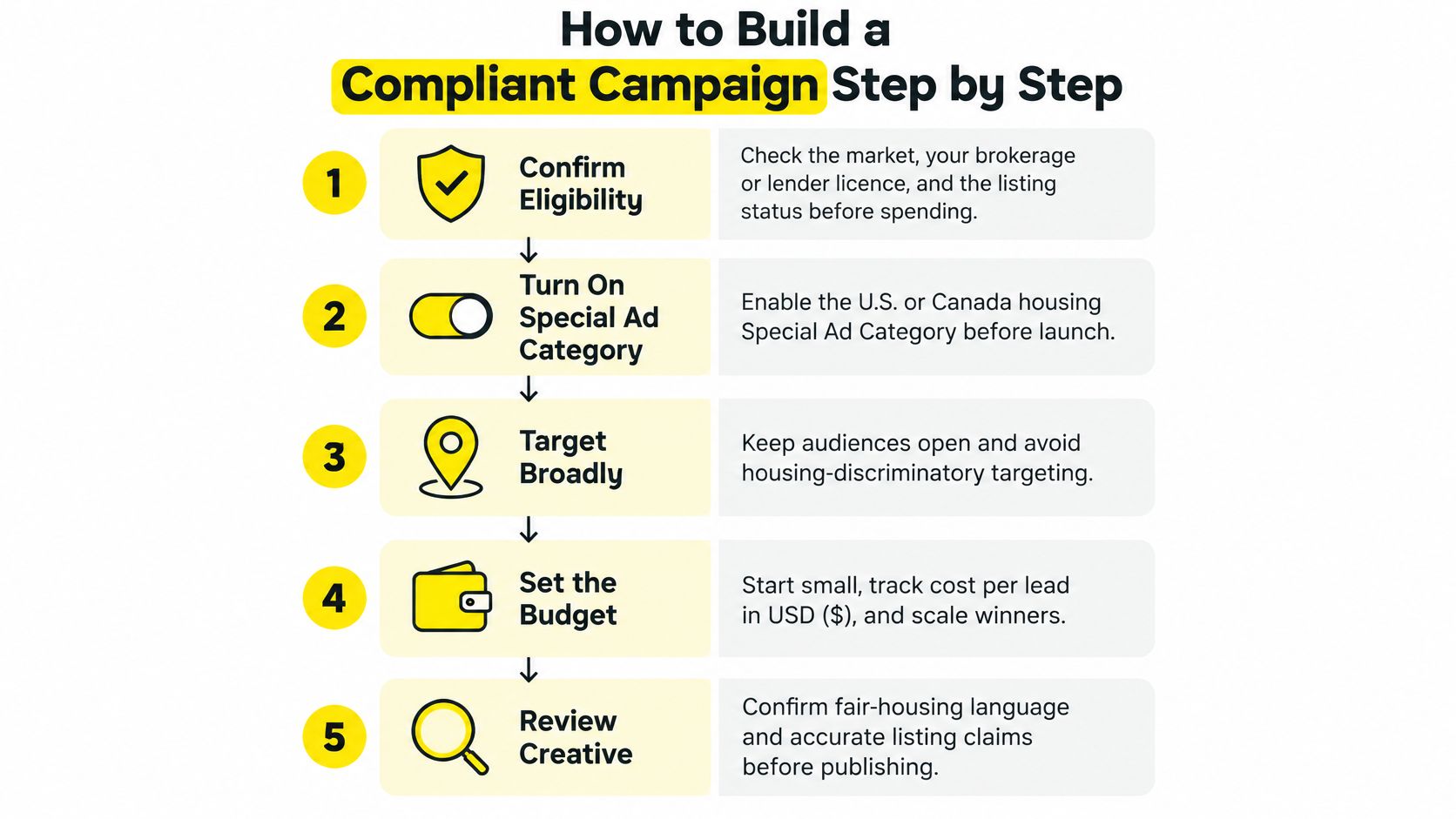
Setup before any spend
Confirm eligibility. Check that the market allows this promotion, that the brokerage or lender license is current, and that the listing status is accurate. Spending against a withdrawn listing creates bad leads and a policy risk.
Turn on the Special Ad Category for U.S. or Canada housing campaigns before any targeting choice. The toggle removes restricted options. Adding it later forces a rebuild.
Match the objective to a qualified action. A booked call or a completed showing request should be the conversion event. A form submit can stay in reporting, but it shouldn't be the only thing the bid chases.
Set geography and keep discovery broad. Country, state, city, or radius is the lawful frame. A tight interest stack won't replace the controls housing rules removed.
Creative, page, and the first read
Add retargeting of people who engaged with real estate videos in the prior 7 to 30 days, and only after you confirm that audience is allowed on the housing campaign. Serve them a property-specific proof asset, not the same discovery clip.
Build two or three ad groups, each opening with a different hook: price, neighborhood, or process. One variable per group makes the winner readable.
Check the landing page shows the brokerage name, license details where required, property status, and one precise follow-up offer. A generic "contact us" page throws away the qualification the video started.
Set a test budget and wait for enough delivery to read the qualified rate. Killing the ad on day two because the form price moved is how good openings get discarded.
Change the audience after the category is on, not before. Reviewers see the restricted fields you tried to use, even if you meant to delete them later.
Common Problems and How to Fix Them
Most "TikTok doesn't work for real estate" postmortems start with the same symptom: cheap leads that never answer. The form asked for a name and a phone number and nothing that would scare off a browser. Add a price-range question and track the qualified rate before you add budget.
Symptom | Likely cause | First fix |
|---|---|---|
Cheap leads that never answer | Curiosity-driven form fills | Add a price range question and track the qualified rate |
Ads rejected in review | Restricted targeting or missing advertiser details | Enable the Special Ad Category and disclose brokerage and licence information |
High views, few clicks | Weak opening or no clear next step | Open with property specifics and a single call to action |
Leads go cold after the form | Slow follow-up or duplicate CRM records | Validate and dedupe leads, then respond within the agreed window |
Retargeting pool too small | Few recent video engagers | Extend discovery spend and keep posting listing videos |
What to do the same day
Review rejections within a day. Check the policy category, the Special Ad Category setting, and the advertiser details on the landing page. That fix is immediate. Some countries ban or limit real estate promotion on TikTok, so confirm local rules before you copy a U.S. campaign into a new market. A compliant U.S. setup is not a passport.
Slow follow-up is a CRM problem, not a creative problem. Agree the response window before launch, validate and dedupe on the way in, and don't let the same person sit in two agents' queues.
What needs a full read
A new opening needs a full week of delivery before you judge it. One afternoon of views isn't a verdict. A retargeting pool that stays tiny needs more discovery spend and a steady run of listing videos. That pool grows with delivery, not with a tighter interest.
Change one variable per test. Keep cost per qualified appointment as the judge, even when the form price looks flattering.
Launch a Compliant Test Campaign Next
Launch one compliant test for a single market or one listing group. Pair discovery ads with a retargeting ad group and a landing page that shows the brokerage name, license details where required, property status, and one follow-up offer. Set the budget before launch and cap it so one week of delivery is enough to read the qualified rate, not so open-ended that a cheap-form winner spends the month.
Week one: finish the build steps and produce three to five listing or neighborhood videos. Weeks two and three: let discovery deliver, then start retargeting recent video engagers once that pool has grown. Week four: compare booked showings, verified phones, and loan prequalifications with total spend. Ignore form volume as the headline.
Write the go or no-go rule before the first dollar. Go if cost per qualified appointment meets the target your team agreed. No-go if it stays above that target after two full creative tests. Then reset the audience frame or the offer, not the budget cap. Pick the next test variable one at a time, and keep qualified appointments as the score.
Wojo Media runs ads across multiple platforms, including Facebook, TikTok, and Google Ads, which matters when a housing campaign can't lean on narrow ZIP codes and has to be judged downstream. A free demo call with Jason or a growth manager is the first step to building a custom paid ad strategy around that appointment metric.
Wojo Media builds paid campaigns for real estate teams that need seller inquiries, buyer requests, and listing traffic measured by booked appointments, not cheap forms. We run TikTok alongside Facebook and Google so the same offer keeps reaching people after the first video. Book a strategy conversation at Wojo Media and bring one market you want to test.
Comments