.png)
User Generated Content Strategy for Paid Ads

Most UGC advice starts with the wrong premise. It tells brands to collect more customer videos, repost them, and trust authenticity to do the selling. That approach produces a content folder, not a performance channel. A serious user generated content strategy treats every asset as a testable advertising input, with a clear owner, usage rights, funnel role, and measurement plan.
Consumers trust peer recommendations more than brand messaging, which helps explain why UGC has become a core marketing asset. Nielsen's widely cited benchmark reports that 92% of consumers trust recommendations from friends and family over other forms of advertising, while industry summaries report that 79% say UGC strongly influences purchasing decisions and view it as 9.8 times more impactful than influencer content (HubSpot's UGC statistics guide). The opportunity is real, but raw authenticity alone won't create scalable results. Your team still needs a production system, a testing discipline, and an attribution model.
Why Most UGC Programs Fail at Paid Media
The most common failure is confusing customer-created content with paid-ready creative. A shaky unboxing clip may feel authentic, but it can still fail if the product appears too late, the audio is unusable, the opening doesn't address a buyer problem, or the creator never gives viewers a reason to act.
Organic teams often optimize for comments, shares, and community participation. Paid media teams need a different hierarchy. They care about whether the first frame stops the scroll, whether the hook holds attention, whether the message earns a click, and whether the resulting traffic produces an acceptable CPA or ROAS. Those aren't competing goals, but they require different briefs and reporting.
A useful starting point is to separate the two operating models:
Dimension | Organic UGC Program | Paid-Ready UGC Engine |
|---|---|---|
Primary purpose | Community participation and social proof | Measurable acquisition and conversion |
Creative selection | Relevance, enthusiasm, brand fit | Hook strength, retention, clarity, conversion potential |
Briefing | Broad prompts and brand themes | Specific problems, formats, claims, shots, and CTAs |
Rights | Repost permission may be enough | Paid usage, channels, territories, duration, and edits |
Testing | Post performance | Controlled tests across hooks, formats, creators, and placements |
Reporting | Reach, comments, shares | Hold rate, CTR, CPA, ROAS, and downstream revenue |
Give every asset a job
Before sourcing creators, define the business question. Are you trying to improve cold-audience CTR, reduce retargeting CPA, overcome a sizing objection, or strengthen a product detail page? A creator can produce an excellent testimonial that still has no role in your current funnel.
I recommend tagging assets at intake with the creator, product, audience, angle, funnel stage, format, rights status, and first-use date. Store the original file separately from edited derivatives. That structure lets a buyer distinguish “creator testimonial for prospecting” from “comparison review for retargeting” without opening dozens of videos.
Practical rule: If an asset doesn't have a defined audience, message, placement, and success metric, it isn't ready for a paid test.
Use thumb-stop rate and early hook retention to judge the opening, CTR to judge message and offer alignment, and CPA or ROAS to make budget decisions. Don't let high engagement rescue an asset that attracts curiosity but fails to produce qualified traffic. Conversely, don't kill a conversion-focused asset because it receives fewer comments than an entertaining organic post.
For a broader view of collection, repurposing, and measurement, Aicut's 2026 UGC strategy guide is a useful complement to a paid-media operating model. The important shift is conceptual: your UGC library should behave more like a creative inventory system than a social scrapbook.
Building a Reliable Creator Sourcing Pipeline
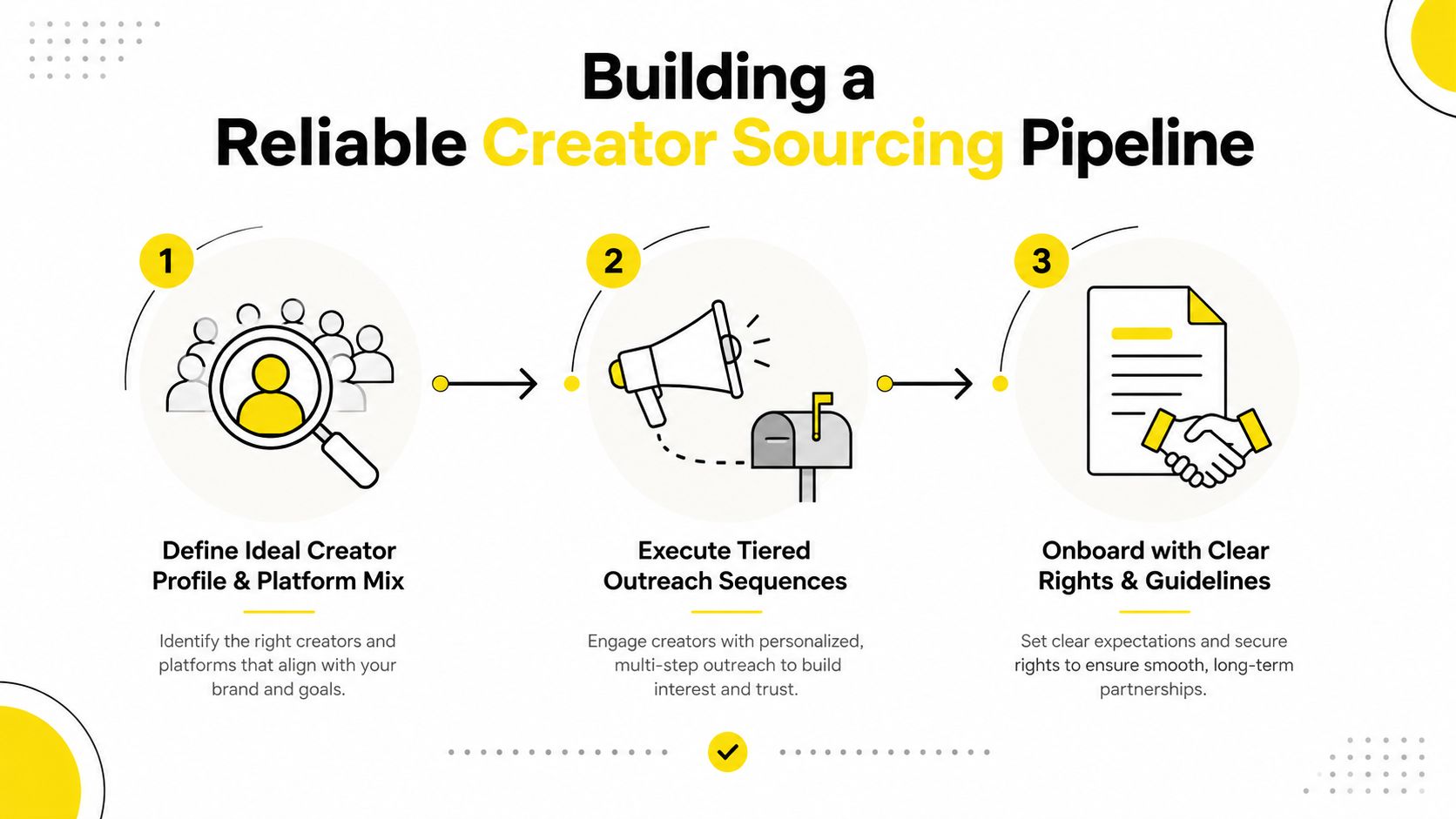
A dependable pipeline begins with a creator profile, not a platform search. Define the customer problem, product category, visual context, communication style, and audience characteristics you need. Then decide whether the campaign calls for customers, professional creators, niche reviewers, or a mixture of all three.
TikTok-native creators usually understand fast hooks, comment-driven objections, and informal delivery. YouTube reviewers often bring stronger demonstrations, longer explanations, and search-oriented product comparisons. Neither is automatically better. Match the creator's native behavior to the job the asset must perform.
Build the roster in layers
A healthy roster usually contains three practical groups:
Product users: Existing customers can explain the use case, common objections, and moments of value with unusual credibility.
Niche creators: Smaller, focused voices often understand the language and frustrations of a specific audience better than broad lifestyle creators.
Production-capable creators: These contributors may not be customers yet, but they can reliably deliver clean footage, multiple hooks, and usable B-roll.
Start outreach with a short, specific message. Explain why you selected the creator, what product or use case you want to feature, the deliverables, compensation structure, review process, and intended paid usage. Avoid “We love your content and would love to collaborate” unless the rest of the message makes the opportunity concrete.
A simple sequence works better than a single blast:
Send a personalized invitation with one clear concept.
Follow up with the deliverables and rights summary.
Answer questions about payment, revisions, disclosure, and timing.
Send a short onboarding form and agreement before shipment or production.
Confirm the brief, submission method, file requirements, and approval contact.
Creator motivation varies. Some want payment, others want products, recurring work, portfolio material, or performance bonuses. Put the incentive in writing, and don't promise future work based on vague expectations. A recurring roster should reward reliability, usable footage, and performance, not follower count alone.
Remove friction before production
Your onboarding form should capture audience profile, filming setup, preferred platform, shipping details, conflicts, disclosure requirements, and permission to use likeness and voice. Give creators a single destination for the brief, agreement, product information, upload link, and questions.
Cold outreach is only one source. Post-purchase email and SMS requests, review prompts, customer communities, creator seeding, and referral programs can create a warmer flow. The strongest system combines planned creator production with spontaneous customer proof, then applies the same moderation and rights process to both.
Creative Briefs That Produce Converting Ad Assets
A vague brief creates predictable waste. “Show how you use the product and make it authentic” gives a creator freedom, but it doesn't guarantee a usable opening, product demonstration, objection response, or CTA.
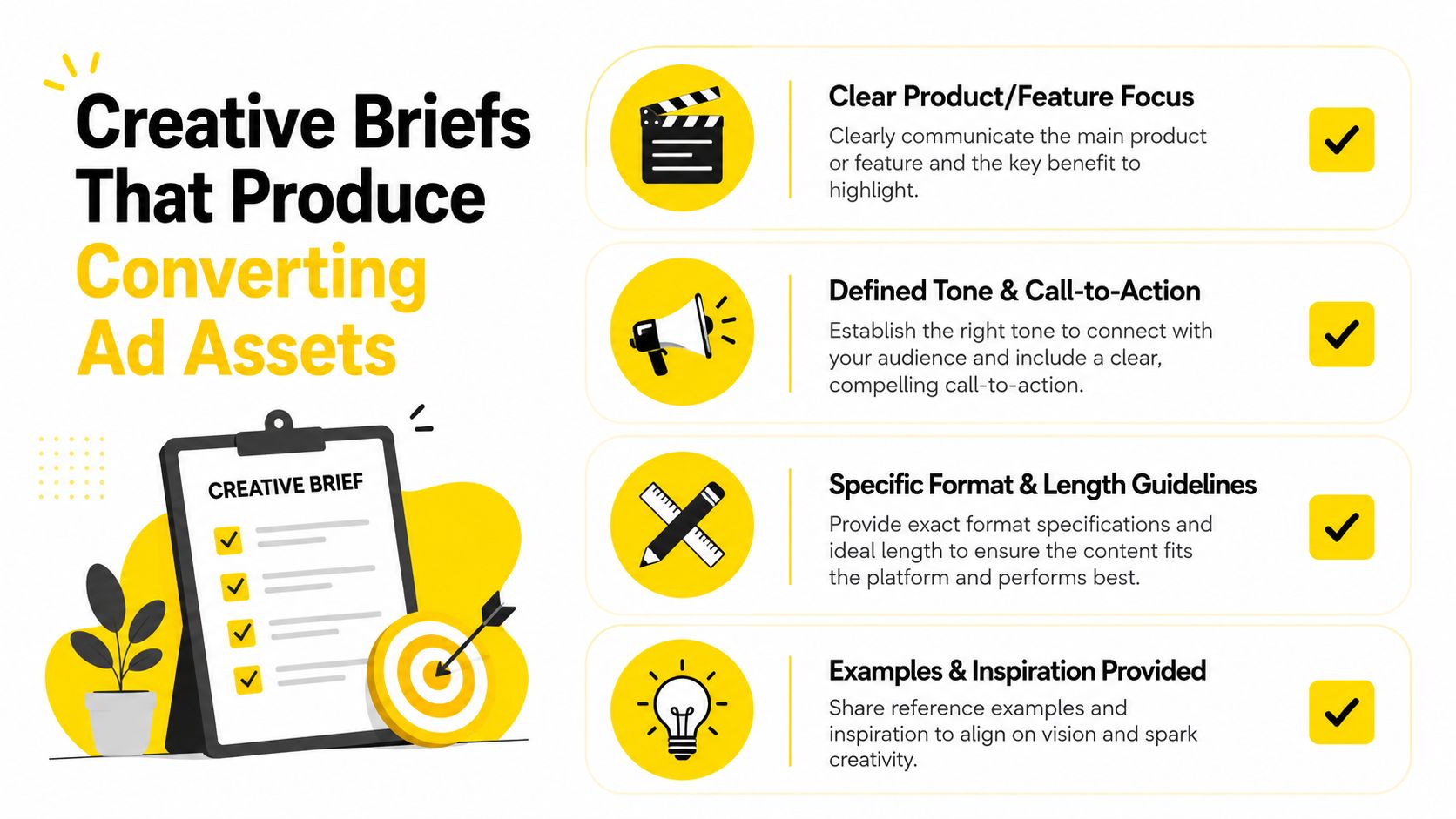
A performance brief should protect the message while leaving room for the creator's delivery. Start with the audience problem and the proof required to resolve it. Then specify the pieces that can be edited into multiple versions.
Use a modular brief
A useful brief includes:
Hook options: Give creators several directions tied to pain points, misconceptions, desired outcomes, or product contrasts. Ask them to record each hook as a separate take.
Proof sequence: Specify the product action viewers need to see. A skincare creator might show texture and application. A software creator might record the workflow that removes a frustrating manual step.
B-roll list: Request close-ups, hands using the product, packaging, environment shots, and result-oriented footage. B-roll gives editors room to vary pacing without reshooting the testimonial.
Message boundaries: Identify approved claims, prohibited claims, required qualifiers, and facts the creator must not imply.
CTA by funnel stage: Prospecting may need a problem-led invitation to learn more. Retargeting may need a comparison, offer reminder, or reassurance about delivery and returns.
The brief should also define orientation, framing, file delivery, captions, disclosure language, and revision limits. Ask for clean footage without platform watermarks when the asset will run across multiple channels. Preserve the creator's natural phrasing, but remove dead air, confusing tangents, and claims that the brand can't substantiate.
Keep the footage real, not careless
Authenticity doesn't require poor production. Natural lighting, clear audio, readable demonstrations, and a stable enough frame make the message easier to absorb. Over-polishing can weaken the native feel, but technical defects can hide the product benefit entirely.
Give creators examples of the pacing and tone you want, not scripts they must recite word for word. A rigid script often produces an advertisement that sounds like one. A structured outline gives the creator enough room to sound like themselves while still delivering the information the buyer needs.
Disclosure belongs in the workflow from the beginning. Paid partnerships, gifted products, affiliate relationships, and creator licensing can trigger different platform and regulatory requirements. Have the creator follow the relevant disclosure instructions for Meta, TikTok, YouTube, and the markets where the ad will run, then review the final asset before launch.
Testing and Iterating UGC Across Paid Channels
Swapping creators isn't a testing framework. If you change the creator, hook, offer, edit, landing page, and placement at the same time, you won't know what caused the outcome.
Start with a creative matrix. Test the opening first, then the format, then the pacing and proof structure. A talking-head problem statement, an unboxing, a tutorial, a reaction, and a comparison can all sell the same product, but they create different expectations in the viewer.
Use staged decisions
The sandbox stage answers, “Can this idea earn attention and qualified interest?” Use early signals such as thumb-stop rate, hook retention, hold rate, and CTR. The scale stage asks whether the winning combination can acquire customers at an acceptable CPA or ROAS. The evergreen stage protects proven concepts from fatigue by producing new creators, openings, demonstrations, and edits around the same core message.
Don't set one universal refresh schedule. TikTok often rewards frequent creative renewal because trends and audience response move quickly. Meta campaigns can benefit from broader asset pools and enough running time for delivery systems to identify useful combinations. YouTube Shorts may need a stronger first-frame visual and a clearer connection to the longer consideration journey.
Channel | Primary Variables to Test | Refresh Cadence | Early Signal KPIs | Scale KPIs |
|---|---|---|---|---|
TikTok | Opening line, native delivery, pacing, comment response | Frequent, based on fatigue and delivery | Thumb-stop rate, hold rate, CTR | CPA, ROAS, qualified sessions |
Meta | Hook, creator angle, format, audience-message fit | Refresh when efficiency or attention declines | Hold rate, CTR, landing-page view rate | CPA, ROAS, conversion volume |
YouTube | Demonstration depth, title-style opening, short versus long edit | Based on retention and search demand | View retention, engaged views, CTR | CPA, assisted conversions, ROAS |
Visual framing, use case, styling, save-worthy instruction | Based on shelf life and engagement | Outbound CTR, saves, video completion | Assisted revenue, conversion rate |
Don't kill tests emotionally
Set decision rules before launch. Define the minimum delivery needed for a fair read, the signal that qualifies an asset for the next stage, and the point at which an underperformer loses budget. The exact threshold depends on spend, conversion volume, attribution quality, and account history, so avoid treating a fixed statistical cutoff as universal.
When a winner appears, isolate why it won. Was the first sentence sharper, was the demonstration easier to understand, or did the creator resolve an objection competitors ignored? Turn that learning into the next brief. A good testing program doesn't merely find winning videos. It builds a library of repeatable message patterns.
Deploying UGC Across the Full Conversion Funnel
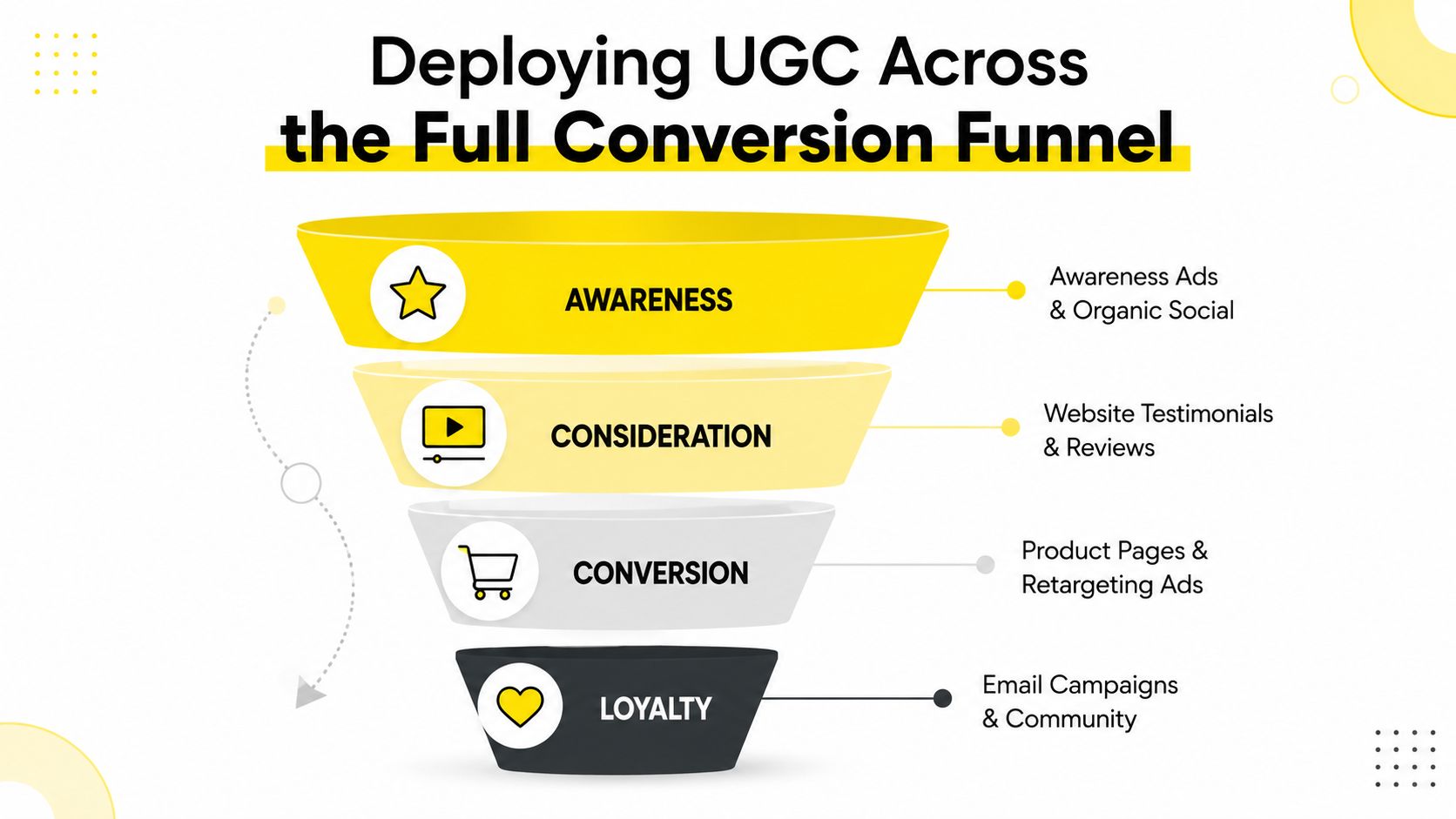
UGC creates more value when the same customer proof travels through the buying journey in adapted forms. A cold prospect may need a problem-led testimonial. A site visitor may need a comparison or objection response. A shopper on a product page may need visual evidence that the item fits real people and real environments.
Match proof to intent
At awareness, use creator stories, demonstrations, and problem-agitation hooks that make the product relevant to someone who hasn't considered it. At consideration, use reviews that answer specific questions about fit, setup, durability, ingredients, compatibility, or results. At conversion, place unboxings, testimonials, FAQs, and product-use clips beside the decision point.
On-site placement matters. An analysis cited by Sepia Lab found that shoppers who interact with UGC on product pages convert at a rate 161% higher than shoppers who don't, based on 200,000 stores and 163 million orders; the reported lift reaches 207% in apparel and accessories (Sepia Lab's UGC marketing statistics). Treat that as a placement and measurement lesson, not a promise for every store. Compare UGC-exposed and non-exposed experiences, and track the product page, add-to-cart, checkout, and purchase steps.
A single winning asset can become a paid ad, landing-page testimonial, email block, product-page gallery item, retargeting edit, and sales-team proof point. Keep the central claim consistent, but adjust the opening and CTA to match the channel. This is how production spend compounds instead of ending after the first ad flight.
Build an AI-search evidence layer
Detailed reviews and creator transcripts can also help answer engines understand product use cases. Current UGC guidance increasingly frames customer content as data for AI, particularly when reviews contain specific experiences that can be cited in AI-generated answers (Yotpo's guidance on UGC strategy). Structure review prompts around real buyer questions, preserve meaningful text, identify verified-buyer status where appropriate, and connect content to the relevant product.
Don't assume that adding a generic review widget guarantees citation. Track branded mentions, review language, product attributes, and the visibility of cited content across search experiences. In a zero-click journey, a citation can be a valuable visibility outcome even when the user doesn't immediately visit the site.
For a broader framework on improving the handoffs between awareness, consideration, and purchase, boost revenue with funnel optimization provides useful context. UGC works best when every stage has a deliberate destination.
Rights Management and Compliance as a Growth Lever
Rights management isn't paperwork that happens after the creative is chosen. It determines whether a winner can keep running, move to another channel, appear on a product page, or be adapted into a new format.
Ask for permissions that match the actual media plan. A creator may approve an organic repost but not paid amplification. They may approve Meta usage but exclude YouTube, retail media, email, or offline placements. Record the territory, duration, channels, editing rights, creator likeness, music restrictions, whitelisting terms, and renewal process in a signed agreement.

Create a rights ladder
Use a simple tiered model:
Organic permission: Reposting on brand-owned social accounts, with defined channels and duration.
Paid usage: Amplification through the brand's ad accounts, with explicit platform and audience permissions.
Extended licensing: Broader editing, placement, territory, and duration for evergreen winners.
This structure gives creators clarity and gives your media team room to scale. It also prevents the common mistake of discovering that the best ad can't be used on the landing page because the original agreement covered only social reposting.
Store rights metadata beside the asset, not in a separate spreadsheet. A digital asset management system or creator CRM should show approval status, expiration date, permitted channels, creator contact, product, claims, disclosure status, and final agreement. Set renewal alerts before expiration, and prevent restricted assets from entering active campaign folders.
Treat disclosure as launch infrastructure
Paid partnerships and gifted products require careful disclosure review. Check platform-specific branded-content tools, ad labels, captions, spoken disclosures, music licensing, testimonials, before-and-after claims, and local requirements. A creator's verbal disclosure can be appropriate in one placement but insufficient when an edit removes that portion of the video.
Compliance advantage: The team with a clean rights record can scale a winning asset immediately, while another team is still searching through messages for permission.
Rights clarity also improves negotiation. Creators are more likely to accept broader usage when the terms are transparent, the duration is defined, and the compensation reflects the scope. Over time, a reliable process supports recurring partnerships and faster creative launches without sacrificing trust or legal control.
Scaling From Campaign to Always-On UGC Engine
A quarterly creator burst is a content spike, not a media system. Once those ads fatigue, the team starts over. An always-on engine keeps sourcing, briefing, approving, licensing, testing, and renewing assets while paid results shape the next production cycle.
A skincare brand can operationalize that model by sourcing 12 assets per month across three creator tiers: customer users, niche skincare creators, and production-capable specialists. Customer users cover routines and lived experience. Creators produce hooks, demonstrations, and objections. Specialists deliver tighter product education and alternate formats. The brand can recycle 40% of those assets into retargeting edits within 90 days, provided the rights agreement covers the placement and edit.
The roster should reflect performance, not follower count. A creator who delivers usable footage on time and produces a strong first three seconds earns recurring assignments. A creator whose content needs extensive repairs may remain project-based, even if the audience fit looks attractive. Review the roster weekly, remove inactive or unreliable partners, and expand each tier when a creator or angle repeatedly produces approved assets that meet the account's target CPA or return threshold.
Change the operating rhythm
An always-on system needs clear ownership and fixed handoffs:
Creator manager: Reviews the roster weekly, manages outreach and onboarding, and confirms delivery expectations.
Creative strategist: Turns paid-media results into briefs, hooks, objections, and new message angles.
Editor or content team: Produces platform-specific cuts, captions, openings, and derivatives for Facebook, TikTok, and YouTube.
Media buyer: Runs structured tests, controls spend, and reports performance by asset, creator, and angle.
Rights owner: Records licenses, disclosures, expiration alerts, permitted channels, and usage restrictions.
Set an approval SLA before production begins. A practical workflow gives the internal reviewer two business days to approve or return clear feedback. Delayed reviews waste creator capacity and leave media buyers without fresh variations. The creator manager should also hold a weekly pipeline review, while the strategist and media buyer conduct a monthly performance review to decide which messages deserve another production cycle.
Use a creator CRM for status and contacts, a rights library for permissions, and an asset repository that preserves originals and derivatives. Connect the content calendar to buying cycles, so a creator is producing a response to a live objection rather than another generic testimonial.
Scale the relationship, not just the volume
Recurring partners should earn that status through delivery speed, product understanding, natural communication, and asset performance. Compensation can combine a production fee with incentives tied to agreed performance or usage. Do not tie creator pay to landing-page failures, offer changes, or other factors outside the creator's control.
The operating advantage comes from reuse and learning. Each test identifies which problem, proof point, creator style, and edit deserves another version. Rights metadata determines where the winner can run, while AI-search attribution and full-funnel reporting show whether UGC assists discovery, retargeting, or conversion beyond the last paid click.
Wojo Media can support brands producing and editing creator-style ad assets, connecting UGC with omnichannel paid campaigns, and tracking backend performance through rights-cleared creative, structured testing, and full-funnel measurement.
Comments