
Conversion Rate Optimization Audit: A Step-by-Step Guide

Your ad dashboard shows conversions, but your sales team says the leads aren't qualified. Or orders are coming in while profit stays flat. Someone suggests a new landing page, and suddenly the discussion turns to headlines, button colors, and a redesign nobody can confidently justify.
A conversion rate optimization audit should settle those disagreements before you spend money changing the site. Start by checking whether the conversion count is trustworthy and whether the conversion produces valuable customers. Then inspect the buying experience, rank the problems, and test the changes that deserve your traffic.
The Five Stages of a CRO Audit
Run the audit in this order: validate data, map the funnel, review pages and offer, rank fixes, and plan tests. Each stage should produce something concrete enough for another person to inspect, challenge, and act on.
The scope can become enormous. The CROBenchmark 2026 report evaluated more than 7,000 e-commerce stores across 65 countries against more than 248 criteria. Most small teams don't need that breadth to make their next useful decision. They need reliable measurement, a clear view of customer friction, and a manageable implementation backlog.
What you should hold before moving on
Stage | What You Check | Output |
|---|---|---|
1. Validate data | Conversion events, consent state, duplicate events, cross-domain tracking | Data-quality scorecard and a do-not-optimize-yet rule |
2. Map the funnel | Ad click, landing page, offer, cart, checkout and confirmation | Drop-off rate at each step, split by device and traffic source |
3. Review pages and offer | Headline match, proof, price clarity, form length, mobile layout | Issue list tagged by page element |
4. Rank fixes | Expected impact, traffic exposure and implementation confidence | Ranked backlog of no more than ten items |
5. Plan tests | Hypothesis, primary metric, guardrail metrics and sample size | Test calendar with stop rules |
The sequence prevents expensive misdiagnoses. If a purchase event fires again whenever someone refreshes the confirmation page, a higher reported conversion rate might reflect repeated events rather than additional customers. A redesign evaluated against that baseline can look successful without improving anything.
The page review also needs commercial context. A short form might generate more submissions while removing information your sales team needs to qualify prospects. A prominent discount might persuade shoppers to order while leaving less money after fulfillment and refunds.
Practical rule: Don't approve a page change until you can explain the customer problem, the evidence behind it, and the business outcome you expect to improve.
Keep the audit usable
Create a shared spreadsheet with a finding, affected page element, evidence, proposed action, owner, and validation method. Attach screenshots and reproduction steps rather than leaving comments such as “mobile experience needs work.”
Keep working elements visible, too. If buyers consistently understand a guarantee or use a shipping estimator successfully, record that as something to preserve.
Start where your evidence is weakest, usually validation. You can inspect pages while tracking repairs are underway, but don't turn uncertain dashboard patterns into confident revenue forecasts.
Validate Your Data Before Trusting Any Drop-Off
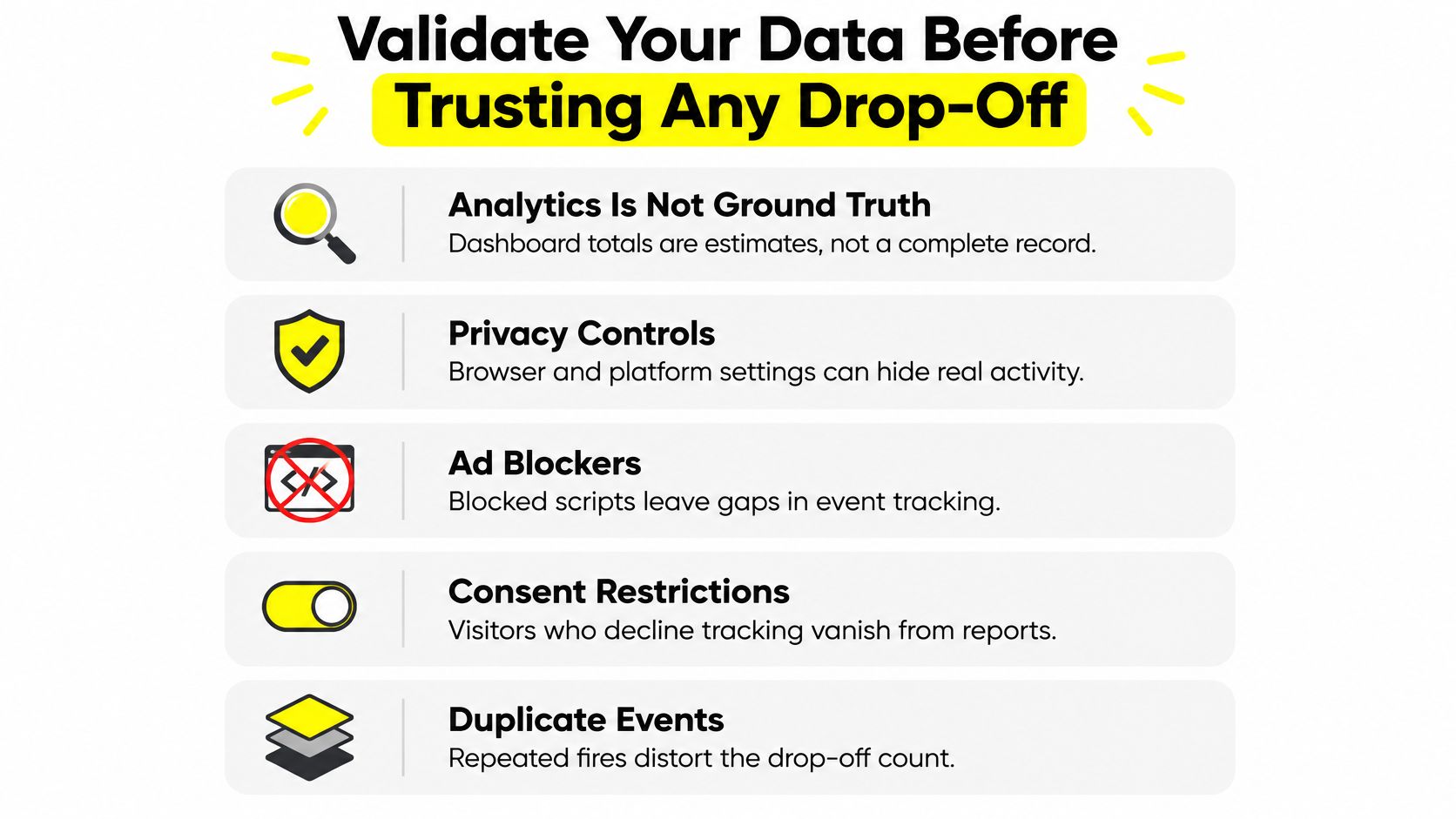
Analytics is not ground truth. It's a record of the activity your implementation and visitors' privacy settings allow you to observe. Ad blockers, consent restrictions, duplicate events, and broken domain handoffs can make a measurement problem look like customer friction.
The Webeyez guide to Google Analytics updates emphasizes checking conversion events, consent states, cross-domain continuity, referral handling, and downstream exports before relying on analytics for optimization. Treat those checks as prerequisites for interpreting your funnel, not optional housekeeping.
Use this checklist to separate missing activity from genuine abandonment.
Trace the event from browser to business record
Inventory conversion definitions. List the events in your ad platforms, GA4, CRM, payment system, and backend. Document the trigger and business meaning of each. A booking-button click, confirmed appointment, and attended appointment are different outcomes, even if someone has named all of them “lead.”
Check consent behavior. Test accepted, declined, and unanswered consent states using browser developer tools and your consent-management platform. Identify which events remain observable and which reports include modeled activity. Respect consent choices rather than trying to recover visibility by bypassing them.
Complete a test transaction. Use Google Tag Manager Preview and GA4 DebugView alongside the order or lead record. Confirm the event fires only after successful completion, carries the correct value and identifier, and doesn't fire again after a refresh or return visit.
Follow the domain handoff. Move from the landing page to the checkout or booking provider. Verify that supported cross-domain measurement preserves the journey rather than creating an unrelated session at the point of conversion.
Inspect referral attribution. Check whether your own domain or payment provider appears as an acquisition source after the customer returns. Configure unwanted referrals appropriately. Don't remove genuine partner referrals because they complicate reporting.
Reconcile completed records. Compare weekly counts across consecutive reporting periods using matching time zones, status definitions, and attribution assumptions. Match transaction or lead identifiers where available instead of expecting aggregate totals to agree automatically.
A payment system may record an authorized payment while the backend reports only captured orders. A CRM may deduplicate repeat submissions while an ad platform attributes several interactions. Write down these differences before labeling them defects.
Make uncertainty visible
Estimate the unobserved share only where you have a defensible denominator, such as consent-platform records or eligible backend transactions. Don't assume that unobserved visitors behave like opted-in visitors. Report observed performance separately from modeled estimates, and explain which population each represents.
For connecting marketing events to downstream outcomes, Revenue Nomad's revenue operations metrics perspective is a useful companion resource. Use that operational lens to check whether a reported conversion reaches the CRM, receives an owner, and progresses toward revenue.
Your data-quality scorecard should show the check, status, evidence, owner, and decision affected. Use statuses such as verified, qualified, and blocked. A qualified result has a known limitation; a blocked result can't support the decision you're considering.
If a tracking defect can materially change the primary conversion count or reverse a test decision, fix the measurement before optimizing that page.
You don't need perfect agreement between systems. You need an explainable difference and a clear boundary around what you can trust. Platform-reported conversions shouldn't substitute for qualified leads, confirmed appointments, paid orders, or recognized revenue.
Map the Path From Ad Click to Paid Order
Approximately 70.19% of online shopping carts are abandoned globally, according to Baymard Institute's checkout usability research. That doesn't mean every abandoned cart represents a recoverable sale. Some visitors are comparing options or aren't ready to buy.
Baymard's U.S. findings provide a practical starting point for checking addressable checkout friction.
Abandonment Cause | Share Citing It | What the Audit Should Check |
|---|---|---|
Extra costs such as shipping, taxes or fees | 48% | Total cost visible before checkout, compared with the cart total |
Forced account creation | 24% | Guest checkout works on mobile and desktop |
Delivery too slow | 22% | Delivery estimate shown on product and cart pages |
Checkout too long or complicated | 17% | Form field count, error messages and unnecessary fields |
Follow the journey across devices, not just the desktop screen where your team builds pages.

Walk the purchase path as a customer
Compare the ad with the landing page. Save the ad creative, headline, audience context, and destination. If the ad promises a free trial, the opening screen should explain that trial and its conditions rather than presenting an unrelated purchase offer.
Check the full cost. Compare the advertised price, product page, cart, and final payment total. Where shipping or taxes require an address, provide an estimate or explain the calculation before the buyer commits effort.
Complete guest checkout on a phone. Look for account prompts that obscure the guest route. Test whether returning customers can recover from a forgotten password without losing their cart.
Inspect delivery promises. Confirm that product and cart pages explain when the order should arrive. Separate processing time from transit time, and verify that checkout doesn't contradict the earlier estimate.
Count fields and provoke errors. Submit an incomplete address, mistype an email, and use the payment provider's supported test cases. Check that messages explain how to recover and preserve information already entered.
Review payment reassurance. Place relevant security information, returns guidance, and support access near the decision they inform. Decorative badges won't compensate for unclear refund terms.
Inspect the first mobile screen. Check whether the offer, price, and next action are understandable without zooming. Don't force a long form into the viewport by shrinking text; prioritize clarity and a usable route forward.
Verify offer consistency. Carry the advertised bundle, discount, or trial through the cart and confirmation. Record renewal terms, eligibility rules, and exclusions wherever a mismatch could surprise the buyer.
Inspect persuasion as well as mechanics
Inventory reviews, guarantees, and relevant certifications. Confirm that useful proof appears before the initial call to action, but judge its relevance rather than just counting badges. A specific review addressing delivery concerns can answer a purchase objection more directly than a wall of unrelated praise.
For another way to organize checkout hypotheses, use Arlo on checkout abandonment fixes. Compare the categories with your own evidence rather than assuming every suggested fix belongs in your backlog.
Use the video as a supplementary reference while documenting the journey.
For every funnel step, record sessions entering, sessions progressing, and the exit reason supported by evidence. Keep the population consistent when calculating drop-off. Label suspected reasons as hypotheses unless recordings, usability sessions, support messages, or customer feedback substantiate them.
Choose the Conversion That Pays
Say landing page A produces more leads than page B, but B attracts prospects who close more often and buy again. You wouldn't choose A just because its form-completion rate looks better. You'd compare the value generated from comparable traffic after acquisition and delivery costs.
That distinction matters even when the usability opportunity is substantial. Baymard Institute's cart abandonment analysis identifies an average potential 35.26% conversion-rate increase for large e-commerce sites through checkout design improvements. That's an opportunity estimate, not a guaranteed test result or proof that additional orders will be profitable.
Match the conversion to the business
Business Type | Conversion to Optimize | Metric to Check After It |
|---|---|---|
E-commerce | Completed purchase | Contribution margin and repeat revenue |
Coaching and consulting | Booked call | Booked-call quality and show rate |
Real estate | Lead | Funded loans or closed deals |
The conversion event is your operational target, not the entire definition of success. A store can optimize completed purchases while rejecting a variant that increases refunds or reduces contribution margin. A consultant can improve bookings while checking whether those prospects attend and fit the service.
For real estate, keep the outcome aligned with the business model. A mortgage lender needs to connect leads to funded loans; an agent or investor needs the appropriate closed-deal outcome. Don't combine these into a generic “qualified” status without a documented definition.
Build the economic view
Connect funnel records to the measures that explain customer value:
Gross margin. Establish what remains after the direct cost of the product or service.
Refund rate. Check whether the offer attracts customers whose expectations aren't met.
Close rate. Determine whether submissions become customers, not just conversations.
Customer acquisition cost. Include the acquisition costs relevant to the decision rather than comparing headline lead prices alone.
Payback period. Assess when customer contribution covers acquisition spending.
Repeat purchase behavior. Separate observed repeat revenue from assumptions about future retention.
A deep discount can increase checkout completion while reducing the money available to cover advertising and overhead. Removing qualification fields can increase bookings while filling the calendar with unsuitable prospects. Neither result deserves automatic approval.
A higher conversion rate is useful only when the additional conversions support the business you're trying to build.
Use acquisition cohorts so that sales and repeat-revenue outcomes belong to the traffic that generated them. Give delayed outcomes time to mature, and don't compare fresh leads against older leads that have already completed the sales cycle.
Decision rule: Choose the measurable conversion closest to realized revenue that produces enough observations for a useful decision. Then protect both downstream customer value and the quality of the step immediately before it.
Rank Fixes and Plan Tests
An audit becomes useful when the team can decide what to do next without reopening every design debate. Rank findings by expected impact on the primary metric, traffic exposure, and implementation confidence. Multiply those factors using a consistent internal scoring method, then discount ideas supported only by opinion or ambiguous heatmap activity.
A payment error affecting the purchase path deserves attention before an unproven headline preference on a rarely visited page. But separate functional repairs from optimization hypotheses. You don't need to deliberately preserve a broken payment button to prove that customers should be able to pay.
Turn findings into a ranked backlog
Group issues by page element. Put observations about a delivery estimator together, even if they came from support tickets, recordings, and manual testing. Otherwise, the same problem can occupy several backlog positions.
Estimate impact on the business metric. Explain the mechanism: earlier delivery information may help qualified buyers decide before checkout. Don't assign a precise predicted lift unless you can justify it from your own evidence.
Measure exposure. Count eligible visitors reaching the affected element over a consistent recent reporting window. Sitewide sessions aren't the right denominator for a problem found only inside a particular checkout branch.
Record confidence. Distinguish reproduced defects, observed usability problems, corroborated behavioral patterns, and practitioner opinion. Implementation confidence should also reflect whether the proposed change addresses the identified cause.
Multiply and sort. Keep the active backlog to ten items or fewer as a working discipline. Preserve the rest in an archive so the team can focus without losing potentially useful ideas.
Use engineering effort and dependencies to sequence similarly ranked items. A high-value checkout change might require payment-provider work, while a related copy clarification can ship independently. Record that distinction rather than manipulating the impact score to make the easiest task win.
Heatmaps are useful for locating questions, not answering them. Repeated clicks might indicate a broken control, an expected interaction, or confusion about what's clickable. Inspect the element and watch the relevant journey before recommending a fix.
Use small studies to resolve uncertainty
Ask participants to complete realistic tasks without telling them where to click. Give them the context a customer would have, such as choosing a product that arrives before an event, then observe whether they can find the information needed to decide.
Convertica's CRO statistics guide summarizes Nielsen Norman Group's model estimating that five test participants uncover about 85% of usability problems, supporting repeated small studies rather than a single large exercise. Use that as a discovery approach, not proof that your audience has been fully represented.
Recruit around the problem. A returning customer who knows the product may overlook confusing language that stops a first-time buyer. Include the device and acquisition context relevant to the finding, and keep sensitive payment information out of recordings.
After each round, distinguish comprehension problems from preferences. “I don't like this color” is weaker evidence than a participant being unable to identify whether the trial renews automatically.
Write the test before building the variant
Take the leading testable hypotheses into the calendar, with no more than three active candidates competing for implementation attention. Run them sequentially when overlapping audiences or page changes would make attribution difficult.
Each test specification needs:
A causal hypothesis. State the change, expected effect, and reason. For example, explaining delivery timing beside the purchase action should reduce uncertainty for buyers with arrival deadlines.
A primary metric. Choose the outcome that determines the decision before launch. Don't switch to whichever metric improves afterward.
Guardrails. Include revenue per visitor, average order value, lead quality, refund rate, or downstream qualification where relevant.
An eligibility rule. Specify who enters the experiment and how returning visitors retain their assignment.
A sample-size calculation. Record the baseline, minimum worthwhile effect, statistical method, and assumptions in your testing tool.
A review and stopping plan. Define completion conditions and safety stops before anyone sees results.
A test calendar should include an owner, implementation dependency, quality-assurance checklist, launch conditions, and decision date. “Run until significant” isn't a complete plan.
Protect the experiment from convenient conclusions
Preserve random assignment and keep traffic allocation fixed during the test. Check that exposure and event logging work in both variants before interpreting performance. If an implementation failure changes who sees a version, investigate rather than treating the resulting difference as customer preference.
Don't stop because the dashboard turns positive. Early movement can reverse as more eligible visitors arrive and delayed outcomes mature. Review according to the preselected statistical method and planned observation period, with early intervention reserved for defined safety issues such as payment failures.
Segment results only when the sample supports the comparison. A promising mobile result inside an inconclusive overall test isn't automatically a rollout instruction. Treat unsupported segment differences as hypotheses for later investigation.
Decision discipline: A test that improves the primary metric but breaches a business-critical guardrail hasn't earned an unrestricted rollout.
If traffic can't support a useful experiment, say so. Use usability evidence and functional checks to make a cautious implementation decision, then monitor comparable cohorts. Don't describe a before-and-after change as causal proof when campaign mix, seasonality, or sales operations also changed.
Record the decision, including losses
Close every test with the observed effect, uncertainty, guardrail results, implementation notes, and rollout decision. A losing test can still establish that a proposed explanation wasn't strong enough to justify the change.
Keep screenshots and the original hypothesis with the result. That record stops future teams from repeating the same idea without understanding what was tested, and it makes the next audit faster to act on.
Wojo Media offers a free demo call with Jason or a growth manager as the first step toward a custom paid ad strategy. Bring your conversion definitions, tracking gaps, and highest-priority findings; on calls with Jason, he discusses your business, what's working, what could improve, and best practices for scaling. Visit Wojo Media to book a call and connect your audit priorities to your paid acquisition strategy.
Comments