.png)
YouTube Retargeting Ads: The Complete 2026 Guide

A shopper watches a 90-second product demonstration, reaches checkout, then disappears. Over the next few days, generic brand ads follow that person around without answering the obvious question: why should they come back and buy now? That gap is where YouTube retargeting ads earn their place.
The tactic isn't just “show another video to anyone who visited.” The strongest accounts separate people who visited the website from people who engaged with the YouTube channel, then sequence creative according to intent. That distinction matters even more as remarketing moves across Shorts, connected-TV viewing, and Demand Gen placements, where last-click reporting can make a campaign look more productive than it really is.
Why YouTube Retargeting Ads Matter in 2026
A shopper who visited a product page and a viewer who completed an educational video have different reasons for not converting. The shopper may need a comparison, guarantee, or checkout reminder. The viewer may still need proof that solving the problem is worth the cost. Combining both signals in one broad audience creates repetitive messaging and gives bidding systems weaker intent data.
YouTube audience infrastructure lets advertisers create data segments from channel interactions, including views, subscriptions, homepage visits, likes, and playlist additions, after linking a YouTube channel to Google Ads. Google Ads explains how YouTube data segments work. This gives advertisers a second retargeting path alongside website visitors. A campaign can respond to what someone did on the site, what they watched on YouTube, or both.
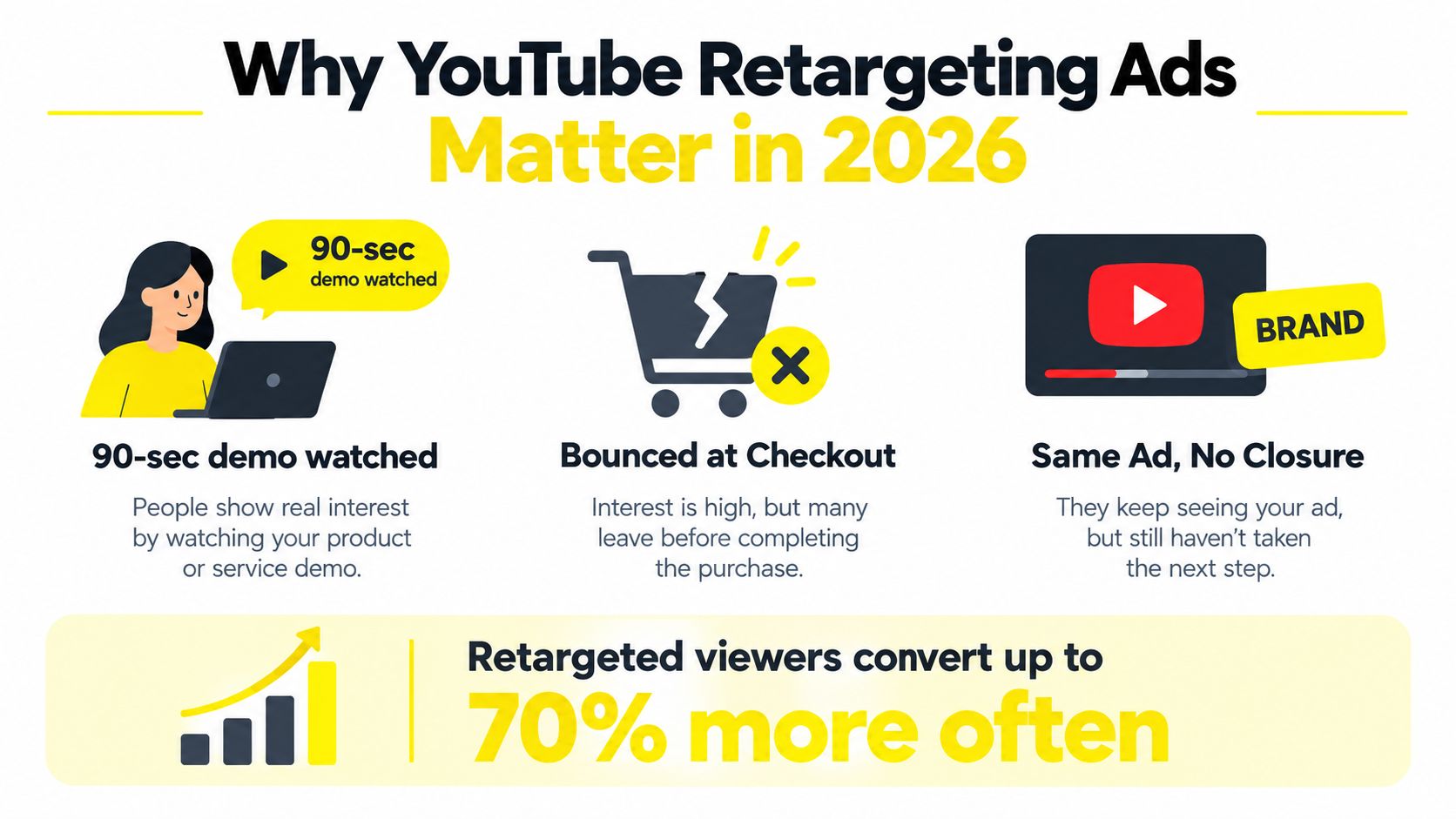
The business case for a dedicated budget is control over the next message. Prospecting introduces the offer. Retargeting can answer the objection revealed by an earlier action. A cart abandoner might receive a short offer-led ad, while a high-completion viewer gets a testimonial or case example. Past purchasers can be excluded from acquisition and moved into an upsell sequence.
Industry benchmark roundups report stronger conversion behavior among people who watched substantial portions of a video and commonly cite YouTube remarketing conversion rates in the 1.5% to 3.0% range. These figures are directional, not a forecast for every account. Results depend on audience quality, offer strength, creative fatigue, and whether the campaign creates incremental demand rather than claiming credit for users who were already close to buying. The benchmark source covers video engagement and remarketing conversion patterns.
Practical rule: Warmth is not one audience state. A product-explanation viewer, checkout visitor, and channel subscriber each bring different objections.
In 2026, Demand Gen, Shorts, and connected-TV inventory make sequencing more useful and attribution less tidy. A repeated spot can collect cheap views while adding little incremental impact, especially on larger screens where another household member may influence the decision. Skippable in-stream, in-feed video, Shorts, and Demand Gen should earn different roles by funnel stage. If organic publishing supports the paid strategy, a YouTube scheduling tool can maintain a consistent content cadence and expand the pool of meaningful viewer signals.
How YouTube Retargeting Actually Works
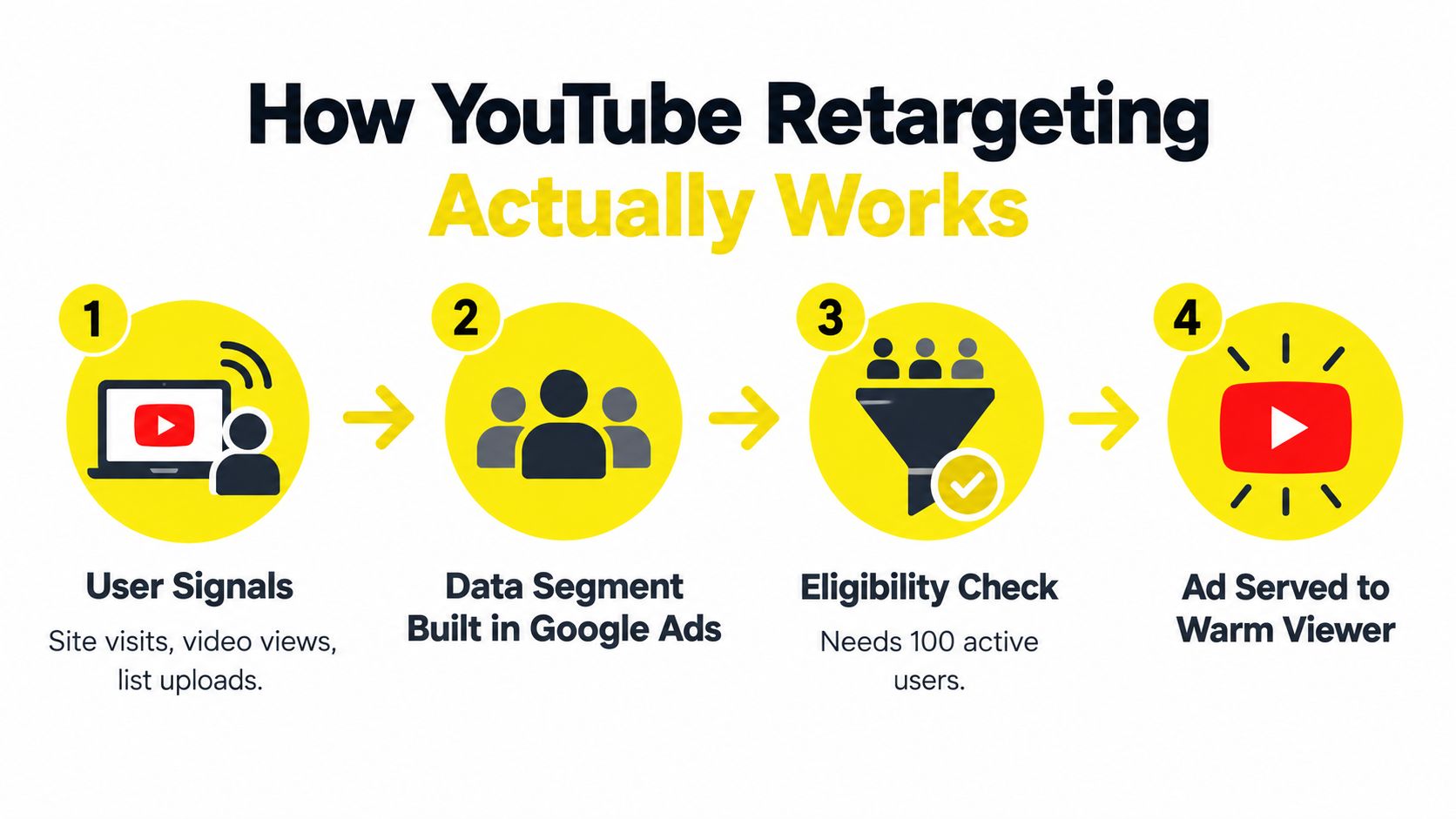
A shopper visits a product page, watches a product demonstration, or starts checkout, then leaves without converting. YouTube retargeting reconnects with that person through a data segment, Google's current term for what marketers often call a remarketing list. The segment groups users by a signal, such as a site visit, video interaction, or first-party list upload. Eligibility depends on recent audience activity and Google Ads requirements, so a segment is not automatically targetable the moment it is created.
The delivery paths
Skippable in-stream works when the opening qualifies the viewer and the remaining seconds make a clear case. A cart abandoner may need a concise reminder of product benefits and a direct landing page. Someone who only viewed educational content usually needs proof, explanation, or objection handling before seeing an offer.
In-feed video appears alongside content people actively choose to watch. Use it for demonstrations, comparisons, and educational follow-ups. The click signals a deliberate content choice, although that intent does not guarantee purchase readiness.
Shorts inventory requires a faster opening, stronger visual hierarchy, and a clear next action. Build Shorts creative for vertical viewing rather than cropping a horizontal ad. The problem and promise should register quickly, especially for cold segments being moved toward consideration.
Demand Gen and connected-TV placements add further sequencing options, but they also make last-click reporting less reliable. A viewer may see a repeated spot on a large screen, discuss it with someone else in the household, and convert later through another device. Assign each format a job, then judge it by assisted actions, reach quality, and incremental lift rather than clicks alone.
Frequency controls stop formats from competing for the same attention. Apply separate limits where available, exclude converters and past purchasers, and prevent active prospecting audiences from receiving lower-funnel reminders. Google's documentation explains the available controls. Recency and intent should determine both exposure and creative.
Display remarketing places banners across websites and apps. YouTube gives product demonstrations, testimonials, and objection handling more room, while search remarketing captures users only when they search again. Analytics audiences can also flow into Google Ads when accounts and settings are connected, often within about 1 day on average. That handoff helps, but weak event definitions still produce an “all visitors” segment that offers little control over sequencing or exclusions.
Audience Types and Where They Fit in the Funnel
The cleanest YouTube retargeting account separates website visitors, YouTube engagers, and Customer Match. They may overlap, but their signals describe different levels of intent.
Audience | Signal Source | Min. Size | Funnel Stage | Primary Use |
|---|---|---|---|---|
Website Visitors | Google tag, GA4 events, page visits | 100 active users for YouTube eligibility | Mid to lower funnel | Re-engage product, pricing, checkout, or lead-page visitors |
YouTube Engagers | Views, subscriptions, likes, playlists, channel interactions | 100 active users for YouTube eligibility | Top to mid funnel | Continue education, build consideration, qualify intent |
Customer Match | Uploaded email or phone lists | Delivery depends on list eligibility and match quality | Retention, expansion, exclusions | Suppress customers, upsell, or support audience expansion |
The website visitor group needs recency and page-depth splits. Someone who visited a blog article shouldn't receive the same ad as someone who started checkout. Product-page viewers can receive proof and comparison content. Cart abandoners can move directly toward the offer, provided the landing page removes the reason they left.
YouTube engagers are valuable because the platform records what they chose to watch. Create segments for channel viewers, subscribers, specific videos, and viewers who reached a meaningful completion threshold. A person who watched an educational video may need a case for change, while a person who watched a product demonstration can move into proof or offer creative.
Customer Match is less about automatic purchase intent than controlled first-party activation. Upload customer lists for exclusions so acquisition ads don't pay to sell the same product to existing buyers. Layer purchasers with product categories or customer status for upsell sequences. Match quality affects delivery, so a large upload isn't useful if the platform can't associate enough records with eligible users.
A small, high-intent segment is often more actionable than a large audience with no behavioral distinction.
Use a simple decision rule. Cart abandoners and high-intent video viewers belong in conversion sequences. Broad channel viewers and educational-video engagers belong in consideration sequences. Customer Match belongs in suppression, retention, and carefully defined expansion workflows. Don't combine a past purchaser with a new prospect unless the creative and business objective are exactly the same.
Setting Up YouTube Retargeting in Google Ads
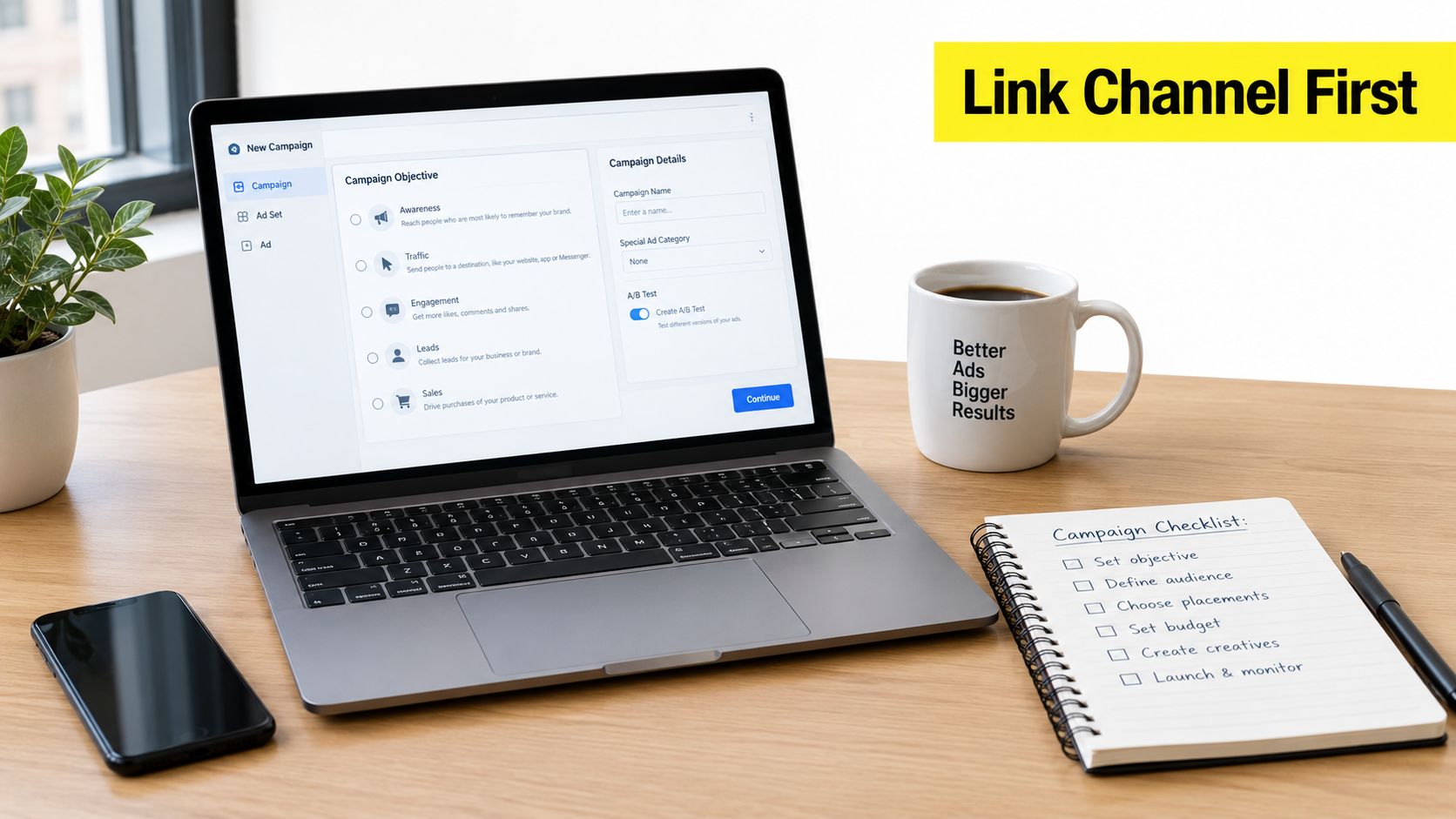
Start with account access, not creative. Link the YouTube channel to Google Ads, confirm the correct owner permissions, and verify that the channel's interaction data can populate usable audiences. If Analytics is part of the measurement setup, link it to Google Ads and define the events you need, such as product views, checkout starts, lead-form submissions, and purchases.
Build audiences before campaigns
In Audience Manager, create separate data segments for the actions that change the sales message. At minimum, distinguish high-intent website visitors from general visitors, then build YouTube-engager segments around specific videos or interaction types. Set a membership duration that matches the buying cycle. Google allows website visitor membership windows up to 540 days, but a maximum window isn't automatically the right window for a short-consideration product.
Keep the targeting boundary explicit. If the campaign is meant to retarget, don't allow optimized targeting or audience expansion to turn it into prospecting. Expansion can have a role in a separate campaign, but its results shouldn't be blended with warm-audience performance.
Choose the format according to the job:
Skippable in-stream for objection handling, demonstrations, and direct-response sequences.
In-feed video for comparisons, education, and content that earns an intentional click.
Shorts for vertical creative with a fast visual payoff.
Demand Gen when you want retargeting lists to support visual storytelling across Google surfaces rather than relying on one YouTube placement.
Apply audience exclusions at the campaign or ad-group level, depending on how much control each sequence needs. Campaign-level targeting is easier to audit. Ad-group targeting can support separate creative paths, but it creates more opportunities for overlap and accidental cold delivery.
A sound launch checklist includes audience eligibility, conversion tracking, exclusions, landing-page relevance, budget boundaries, and frequency controls. Don't judge the setup by impressions alone. The segment must be large enough to serve, the ad must match the user's previous action, and the conversion path must preserve the source data.
A practical walkthrough can help new buyers visualize the interface and campaign flow:
Creative Sequencing and Bidding by Vertical
The right sequence depends on the objection, sales cycle, and value of the conversion. A generic “brand reminder” wastes the strongest signal in the audience. Build each ad around what the viewer already knows.
Vertical | Primary Format | Sequence Pattern | Bidding Strategy | Frequency Cap |
|---|---|---|---|---|
E-commerce | Bumpers, skippable in-stream, product feeds | Product reminder, proof, offer | Target CPA against high-intent groups | Use lower exposure for cart abandoners and rotate offer creative |
Local services | Skippable in-stream | Problem, proof, appointment offer | Capped CPM or conversion-focused bidding | Keep exposure controlled across a short site-visitor window |
Coaching | Longer skippable video | Story, mechanism, credibility, application | Maximize Conversions with carefully reviewed view-through data | Cap repetition before narrative fatigue develops |
Real estate | Skippable in-stream and educational video | Market problem, expertise, next step | Lead-focused bidding with CRM validation | Conservative delivery, such as one impression per user per seven days |
E-commerce
A shopper who viewed a product but didn't buy needs relevance before persuasion. Dynamic remarketing catalogs can show the item or category the person considered, while a 6-second bumper can reinforce the product benefit before a 30-second skippable ad handles objections. Those format lengths are tactical choices, not universal requirements.
Use Target CPA only when the conversion event reflects meaningful commercial value and the audience has enough activity to support learning. Cart abandoners deserve tighter exclusions and more careful frequency control than broad product viewers. If the same discount appears repeatedly, the campaign may train shoppers to wait.
Local services
A med spa, barber, or home-services company should sequence the message around confidence. Start with the problem, show proof of the service experience, then offer a specific next step such as a consultation or booking. A 30-day site list can work when the decision cycle is short, but the landing page must continue the same promise.
Capped CPM bidding can give the buyer more control over delivery when the objective is sustained local visibility among known visitors. Keep the campaign separate from broad geographic prospecting so frequency reports remain interpretable.
Coaches and course creators
Coaching decisions often need more explanation than a product purchase. Longer 60 to 90 second narrative ads can introduce the mechanism, challenge a common assumption, and direct qualified viewers toward an application or webinar. Layer Customer Match for exclusions and retention, but don't assume a contact-list member is ready to buy.
Maximize Conversions can support the sequence when the conversion event is trustworthy. Review view-through conversions alongside click-based actions, lead quality, and downstream sales. A cheap form fill isn't a successful campaign if the CRM shows poor fit.
Real estate
Real estate retargeting needs restraint. The person may be researching financing, comparing neighborhoods, or deciding whether to speak with an agent. Educational creative can preserve credibility better than repeated urgency, and a conservative cap of one impression per user per seven days can protect the brand during a long decision cycle.
Google's documented weekly and monthly controls provide the operating boundaries, but the account still needs vertical-specific judgment. A cap that protects a real estate brand may underserve a checkout reminder. Adjust by intent, not by habit.
Measuring Incremental Lift Instead of Last-Click Credit
Retargeting naturally attracts credit because the audience already knows the brand. A viewer may have converted without the ad, then clicked a later reminder and handed the campaign the last interaction. That makes reported efficiency look stronger than the campaign's incremental revenue.
Start with clean UTMs on every YouTube destination. Include campaign, audience, creative, format, and placement context, then confirm that GA4 records the landing-page visit and downstream event. Keep naming consistent between Google Ads, GA4, and the CRM so a lead that becomes revenue can be traced beyond the initial form submission.
Connect media to commercial outcomes
Pass the relevant click identifiers and campaign metadata into HubSpot or Salesforce when a prospect submits a form. The media buyer should be able to compare spend with qualified opportunities, booked appointments, closed revenue, refunds, and repeat purchases. A platform conversion is useful for optimization, but it isn't the same as a profitable customer.
View-through conversions need even more caution. They can show that an ad appeared before a conversion, but they don't prove that the impression changed the outcome. Compare them with click-through conversions and revenue cohorts instead of treating every attributed action as equivalent.
Measurement rule: If the report stops at “conversion,” it stops before the business question.
A geo holdout test offers a stronger incrementality read when the business can separate comparable regions. Keep the retargeting campaign active in one group and withheld in another, then compare qualified outcomes rather than platform-reported conversions. The test needs stable sales operations and enough volume to reduce noise, so it won't fit every account.
Data-driven attribution can provide a more balanced allocation than a simple last-click model, but modelled credit still isn't a holdout. Treat attribution as a decision aid, then validate the budget with CRM revenue and controlled tests. A short click window and a deliberately reviewed view-through window usually produce a more defensible picture than allowing retargeting to claim every later conversion.
Fatigue, Privacy, and When Retargeting Stops Working
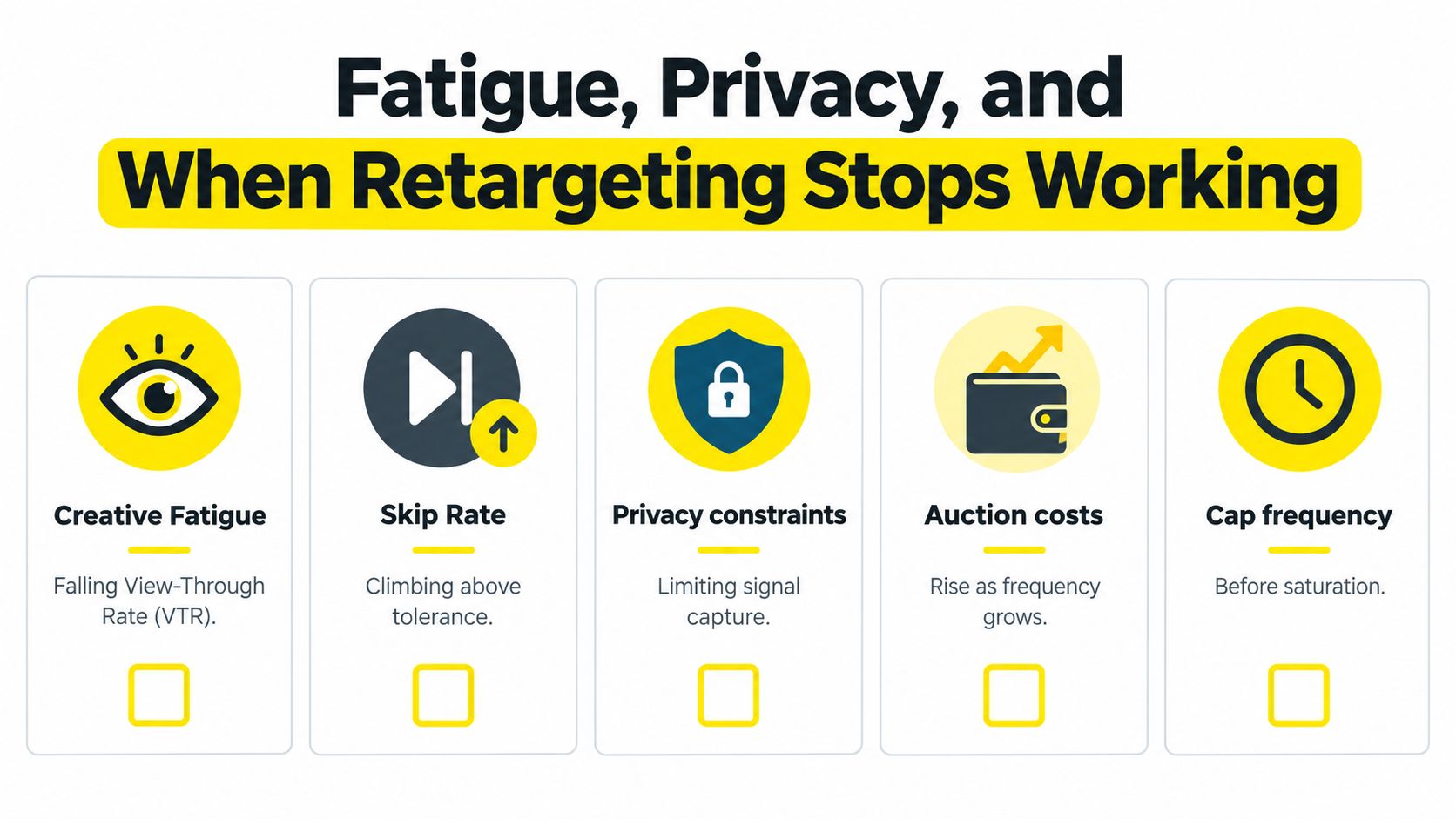
Retargeting performance usually declines before the dashboard shows an obvious failure. A viewer may remember the brand but lose urgency, ignore repeated creative, or convert through another channel. Higher frequency can also raise auction costs without creating new demand.
Monitor view-through rate, skip behavior, frequency, CPM, and qualified conversions together. Falling VTR with rising skips usually points to a weak or overused opening. Rising frequency with flat qualified conversions means the campaign is repeating a message the audience has already evaluated.
Diagnose the failure before changing the bid
Creative fatigue: Change the hook, proof, and offer. A new thumbnail alone rarely fixes a worn-out message.
Audience decay: Shorten membership windows for fast-moving offers and keep YouTube-engager pools active with fresh videos. Website visitors and YouTube engagers should not receive identical sequences, because their intent signals differ.
Signal loss: Consent choices and browser restrictions reduce the audience you can observe. For European traffic, review consent implementation alongside campaign results. Managing cookie consent with Google Mode provides useful context.
Inventory expansion: Demand Gen, Shorts, and connected-TV placements can extend reach beyond familiar retargeting surfaces. They also make placement quality, exposure control, and incrementality harder to judge from last-click reports.
Overexposure: Use weekly caps of 2 to 4 and monthly caps of 4 to 8 as starting boundaries for relevant skippable and bumper formats. Google's frequency guidance documents these controls.
Use operating thresholds to trigger investigation, not automatic pausing. Review the campaign when CPM rises while qualified conversions stay flat, frequency exceeds 3 to 4 exposures in 7 days, or the active audience falls below 1,000 users. These are practical heuristics, not Google eligibility rules. If the pool is saturated, refresh the content library, shift budget toward new upper-funnel video, or test Demand Gen with a separate incrementality plan.
Retargeting should capture existing demand without disguising weak demand creation. Once the warm pool is exhausted, create more qualified engagement instead of showing the same sales message repeatedly.
Wojo Media can coordinate viewer-based and website audiences, connect sequences with landing pages and backend KPI tracking, and support e-commerce, local-service, coaching, and real-estate campaigns. Visit Wojo Media to discuss a paid-media plan that separates intent, creative sequencing, and incremental revenue from last-click credit.
Comments