.png)
Benefits of Omnichannel Marketing for Scaling Brands

Brands using three or more channels in one campaign earned a 287% higher purchase rate than single-channel campaigns, according to a 2020 Omnisend analysis summarized by Porch Group Media. That finding changes how scaling teams should think about omnichannel marketing. The opportunity isn't to appear on more platforms. It's to make each interaction remember what happened before, respond to the customer's current intent, and move the next step forward.
That distinction matters because fragmented campaigns create duplicated spend, contradictory offers, and unreliable reporting. A synchronized system can use social media to create demand, search to capture active intent, and email or SMS to continue the conversation after the paid impression disappears. The benefits of omnichannel marketing emerge when those touchpoints operate as one customer journey rather than as disconnected channel budgets.
The Reality of Cross-Channel Customer Journeys
Most businesses start with a multichannel setup. They run Meta ads, publish on TikTok, bid on Google, send email, and perhaps add SMS. Each platform has its own audience definitions, creative calendar, conversion report, and optimization target. The brand may be present in several places, but the customer still experiences separate conversations.
Omnichannel marketing is different. It connects identity, message, timing, and behavioral state across touchpoints. If someone watches a product demonstration on social media, visits a product page through search, adds an item to a cart, and then buys, the system should recognize those actions as one developing decision. The customer shouldn't keep seeing the same introduction after demonstrating stronger intent, and a buyer shouldn't continue receiving acquisition ads for the product they already purchased.
Practical rule: More channels don't create an omnichannel strategy. Shared customer state does.
The customer journey rarely follows the neat path shown in a funnel diagram. A prospect might discover an offer in a short-form video, search for reviews later, return through a branded query, and respond to a direct message when the timing feels right. Each channel has a different role, so teams need a clear view of channel roles for eCommerce rather than treating every placement as interchangeable.
From exposure to remembered intent
A useful cross-channel state model tracks more than whether someone clicked. It records events such as:
Discovery: The person saw or engaged with an introductory ad.
Consideration: The person visited a landing page, watched deeper content, or searched for the offer.
Evaluation: The person viewed proof, pricing, FAQs, or product details.
Conversion: The person submitted a lead form, purchased, or booked.
Retention: The customer entered onboarding, replenishment, loyalty, or cross-sell communication.
That state determines what happens next. A discovery-stage user may need education. An evaluator may need proof or an objection-handling asset. A converted customer needs confirmation and fulfillment communication, not more prospecting pressure.
This is why omnichannel should be treated as a retention and conversion system, not only a media buying tactic. Consistent identity reduces the need for customers to repeat themselves. Consistent messaging preserves brand memory. Coordinated timing reduces the gaps where intent fades.
Single-channel reporting hides this movement. A social ad may introduce the problem, while Google Search captures the final demand. Last-click reporting then assigns the sale to search and makes social appear inefficient. The result is a familiar failure pattern: the team cuts the channel that created demand, search volume softens, and the account becomes more expensive to operate.
Measurable Benefits of Omnichannel Campaigns
The strongest financial case for omnichannel marketing comes from two linked mechanisms: retention and conversion efficiency. A coordinated journey reduces friction at the moment of decision, then gives the business more opportunities to retain the customer after the first transaction.
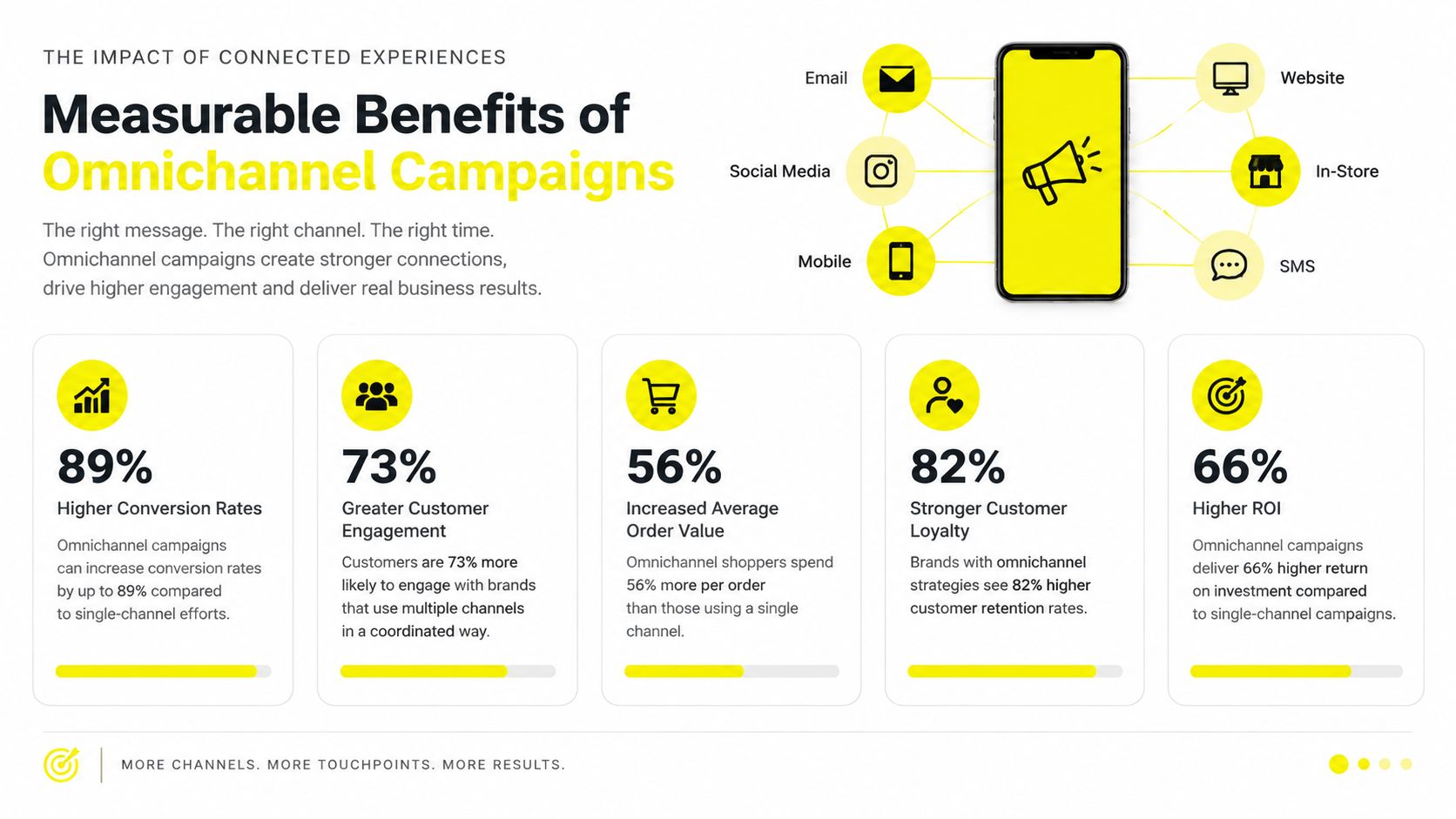
Brands with strong omnichannel customer engagement retain about 89% of customers, compared with 33% for weak engagement, according to the research summarized in this Semantic Scholar paper. That's a 56-point gap, and it illustrates why retention is more than a customer experience metric. When more first-time buyers return, the business can recover acquisition costs across additional purchases instead of relying on a new paid conversion every time revenue is needed.
Retention changes the economics of acquisition
A synchronized customer profile lets teams suppress irrelevant prospecting and transition buyers into useful post-purchase journeys. For an e-commerce brand, that could mean product education, replenishment reminders, complementary recommendations, or loyalty communication. For a service business, it could mean appointment confirmations, follow-up education, review requests, and rebooking prompts.
This state management also improves measurement. Instead of asking only which ad produced the first conversion, the team can compare repeat purchase rate, churn, and cohort retention by the sequence of interactions. That reveals whether paid social is introducing valuable customers, whether search is closing high-intent demand, and whether messaging channels are creating durable relationships.
The conversion case is also substantial. Benchmark summaries cited by World Metrics report 15% to 20% higher conversion rates for omnichannel campaigns in one benchmark and 48% higher conversion when personalization is layered into the omnichannel flow in another. These figures shouldn't be treated as a universal forecast. They're useful benchmarks for understanding the upside when segmentation, sequencing, and message relevance work together.
The efficiency comes from channel specialization
Social channels create and shape demand. Search captures explicit intent. Email and SMS reactivate people who already know the brand. A connected flow lets each channel do the job it handles best instead of forcing one platform to carry the entire funnel.
The practical benefits include:
Higher conversion density: Warm prospects receive messages matched to their behavior instead of repeated introductory creative.
Lower wasted impressions: Converted buyers can be excluded from acquisition campaigns and placed into retention sequences.
More predictable LTV: Cohort behavior becomes visible across the full relationship, not just at the first sale.
Better budget decisions: Teams can evaluate channel sequences rather than treating every platform as an isolated P&L.
A 2026 summary from Revenue Memo also reports 9.5% yearly revenue growth for omnichannel companies versus 3.4% for non-omnichannel companies, alongside 30% higher lifetime value for omnichannel shoppers. The strategic lesson is straightforward: adding channels isn't the objective. Lowering friction and extending customer value is.
The video below provides another visual explanation of how coordinated channels support customer engagement and conversion.
Industry-Specific Applications and Mini-Case Studies
Omnichannel execution depends on the buying cycle. An impulse-friendly product, a local appointment, and a high-consideration coaching offer shouldn't share the same sequence because they use the same platforms.

E-commerce brands
A direct-to-consumer brand might begin with TikTok or Meta creative built around a product problem, demonstration, or customer use case. The first interaction isn't expected to close every sale. It establishes the product category and gives the prospect a reason to investigate.
The next state could involve YouTube retargeting with a longer demonstration, followed by branded search capture when the person looks for reviews, sizing, shipping details, or comparisons. Once the visitor reaches the site, the landing page should preserve the promise from the original creative. If the visitor adds to cart but doesn't purchase, email or SMS can address the exact product and objection without restarting the story.
After purchase, acquisition ads should stop or change purpose. The customer might receive setup content, accessory recommendations, or replenishment communication. The sequence is more valuable than any individual ad because it carries intent from discovery to repeat purchase.
Local med spas
A med spa has a different conversion event. A lead form submission isn't the same as revenue, and a cheap lead isn't useful if the prospect doesn't qualify or attend.
A practical sequence starts with Facebook or Instagram ads offering a clear consultation or treatment-related next step. The form should capture the information the sales team needs to respond appropriately, while the CRM immediately places the lead into a follow-up state. SMS can confirm the request, clarify what happens next, and provide a direct path to booking.
If the lead books, prospecting communication should stop. The next messages should reduce uncertainty about preparation, arrival, expectations, and follow-up. If the lead doesn't respond, the system can use a different channel or angle rather than sending the same reminder repeatedly. The performance team should judge the sequence by qualified appointments and attended consultations, not by platform-reported lead volume alone.
Coaches and consultants
A coach or consultant may use short-form video, YouTube content, or Meta ads to introduce a point of view. Search then captures people actively looking for help with the problem, while a webinar or educational event gives prospects a structured way to evaluate the offer.
A lead who registers should move out of acquisition messaging and into attendance reminders, preparation content, and post-event follow-up. Someone who attends but doesn't book may need proof, answers to objections, or a sales conversation. Someone who books needs operational communication, not another invitation to the webinar.
The common thread across all three scenarios is state advancement. Channel selection matters, but the larger benefit comes from knowing what the prospect has already done and changing the next message accordingly.
Tracking and Attribution Across Multiple Touchpoints
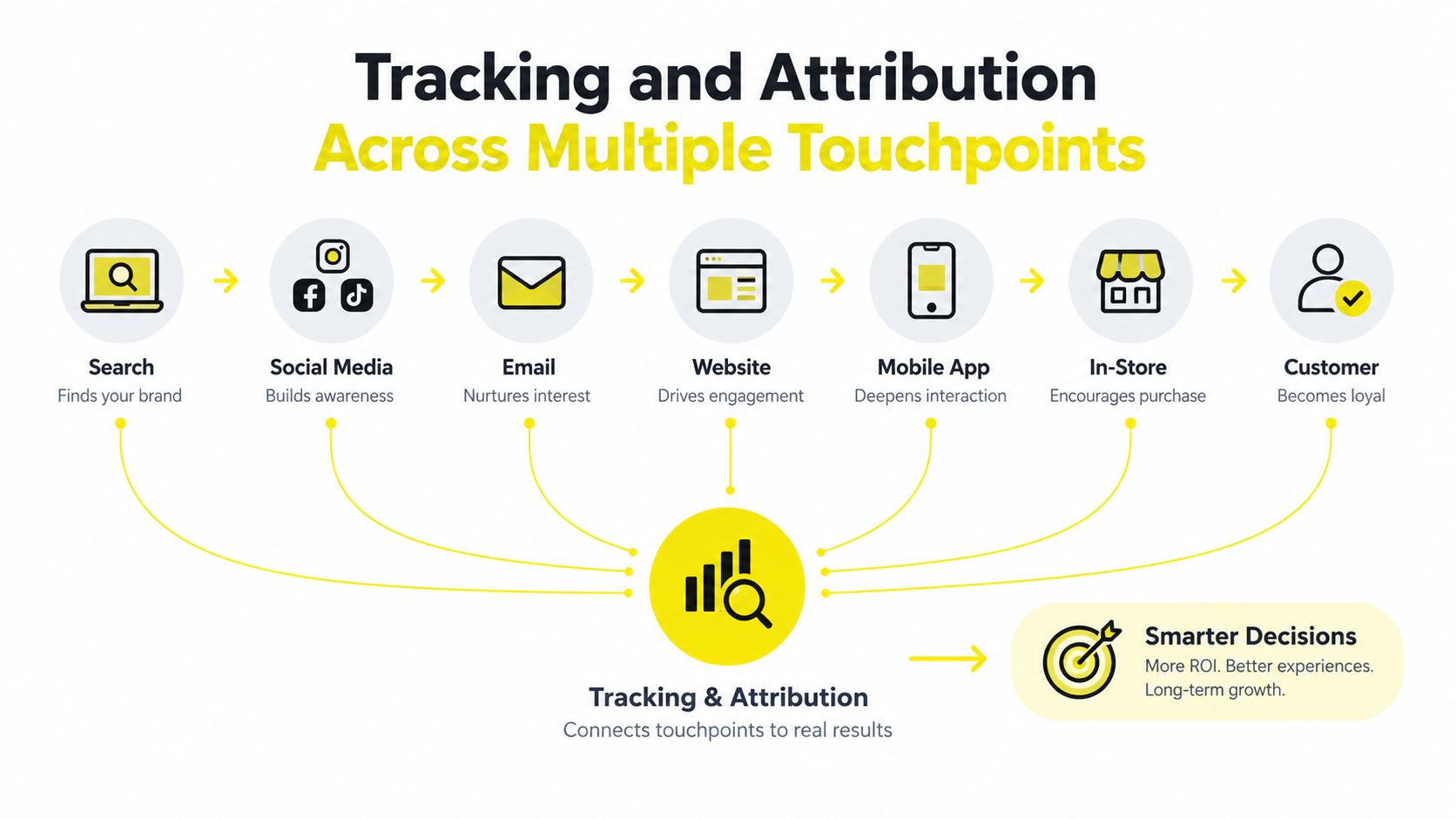
Attribution becomes difficult when a customer sees several ads, searches independently, opens an email, and converts through a direct visit. Each platform wants credit for the outcome, while the business needs to know whether the entire system created incremental value.
Last-click reporting is useful for operational diagnosis, but it isn't a complete explanation of demand creation. It tends to reward the final measurable interaction, often branded search or a remarketing click, while underrepresenting earlier social or video exposure. Cutting those early channels because they don't receive final-click credit can weaken the downstream demand that the reporting model appears to reward.
Build measurement around customer state
Start with a shared event taxonomy across the CRM, website analytics, ad platforms, and messaging tools. Events should distinguish exposure, engaged visit, lead submission, qualified lead, booking, purchase, repeat purchase, and cancellation or churn where relevant.
Then join those events to a stable first-party identifier where consent and platform policy allow it. The purpose isn't to force perfect person-level visibility across every environment. It's to create enough continuity to compare behavior by cohort and sequence.
A useful reporting layer should include:
Cohort retention: Compare whether customers acquired through different channel sequences return over time.
Repeat purchase rate: Measure subsequent transactions by initial source and journey path.
Qualified conversion: For lead generation, connect ad leads to booked and completed outcomes.
Blended acquisition cost: Evaluate total new-customer cost against downstream value, not only platform conversion cost.
Incremental testing: Hold out audiences, regions, or time periods where practical to estimate whether exposure caused additional action.
UTM parameters still matter, especially for separating campaigns, creative themes, and landing page destinations. Consistent naming prevents analytics pollution, so teams should review guidance on how to avoid UTM tagging mistakes before building dashboards.
Use models as decision aids
Media mix modeling can help estimate channel contribution at an aggregate level when user-level tracking is incomplete. It works best alongside experiments and cohort analysis, not as a replacement for them. A model that says social contributed value is useful, but the team still needs to test whether changing social spend changes total conversions or merely shifts credit between platforms.
Measurement principle: Don't ask which channel deserves all the credit. Ask which combination produces profitable new customers and durable retention.
Tactical Implementation for Paid Social and Search
Paid social and search work best when the creative narrative carries across the handoff. The social ad creates a reason to care, while search captures the prospect once the problem has become active enough to investigate.
Start by writing the customer state before writing the ad. Define what the prospect knows, what they're likely to search next, and what evidence they need before taking action. This prevents the common mistake of sending every audience to the same generic landing page.
Build the sequence
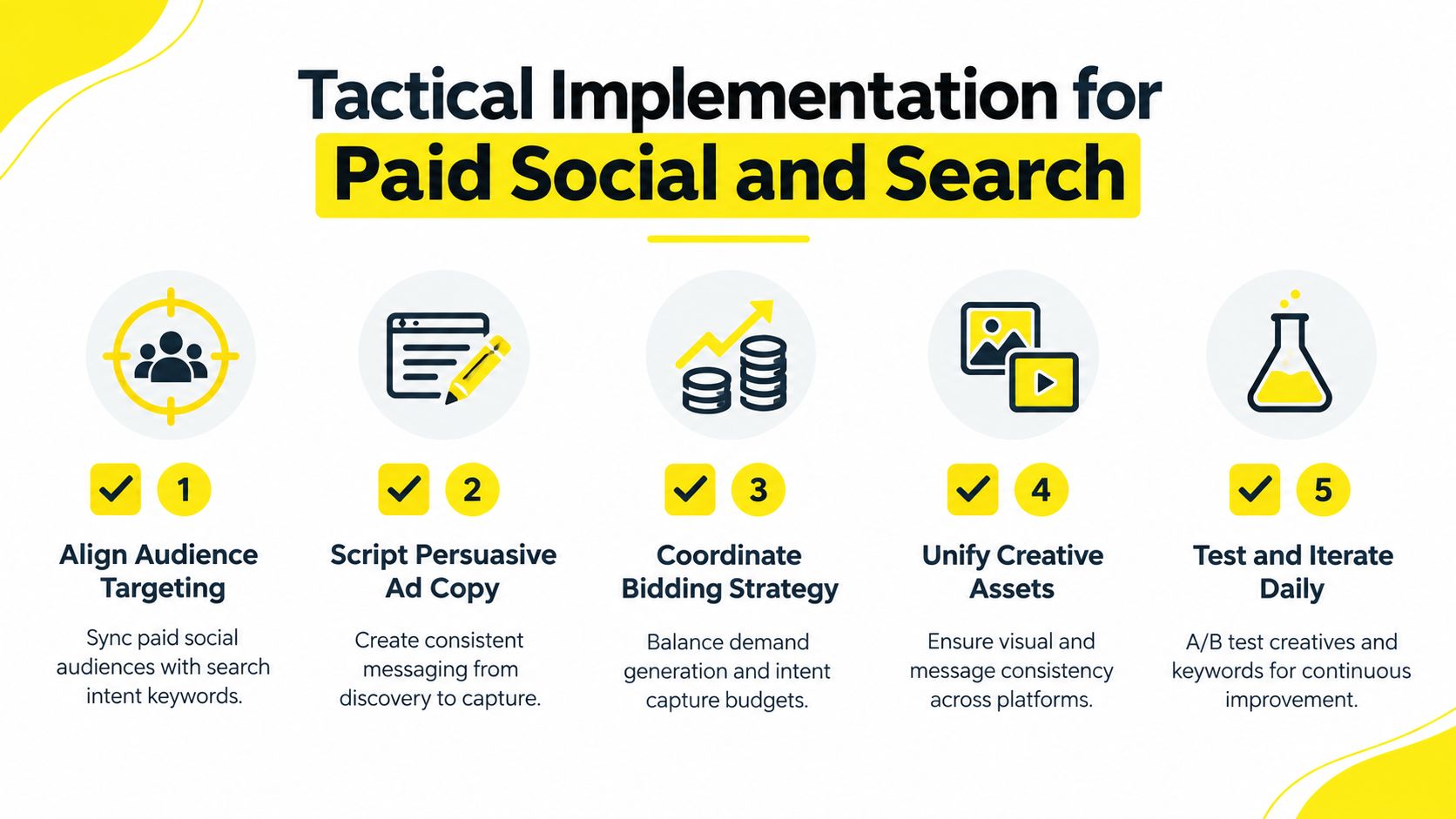
A practical paid social and search workflow looks like this:
Align audience targeting: Build social audiences around awareness, engagement, site behavior, and customer status. Map those states to search themes that reflect active intent.
Script persuasive ad copy: Repeat the core promise, but change the depth. A social video may lead with the problem, while a search ad answers the immediate question with a specific benefit or proof point.
Coordinate bidding strategy: Protect demand-generation spend while capturing high-intent searches. Search may convert faster, but its volume depends partly on the demand social and video create.
Unify creative assets: Keep the offer, visual language, claims, and call to action recognizable across Facebook, Instagram, TikTok, YouTube, and Google.
Test and iterate: Change one meaningful variable at a time, such as the opening hook, keyword group, landing page headline, or follow-up sequence.
A content scheduling tool such as Post To All Social Media At Once can help teams coordinate publishing, but distribution alone doesn't create continuity. The audience state, exclusions, creative order, and conversion events still need to connect to the advertising and CRM systems.
Preserve message match after the click
The landing page should make the next step feel like a continuation, not a new sales pitch. If the Facebook video promises a simple consultation, the landing page should lead with that consultation. If a Google ad targets a specific service or product use case, the page should answer that intent directly instead of forcing the visitor to explore a broad homepage.
Use behavioral advancement rather than platform silos. Someone who watches a video but doesn't visit the site needs a different message from someone who viewed pricing. Someone who submits a form should leave prospecting audiences immediately and enter a qualification or booking flow.
The most important handoffs are often operational. Confirm the lead, alert the sales team, record the outcome, and feed the result back into audience logic. Without that loop, paid social and search may appear coordinated on the front end while the business continues optimizing against incomplete conversion data.
Common Pitfalls and How to Avoid Them
The most expensive omnichannel mistake is assuming that more touchpoints automatically improve performance. A customer can receive a discount email, see a different price in a social ad, encounter a third offer in search, and then continue receiving prospecting messages after purchasing. That isn't a journey. It's a sequence of brand contradictions.
Integration must change decisions
A connected data layer matters only if it changes what the customer sees and what the team does. Audit the system for these failure points:
Contradictory offers: Align price, guarantee, availability, and qualification requirements across channels.
Missing suppression: Remove purchasers, booked leads, and unqualified contacts from the campaigns that no longer fit their state.
Repeated introductions: Advance engaged users into deeper creative instead of showing the same awareness ad indefinitely.
Siloed budgets: Evaluate the contribution of demand creation, intent capture, and retention together.
Unowned handoffs: Assign responsibility for lead routing, follow-up speed, status updates, and outcome reporting.
Frequency is another practical risk. A prospect who sees the same creative on every platform may develop fatigue before they're ready to buy. Set channel rules, rotate angles, and let behavior determine whether the person receives education, proof, urgency, or a post-purchase message.
Don't let attribution dictate strategy
A last-click dashboard can encourage teams to overfund branded search and underfund discovery. A platform dashboard can also report conversions without telling you whether the customer would have acted anyway. Use platform data for optimization, then validate strategic budget decisions with cohort outcomes, blended economics, and incrementality tests.
The right audit question is not “Are we on every channel?” It's “What does each channel know, and what does it cause the next channel to do?” If the answer is nothing, the business has a multichannel media plan, not omnichannel marketing.
Scaling Predictably with Wojo Media
Omnichannel performance depends on four operating pillars: the offer, landing pages, omnipresent ads, and data. Weakness in any one of them creates misleading results. A strong offer can't overcome a broken landing page, and excellent creative can't compensate for missing lead qualification or unreliable purchase tracking.
Wojo Media applies an omnipresent framework across Facebook, Instagram, TikTok, Google, and YouTube. The agency reports $145M+ in online revenue driven and 1,320+ businesses scaled, as stated in its publisher brief. Its operating model bolts onto existing brands, with work spanning offer refinement, conversion-focused pages, cross-platform creative, and backend KPI tracking.
What the framework needs to solve
For e-commerce brands, the practical focus is connecting product discovery, search intent, conversion, and repeat purchase behavior. For local services, the system needs to distinguish inexpensive inquiries from qualified leads and booked appointments. For coaches, consultants, tax advisors, and similar businesses, the sequence may center on webinars, applications, sales calls, and follow-up state.
That requires more than launching another campaign. The team needs to define the offer, preserve message match, assign channel roles, suppress audiences at the right events, and report on business outcomes beyond the ad platform. Wojo Media positions its service around those execution gaps, combining copywriting, design, influencer and UGC production, paid media, and tracking.
The benefits of omnichannel marketing become predictable only when strategy and operations remain connected. A brand can have strong reach and still lose money if the landing page weakens intent, sales follow-up fails, or retention data never reaches the acquisition team. The practical objective is a feedback system that makes each campaign more informed than the last.
Wojo Media helps e-commerce brands, local service businesses, and coaches connect offers, landing pages, omnipresent paid ads, and backend data into a coordinated acquisition system. Visit Wojo Media to book a free demo call and request a custom paid ads strategy built around your customer journey, channel handoffs, and growth targets.
Comments