.png)
Google Ads for Service Businesses: A Practical Playbook

More clicks won't automatically produce more booked jobs. That popular Google Ads advice is incomplete, and for service businesses it can be expensive. A campaign can generate calls, form fills, and attractive dashboard metrics while sending your team a stream of price shoppers, out-of-area prospects, and people who never intended to hire anyone.
The better target is qualified appointments and closed revenue. Google's own Local Services Ads reporting separates charged leads, lead spend, and lead types such as calls, messages, and bookings, which reflects the metric service businesses need: customer action, not traffic volume (Google's Local Services Ads reporting guidance). This playbook focuses on building Google Ads for service businesses around lead efficiency, CRM qualification, booked jobs, and the projected migration of some Local Services Ads advertisers toward Performance Max in 2026 (Google's Local Services Ads migration announcement).
Why Most Google Ads Campaigns for Service Businesses Fail
More clicks equal more business only when the clicks come from people who need your service, live inside your service area, meet your commercial criteria, and can reach a booking decision. Most accounts fail before bidding becomes the problem. They count every inquiry as a win, then wonder why the bank account doesn't reflect the reported lead volume.
Google Ads benchmarks show why generic averages are dangerous. One benchmark set reports Search conversion rates of 6.98% for Legal, 5.00% for Consumer Services, 5.13% for Employment Services, 5.10% for Finance and Insurance, and 6.03% for Auto, compared with a cross-industry Search average of 3.2% (2026 Google Ads benchmarks). Those figures show that high-intent service searches can convert well, but they don't tell you whether the leads become profitable jobs.
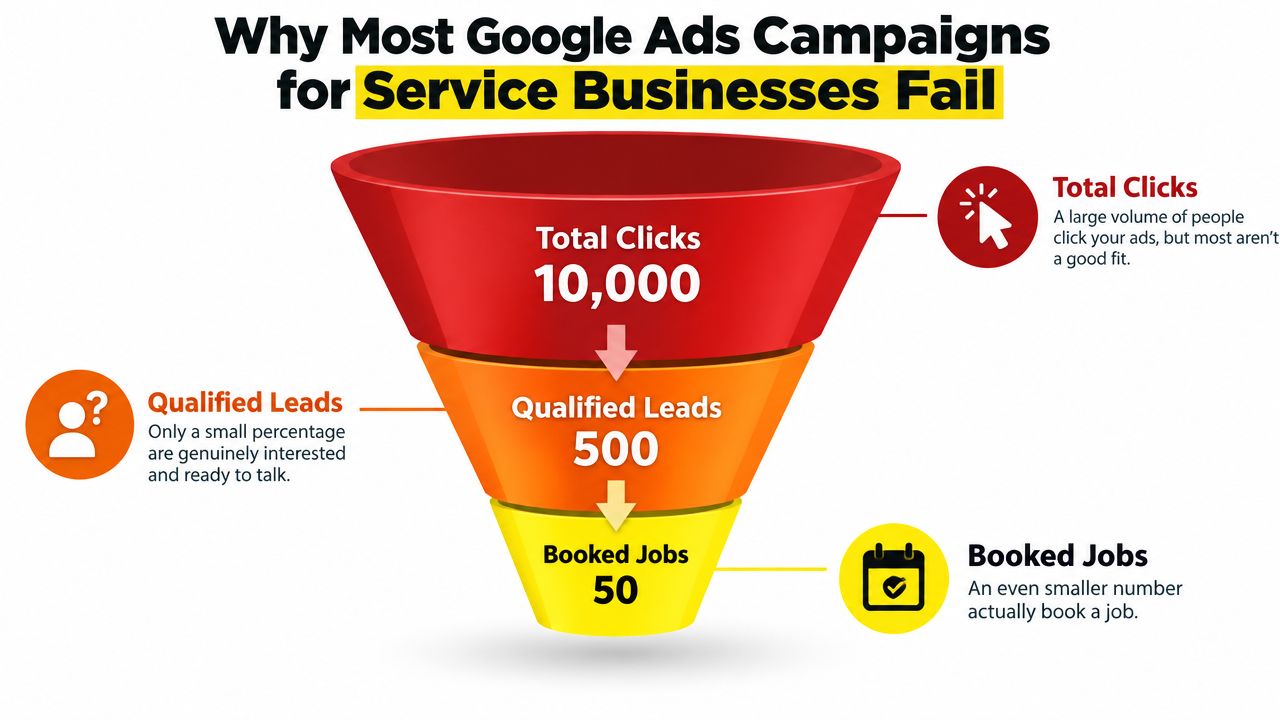
The three setup mistakes that create waste
Broad targeting without a serious negative list lets in searches for jobs you don't perform, DIY instructions, employment, training, parts, and bargain hunting. A keyword can be relevant to your industry and still be commercially useless.
Sending every click to the homepage forces a visitor to figure out what you do, where you work, and how to contact you. A person searching for emergency drain repair should land on a page about emergency drain repair, not a general navigation menu.
Optimizing to form fills instead of revenue teaches Google to find people most likely to submit something, not people most likely to buy. If your CRM doesn't distinguish a qualified lead from a junk inquiry, automated bidding receives contaminated data.
Practical rule: Define a qualified lead in your CRM before you launch. Include service needed, service area, contactability, urgency, and whether the prospect meets your minimum commercial threshold.
Track the stages that matter: lead, qualified lead, appointment, booked job, and closed revenue. If you need a practical framework for estimating lead economics before launch, review this guide to estimate leads with Estimatty, then replace assumptions with your own CRM outcomes as data accumulates.
Choosing the Right Google Ads Campaign Structure
Start with Search when people actively search for your service. It gives you direct control over the query, ad, location, and landing page, making it the strongest foundation for qualified appointments. Searches such as “emergency electrician near me,” “personal injury lawyer consultation,” and “AC repair” show a prospect naming a problem and looking for a provider.
Add Local Services Ads when your category and location qualify, and your team can answer phone-led inquiries. LSAs use pay-per-lead pricing and report charged leads by type, including calls, messages, and bookings (Google Local Services Ads support). That makes them useful for plumbers, electricians, HVAC companies, and similar businesses whose sales process starts with a conversation. Treat lead quality as the test. Cheap inquiry volume is not the goal if your staff cannot qualify or schedule the caller.
Use Performance Max as an expansion layer, not as the only campaign in a new lead-generation account. It fits businesses with usable creative, first-party audiences, brand reinforcement needs, and reliable conversion data, especially data tied to qualified appointments or closed jobs. Without those signals, automated bidding can pursue easy conversions instead of profitable work.
Campaign Type | Best For | Pricing Model | Key Limitation |
|---|---|---|---|
Search | High-intent service and location searches | Pay per click | Requires disciplined query control and landing-page alignment |
Local Services Ads | Phone calls, messages, and bookings from eligible local categories | Pay per lead | Eligibility, lead quality, and platform rules limit control |
Performance Max | Broader reach, remarketing, and brand reinforcement | Automated bidding across Google inventory | Less transparent query and placement control |
Use a decision rule, not a platform checklist
Emergency businesses should prioritize call availability, rapid-response messaging, and Search plus LSAs. Scheduled services need separate service-line campaigns that send visitors to appointment-focused pages. Considered purchases, including legal consultations, remodeling, and financial services, can combine Search with educational remarketing and stronger qualification steps.
Google has announced a phased migration of some LSA advertisers to Performance Max. The change begins with select United States home and storefront service advertisers in August 2026, expands to broader service-area businesses in late 2026, and moves remaining non-United States accounts in 2027, according to its announcement (Google's LSA transition details). Build for that shift now. Keep call tracking, CRM stages, offline conversion imports, and booking data portable, so your reporting and bidding do not depend on one platform interface. A setup that measures qualified appointments and revenue will survive the transition better than one optimized for raw lead counts.
Building a Keyword Strategy Around Buyer Intent
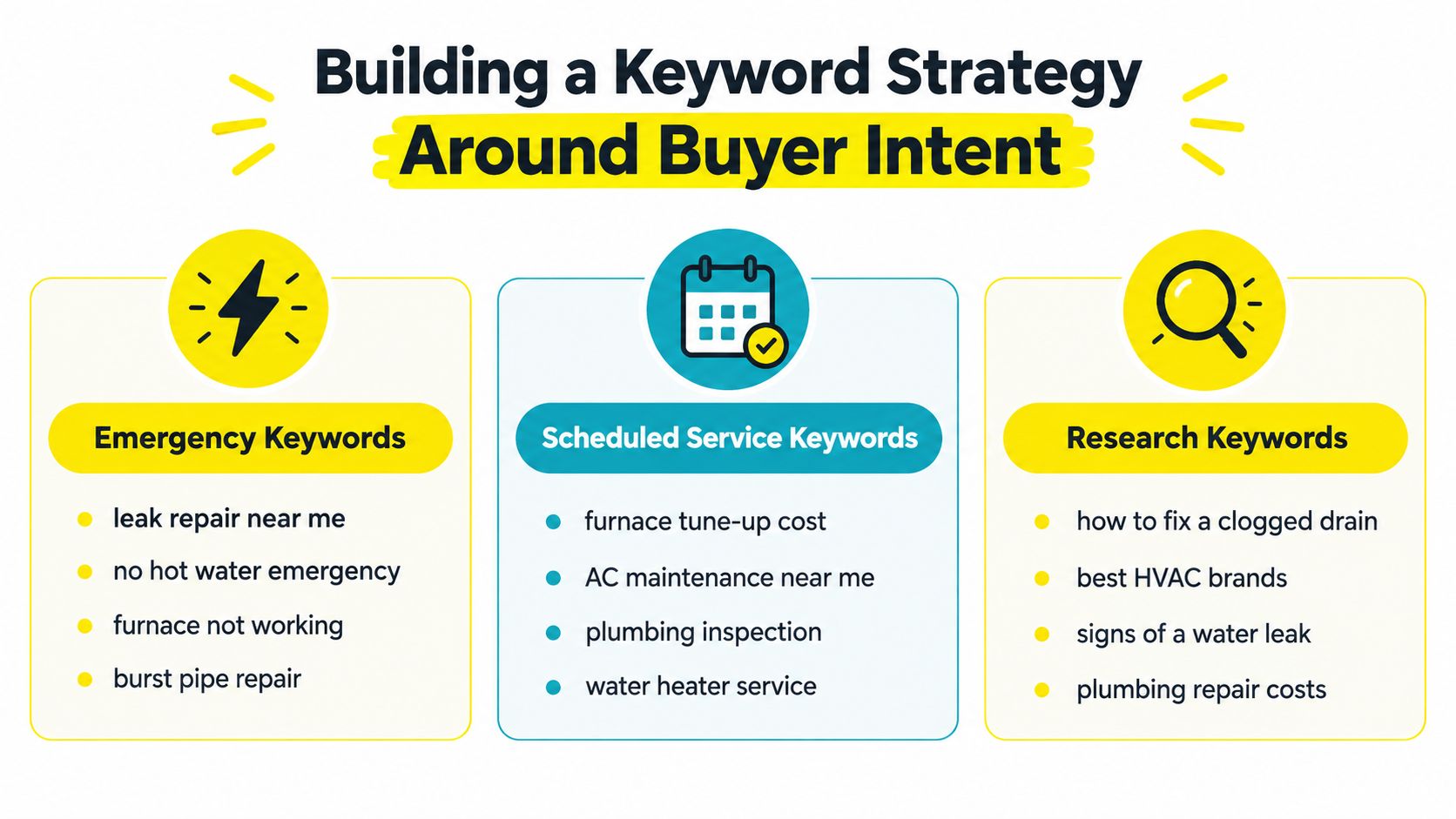
Keyword volume is a distraction when your business has limited crews, appointment capacity, or service territory. Build themes around the buyer's readiness to hire, then give each theme a landing page and ad message that matches the decision.
Emergency intent includes searches such as “leak repair near me,” “24 hour plumber,” and “emergency furnace repair.” These terms justify direct calls to action, availability messaging, and call-focused assets.
Scheduled intent includes “furnace tune-up,” “roof inspection,” and “office cleaning service.” These searches need clear service scope, scheduling options, and a reason to choose your team.
Research intent includes “how to fix a clogged drain,” “furnace tune-up cost,” and “best options for knee pain.” Some research traffic can become future demand, but it shouldn't consume the same budget as urgent hiring intent.
Match types and exclusions
Use exact and phrase match for initial control. Broad match can uncover useful demand, but only after your conversion definitions, bidding signals, and negative keyword process are mature. Don't use broad match as a shortcut for strategy.
Start your negative list with categories that regularly create waste:
DIY and instructional terms: “how to,” “tutorial,” “instructions,” and “fix it yourself.”
Employment searches: “jobs,” “career,” “salary,” “apprenticeship,” and “hiring.”
Training and education: “class,” “course,” “certification,” and “school.”
Free and bargain intent: “free,” “cheap,” “discount,” and “coupon,” unless those searches fit your offer.
Parts and products: “parts,” “manual,” “replacement,” and specific product-only searches.
Adjacent services: neighboring categories your team doesn't perform.
Irrelevant locations: cities and neighborhoods outside your service area.
Review the search terms report weekly. Classify every meaningful query as keep, exclude, or investigate. Then connect the query to CRM outcomes rather than stopping at a conversion event. A click that generates no booked job after your evaluation window is a pause candidate, not an excuse to keep tweaking the ad group. For a broader framework on prioritizing keyword types, use intent as the organizing principle rather than search volume.
Writing Ad Copy That Generates Calls and Form Fills
Lead-intent copy isn't brand copy. The searcher has already described a problem, so your ad must answer the practical questions behind it: Can you handle this job, how soon can you respond, and what makes contacting you worthwhile?
A strong responsive search ad usually combines three jobs:
Name the problem: “Emergency Drain Repair.”
State the differentiator: “Upfront Flat Pricing.”
Ask for the action: “Call for Same-Day Service.”
Descriptions should add proof you can verify, such as licensing, warranties, service coverage, response availability, or a transparent consultation policy. Don't manufacture urgency or promise response times your dispatch team can't meet.
Examples that sound like a provider, not a brochure
A plumber should replace “Quality Plumbing Services” with language such as “Burst Pipe Repair,” “Licensed Local Plumbers,” and “Call for Fast Dispatch.” An HVAC company can use “AC Not Cooling?” followed by “Clear Repair Options” and “Book a Service Visit.” A personal injury lawyer might test “Injured in an Accident?” with “No Fee Unless We Win,” but only if that fee arrangement is accurate and legally compliant.
Call assets matter when calls close more jobs than forms. Lead-form assets can help prospects who aren't ready to talk, while location and structured information assets can clarify coverage and services. Pin only when a specific message must appear in a specific position. Excessive pinning reduces Google's ability to assemble combinations and often turns a responsive ad into a rigid template.
Element | Generic Version | Lead-Intent Version |
|---|---|---|
Problem | Quality Service Provider | Emergency Water Damage Cleanup |
Differentiator | Experienced Team | Licensed, Insured Technicians |
Offer | Contact Us Today | Book a Same-Day Assessment |
Description | We provide excellent service | Get clear next steps and upfront service information |
CTA | Learn More | Call Now or Request an Appointment |
Keyword insertion isn't a copy strategy. Write for a person who is one tap away from calling a competitor, then make the next step obvious. If the ad promises a specific service, the landing page must repeat that promise immediately.
Landing Pages That Turn Clicks Into Booked Jobs
The homepage is usually the wrong destination for paid service traffic. It may contain every service, every location, a company history, and several competing calls to action. That creates friction precisely when the visitor wants a simple answer: “Can this business solve my problem?”
Build a dedicated page for each important service line and location combination. A page for “commercial drain cleaning” should not be the same page as “residential emergency plumbing,” even if the same company fulfills both jobs. Separate pages let you align the search term, ad, proof, qualification questions, and booking path.
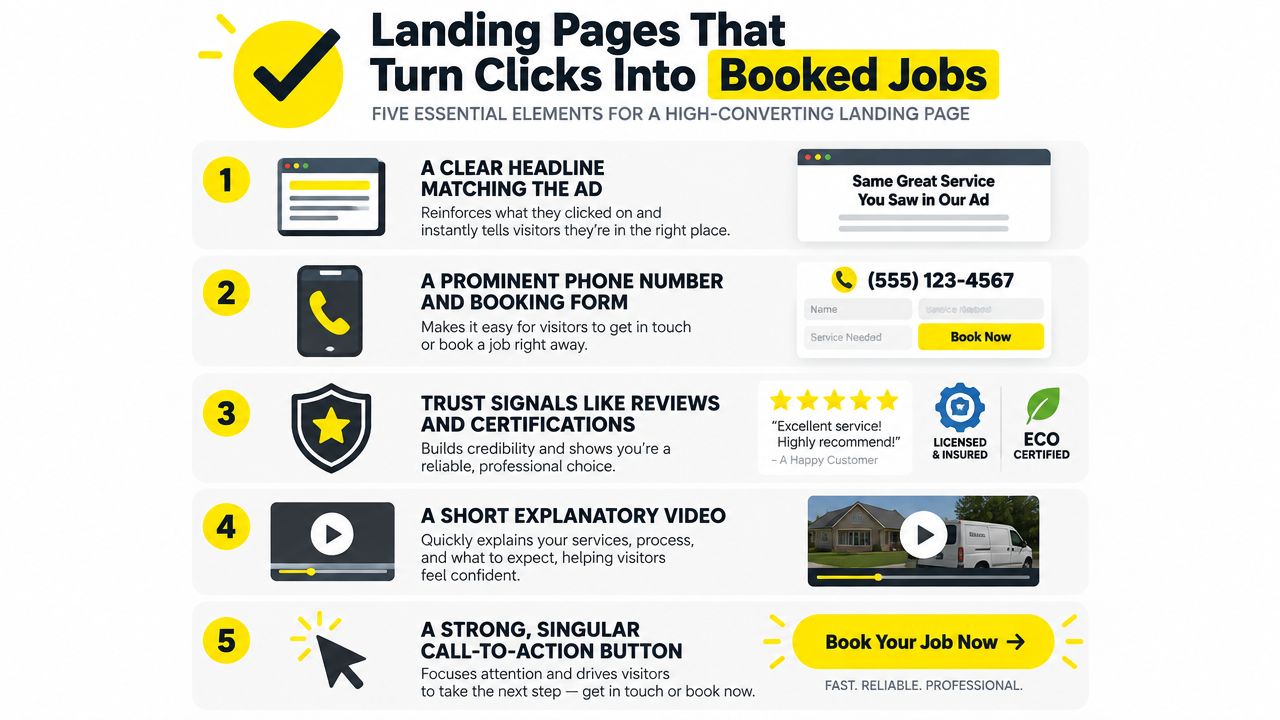
The page should make one decision easy
Put the service and outcome in the headline. If the ad says “Emergency Drain Repair,” the page headline shouldn't say “Welcome to Smith Plumbing.” It should confirm the visitor's intent and give them a clear next step.
Use one dominant offer, one prominent phone number, and one primary booking path. A short form should ask only for information your team needs to route the inquiry. A form that feels like a job application will lose prospects who would have called.
Trust elements belong close to the decision point, not hidden on an About page:
Proof of legitimacy: Display licenses, insurance details, certifications, and service-area information where applicable.
Customer confidence: Use authentic reviews, testimonials, and before-and-after work that match the service being advertised.
Risk reduction: Explain warranties, guarantees, estimates, consultation terms, or cancellation policies accurately.
Human access: Show who answers the phone and what happens after someone submits the form.
Mobile action: Keep a tap-to-call button visible on mobile screens.
Skip the clutter. Chat widgets that interrupt the page, aggressive pop-ups, carousels that bury the offer, and long forms often create more friction than value. Test them only when your baseline page already produces qualified outcomes and you can measure the trade-off.
Speed matters because service prospects frequently search on mobile while dealing with an immediate problem. Use Google PageSpeed Insights to identify heavy scripts, oversized images, delayed fonts, and third-party tools that slow the first useful interaction. Don't publish a speed promise you haven't tested across the devices and connections your customers use.
Bidding is a margin decision
Manual CPC is a sensible starting point for a new account with limited conversion history. It gives you control while you validate search terms, geography, landing pages, and lead quality. That control is valuable for a solo electrician or small operator who can't afford to let an unproven campaign explore every possible variation.
Maximize Conversions becomes more useful once the account has enough trustworthy conversion data for the system to learn from. The word trustworthy matters. If most recorded conversions are junk forms, the algorithm will pursue more junk forms efficiently.
Target CPA belongs later, after closed-loop tracking gives you a defensible cost-per-qualified-lead target. Set it from margin and booked-job economics, not from a generic industry recommendation. A target that's too restrictive can choke delivery, while one that's too loose can buy volume your operation can't monetize.
Enhanced CPC is usually a compromise rather than a deliberate growth strategy. Choose a bidding approach based on data quality, capacity, and acceptable acquisition economics, then revisit it as your CRM evidence improves. A solo operator and a regional HVAC company may use different settings, but both should answer the same question: what can we pay for a lead that becomes profitable work?
Tracking Qualified Leads From Click to Closed Job
Conversion tracking must reflect the way customers hire you. A form submission is only the beginning if your sales process depends on a phone conversation, an appointment, an estimate, or an in-person visit.
Start with the Google tag and GA4 events for every meaningful action:
Forms: Record successful submission, not just a button click.
Calls: Track calls from ads, landing pages, and Google forwarding numbers where available.
Bookings: Capture completed appointments separately from calendar opens.
Early signals: Track quote starts, contact-field completion, and booking-widget engagement as diagnostic events.
Use call-tracking platforms such as CallRail, WhatConverts, or Invoca when phone qualification drives revenue. The useful record isn't merely “a call happened.” It includes the source, duration, recording where lawful, service requested, location, qualification status, and eventual outcome.
Move revenue data back into Google Ads
Map the CRM stages as a sequence: lead, qualified, appointment, closed. Pass identifiers through the form and call workflow, then import offline conversions so Google can learn which interactions lead to valuable outcomes. Enhanced conversions can strengthen measurement when implemented correctly, but privacy, consent, and platform requirements still need attention.
Don't let low-volume accounts ignore early signals. Micro-conversions can help diagnose where prospects stall, but they shouldn't replace qualified-lead and revenue events once enough data exists. Keep the reporting hierarchy visible so a rise in quote starts doesn't distract from a decline in booked work.
Missed calls also corrupt attribution and revenue. If your team can't answer during operating hours, review a solution such as SkipCalls call answering, then measure whether answered inquiries become qualified appointments rather than treating call coverage as a vanity metric.
Connecting Google Ads to Your Omnipresent Paid Mix
Google captures demand at the moment a prospect searches. It doesn't always create that demand. Meta, Instagram, TikTok, LinkedIn, and YouTube can introduce the problem, demonstrate your process, and build familiarity before someone searches for your company or service.
Use each channel for a distinct job. Meta can educate a cold audience, retarget site visitors, and create audiences from closed-deal CRM lists. YouTube can demonstrate a service, answer objections, or reach viewers researching a category. Google Search then captures branded and non-branded intent when the prospect is ready to compare providers or request help.
Build one measurement system
A fragmented account structure encourages every platform to claim the same customer. Share exclusions, audience definitions, geographic rules, and CRM stages across the paid mix. The customer may see a YouTube video, click a Meta ad, and search your brand later, but your reporting should show the path instead of awarding every touchpoint equal credit.
Coordinate the creative angle. Social ads can explain why the service matters, show technicians at work, and establish trust. Search ads should answer the immediate need with specific service language, proof, and a direct action. Retargeting should reflect the page the prospect visited, not show the same generic company ad to everyone.
Review the business outcome weekly:
Cost per qualified lead, by channel and service line.
Appointment rate, including show and cancellation patterns.
Booked-job rate, separated from raw inquiry volume.
Closed revenue, connected to source and campaign.
Capacity and margin, so profitable demand doesn't overwhelm operations.
A cheap lead that never closes is more expensive than a higher-priced lead that becomes profitable work. Conduct a channel audit quarterly and reallocate budget based on cost per closed job, not cost per lead.
A practical 14-day reset
Days 1 to 3: Audit Google tags, GA4 events, call tracking, form submissions, and booking confirmations.
Days 4 to 6: Review the search terms report, remove irrelevant queries, and expand negative keyword categories.
Days 7 to 9: Test landing-page speed, simplify the form, verify the phone path, and align each page with its ad group.
Days 10 to 11: Map CRM stages from lead to closed job and confirm that identifiers pass through the sales process.
Days 12 to 13: Refresh Meta audiences from qualified and closed customers, then build one cross-channel retargeting sequence.
Day 14: Compare qualified appointments and booked revenue by channel, service, and location. Pause campaigns that produce activity without acceptable economics, even when the dashboard looks busy.
Wojo Media offers Google Ads management and broader paid advertising support that connects campaign structure, landing pages, creative, tracking, and backend KPI reporting for service businesses. If your account needs a qualified-lead system built to withstand changing platform workflows, visit Wojo Media to discuss a practical paid media strategy.
Comments