.png)
What Is Advertising Copywriting and How It Works

Advertising copywriting is the paid-media discipline of writing headlines, hooks, and CTAs engineered to lift measurable outcomes such as CTR, CPC, and conversion rate across search, social, display, and video. In one controlled comparison, human-written search ads generated 65 clicks from 1,306 impressions, while AI-generated ads produced 26 clicks from 713 impressions, with CTR moving from 3.65% to 4.98% and average CPC from $6.05 to $4.85 (Search Engine Journal).
You're probably facing the practical version of the problem right now: an empty headline field, a product or service that needs demand, a media budget attached, and a launch deadline that won't move. The question isn't whether you can write something persuasive. It's whether the words can earn attention in the placement, communicate value before the user scrolls, and produce a better commercial result than the message currently running.
What Advertising Copywriting Actually Is
A paid campaign is waiting on a headline, a social hook, or a call to action. The media budget is already attached, the placement has limited space, and the audience will decide within seconds whether to ignore the message or continue. Advertising copywriting handles that writing job, from search headlines and social primary text to display descriptions, video hooks, offer language, and calls to action.
The objective is a measurable next step: a click, lead, purchase, booking, or completed application. That requirement separates ad copy from content writing, brand storytelling, and SEO blogging. A blog post can earn value through organic visibility, reading depth, or useful information. A brand story can build familiarity over time. Paid copy must fit an auction, reach a defined audience, and make the offer relevant within the limits of its placement.
The working definition
A useful definition is:
Advertising copy is message engineering for paid distribution.
Every ad has four practical jobs:
Interrupt attention: Give the reader a reason to stop, listen, or look.
Create relevance: Show how the message connects to the audience's situation.
Reduce uncertainty: Explain the offer and provide credible evidence.
Direct action: Make the next step clear and proportionate to intent.
These jobs change with the audience and stage of consideration. A first-time visitor may need a problem-led introduction. Someone who viewed a product page may need reassurance about fit, delivery, or risk. A past purchaser may respond to a replenishment offer or a complementary product.
The offer stays constant. The message does not.
Why the outcome matters more than the line
A clever line can win internal approval and still lose in the auction. Effective copy improves the connection between audience, message, placement, and action, which is why the same offer needs different execution in search, social, display, and video.
Research covering two car-model campaigns on a major Chinese automotive platform ran for 188 days and reached 1.455 million consumers. Copy matched to the audience outperformed traditional professionally written ads on engagement, supporting the value of relevance and segmentation in performance (Electronic Commerce Research).
Start by identifying the audience and the one point it must understand. Select proof that addresses its main doubt, then write the shortest message that earns the next step. Test that version against a control, and judge it by the commercial result rather than the line's polish.
How Advertising Copywriting Evolved Into a Performance Discipline
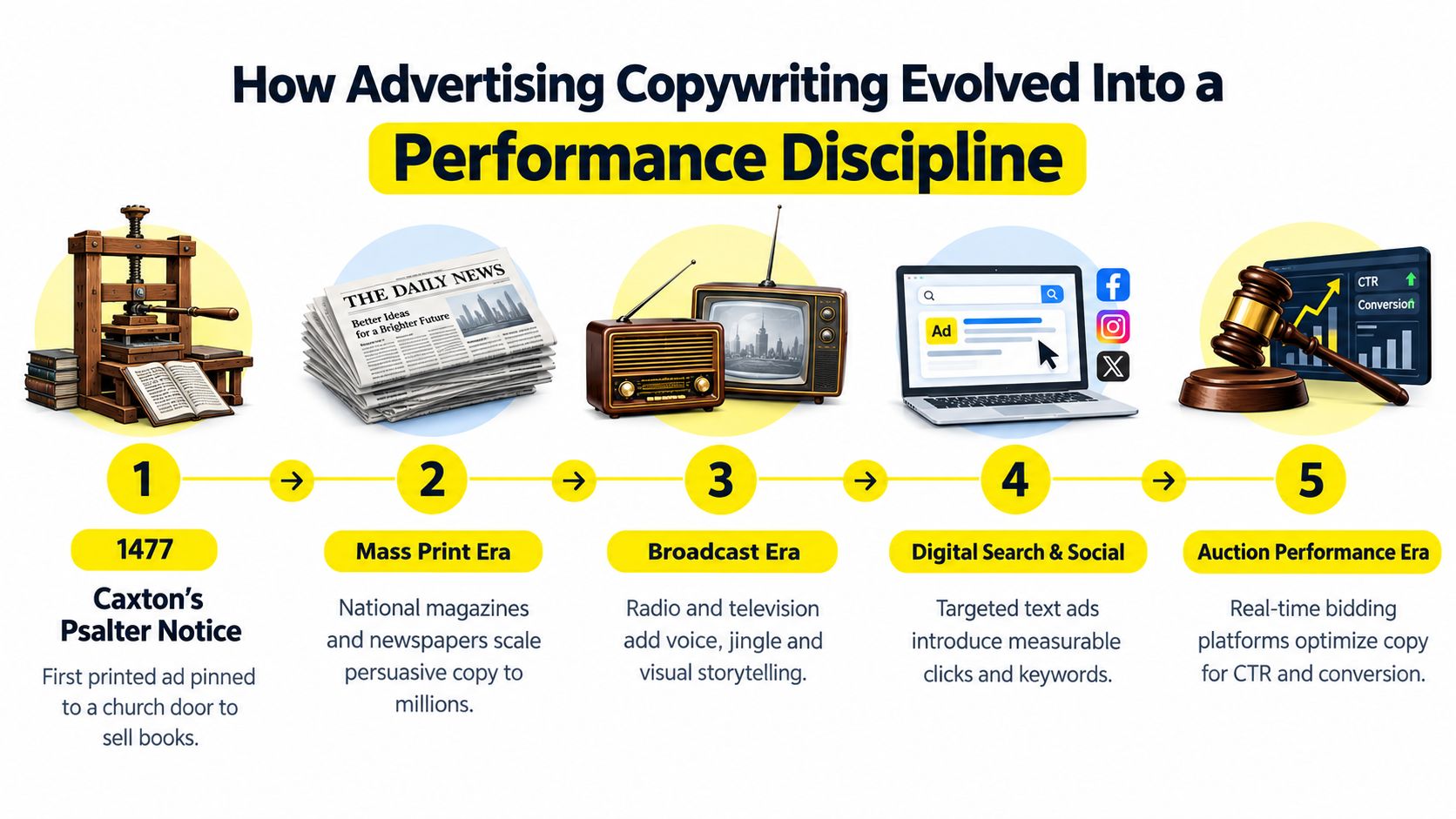
Advertising copywriting began with a simple constraint: a printed message had to earn attention without targeting data or instant measurement. One widely described early surviving example appeared in 1477, when an English notice promoting a prayer book was posted on church doors (Wikipedia's history of copywriting). The writing had to remain visible, understandable, and persuasive in a physical setting.
As print distribution expanded, newspapers and magazines created demand for concise sales language that could reach broad audiences consistently. By the late eighteenth century, copywriters were also using humor, slogans, riddles, and illustrations to compete for attention in crowded print markets. Each format changed how quickly the reader could understand the offer and what the copy had to do next.
Every medium changed the writing job
Radio made the voice and sonic hook central. Listeners could not reread a sentence, so scripts needed natural speech, repeated key information, and memorable phrasing. Television added visual demonstration. The words had to reinforce what viewers saw rather than compete with the product, presenter, or proof on screen.
A professional shift followed the growth of agencies. In 1841, Volney B. Palmer opened what's generally recognized as the first American advertising agency in Philadelphia. Early agencies mainly sold ad space, while advertisers handled the writing. By the 1890s, copywriting had developed into a dedicated agency service as demand for specialized persuasive writing increased, as documented in the history of copywriting.
Digital media changed the operating model again. Search, social, display, and video platforms distribute messages using audience signals, predicted engagement, relevance, and advertiser competition. The editor no longer controls who sees the message. The platform ranks and serves it based on its auction and delivery systems.
The modern copywriter writes for two readers at once, the person deciding whether to act and the system deciding whether to show the ad.
That reality makes copy specific, modular, and testable. The same offer may need a query-matched headline for search, a pattern interrupt for social, a compact benefit for display, and a spoken payoff for video. Performance copy earns its place through relevance first, then proves its value through CTR, CPC, and conversion results.
The Four Jobs Every Piece of Ad Copy Must Do
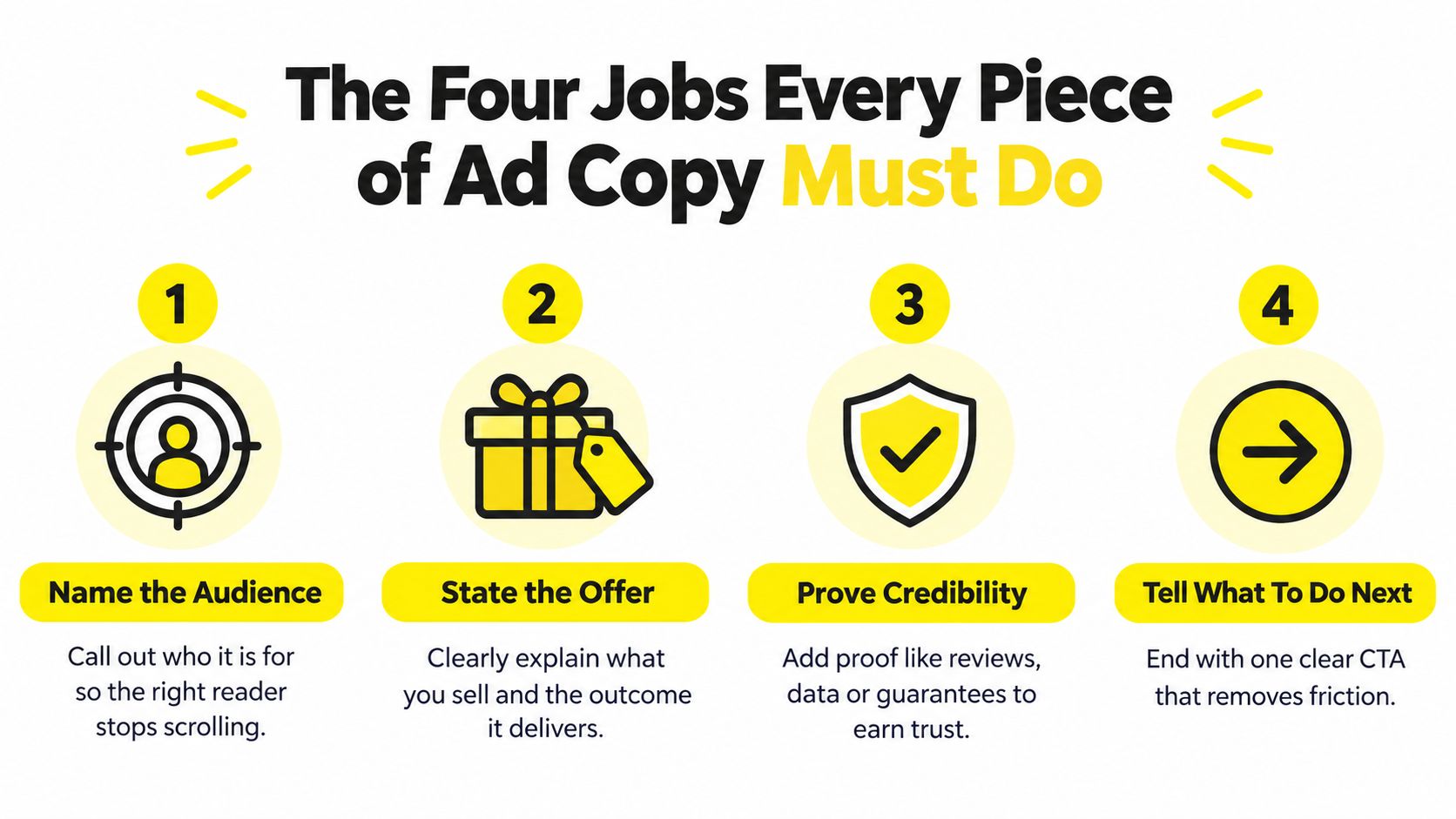
A paid ad has limited room to make its case. One recent practical framework emphasizes four requirements, the copy must name the audience, state the offer, prove credibility, and tell people what to do next (Anderson Collaborative's ad copywriting framework).
Name the audience
Relevance starts with recognition. A search ad for “emergency boiler repair” already inherits intent from the query, so the headline can mirror that language and move quickly to availability or service area. A Meta or TikTok ad often needs to establish the audience in the opening line or first visual because the user hasn't declared the problem through a typed query.
“Skincare for sensitive skin” is more useful than “Better skincare.” “For first-time landlords” is more discriminating than “Property advice.” The audience label helps the right person stop and gives the wrong person permission to keep moving.
State the offer
The reader should understand what's being sold and why it matters before encountering a list of features. Lead with the outcome, then explain the mechanism. “Reduce missed appointments with automated reminders” gives a buyer a reason to care. “SMS and email notifications” describes a feature without establishing its commercial value.
Platform fields impose hard limits, including headline, primary text, path, and description constraints. Treat every character as a decision. Remove throat-clearing language before removing the benefit.
Prove credibility
Proof can live inside the copy or inside the platform format. Reviews, star ratings, creator demonstrations, customer content, guarantees, and recognizable client references can carry trust without using extra words. Copy-driven proof should be concrete and verifiable, such as a named outcome, a defined process, or a clear condition.
Avoid unsupported superlatives. “The best,” and “number one” create claims that require substantiation and often communicate less than a specific explanation of how the offer works.
Tell people what to do next
A CTA should match the audience's readiness. “Buy now” may suit a high-intent product viewer. “See how it works” can make more sense for someone encountering a complex service for the first time. Action verbs reduce ambiguity, while outcome-led CTAs can reduce perceived commitment.
The button is only one part of the instruction. The surrounding copy should make clear what happens after the click, such as viewing a product, checking availability, booking a consultation, or downloading a guide.
How Ad Copy Changes by Channel and Format
A single offer can't be pasted unchanged across every placement. Consider an organic skincare set priced at $49. The commercial proposition stays constant, but the message must reflect what the user is doing, how much attention the placement allows, and what the platform can infer from the surrounding context.
Channel | Format limit | Rewritten headline or hook | Primary auction signal |
|---|---|---|---|
Google Search | Short headline assets and compact descriptions | “$49 Organic Skincare Set for Sensitive Skin” | Query relevance and predicted response |
Meta Feed | Opening text and visual-led feed experience | “Sensitive skin reacting to your current routine?” | Predicted engagement and downstream action |
TikTok In-Feed | Native creator-style video script | “I stopped guessing which products would irritate my skin” | Early engagement and viewing behavior |
YouTube Pre-Roll | Spoken hook before the skip decision | “If your skincare routine keeps causing irritation, start here” | Attention, viewing behavior, and response |
Google Search rewards language that connects directly to intent. Put the problem, product category, or audience signal near the front, then use the description to handle differentiation and the next step. Search copy can be explicit because the user has already typed a need.
Meta requires a stronger interruption. The first line and first frame have to create enough tension to stop a scrolling user. The body can then explain the offer, show proof, and answer objections. TikTok usually performs better when the script sounds native to the platform, with a creator cadence, a lived problem, and a visible demonstration rather than a polished commercial voice.
Video adds a second constraint, the audience can leave before the message finishes. Put the core problem and promised outcome into the spoken opening, then repeat the CTA clearly enough to survive partial viewing.
For practical scripting patterns, these creator UGC ad script examples are useful when you need to translate a product benefit into a natural creator-led delivery.
Channel-fit rule: Write for where the audience types, scrolls, watches, or listens, not where the brand team feels most comfortable publishing.
Copy Formulas and Real Examples That Convert
A reliable ad structure has four movable parts: headline, hook, body, and CTA. The sequence resembles an AIDA and PAS hybrid. Start with the audience's problem, make the cost of inaction recognizable, present the offer as the resolution, and ask for one next step.
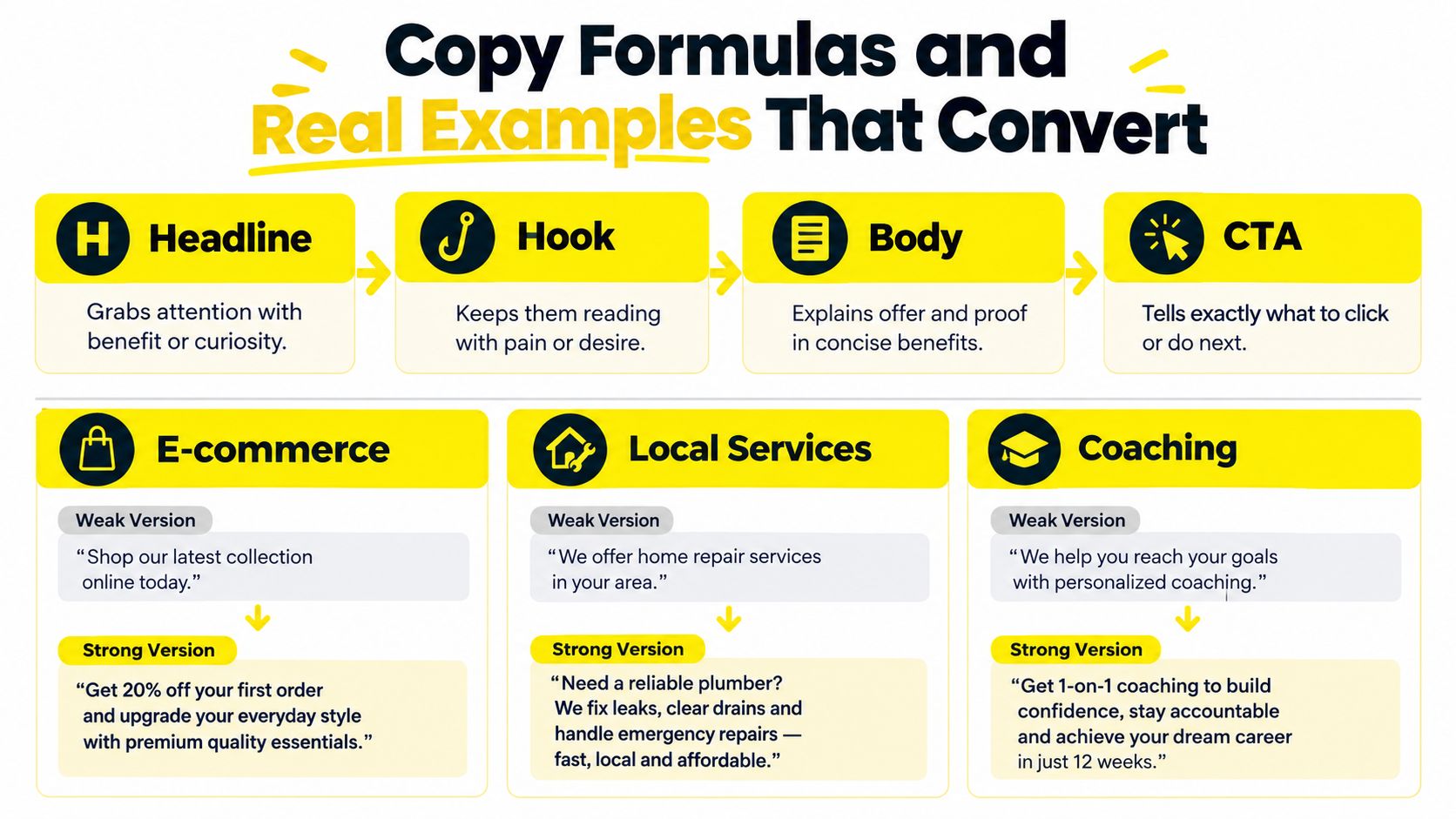
E-commerce example
Weak version
Premium organic skincare. High-quality ingredients. Shop now.
The ad names a category but not an audience problem. It lists a general feature, offers no reason to believe the claim, and uses a generic CTA.
Stronger version
Sensitive skin shouldn't require constant product switching.Build a simpler organic routine with a four-product set designed for gentler daily care. See the ingredients and choose your routine.
The rewrite leads with a recognizable frustration, explains the offer, and directs the reader to inspect the product rather than forcing a purchase before trust exists.
Local service example
Weak version
Need plumbing help? We provide reliable services at competitive rates. Contact us today.
This could describe almost any contractor. It avoids the specific situation that creates urgency.
Stronger version
Leaking pipe under the sink?Get a clear repair recommendation and a scheduled service visit from a local plumbing team. Request availability today.
The revised copy makes the audience self-identify, states the immediate service, and gives a practical next step.
Coaching example
Weak version
Transform your business with expert coaching. Book now.
The promise is broad and difficult to evaluate.
Stronger version
Still changing your offer every week?Use a focused clarity session to identify the strongest customer, problem, and next campaign angle. Book a free 15-minute clarity call.
The CTA communicates the commitment, while the body turns an intangible service into a defined experience.
Use this pattern on a live ad:
Headline: What specific audience or problem should stop?
Hook: What frustration, desire, or risk should feel familiar?
Body: What does the offer change, and what proof supports it?
CTA: What single action fits the reader's current intent?
If one of those answers is vague, the draft probably is too.
Measuring and Optimizing Copy Like a Performance Team
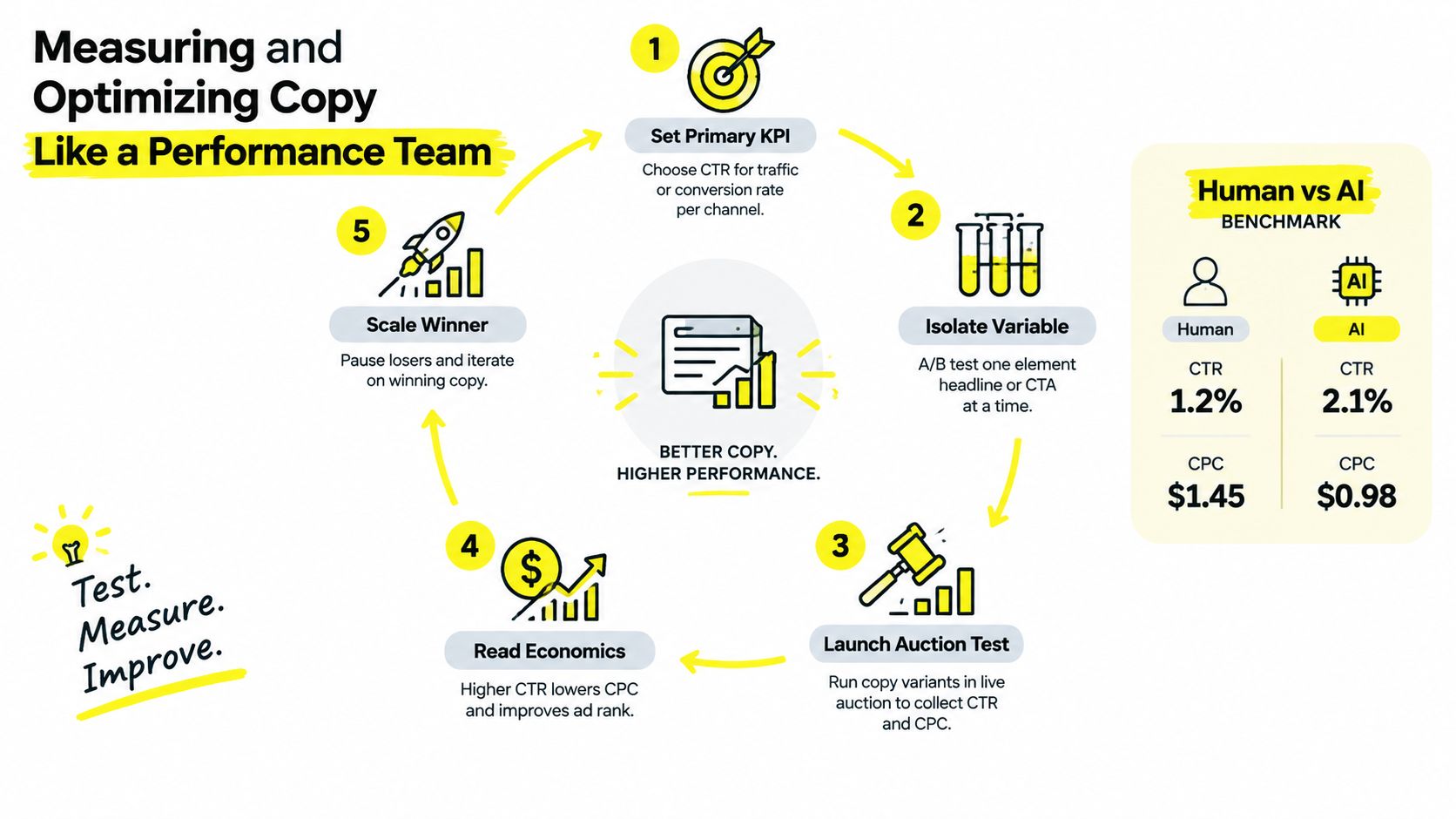
Copy affects auction economics because audience response affects the inputs platforms use to price and deliver ads. A reported comparison found that human-written search ads generated stronger CTR and lower CPC than AI-generated ads, while a separate experiment found that AI-assisted copy lightly edited by humans increased CTR by 26% over human copy alone. The practical lesson is to compare workflows, not treat human and machine writing as fixed opposing choices. Machines can produce variants quickly. Humans still need to judge audience fit, offer clarity, proof, and intent.
Build the measurement loop
Choose one primary KPI for the channel before writing variants. Use CTR when the immediate job is qualified traffic. Use conversion rate when the campaign has enough post-click signal. CPC shows the cost of earning attention, but a cheaper click has little value if it produces weak leads or no purchases.
Control the test. If the headline, image, audience, landing page, bid strategy, and offer all change at once, the result cannot identify the message responsible. Test one meaningful copy element at a time, such as the audience callout, problem framing, benefit, proof, or CTA.
Turn tests into operating knowledge
A performance copy test can follow this sequence:
Write a hypothesis: “A problem-led opening will attract more qualified clicks than a product-led opening.”
Create controlled variants: Keep the offer and destination stable while changing the selected copy element.
Read leading signals: Review CTR and CPC for search and feed placements. For video, check attention signals before conversion volume matures.
Inspect quality: Compare conversion rate, lead quality, purchase behavior, or booked-call quality instead of judging success by cheap clicks alone.
Document the pattern: Record the audience, angle, proof, and CTA combination behind the result.
The Search Engine Journal's ad copy test coverage illustrates why reported outcomes should be read in context. Results depend on the audience, channel, offer, and test design. Teams can also evaluate NotFair for performance marketers as part of a broader Google Ads optimization workflow. It supports account analysis, but it does not replace a clear hypothesis or copy judgment.
Operating rule: Write to a hypothesis, measure against a defined threshold, and repeat the patterns that improve qualified business results.
Why Great Copy Is Relevance Engineering in 2026
Clever wording has never been a sufficient performance strategy, and it's even less reliable as audiences fragment across placements and privacy limits reduce the signals platforms can use. In 2026, the practical copywriting job is closer to relevance engineering, matching a message to a cohort, context, funnel stage, and placement.
Recent industry discussion points to contextual copywriting, privacy-first advertising, and AI-driven creative optimization as important developments in the discipline (Creative Ads Lab on ad-tech and copywriting trends). The implication is operational. Copywriters need to produce more useful variations, not just more decorative taglines.
One offer, several audience states
An e-commerce brand might sell the same skincare set to three groups:
First-time browsers: Introduce the problem, category, and core benefit without assuming product knowledge.
Cart abandoners: Address uncertainty around ingredients, delivery, returns, or routine fit.
Past purchasers: Focus on replenishment, complementary products, or the next relevant use case.
Generic “benefits-focused” copy can underperform because it asks one message to do too many jobs. A user searching with clear intent needs specificity. A social user needs an interruption that makes the product relevant before the platform has delivered a full explanation.
The deliverable has changed
A senior copy lead shouldn't hand over a few isolated slogans and call the job complete. The useful asset is a tested library of headline and hook combinations mapped to audiences, placements, objections, and funnel stages.
Performance reviews should therefore look beyond CTR. Teams also need to understand whether creative variations are attracting distinct responses, holding attention, and preventing audience fatigue. The exact dashboard depends on the channel and campaign objective, but the principle stays stable: create enough message diversity to learn which relevance signals matter for each audience.
Your Pre-Launch Copy Checklist and Next Move
Before spending starts, run every ad through a short quality check:
Lead with the hook: Put the audience problem, desire, or tension in the opening words.
Name the benefit early: Explain the result before expanding on the feature.
Match the CTA to intent: Ask for a purchase, booking, view, or conversation that fits the funnel stage.
Respect the placement: Check how the copy appears on mobile, in-feed, in search, and in spoken video.
Add proof for cold traffic: Use reviews, demonstrations, guarantees, customer language, or specific evidence where available.
Prepare audience variants: Build distinct angles for your most important cohorts instead of forcing one message everywhere.
Verify measurement: Confirm that CTR, CPC, and conversion events are tracked before launch.
Then stop brainstorming and fund a controlled test. Put two or three creative angles into market, review thumb-stop and hook-hold signals at 3 and 6 seconds for video, and monitor CTR and CPC during the first week. Keep the strongest upper-funnel angle, then refine its body and CTA instead of rewriting the entire ad without learning what caused the response.
Wojo Media offers paid-ad copywriting, conversion-focused landing-page messaging, and creative production for e-commerce brands, local services, coaches, consultants, and other growth-focused businesses. If you want a campaign team to turn your offer into channel-specific ads and measure the result against CTR, CPC, and conversion goals, visit Wojo Media to explore its paid advertising services.
Comments