.png)
YouTube Ads for Lead Generation: The 2026 Playbook

You've launched a YouTube campaign, the view count looks healthy, and the CRM is filling with contacts. Then sales asks the question that exposes the problem: How many of these people can become customers?
That gap defines YouTube ads for lead generation in 2026. Video reach is easy to buy. Qualified pipeline requires a matched offer, a deliberate Demand Gen structure, sequential retargeting, and conversion data that reaches Google Ads after the form submission. The advertisers getting value from YouTube aren't treating it as a cheaper version of paid search. They're using it to create demand, capture intent, and improve the quality of the signals their bidding systems receive.
Why YouTube Belongs in a 2026 Lead Generation Mix
A YouTube campaign can generate plenty of views and still produce weak pipeline. The channel earns budget when its scale supports the economics of the offer, its creative creates enough interest to continue researching, and the campaign measures more than the first form submission.
YouTube's commercial reach is substantial. A recent industry compilation reports 2.72 billion monthly users in 2026, with $36.1 billion in advertising revenue in 2025, up from $31.5 billion in 2024 (Digital Applied's YouTube platform data). That scale gives advertisers broad inventory, but reach alone does not make a lead valuable. The offer, landing page, qualification process, and sales follow-up determine whether inexpensive exposure becomes revenue.
Where YouTube wins and where it struggles
Paid search captures people who are already expressing a need. LinkedIn can add professional context for B2B targeting, though that audience often costs more to reach. YouTube offers more time to explain a high-consideration service, show how a problem is solved, and create familiarity before a prospect is ready to convert.
Channel | Avg. CPL, B2B | Avg. CPL, B2C Services | Best Funnel Stage | Lead Quality Notes |
|---|---|---|---|---|
YouTube | Varies by offer and funnel | Varies by offer and funnel | Awareness to consideration | Requires qualification and nurture |
Paid Search | Varies by category and competition | Varies by category and competition | Consideration to conversion | Stronger immediate intent |
Varies by audience and offer | Varies by audience and offer | B2B awareness to consideration | Useful professional context, often needs follow-up |
The table avoids universal CPL claims because geography, competition, sales-cycle length, creative quality, and the selected conversion event can change costs sharply. YouTube can look inefficient if judged only by last-click CPL, especially when the campaign introduces a problem that prospects research through other channels later.
Google's analysis of 56,000 advertisers found that awareness-format video ads accounted for 28% of conversion assists (Google's video ads analysis). That supports a broader measurement model. A YouTube ad may create the initial interest, while a later search, direct visit, retargeting impression, or sales interaction produces the form fill. Campaign evaluation should therefore include qualified opportunities and pipeline, not just reported conversions.
The post-migration operating model
Video Action Campaigns were auto-upgraded into Demand Gen by September 2025, so old TrueView setup advice is no longer a dependable operating manual (MediaPost's Demand Gen coverage). Demand Gen shifts the planning task toward asset selection, audience signals, available surfaces, and the conversion events Google uses to find prospects. It also makes sequential retargeting and downstream conversion quality more relevant than a basic view campaign setup.
YouTube fits a lead-generation mix when the average deal value supports nurturing, the sales cycle allows time for research, and the team can produce creative that explains a costly or complicated problem. Search usually deserves priority when the goal is an immediate response from people actively looking for a service. YouTube has the stronger case when video can communicate value that a text ad cannot.
The platform also requires operational follow-through. YouTube contacts should enter the CRM with source data, qualification fields, and a defined follow-up path. Guidance on how to convert followers into clients with CRM is relevant when teams need prompt routing, segmentation, and sales visibility instead of a static spreadsheet export.
Locking In the Offer and Landing Page Before You Spend
The most expensive YouTube mistake usually happens before campaign launch. An advertiser produces a polished video, chooses a broad audience, and sends traffic to a page that asks visitors to “learn more.” That setup creates views and weak intent because the ad gives the prospect no compelling reason to exchange contact information.
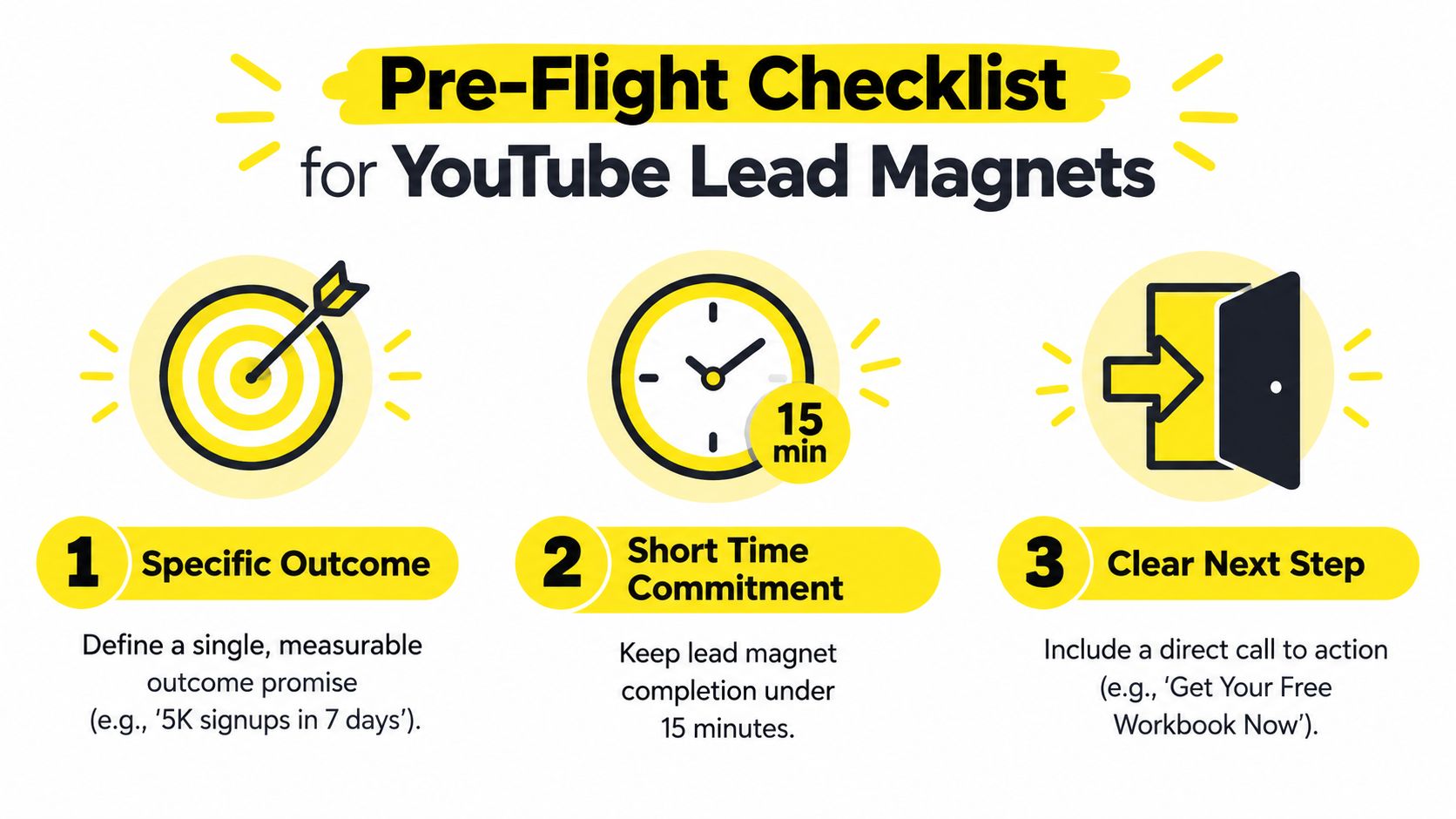
A YouTube lead magnet needs three characteristics:
A specific outcome: Promise one useful result, such as an audit, benchmark, calculator, planning document, or diagnostic.
A short time commitment: The prospect should understand what they'll receive and how quickly they can use it.
A clear next step: Connect the download or form submission to a booked call, demo, consultation, or qualified follow-up.
A generic newsletter and a vague whitepaper rarely create enough urgency for cold video traffic. A sector-specific benchmark report, ROI calculator, free account audit, or implementation checklist gives the viewer a concrete reason to act.
Match the page to the promise
Your landing page should feel like the next frame of the ad, not a different campaign. Echo the video's promise in the headline, repeat the key benefit near the form, and remove navigation that sends visitors into unrelated content.
Use one primary conversion path. A top-funnel guide can justify a shorter form, while a bottom-funnel consultation can support more qualification because the visitor has stronger intent. The right form length depends on perceived value and sales requirements, not a universal rule.
A practical landing-page structure includes:
Promise-led headline: Repeat the outcome from the ad.
Proof and explanation: Show what the prospect gets and why it matters.
Low-friction form: Request only information the sales process uses.
Expectation setting: Explain delivery time, contact method, and next steps.
Trust elements: Include privacy language, relevant credentials, and clear consent.
Sensitive categories need tighter message control. Finance, legal, and health advertisers should make sure claims in the video, form, and landing page use consistent language. Avoid implying guaranteed outcomes when the landing page only offers an assessment or consultation.
Before launch, test the page on mobile, confirm the form submits correctly, verify consent mode and analytics events, and inspect the thank-you flow. The CRM handoff should identify the campaign, ad, audience, and offer. Sales should know what the person requested before making contact.
Pre-launch rule: Don't judge a video campaign until you've confirmed that the promise, page, form, consent experience, and sales handoff all describe the same next step.
Choosing the Right YouTube Lead Gen Format
Format selection should follow the offer, not the creative asset you happen to have. A long-form explainer, a vertical hook, and a native lead form solve different problems inside the funnel.
Skippable in-stream
Skippable in-stream ads send the viewer to a landing page through a call to action. They work well for considered offers where the video needs to establish a problem, explain a mechanism, or qualify the prospect before the click.
The landing page carries much of the conversion responsibility. This format suits B2B consultations, professional services, complex software, and high-ticket offers where a prospect needs context. It also gives the advertiser more control over the form experience, qualification questions, tracking, and thank-you flow.
The trade-off is friction. The viewer must watch enough to understand the promise, click, load the page, and complete the form. A weak hook or slow mobile page can break the sequence.
Shorts ads
Shorts ads are vertical, fast-moving, and useful for inexpensive reach at the top of the funnel. They're better at creating an audience pool than closing a complex lead immediately. The strongest setup uses a concise problem statement, one visual idea, and a simple action that feeds a later retargeting sequence.
Shorts shouldn't carry the entire sales argument. Use them to earn attention, then show a more detailed in-stream or Demand Gen message to people who watched, visited, or engaged.
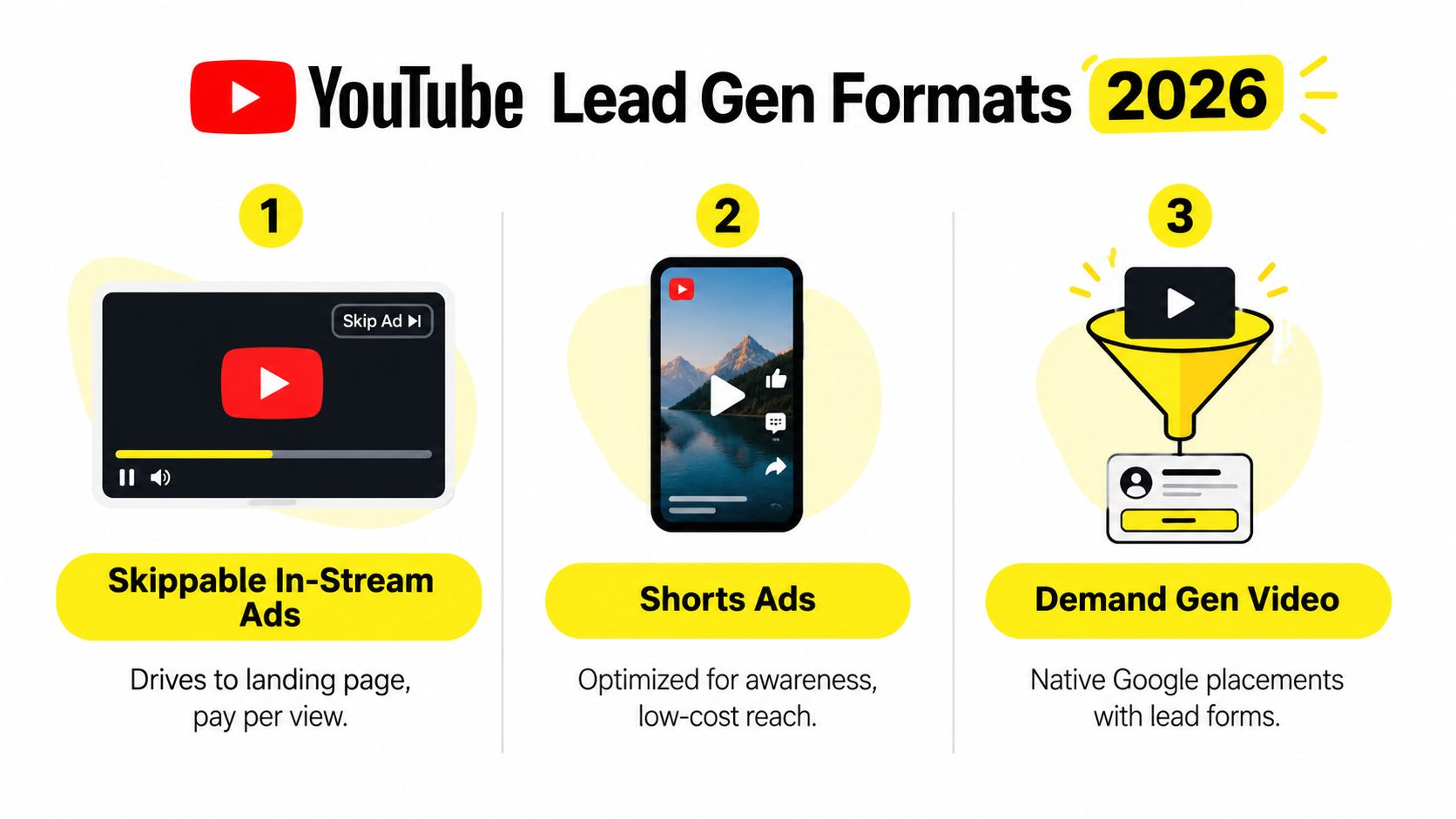
Demand Gen video with lead form
Demand Gen can use native Google lead forms, allowing a prospect to submit contact information without completing a separate landing-page journey. That reduced friction can improve form-fill volume, but it can also reduce commitment and increase qualification work for sales.
Use qualifying questions where they help separate curiosity from buying intent. Ask about service need, business type, timing, or budget only when the answers will change routing or follow-up. Don't turn a simple lead magnet into a lengthy application.
Format | Lead capture | Best use | Main trade-off |
|---|---|---|---|
Skippable in-stream | Landing-page form | Considered offers and explanation-led selling | More post-click friction |
Shorts | Usually a low-friction click or engaged audience action | Awareness and cold-audience building | Needs retargeting to convert |
Demand Gen video | Native lead form or website conversion | Multi-surface prospecting and direct capture | Lower friction can mean weaker qualification |
Run formats in parallel when they have distinct jobs. Shorts can build the warm audience, in-stream can explain the offer, and Demand Gen forms can capture prospects already showing stronger engagement. Keep the messages connected so the audience experiences a sequence rather than unrelated ads.
Building a Demand Gen Campaign Step by Step
Start inside Google Ads by selecting a lead or website-conversion objective. Don't choose awareness when the business needs qualified inquiries, because the campaign will optimize toward the wrong behavior.
Choose the conversion action that reflects the business outcome. If the campaign uses an on-site form, make the completed form the primary action. If it uses a Google lead form, connect that submission to the CRM and define a separate quality event for later optimization.
Campaign controls and assets
Demand Gen can reach multiple Google surfaces. If the offer only makes sense in video environments, review channel controls and decide whether Discover and Gmail belong in the initial test. Don't assume broader inventory is automatically better. A placement can generate cheap engagement while producing contacts that sales can't use.
Build audience signals from customer lists, competitor URLs, relevant search themes, and first-party converter data. Signals guide the system, but exclusions protect the campaign from spending on people who already converted, existing customers, or active sales opportunities.
Give the system a complete asset set:
Video variations: Include horizontal and vertical versions when the placement mix requires both.
Text assets: Prepare multiple headlines and descriptions with distinct hooks.
Brand assets: Upload the logo and confirm display treatments across placements.
Lead form details: State the offer, privacy information, qualification questions, and follow-up expectation.
Asset rotation matters because Demand Gen pairs creative components automatically. If every video says the same thing, automation has little meaningful variation to test. Build different angles around the same offer, such as cost reduction, speed, risk reduction, or a diagnostic insight.
After the build is complete, inspect previews on each eligible surface. Check cropping, captions, form language, button behavior, and the mobile experience before publishing.
Bidding and form decisions
Start with Maximize Conversions when the account lacks dependable conversion history. The campaign needs room to learn before you restrict delivery. A tCPA cap can make sense once the account has stable data, but an aggressive cap can starve a new campaign before it discovers viable users.
On-platform forms reduce clicks and simplify capture. On-site forms provide stronger control over qualification, page analytics, consent, content delivery, and CRM enrichment. Choose based on the quality of data sales needs, not just the number of submissions.
Targeting, Bidding, and Retargeting Sequences
A profitable YouTube funnel rarely relies on one audience. It uses different messages for people who have never heard of the brand, people who engaged with the content, and people who have already visited a high-intent page.
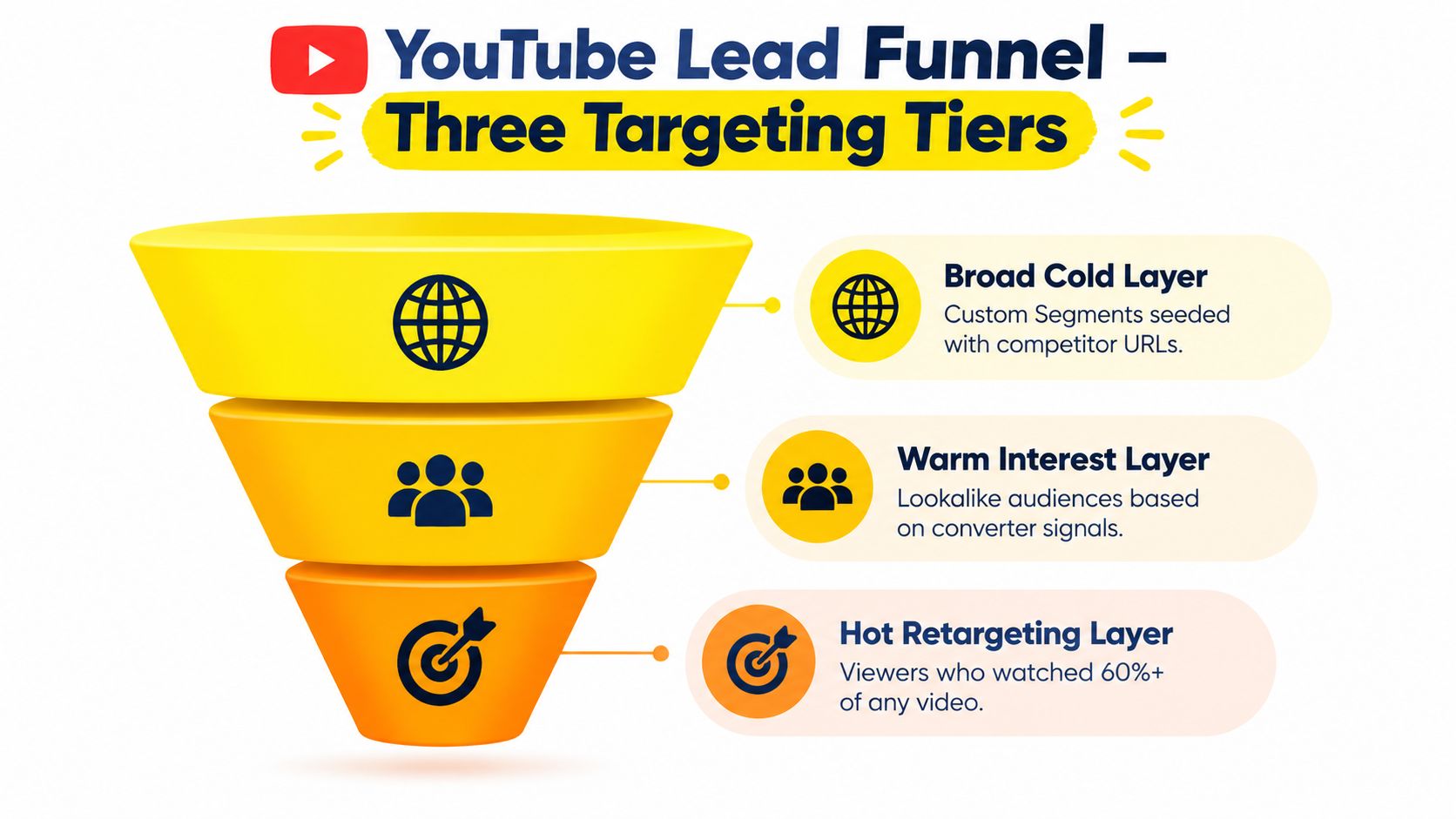
The three audience layers
The broad cold layer uses Custom Segments built from competitor URLs, relevant keywords, apps, or customer lists. Treat these as discovery inputs, not guaranteed intent. The objective is to find people with a plausible relationship to the problem while giving the algorithm enough room to explore.
The warm layer contains viewers who watched a meaningful portion of a video, engaged with a channel, or visited important pages. These prospects have earned a more direct message. Show proof, explain the offer, address objections, or invite them to use the lead magnet.
The hot layer includes pricing-page visitors, cart abandoners, recent form starters, and qualified lead lists. These people need a clear next action, not another broad introduction.
Audience signals aren't the same as hard targeting. Demand Gen automation can expand beyond a signal when it sees a conversion opportunity. Use exclusions to prevent that flexibility from working against the funnel. Remove existing customers, current sales-qualified opportunities, recent converters, and people who already completed the offer.
Bidding by intent depth
Maximize Conversions is the sensible learning-stage option. Move to tCPA after conversion volume and lead quality become stable. tROAS only makes sense when the account receives reliable lead values, such as qualified opportunities or closed revenue, rather than treating every form fill as equal.
A practical sequence looks like this:
Cold discovery ad group: Broad Custom Segments, educational creative, Maximize Conversions.
Engaged-view ad group: Video viewers and key-page visitors, proof-led creative, a stronger conversion request.
High-intent retargeting ad group: Pricing visitors, form starters, and qualified lead lists, direct offer and tighter bidding.
Keep frequency controlled for cold audiences so the same prospect doesn't see an introductory message repeatedly. Retargeting can support higher exposure because the audience has demonstrated interest, but fatigue still appears when the creative never changes.
The benchmark evidence supports measuring more than views. One 2026 summary reports professional-services prospecting at 0.6% discovery CTR and a 0.8% view-through lead rate, with retargeting at 1.5% CTR and a 3.2% lead rate (ROA Marketing's YouTube benchmarks). The direction matters more than treating those figures as a promise. Warm sequencing should improve the quality and efficiency of the next action.
Tracking Conversions and Routing Leads to Your CRM
YouTube often looks weak when the measurement system only credits the final click. A viewer can watch an explanation, return later through branded search, and submit a form without the original video receiving meaningful credit. Your tracking setup needs to preserve those interactions while separating engagement from actual pipeline progress.
Deploy Google Tag Manager across the site and define conversion events deliberately. An engaged-view conversion can fire after a qualifying interaction or when the viewer completes the relevant skippable experience, while the lead conversion should fire only after a successful form submission. Keep those events separate so Google Ads doesn't optimize for attention when the business needs inquiries.
GA4 should use consistent event names, including for the completed lead action. Mark the appropriate event as a key event, then import the conversion into Google Ads after validating that the event fires once and carries the correct campaign information.
Send quality signals back
The form submission is only the start of the commercial process. When a contact becomes an MQL, SQL, or closed customer, send that offline conversion back to Google Ads with the original click identifier where available. Google Ads API workflows, CRM integrations, and automation tools can pass those outcomes into bidding so the system learns from pipeline quality rather than raw form volume.
On the CRM side, capture hidden fields for campaign, source, medium, content, term, landing page, and form version. HubSpot and Salesforce can store these values alongside lifecycle-stage changes. Add a failed-delivery alert in Slack or your automation platform so a broken webhook doesn't discard leads.
UTM structure should be documented before launch. A practical reference on what my UTM experiment revealed can help teams standardize naming and avoid reports where the same campaign appears under multiple source labels.
Before calling Demand Gen optimized, verify:
Event integrity: Forms fire one conversion, not several.
Lead routing: Every submission reaches the right CRM owner.
Source retention: UTMs and click identifiers survive the handoff.
Lifecycle feedback: MQL, SQL, and revenue events return to Google Ads.
Quality reporting: Sales rejects and accepted leads are visible by campaign and audience.
View-through conversions are useful context, but they shouldn't excuse poor lead quality. The account needs both attribution signals and a clear definition of what sales considers worth pursuing.
Optimization Cadence and Benchmark Interpretation
A useful optimization cadence separates learning from diagnosis. Changing audiences, bids, landing pages, and creative at the same time leaves you with no explanation for the result.
Days 1 through 30
Launch with several creative variants per ad group, then hold the core audience and bid settings steady long enough to read behavior rather than noise. Review cost per lead, form completion quality, sales acceptance, and assisted conversion patterns. View-through rate can reveal whether the opening earns attention, but it isn't the success metric.
Your first month should answer basic questions:
Does the opening communicate the problem quickly?
Do engaged viewers move to the landing page or form?
Are submitted details usable by sales?
Does one creative angle attract better prospects?
Are mobile users encountering page or form friction?
Days 31 through 60
When CPL rises, diagnose before cutting the campaign. A falling hook rate with stable landing-page behavior points toward creative fatigue. Strong engagement with weak form completion points toward page or offer friction. Stable CPL with declining sales acceptance points toward targeting, qualification, or routing.
The gap between reach and quality is especially important because benchmark summaries warn that high conversion rates depend on tight alignment among the offer, targeting, and landing page, while broader ecommerce campaigns can perform far lower (Store Growers' YouTube benchmark guidance). Don't copy a benchmark into a forecast. Use it to ask which part of your funnel is misaligned.
Days 61 through 90
At the portfolio level, refresh fatigued creative, protect the strongest audience combinations, and tighten tCPA only after the campaign has enough trustworthy conversion history. Reintroduce proven Custom Segments into always-on Demand Gen, but keep exclusions current as the CRM changes.
There isn't a universal benchmark table that can responsibly predict your results without knowing offer, geography, sales process, and conversion definition. Use this operating table as a measurement framework rather than invented target data:
Vertical | Target CPL | View-Through Rate | Engaged-View Conv. Rate | Lead-to-Close |
|---|---|---|---|---|
B2B | Set from qualified pipeline economics | Compare by creative and audience | Compare by qualified lead event | Track by lifecycle stage |
SaaS | Set from trial, demo, or opportunity value | Compare by asset type | Compare by activation or demo quality | Track by opportunity outcome |
High-ticket services | Set from booked-call economics | Compare by message and frequency | Compare by attended-call quality | Track by attended call and sale |
If sales needs more human follow-up capacity after lead volume improves, a specialized option such as hire cold callers can be evaluated alongside CRM routing and qualification. The media campaign and the sales response should be optimized as one system.
Wojo Media helps brands connect YouTube and other paid channels to stronger offers, conversion-focused landing pages, creative production, and backend KPI tracking. If you want a practical Demand Gen plan built around qualified leads and pipeline feedback, visit Wojo Media to explore its paid advertising services and request a strategy conversation.
Comments