.png)
8 Best Practices for Retargeting Ads

A prospect visits a product page, checks the price, and leaves without buying. Over the next several days, they see the same generic banner on Instagram, YouTube, and unrelated websites. The brand has achieved visibility, but it hasn't created a more useful reason to return.
That distinction defines the best practices for retargeting ads. Retargeting isn't a license to repeat one message until someone gives in. It's a coordinated system of decisions about intent, timing, creative, offers, channel mix, landing-page continuity, and measurement. Historical benchmark summaries report average retargeting click-through rates around 0.7%, compared with about 0.05% for standard display ads, while conversion rates have been reported as roughly 70% higher than first-time visitors, with results varying significantly by audience and offer (retargeting benchmark data). The lesson isn't to maximize impressions. It's to make every impression relevant enough to move a qualified prospect forward.
The eight practices below organize retargeting around that progression. They cover audience segmentation, dynamic creative, frequency control, exclusions, sequential messaging, landing pages, cross-platform coordination, and offer testing. For inspiration, compare these examples of high-impact retargeting ads, then build a system that fits your own buying journey.
1. Segment Audiences by Purchase Intent and Funnel Stage
A homepage visitor and a cart abandoner have shown interest, but they haven't shown the same interest. Treating them as one audience forces one message to do incompatible jobs. A visitor who glanced at a service page may need proof and education, while someone who reached checkout may need reassurance about price, delivery, or risk.
Start with behavior-based pools rather than broad “all visitors” audiences. Useful groups include cart abandoners, product viewers, pricing-page visitors, lead-form starters, webinar attendees, and recent purchasers. For a local service business, someone who submitted an inquiry but didn't book deserves a different sequence from someone who only read a blog post. For a coaching program, a webinar attendee may be ready for an enrollment invitation, while a visitor to the webinar registration page may still need a reason to attend.
Practical rule: Segment by the strongest action a person completed, then by how recently they completed it.
Match the message to readiness
High-intent audiences can receive direct calls to action, product-specific reminders, consultation prompts, or truthful urgency. Mid-intent audiences often need reviews, demonstrations, comparisons, and answers to objections. Low-intent audiences are better served by educational content, category guidance, and social proof.
Use platform-native audience tools such as Meta Custom Audiences, Google Ads audiences, and TikTok Custom Audiences, while naming events consistently across platforms. UTM parameters and custom events should identify both the page viewed and the action taken, so a pricing-page visitor isn't accidentally grouped with someone who only saw an article.
The historical performance advantage of retargeting supports this discipline, but it doesn't make every retargeted user equally valuable. One benchmark summary reports behavioral retargeting at approximately 0.68% CTR and dynamic product retargeting at approximately 0.62%, with both above contextual display in that report (behavioral and dynamic retargeting benchmarks). Build lookalike audiences from the highest-converting segment only after the segment itself is clean and properly tracked.

2. Implement Dynamic Creative Optimization with Multiple Ad Variations
Retargeting creative should reflect what a person already considered, not announce that the brand exists. Dynamic creative optimization, or DCO, helps assemble different combinations of images, videos, headlines, descriptions, and calls to action for defined audience pools. That gives the campaign more ways to find a relevant message without requiring a separate manually managed campaign for every variation.
An e-commerce brand might pair a product image with a review-led headline for a product viewer, then use a lifestyle image and a reassurance-led headline for someone who abandoned checkout. A med spa could show treatment education to an early browser and a provider introduction or before-and-after creative to a prior inquiry. A real estate advertiser might show the specific property a person viewed, while an early-stage visitor sees neighborhood or market education.
The system only works when the inputs are deliberate. Create variations around clear messaging pillars rather than uploading random assets and hoping the algorithm finds a winner.
Product relevance: Show the item, service, or category the person engaged with whenever the data supports it.
Benefit framing: Pair product-focused creative with outcome-focused alternatives, such as convenience, confidence, savings, or risk reduction.
Objection handling: Test proof, guarantees, delivery information, financing explanations, or consultation details against purely promotional copy.
Format diversity: Use static images, short videos, carousels, and platform-native placements where they suit the audience.
Brand consistency: Keep every variation within approved visual, legal, and offer guidelines.
Let testing answer a business question
Don't ask only which image receives the most clicks. Ask which creative combination produces qualified actions from the right segment. A testimonial may attract fewer casual clicks than a discount image while producing better leads or higher-quality purchases. Review performance regularly, pause combinations that spend without meaningful progression, and refresh creative before repetition becomes the only reason a person recognizes the ad.
Creative fatigue is an operational problem, not just a design problem. If an audience has already seen a message repeatedly, changing the headline while preserving the same visual may not create a new experience. Build a rotation plan around distinct angles, not cosmetic edits.
3. Deploy Strategic Frequency Caps to Prevent Ad Fatigue
Frequency is where retargeting campaigns often lose control. A small, high-value audience can respond well at first, then disengage as the platform repeats the same ads. Raising delivery extends reach inside the audience without adding intent, so the extra impressions mostly repeat the same message.
Benchmark guidance commonly starts around 3 to 5 impressions per user per week for retargeting, with other recommendations ranging from 5 to 7 or 5 to 12, depending on the platform, audience size, and campaign purpose (frequency guidance for display campaigns). Treat these ranges as working settings, then adjust them against cost, engagement quality, and conversion behavior.
Set caps by audience temperature. Cart abandoners may justify concentrated exposure soon after abandonment, especially when the landing page and offer address the exact step they left behind. Older page visitors usually need lighter delivery. Small audiences require extra care because even a modest daily cap can create rapid repetition.
A useful cap protects the audience from your campaign, not just the campaign from overspending.
Watch for the fatigue pattern
The pattern is usually clear: early impressions generate clicks or conversions, then engagement weakens while costs rise. Another benchmark summary reports that conversion rates often peak after roughly 5 to 7 impressions, while engagement can decline after more than 10 retargeting impressions per month (retargeting frequency performance data). Review reach, frequency, cost per result, conversion rate, and creative-level performance together. A low click-through rate alone cannot show whether the audience has exhausted the message or the offer has lost relevance.
Change the message across exposure stages. Early creative can demonstrate the product, later creative can address a concern, and a subsequent version can present a truthful offer. Refresh assets on a planned schedule, commonly every 2 to 3 weeks in benchmark guidance, and shorten the audience window when older visitors stop responding. Connect these caps with platform and landing-page performance, then judge success by qualified conversions and incremental business value. A controlled campaign can spend less while remaining useful.
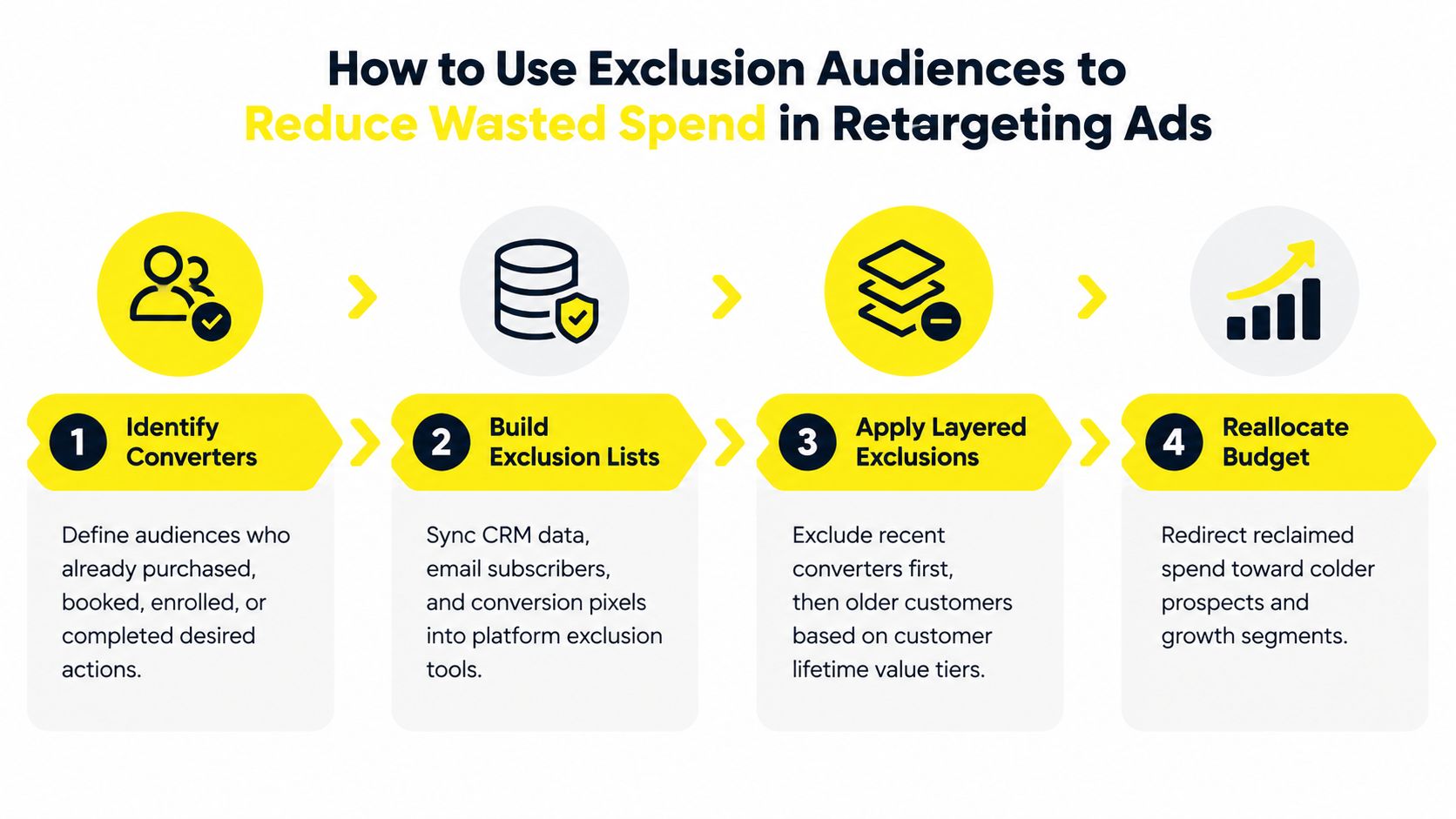
4. Use Exclusion Audiences to Reduce Wasted Spend
Retargeting should stop when the prospect completes the action the campaign was designed to generate. A customer who has purchased shouldn't continue receiving a first-purchase reminder. Someone who booked a consultation shouldn't keep seeing an ad asking them to book one. These impressions can create confusion and consume budget without adding incremental value.
Build exclusions around every important conversion event, including purchases, bookings, consultations, enrollments, form submissions, and qualified sales outcomes. For e-commerce, a recent purchaser may be removed from an acquisition retargeting campaign and placed into a separate cross-sell or retention program. For a med spa, booked clients can leave the inquiry campaign and enter appointment preparation or follow-up messaging. For a coaching business, enrolled students should exit the enrollment sequence immediately.
Build an exclusion hierarchy
The first exclusion should usually be the most recent or most relevant converter. Then decide whether older converters belong in retention, upsell, or reactivation campaigns rather than prospecting. The right duration depends on the customer relationship and product cycle. A high-consideration service may require a longer separation from acquisition messages than a frequently purchased product.
Connect platform audiences to CRM outcomes where possible. Browser events alone may miss offline bookings, sales calls, or manually confirmed enrollments. A weekly CRM sync is better than allowing a completed customer action to remain invisible to advertising systems.
Check exclusions as carefully as inclusions. If a supposedly small conversion audience suddenly removes a large share of visitors, investigate duplicate events, broken thank-you pages, or incorrect audience rules. The purpose isn't to suppress valuable customers permanently. It's to ensure each person receives the message appropriate to their current relationship with the brand.
5. Implement Sequential Messaging and Progressive Offer Escalation
One retargeting ad rarely needs to carry the entire sales argument. A prospect can first receive useful product information, then proof, then objection handling, and finally a direct offer. That sequence feels more like a guided decision than a repeated interruption.
For an e-commerce campaign, early creative might show product use and customer reviews. Later creative can address fit, shipping, returns, or a specific reason the shopper hesitated. A local service business might move from treatment education to provider credibility, then to consultation availability. A coaching program could begin with a useful resource, progress to a webinar or training session, and then explain enrollment, support, and payment options.
Don't escalate the discount because the calendar advances. Escalate the value of the information first. A stronger guarantee, clearer proof, a payment plan, or a bonus service may resolve the objection without cutting price.
Design the sequence around events
Use recency windows and custom events to advance people when they engage, not only when a fixed number of days passes. Someone who watches a demonstration or visits a pricing page has earned a more direct message than someone who ignores every ad. Likewise, a person who reaches the final offer without converting may need a pause or a new angle instead of more urgency.
A practical sequence can contain these stages:
Education: Explain the product, service, process, or problem.
Consideration: Add reviews, demonstrations, comparisons, and proof.
Decision: Present the relevant product, consultation, enrollment, or checkout action.
Objection handling: Address price, risk, timing, implementation, or trust concerns.
Re-engagement: Pause, change the angle, or invite a lower-commitment action.
Use UTM parameters for each stage so reporting can show which sequence contributes to qualified outcomes. A final offer may receive the conversion credit, but earlier messages may have created the confidence that made the conversion possible.
6. Optimize Landing Page Experience for Retargeting Traffic
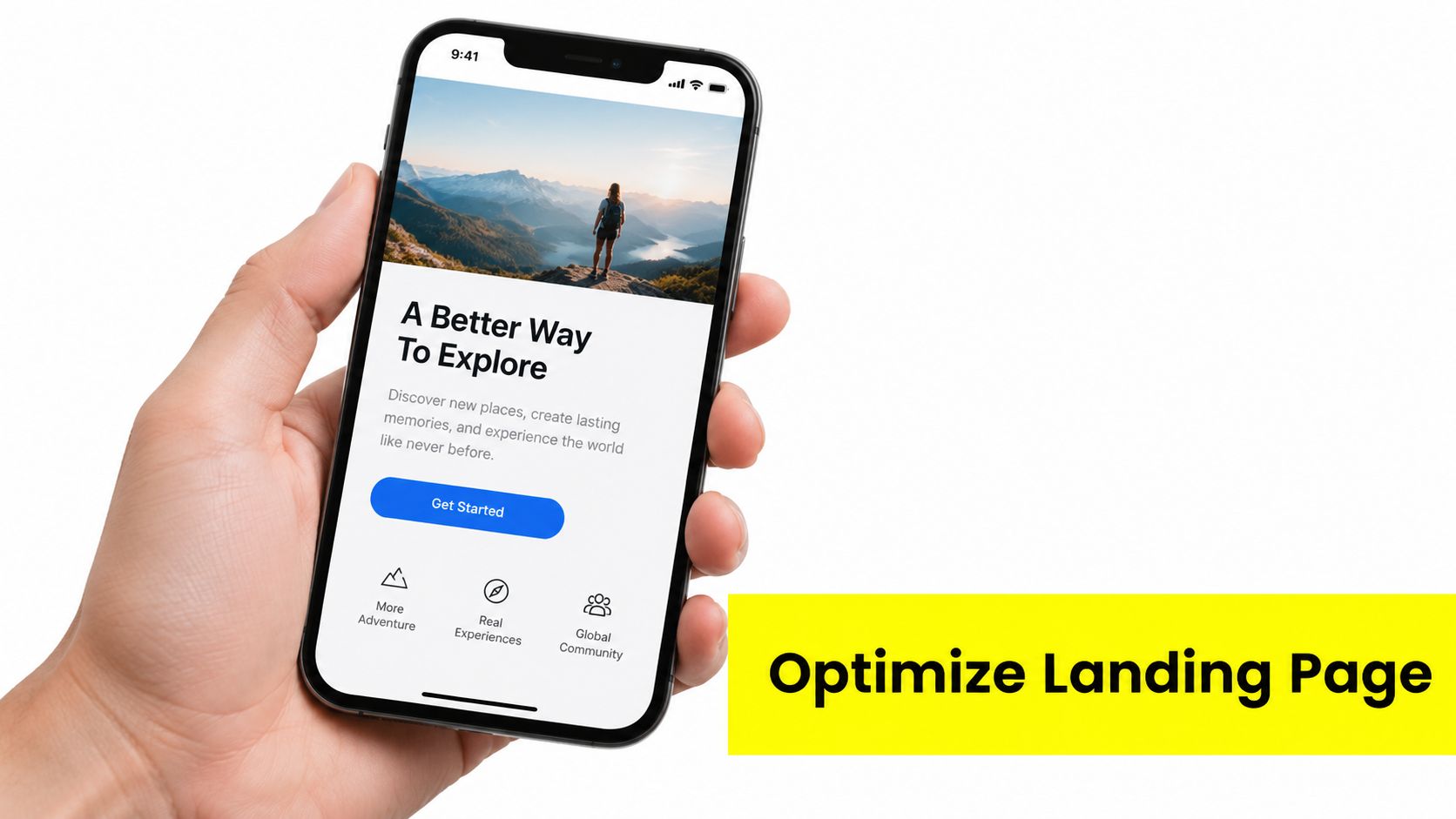
A retargeted visitor arrives with context. Sending that person to the same long introductory page used for cold traffic can force them to repeat research they've already completed. The landing page should continue the conversation started by the ad.
A product viewer who clicks a review-led ad may need to see relevant reviews immediately, followed by the product details and a clear purchase action. Someone returning to a med spa page may be ready for appointment availability, provider credentials, and treatment results rather than another full explanation of the service menu. A real estate prospect who viewed a property can be directed to property-specific details and a short inquiry form.
Create page variants based on intent, but don't over-personalize beyond what your data can support. A cold page can carry more education. A warm retargeting page can prioritize proof and comparison. A hot page can focus on the offer, reassurance, and a frictionless next step.
Message match: Repeat the product, service, or benefit promised in the ad.
Form simplicity: Ask for the information needed to take the next action, then collect secondary details later.
Relevant proof: Use testimonials or examples connected to the advertised offer.
Truthful urgency: Show availability, deadlines, or inventory limits only when they're real.
Mobile usability: Make the page easy to scan, tap, and complete on a phone.
The page should load quickly and preserve the visual language of the ad. If a visitor clicks a carousel featuring several products, show those products or the selected item rather than dropping them onto a generic category page. If the ad leads with a testimonial, place proof close to the top of the destination.
A mobile experience that works well matters because retargeting often reconnects with people while they're moving between apps and browsers.
Landing-page testing should evaluate more than button clicks. Compare completed purchases, qualified form submissions, booked appointments, and downstream sales quality. A higher click-through rate can be a distraction if the page attracts curiosity without producing profitable action.
7. Coordinate Cross-Platform Retargeting for Omnipresent Visibility
Cross-platform execution coordinates one narrative across different environments. Prospects may compare products through Google, watch a YouTube review, browse Instagram, read a publisher article, and return through branded search. A single-channel plan leaves gaps and makes overall exposure harder to control.
Coordination does not mean duplicating one ad everywhere. An e-commerce brand might use Meta for product carousels, Instagram Stories for customer content, Google Search for branded and product-specific intent, YouTube for demonstrations, and TikTok for creator-style product usage. A local service business may depend more on Google Search and Maps, while Facebook and Instagram reinforce trust and availability.
Give each platform a job
Match creative to channel behavior. Vertical short-form video suits TikTok and mobile placements. YouTube can support demonstrations or educational explanations. Google Search captures active demand through text and landing-page relevance. Meta placements can provide visual proof, product browsing, and controlled repeat exposure.
Define audiences consistently through native tools or customer-data systems such as Segment or Tealium. Use shared UTM conventions so platform reports can be compared with analytics and CRM outcomes. Without that structure, several platforms may claim the same conversion, leaving the business uncertain about the customer's actual path.
Wojo Media's full-funnel approach fits this coordination model by connecting audience intent, channel roles, creative, and landing-page actions rather than treating each platform as an isolated campaign.
Privacy changes and signal loss make this setup more important. Recent privacy-aware retargeting guidance emphasizes first-party data, CRM joins, server-side signals, and multi-signal setups instead of relying on one cookie trail, while mature B2B programs increasingly reach buying committees across platforms. Build consent-aware audience collection, connect known leads where permitted, and treat platform audiences as components of a broader system, not complete customer records. Evaluate the system through qualified leads, purchases, and incremental business outcomes, rather than surface-level platform metrics alone.
8. Test and Optimize Offer Structures to Maximize Conversion Rates
The offer determines what the prospect is being asked to risk. A discount can help a price-sensitive shopper, but it can also reduce margin when the customer would have purchased at the regular price. A payment plan may suit a high-value service better than a lower price. A guarantee, consultation, bonus, bundle, or free-shipping offer can remove a different objection altogether.
Test offers by segment. Cart abandoners may need a reminder of product value or reassurance about returns. A high-consideration coaching prospect may respond better to a payment option or a clear guarantee than to a discount. A local service lead may need immediate appointment availability and transparent pricing before any incentive becomes persuasive.
Start with one variable at a time. Compare discount type, bonus value, guarantee language, payment structure, or bundle composition before combining several changes. Include a regular-pricing control where practical, because not every retargeted conversion requires a special offer.
Measure profit, not just response
Offer framing can change perception without changing the underlying economics. “Save $50” communicates differently from “25% off,” but the business still needs to know which version produces better customers. Track:
Conversion rate: Did the audience complete the intended action?
Cost per acquisition: What did the incremental customer or lead cost?
Average order value: Did the offer increase or reduce transaction size?
Customer quality: Did leads book, close, renew, or purchase again?
Lifetime value: Did the offer attract durable value or one-time discount seekers?
Incremental revenue: Did the campaign create additional outcomes beyond what would have happened anyway?
Use truthful deadlines and scarcity only when they reflect real business conditions. A fake countdown may create a short-term action while damaging trust. The strongest offer is often the one that resolves the buyer's specific hesitation without eroding the economics of the sale.
8-Point Retargeting Best Practices Comparison
Strategy | 🔄 Implementation complexity | ⚡ Resource requirements | 📊 Expected outcomes | 💡 Ideal use cases | ⭐ Key advantages |
|---|---|---|---|---|---|
Segment Audiences by Purchase Intent and Funnel Stage, tailor messaging by intent | 🔄 Medium–High: needs pixel events, audience logic, ongoing updates | ⚡ Moderate: analytics, CRM sync, multiple creatives per segment | 📊 Higher conversion rate and better ROI; improved attribution | 💡 E‑commerce cart abandoners, service leads, webinar attendees | ⭐ More relevant ads, reduced ad fatigue, efficient budget allocation |
Dynamic Creative Optimization (DCO), algorithmic creative testing | 🔄 Medium: set up asset permutations and DCO settings | ⚡ High: multiple high‑quality images/videos, headlines, platform support | 📊 Faster learning; often 15–40% CTR/conv lift when volumes sufficient | 💡 High‑traffic e‑commerce, brands with many creatives/UGC | ⭐ Scales creative testing, reduces manual A/B work |
Strategic Frequency Caps, control impressions to avoid burnout | 🔄 Low–Medium: configure caps per audience and monitor | ⚡ Low: creative rotation & platform settings; audience size matters | 📊 Improved CTR/CPA; better user experience when sized correctly | 💡 Small warm audiences, cart abandoners, recurring prospects | ⭐ Lowers wasted impressions, protects brand perception |
Exclusion Audiences, remove converted/known users from retargeting | 🔄 Low–Medium: requires CRM sync and accurate conversion tracking | ⚡ Low: conversion pixels, list syncing, regular maintenance | 📊 Higher ROAS by removing non‑incremental spend; clearer incrementality | 💡 Any retargeting where repeat exposure wastes budget (e‑comm, services) | ⭐ Saves budget, reduces irrelevant ads, clarifies true impact |
Sequential Messaging & Progressive Offer Escalation, time‑based nurture sequences | 🔄 High: multi‑stage flows, auto‑advancement rules, timing tests | ⚡ High: multiple creatives, tracking, campaign orchestration | 📊 Large lift vs static retargeting (often 30–100%); smoother funnel progression | 💡 High‑consideration sales: coaching, high‑ticket services, real estate | ⭐ Moves users through funnel logically; maximizes conversions & LTV |
Optimize Landing Page Experience for Retargeting Traffic, message matching | 🔄 Medium: build multiple LP versions and dynamic content | ⚡ Moderate: landing pages, personalization, faster UX testing | 📊 2–3x higher conversions vs cold pages; lower bounce | 💡 Warm traffic, cart abandoners, returning visitors | ⭐ Improves relevance, reduces friction, increases conversion velocity |
Cross‑Platform Retargeting, omnipresent visibility across channels | 🔄 High: audience sync, attribution, platform coordination | ⚡ High: platform‑specific creative, budget across channels, analytics | 📊 Larger reach and recall; documented lift vs single‑platform strategies | 💡 Brands targeting diverse demos; scale e‑commerce and awareness + intent | ⭐ Broader reach, captures platform‑specific intent, reduces single‑channel risk |
Test & Optimize Offer Structures, discounts, guarantees, payment plans | 🔄 Medium: structured tests and significance analysis | ⚡ Moderate–High: offer fulfillment, margin tracking, traffic for tests | 📊 Often 20–50% conversion lift; informs pricing & LTV tradeoffs | 💡 Price‑sensitive segments, high‑AOV products, subscription offers | ⭐ Identifies highest‑converting, highest‑LTV offers; reduces friction to buy |
Turn Retargeting Into a Measurable Growth Loop
The eight practices work best as an operating rhythm, not as isolated campaign settings. Begin with an audience audit. Confirm that product viewers, cart abandoners, inquiry leads, purchasers, and other behavioral groups are receiving the correct event, recency window, message, and exclusion rule. A broken conversion event can keep customers in prospect campaigns, while an overly broad audience can dilute the intent signal that makes retargeting valuable.
Review frequency and creative fatigue on a regular schedule. Look for rising costs, falling engagement, repeated ad exposure, and weak performance from older creative. Historical guidance supports moderate exposure and shorter recency windows for many direct-response campaigns, but the right threshold still depends on audience size, buying cycle, offer strength, and platform behavior (retargeting frequency and recency guidance). Don't increase delivery merely because the platform can find more impressions. Ask whether the additional exposure creates qualified progression.
Then inspect the sequence. Did education lead into consideration? Did proof address the objections implied by the audience's behavior? Did the final offer create profitable action, or did it claim conversions that were already likely? Compare audience segments separately, because an offer that works for cart abandoners may be unnecessary for recent product viewers.
Landing-page continuity deserves its own review. Match the ad promise to the page headline, proof, form, and next step. Reconcile cross-platform results through UTMs, analytics, CRM outcomes, and consented first-party data. Platform metrics such as clicks and attributed conversions are useful diagnostics, but they aren't the final business answer.
Judge the program using qualified leads, purchases, cost per acquisition, average order value, lifetime value, and incremental revenue. Incrementality matters because retargeting reaches people who already expressed interest. A conversion attributed to an ad isn't automatically a conversion created by that ad.
Wojo Media's full-funnel approach reflects this connected model through four operating pillars, offers, landing pages, omnipresent ads, and data. Its stated services include coordinated retargeting across social platforms, creative production for ads and retargeting, conversion-focused landing pages, and backend KPI tracking. Whether you manage campaigns internally or work with an agency, the principle remains the same: connect the decisions so the audience, message, destination, and measurement reinforce one another.
Choose one audience segment for the next optimization cycle. Build one clear sequence for that segment, then improve one measurement layer, such as CRM outcome syncing, exclusion accuracy, or incrementality testing. That focused loop will teach you more than launching another broad campaign with another generic reminder.
Wojo Media helps brands coordinate retargeting across Facebook, Instagram, TikTok, Google, and YouTube, while refining offers, landing pages, creative, and backend measurement. Visit Wojo Media to explore a connected paid advertising approach and discuss a retargeting strategy for your business.
Comments