.png)
Retargeting Website Visitors That Converts More Traffic

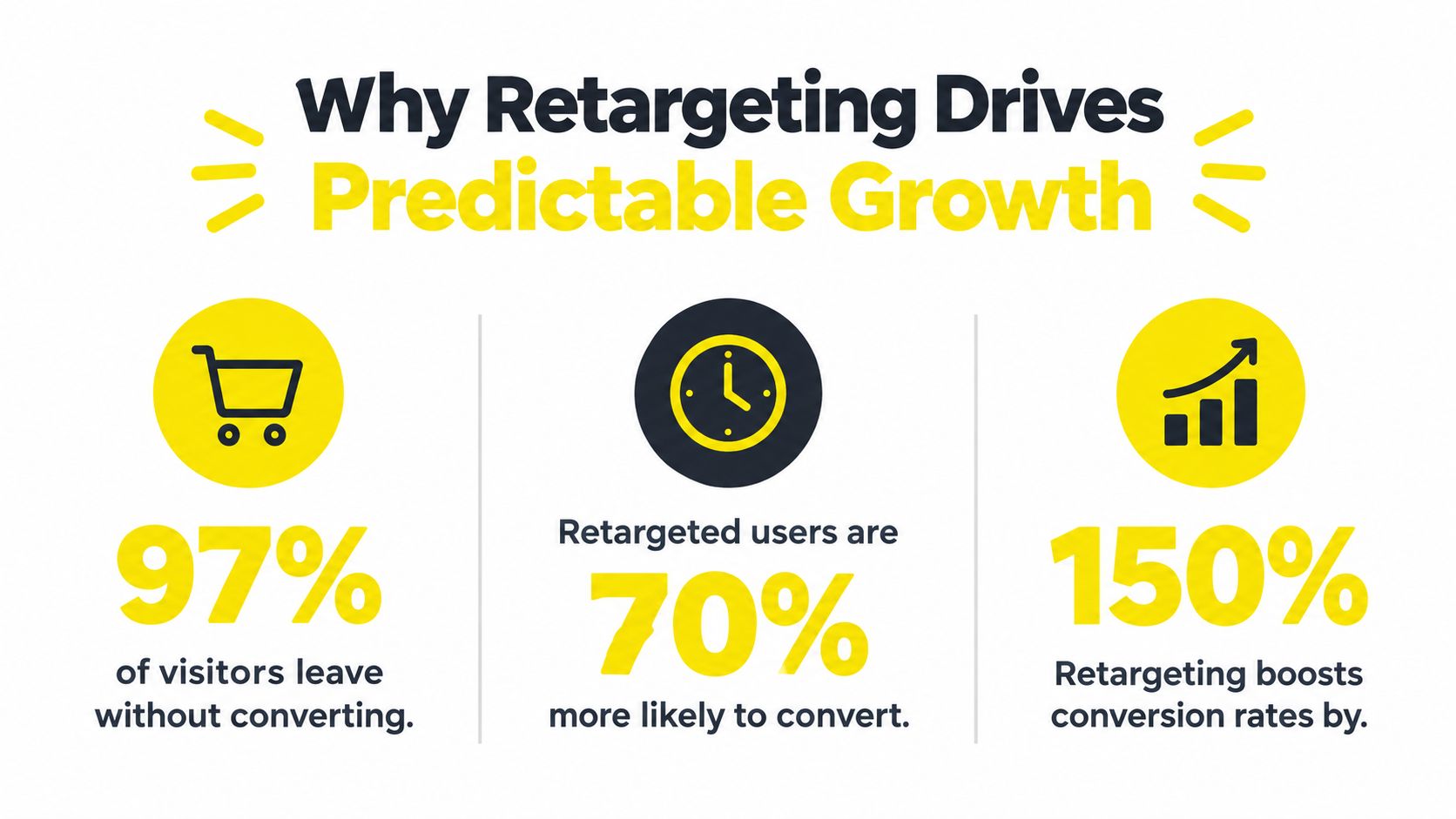
Only about 2% of website visitors convert on their first visit, which leaves roughly 98% of traffic without a purchase or lead action. Invesp's retargeting analysis explains why retargeting website visitors became a standard performance tactic: the largest opportunity often isn't finding more people, it's bringing interested people back at the right moment.
The mistake is treating every visitor as equally valuable. A pricing-page viewer, a blog reader, and someone who started checkout need different messages, different landing pages, and different impression pressure. A recency-weighted sequence turns follow-up advertising into a controlled system instead of an always-on blast.
Why Retargeting Website Visitors Drives Predictable Growth
Paid traffic rarely converts in one touch. Visitors compare offers, read reviews, switch devices, get interrupted, or need more confidence before sharing payment details. Retargeting closes that gap by bringing qualified visitors back after they have shown interest.
The performance case is measurable. Retargeted visitors were 70% more likely to convert than non-retargeted visitors, and site retargeting represented 87.9% of retargeting activity in one industry survey, according to Invesp reports. Those figures support a practical allocation rule: prioritize people who already reached your site before paying to reach entirely new users.
Visitor behavior should determine both budget and message. A person who viewed a service page has a stronger commercial signal than someone who left the homepage immediately. Someone who initiated checkout has supplied a stronger signal still. Recency weighting turns those differences into buying decisions: front-load spend on fresh, high-intent visitors, then taper exposure as the visit ages.
The economics depend on what happens after the click
Retargeting cannot fix a weak offer or confusing landing page. It can reinforce a relevant offer, address hesitation, and give a qualified visitor a clearer route back to purchase. If the ad promises a guarantee but the landing page hides it, the campaign pays to recreate the same friction.
For ecommerce, a sequence might move from viewed product to reviews or comparison content, then to a cart reminder. A med spa can move from treatment education to proof and a booking offer. A coach can move from webinar content to an application page with clearer qualification. Each sequence should match the visitor's last meaningful action rather than repeat one generic ad across every platform.
Cart abandonment needs separate handling because the visitor has already selected a product. The Come Together Media LLC cart guide provides practical recovery guidance for the post-cart portion of the funnel.
Recency creates the advantage
Recent visitors are easier to reconnect with because the original need is still active. An experimental study summarized by SQ Magazine found that enabling retargeting increased the share of users returning to a website within four weeks by 14.6%, with 33% of the first week's effect occurring on day one.
Use that pattern to structure spend. Apply the strongest pressure immediately after a high-intent visit, sequence proof or objection handling next, and reduce exposure as the visitor becomes less recent. Omnipresent sequencing works when each channel reinforces the next message, not when every platform blasts the same audience with the same creative. The goal is timely relevance, not indefinite follow-up.
Tracking Foundations That Make Retargeting Work in 2026
Retargeting audience quality starts with event quality. If the platform can't distinguish a product view from a completed purchase, it can't sequence messages properly or suppress people who've already converted. You'll end up paying to promote the same offer to customers who should be receiving a confirmation, upsell, or retention message.
Install and verify the core events
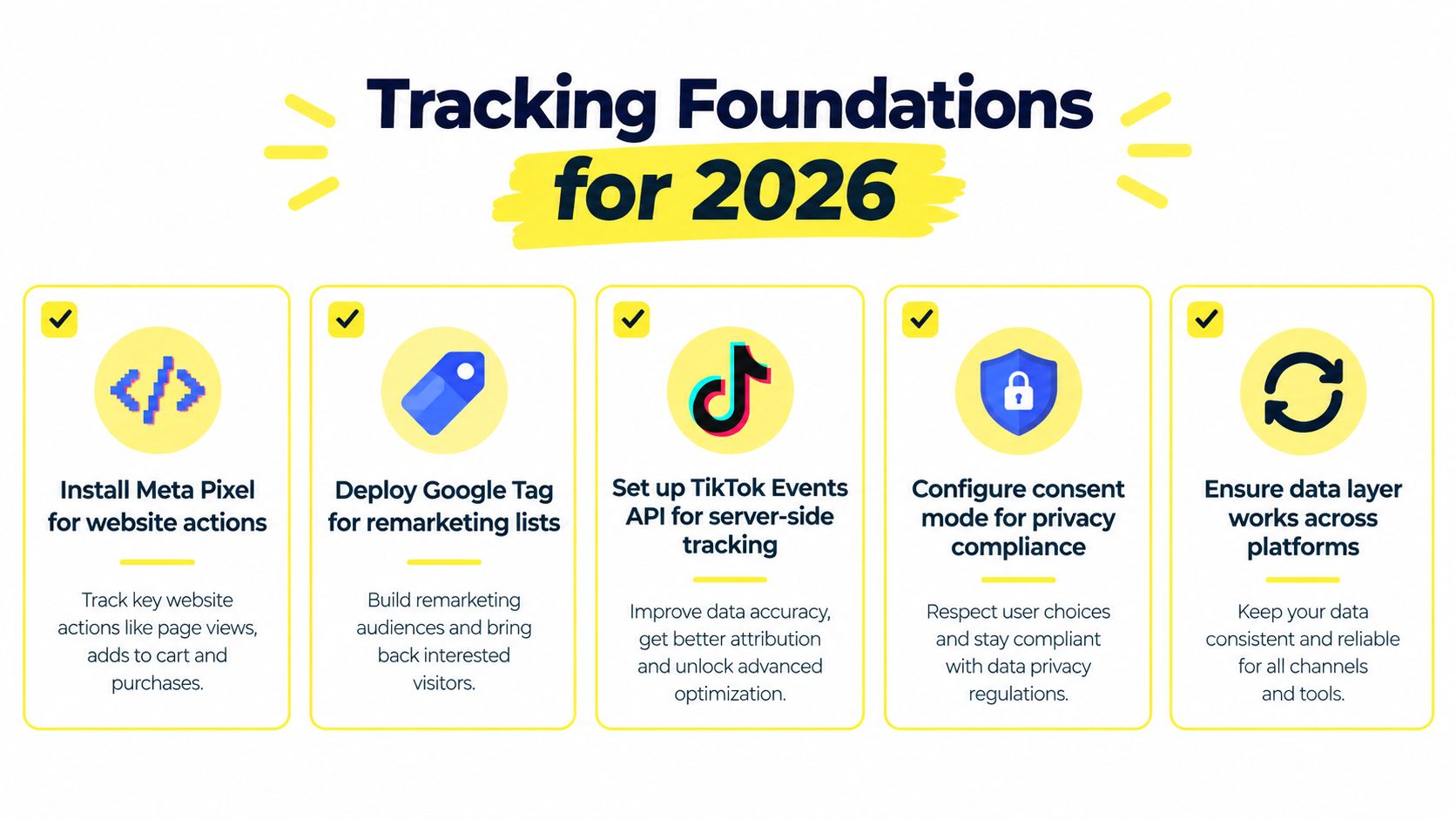
On Meta, install the Meta Pixel and configure browser events for meaningful actions such as page views, product views, lead submissions, add-to-cart events, checkout starts, and purchases. On Google, use the Google Tag with Google Ads and Google Analytics so audiences and conversions share a consistent measurement layer. TikTok needs properly mapped events as well, particularly when the platform is part of the acquisition mix.
Don't stop after installation. Open the site in a test browser, complete each important journey, and confirm that the expected event fires once. Check the event name, value, currency, URL, and event parameters. A purchase event that fires on a thank-you page refresh can distort both optimization and audience suppression.
Server-side tracking matters because browser-only signals can be interrupted by consent choices, browser restrictions, ad blockers, and unstable page scripts. Meta Conversions API and TikTok Events API can send selected events from your server or commerce platform, but they must complement browser events rather than duplicate them blindly.
Practical rule: Every conversion event needs a reliable event ID or equivalent deduplication method so browser and server signals count as one action.
Make privacy part of the data layer
Retargeting is based on prior website behavior, so consent and opt-out enforcement aren't side paperwork. LeadEnforce's privacy-safe retargeting guidance emphasizes first-party data, server-side event tracking, consent logs, and event deduplication as practical requirements for privacy-conscious campaigns.
Use a consent management platform that records the visitor's choice and controls marketing tags accordingly. Configure Google Consent Mode where applicable, document which platforms receive which events, and make suppression logic respect withdrawal requests. Your CRM, ecommerce platform, and ad accounts should agree on the status of a person before a campaign uses that person for follow-up.
A clean foundation should pass this audit:
Event accuracy: Each key action fires with the correct parameters.
Deduplication: Browser and server events aren't counted twice.
Consent handling: Tags and server events follow the visitor's permissions.
Suppression readiness: Purchasers, booked leads, and opted-out users can be excluded.
Platform consistency: Meta, TikTok, Google Ads, and YouTube receive comparable audience signals.
First-party customer lists become especially valuable when pixel pools are incomplete. Upload only permitted contacts, keep identifiers current, and use those lists for customer exclusion, existing-customer messaging, or high-intent follow-up where consent supports it.
How to Segment Visitors by Intent and Recency
“All website visitors” is an audience definition, not a strategy. It combines casual researchers, active buyers, existing customers, employees, accidental clicks, and people who may never have understood the offer. When one audience receives one message everywhere, the campaign loses relevance and the budget follows low-intent traffic.
Start with the visitor's strongest observable action. URL rules, event parameters, product IDs, CRM status, and purchase history can create useful pools without requiring elaborate modeling.
Build intent tiers
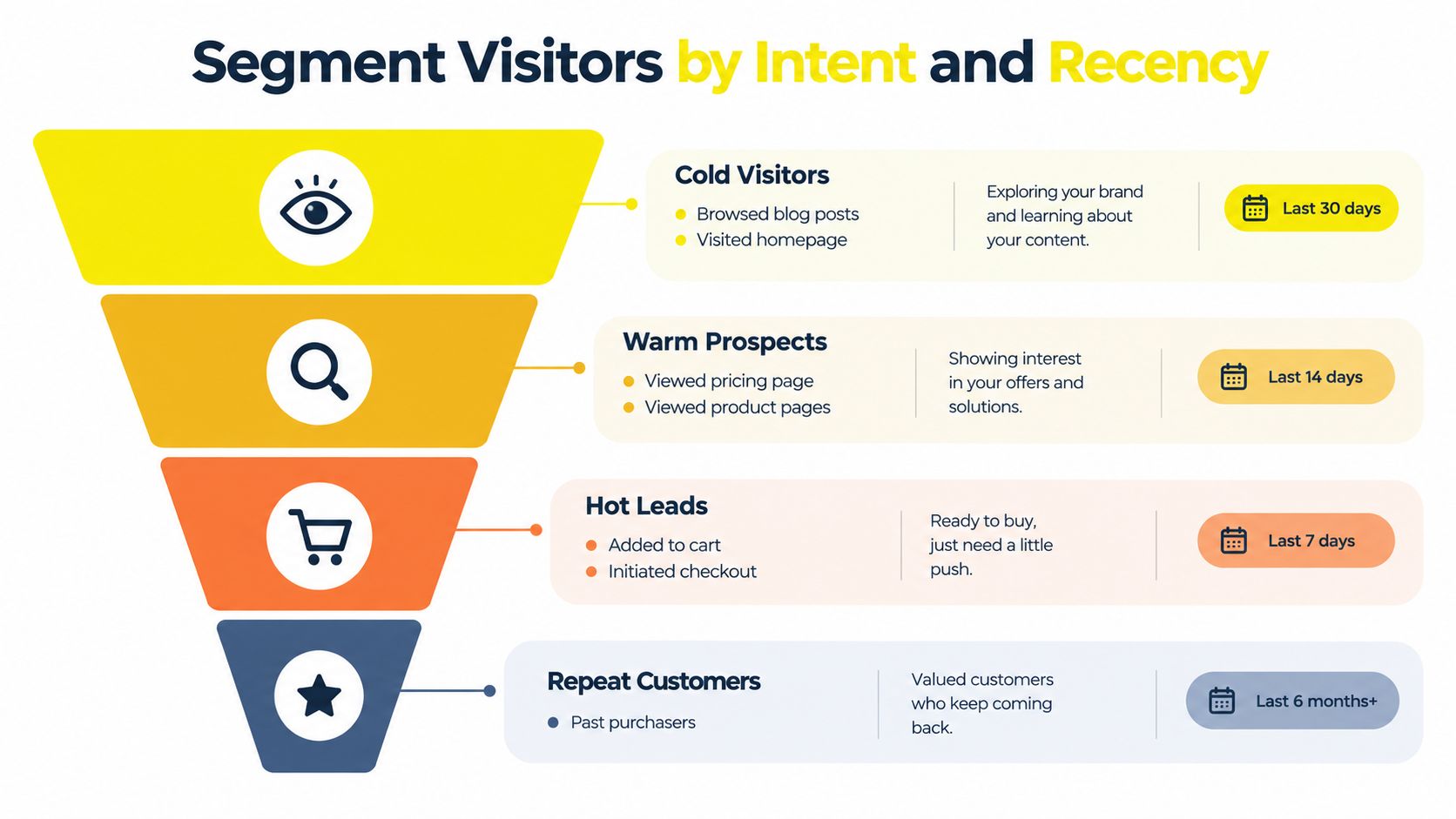
Content readers and homepage visitors belong in a lighter nurture pool. They may need education, category explanations, social proof, or a useful lead magnet before they see a hard offer. Sending them directly to checkout usually wastes the information you have about their stage.
Product and pricing-page viewers have shown clearer commercial intent. Send them to the relevant product or service page, not a generic homepage. For a software company, pricing-page viewers might receive comparison content or implementation proof. For a local service, service-page viewers might see reviews, availability, and a low-friction booking path.
Cart abandoners and checkout starters deserve the most immediate treatment. Use the exact product, service, or application context when possible. The message should remove the reason for hesitation, such as uncertainty about delivery, fit, guarantees, financing, or the next step. Don't keep showing discovery content to someone who was already entering payment information.
Purchasers and converted leads should usually be suppressed from acquisition retargeting. Their next message may be onboarding, replenishment, referral, cross-sell, or appointment preparation. Treating them as unconverted visitors creates poor customer experiences and consumes budget.
For broader planning principles, this guide to segmentation for better conversion rates provides useful context on why behavioral differences should shape messaging rather than sit inside one blended list.
Apply recency windows to every tier
Recency is the second dimension. A recent checkout starter should receive a faster sequence than an older blog reader. The precise windows depend on the buying cycle, but the structure should always move from high-intent urgency toward lower-frequency nurture.
A practical sequence looks like this:
Fresh visitors: Use the strongest relevant reminder, proof, or offer while the original intent remains active.
Recent visitors: Shift from direct reminder to objections, comparisons, testimonials, or education.
Older visitors: Reduce pressure and use broader nurture or seasonal messaging.
Converted visitors: Remove them from acquisition campaigns and move them into the appropriate customer track.
Match the landing page to the segment. A cart abandoner should return to cart or product context. A pricing visitor should return to pricing with the unanswered objection addressed. A content reader may need a focused guide or email capture rather than a sales-heavy destination.
Building Retargeting Audiences Across Facebook Instagram TikTok Google and YouTube
The audience strategy becomes useful only after it exists inside each platform. Build the pools with naming conventions that expose both intent and recency. A label such as tells the buyer what the audience contains and what exclusion it expects. A label such as doesn't.

Meta for Facebook and Instagram
In Meta Ads Manager, open Audiences, choose Create Audience, and select Custom Audience. Build website audiences from the Meta Pixel, then use URL rules or event rules to separate product viewers, pricing visitors, checkout starters, and purchasers.
Create the exclusion before launch. For a purchase campaign, exclude the purchase event or a customer list that reflects completed transactions. For lead generation, exclude submitted leads from the prospecting retargeting ad set. Use the same audience logic across Facebook and Instagram placements unless placement-level results show a meaningful reason to separate them.
Dynamic product ads can work well for ecommerce when the product catalog, event parameters, and product IDs match. If the catalog is inaccurate, the platform may show the wrong item or unavailable inventory, which turns personalization into friction.
TikTok
In TikTok Ads Manager, use Assets and then Audiences to create website custom audiences from TikTok Pixel activity. Map page views, content views, lead events, add-to-cart actions, and purchases so the audience builder can distinguish browsing from buying.
TikTok creative needs a native feel. A polished brand commercial may underperform against a direct demonstration, creator-style explanation, or problem-first hook. Keep the audience definition tight, then let the creative carry the context. Use TikTok Events API where server-side event delivery is appropriate, and verify that browser and server activity deduplicates correctly.
Google Ads and YouTube
Google Ads supports website visitor audiences through the Google tag and remarketing data. Build lists for relevant page visitors, users who completed valuable actions, and users who should be excluded. Apply those lists to display, demand-focused campaigns, or search campaigns where past visitors can receive personalized treatment.
For YouTube, link the relevant YouTube channel to Google Ads and create viewer-based audiences from interactions such as video views or channel engagement. A viewer who watched an educational video may need a different message from someone who visited a pricing page. Use YouTube to extend the sequence, not to repeat the same banner message in a different format.
The platform build should produce a coordinated system:
Meta: Website and event-based Custom Audiences across Facebook and Instagram.
TikTok: Pixel and server-supported event audiences with native creative.
Google Ads: Website lists for display and search customization.
YouTube: Viewer and engagement audiences connected through Google Ads.
Shared exclusions: Purchasers, submitted leads, booked appointments, and opt-outs.
A campaign can be present across every channel and still feel inconsistent. Keep the offer, proof, and next step aligned while adapting the format to each placement.
Before scaling, preview every audience, check estimated eligibility, confirm the exclusions populate, and test the destination URL on mobile. An audience that technically exists but can't deliver, or sends traffic to a broken page, isn't ready for spend.
Creative Sequencing Frequency Caps and Bidding That Lower CPA
Omnipresence doesn't mean showing the same ad everywhere until the visitor gives in. It means coordinating the next useful message across the channels where the person is eligible to see it. The sequence should become more specific as intent rises and less intrusive as the visit gets older.
Fresh product viewers can receive social proof, creator demonstrations, product benefits, and a clear return path. Cart abandoners need fewer explanations and more reassurance. A lead who visited a consultation page may respond to process clarity, proof of outcomes, and a direct booking action. Existing customers should be removed from the acquisition sequence and placed into a retention track.
Match creative to the stage
Use creative rotation by audience stage, not random rotation. A prospect who has only read educational content shouldn't see a hard discount before understanding the value. A checkout starter shouldn't receive a generic brand video that forces them to restart the decision process.
Retargeting benchmark summaries report average display CTR around 0.7%, roughly 10 times the cited standard display CTR of about 0.07%, while more recent summaries place retargeting CTR in the 0.9% to 1.2% range for 2025 to 2026. These figures appear in Shno's benchmark summary, but they're reference points, not promises. Your audience size, offer, placement mix, consent rate, and creative quality determine the result.
Use a simple stage-based rotation:
Audience stage | Creative emphasis | Landing-page destination |
|---|---|---|
Recent content reader | Education, proof, problem awareness | Relevant guide or focused offer page |
Product or pricing viewer | Benefits, comparison, objection handling | Product or pricing page |
Cart abandoner | Reassurance, guarantee, completion reminder | Cart or checkout context |
Converted customer | Onboarding, cross-sell, replenishment | Customer-specific destination |
Control exposure before it controls spend
Frequency caps should reflect intent. A recent checkout starter can justify more immediate contact than an older content reader, but neither should remain in an uncapped campaign indefinitely. Suppress converters quickly, rotate fatigued ads, and watch for declining click quality rather than chasing impressions.
Searchlab's 2026 retargeting benchmarks report median retargeting conversion rates around 3.8% and CPA reductions of 40% to 70% versus prospecting in a separate benchmark source. The same summary warns that overexposure can flatten incremental lift when campaigns lack exclusions, caps, or creative refreshes.
Bidding should follow the value of the audience. Use conversion optimization when the account has dependable conversion signals. For smaller pools, avoid forcing aggressive automation before the event data is trustworthy. Front-load budget toward fresh, high-intent segments, then taper older pools rather than increasing spend just to maintain reach.
Teams that need faster creative iteration can use ad creatives with Hooked as one production option, but automation doesn't replace stage-specific strategy. Every variation still needs a clear audience, claim, proof point, and destination.
Measuring Scaling and Troubleshooting Your Retargeting Engine
CTR tells you whether the ad earns attention. It doesn't tell you whether retargeting creates profitable demand. Track the full path from audience eligibility to landing-page behavior, conversion rate, CPA, ROAS, revenue quality, and the difference between retargeted outcomes and what would have happened without the ads.
Attribution can over-credit retargeting because these visitors were already interested. That's why incremental lift matters. Holdout tests, platform experiments, audience exclusions, and controlled budget changes can help you judge whether the campaign is creating additional conversions or merely collecting credit for conversions already likely to happen.
Diagnose the failure by layer
If impressions are low, inspect consent rates, audience eligibility, event delivery, audience size, and exclusions. If impressions are high but clicks decline, inspect frequency, placement quality, creative fatigue, and whether the message still matches the visitor's stage.
If clicks are healthy but conversions are weak, stop changing bids first. Check the landing page, mobile experience, offer clarity, checkout friction, page speed, and whether the ad sends the visitor to the correct product or service context.
Use this troubleshooting order:
Tracking: Confirm events, parameters, deduplication, and consent behavior.
Audience: Check recency, intent rules, overlap, and converter suppression.
Creative: Compare hooks, proof, format, and message fatigue.
Landing page: Verify continuity between ad promise and page experience.
Economics: Review CPA, ROAS, margin, lead quality, and downstream outcomes.
Incrementality: Test whether retargeting adds conversions beyond existing demand.
Scale only what remains profitable
Scaling doesn't mean opening every audience window or raising every bid. Expand from the freshest high-intent pool into broader nurture only when the conversion signal, landing page, and offer remain stable. If performance deteriorates after expansion, return to the last profitable segment and identify whether the problem came from audience dilution, frequency, creative fatigue, or tracking loss.
Wojo Media's operating model combines offer development, conversion-focused landing pages, omnipresent advertising across major platforms, and backend data review. For brands that want an external team to coordinate those pieces, Wojo Media offers performance advertising support built around retargeting website visitors, creative production, and full-funnel optimization. Book a strategy conversation to review your tracking, segment structure, and recency-weighted campaign plan before adding more budget.
Comments