.png)
Real Estate Investor Ads That Actually Convert

Most advice about real estate investor ads starts with the wrong question: “Should I use Google or Meta?” That debate is convenient, but it doesn't fix the reason campaigns lose money. A search click and a social click can both become expensive failures when the offer is vague, the landing page is generic, qualification is missing, or the sales team responds too slowly.
The useful question is different: Can your acquisition system turn attention into qualified conversations and profitable deals? A 2026 benchmark puts median Google Ads performance for real estate investors at a 3.84% click-through rate, $8.84 cost per click, 4.4% conversion rate, and $148 cost per acquisition, while Meta Ads recorded a 1.14% click-through rate and 2.4x ROAS in the same benchmark. The numbers show that both channels can matter, but neither platform can rescue a weak funnel. (Real estate investor advertising benchmarks)
Why Most Real Estate Investor Ads Miss the Point
The "best platform" question hides the actual problem. Google captures existing intent, while Meta creates and shapes attention. One may produce stronger immediate intent, while the other builds repeated exposure. Neither channel turns attention into a deal by itself. Your offer, landing page, qualification process, and follow-up decide whether the opportunity becomes revenue.
A channel-mix benchmark recommends a broader acquisition model, with 40% to 50% digital, 20% to 30% outbound, 15% to 20% referral and repeat business, and 10% to 15% other tactics. It also places Google Ads in a range of $8 to $60 per click and $80 to $300 per lead in competitive markets. (Multi-channel investor lead generation guidance) Treat those figures as planning references, not a template. A single-channel strategy leaves your pipeline exposed to auction costs, shifting demand, and audience fatigue.
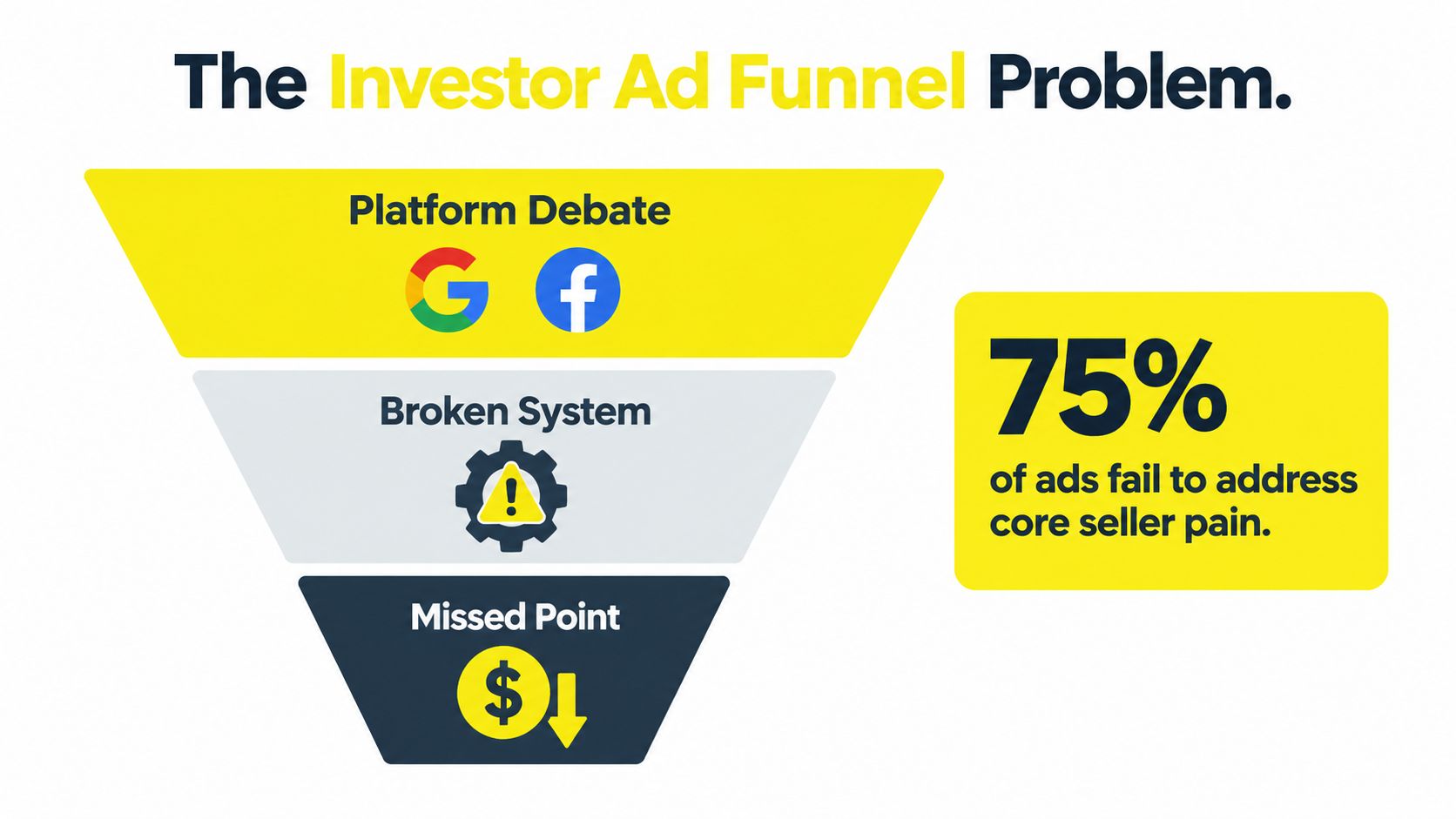
The funnel matters more than the placement
A seller who clicks a search ad and abandons a slow page is no more valuable than a seller who submits a low-intent Meta form. Both consume budget and create follow-up work. The difference appears only when you measure what happens after the initial lead.
Practical rule: Judge every channel by the cost of a qualified opportunity and the cost of an acquired deal, not by the cheapest form submission.
A low raw CPL can conceal poor qualification. Benchmark summaries indicate that only 20% to 40% of paid social or search leads may qualify, which can multiply actual acquisition cost by roughly 2.5x to 5x after filtering. (Investor lead qualification and CPL benchmarks) A higher-priced lead with a clear situation, realistic timeline, and reachable owner can outperform a cheap form completed by someone who never intended to sell.
The advantage comes from system design. Tighten the promise, ask better questions, route leads quickly, and judge channels by blended acquisition economics. Platform selection matters, but it follows the work of identifying and converting deal-ready sellers.
Building the Investor Ad Foundation Before You Spend
Ads amplify decisions. If the offer, the audience, and the financial guardrails are unclear, they amplify waste. Define all three before buying an impression. Your campaign needs a specific seller action, a clear reason that seller fits your business, and a cost limit tied to qualified opportunities.
Start with a concrete seller promise
“We buy houses” describes your company, not the seller's payoff. State the situation you solve and the tradeoff you offer. That could mean an as-is sale, no showings, a clear closing process, or a cash offer shaped around a specific property problem. Keep every claim truthful and compliant, then make the next step obvious.
Write separate offers for inherited property, tired landlords, foreclosure pressure, code violations, and owners living out of state. “Sell inherited property as-is in [County]” gives the visitor a reason to continue. A generic headline makes the seller decide whether your company can help, which is work your ad should have done already.
Segment by situation, not broad demographics
Group Google campaigns around problem-aware searches. Searches about selling a house fast for cash, selling an inherited property, avoiding foreclosure, or selling a rental from another state should not all share one message and destination. Send each intent group to a page that repeats its motivation instead of forcing every seller into one universal form.
Meta requires a different setup. Use creative and audience signals that reflect the same situations, then let the ad filter responses before the form appears. A video about inherited property should lead to a page written for inherited-property owners, not landlords. Message consistency improves the conversation and gives your sales team better context.
Build the qualification path before launch. Decide which answers identify a deal-ready lead, who receives the notification, and how quickly the first response happens. A channel is useful only when it produces leads your team can reach, assess, and advance.
Use benchmarks as guardrails, not promises
Investor marketing varies sharply by market and intent. A 2025 report placed the median annual marketing budget at $12,000, with investors ranging from under $1,000 to more than $100,000 per year. The same report recorded average Google Ads CPC of $25.20 in 2024. (Investor lead-generation and budget data)
A separate 2026 benchmark reports median investor search performance at $8.84 CPC and $148 CPA, plus a 4.0% landing-page conversion rate. (Investor advertising performance benchmark) Those figures do not conflict. They show why market, keyword intent, competition, offer strength, and tracking must shape your forecast.
Channel | Raw CPL | Qualified CPL | Notes |
|---|---|---|---|
Google Ads | Varies by market and intent | Calculate from qualification data | Search captures active demand, but competitive investor terms can be costly |
Meta Ads | Varies by audience and creative | Calculate after filtering | Meta can create demand and support multi-channel acquisition |
Retargeting | Varies by audience size and frequency | Measure through assisted conversions | Retargeting reinforces prior interest rather than replacing qualification |
Set a maximum acceptable cost per qualified opportunity before launch. Track spend through qualification, appointments, offers, and acquired deals. Raw CPL is only the entry price. If the team cannot define what makes a lead valuable, increasing budget only increases uncertainty.
Writing Ad Copy and Creative That Gets Responses
Investor creative fails when it talks about the investor instead of the seller. “We're a trusted local home-buying company” may be accurate, but it doesn't name the problem that caused someone to stop scrolling or search for help.
Lead with the situation. Then explain the path forward.
Make the first message specific
Google responsive search ads should combine problem-aware headlines with a concrete next step. “Sell inherited house as-is in [County]” is more useful than “Get a Home Offer.” “Avoid foreclosure and discuss your options” creates a clearer context than “We Buy Houses Fast.” Don't promise a guaranteed price or closing outcome unless you can substantiate it and deliver it.
Use sitelinks to separate legitimate paths, such as a cash offer, rental takeover, or seller-financing information. This reduces ambiguity and gives visitors a way to self-select based on their actual situation.
Meta has less time to earn attention. A plain-text card, a short operator video, a property-condition image, or a seller voicemail recreation can interrupt the scroll more effectively than polished lifestyle imagery. The creative should identify the exact scenario in the opening seconds, then show what happens next.

Build variations around motivations
Don't produce ten versions that all say “sell fast.” Create distinct hooks:
Inherited property: Explain how the owner can discuss an unwanted house without preparing it for showings.
Tired landlord: Focus on tenant problems, deferred maintenance, and the desire to exit a rental.
Foreclosure pressure: Present a prompt conversation about available options without implying a guaranteed rescue.
Severe condition: Explain the as-is process and what information the investor needs to assess the property.
Voice-over user-generated content can feel more credible than stock images because the operator appears to understand the situation. For practical guidance on building visual variations and structured ad assets, review this Bulk Image Generation ad guide.
Give every ad one direct action, such as “Request a cash offer” or “Tell us about the property.” “Learn more” is often too vague for a direct-response campaign. Refresh the concept when the audience has seen it too often, but don't change the headline, image, audience, and offer simultaneously. You need to know what caused performance to move.
Landing Pages and Qualification That Protect Your Budget
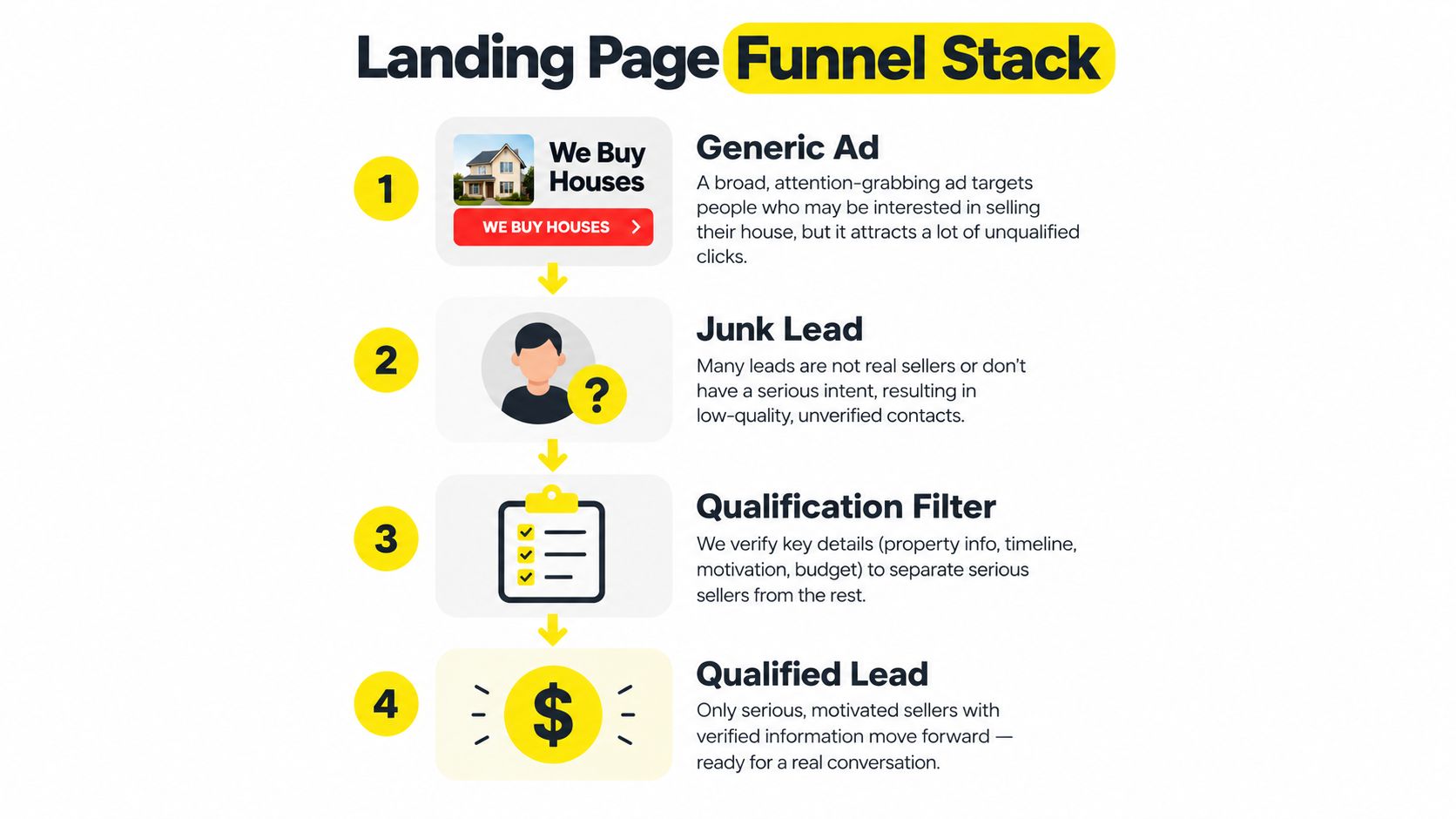
A landing page should answer three questions immediately: Is this for my situation, can I trust the buyer, and what happens after I submit? Generic “we buy houses” pages usually answer none of them with enough precision. They make the seller search for relevance, which creates friction after you've already paid for the click.
Put one conversion goal above the fold. Match the headline to the ad motivation, explain the as-is or cash process plainly, and show a short path to contact. Mobile speed matters because a seller who waits for a page to load can leave before reading the offer.
Put qualification inside the conversion path
The form shouldn't collect only a name and phone number. Ask questions that help distinguish a potential deal from an unworkable inquiry:
Property situation: Is the home inherited, tenant-occupied, vacant, in foreclosure, or owner-occupied?
Ownership status: Can the person authorize a sale or connect you with the decision-maker?
Property condition: What repairs or issues affect the property?
Timeline: Does the seller want to explore options now, later, or only gather information?
Contact permission: Has the person clearly consented to the communications your team plans to send?
A short pre-qualification form or IVR step can protect sales capacity, but it shouldn't become an interrogation. Ask only what changes routing, underwriting, or follow-up. The objective isn't to reject every imperfect lead. It's to separate urgent opportunities from educational inquiries and assign each to the right response.
Trust signals should support the decision without overwhelming the page. Consider proof of funds where appropriate, local closing photos, clear company identification, and authentic testimonials that comply with applicable advertising rules. A seller needs confidence that a real person will explain the process, not another anonymous lead buyer.
A dedicated page for each major motivation usually beats one shared homepage because the message, questions, and proof can align. Dynamic keyword or situation text can help maintain that alignment, but review every variation manually. Automation that inserts an inaccurate location or unsupported claim creates a compliance problem faster than it creates conversion value.
For investor teams using property walkthroughs or visual explanations, an AI video tour landing page can provide ideas for presenting property information in a more engaging format.
Tracking the Numbers That Actually Matter
Raw CPL is a diagnostic, not a business result. A lead has value only after the team confirms the owner qualifies, answers follow-up, books a conversation, signs a contract, and produces an acceptable return. Optimize for acquired deals, not cheap form fills.
Track the journey as a connected metric stack:
Lead-to-qualified-lead rate shows how much submitted volume survives your buying criteria.
Qualified-lead-to-appointment rate reveals whether follow-up and the handoff are working.
Appointment-to-contract ratio tests the sales conversation, offer, and seller fit.
True cost per acquired deal divides total channel and production costs by closed acquisitions.
The benchmark data cited earlier reinforces the need for post-click measurement. Its landing-page, search, and social figures show why a page can become the bottleneck even when media buying appears healthy. A campaign may report an acceptable CPL while the page, qualification process, or sales response destroys the economics.
Metric | What It Tells You | Why It Misleads |
|---|---|---|
Impressions | Whether ads are entering auctions | Visibility does not show intent or profitability |
Click-through rate | Whether the message earns attention | A click can still come from the wrong audience |
Raw CPL | What the platform charges for an initial lead | It ignores qualification and sales outcomes |
Qualified-lead rate | Whether inquiries match your buying criteria | A high rate can still hide weak follow-up |
Appointment rate | Whether qualified sellers engage with the team | Scheduling friction can distort the result |
Cost per acquired deal | Whether the acquisition system supports profit | It takes longer to measure and requires clean data |
Build tracking around actual outcomes
Send form submissions into GA4 through a reliable thank-you event. Use consistent UTM naming across Google, Meta, retargeting, and outbound campaigns, then add call tracking with dynamic number insertion so inbound calls remain tied to their sources. The sales team must record disposition, qualification, appointment, and contract status in the CRM.
Import offline conversion events into Google Ads and Meta when the account setup supports it. A closed acquisition carries more decision value than a form fill, so feeding platforms better outcome signals can improve optimization over time. Keep consent records and privacy disclosures aligned with the communications you use.
Last-click attribution deserves skepticism. Search often receives the final click, while Meta, YouTube, direct mail, or referrals may have created earlier awareness. Compare platform reports with blended acquisition cost and geographic tests. Do not let one attribution window decide every budget move.
Review the numbers by motivation, geography, creative, and source. A low CPL from broad seller messaging may produce fewer qualified opportunities than a higher CPL from a specific problem, such as inherited property or a time-sensitive sale. The winning campaign is the one that produces enough deal-ready leads at an acceptable acquired-deal cost.
Test one meaningful variable at a time. Compare hooks, offers, landing pages, or qualification questions separately. Geographic split tests by zip-code clusters can show whether the problem is creative or market fit, but do not move budget after a handful of conversions. Wait for consistent evidence, then adjust the channel mix and follow-up process together.
Scaling Investor Ads Across Multiple Channels
A motivated seller doesn't behave like a clean attribution report. They may search Google, see a Facebook ad later, watch a YouTube explanation, and finally call after receiving a direct-mail piece. A single-channel campaign can't create that sequence reliably, and it often reaches a volume ceiling once the same audience has seen the same message repeatedly.
Google should capture active demand. Meta should create familiarity and test seller situations through creative. Retargeting across Display, Meta, and YouTube should bring back visitors who showed interest but didn't complete the next step. Outbound, referrals, and direct mail then add touchpoints that paid media alone can't provide.
The right allocation depends on the market and the investor's capacity. The channel-mix guidance cited earlier recommends a majority digital presence supported by outbound, referral, repeat, and other tactics. Treat that as a planning reference, not a rigid formula.
Scale in sequence
Prove the system before expanding it. First, confirm that the offer generates relevant inquiries and that the team can contact them consistently. Next, expand the winning motivation into adjacent geographic areas. Then adapt the same hook for another format rather than increasing spend against a fatigued audience.
Useful expansion moves include:
Search expansion: Add tightly related keyword groups only after the original intent cluster produces qualified conversations.
Creative expansion: Turn a strong static concept into a short video, carousel, operator-led explanation, or property-condition sequence.
Audience expansion: Build retargeting pools from page visitors and engaged viewers, then test broader prospecting without removing qualification language.
Operational expansion: Increase territory only when underwriting, callbacks, and appointment capacity can keep pace.
Don't confuse more leads with successful scaling. A larger budget can lower relevance, increase low-intent volume, and overwhelm the team. Protect the qualification rate and cost per acquired deal while you expand. If those metrics deteriorate, return to the last stable combination of offer, audience, creative, and page.
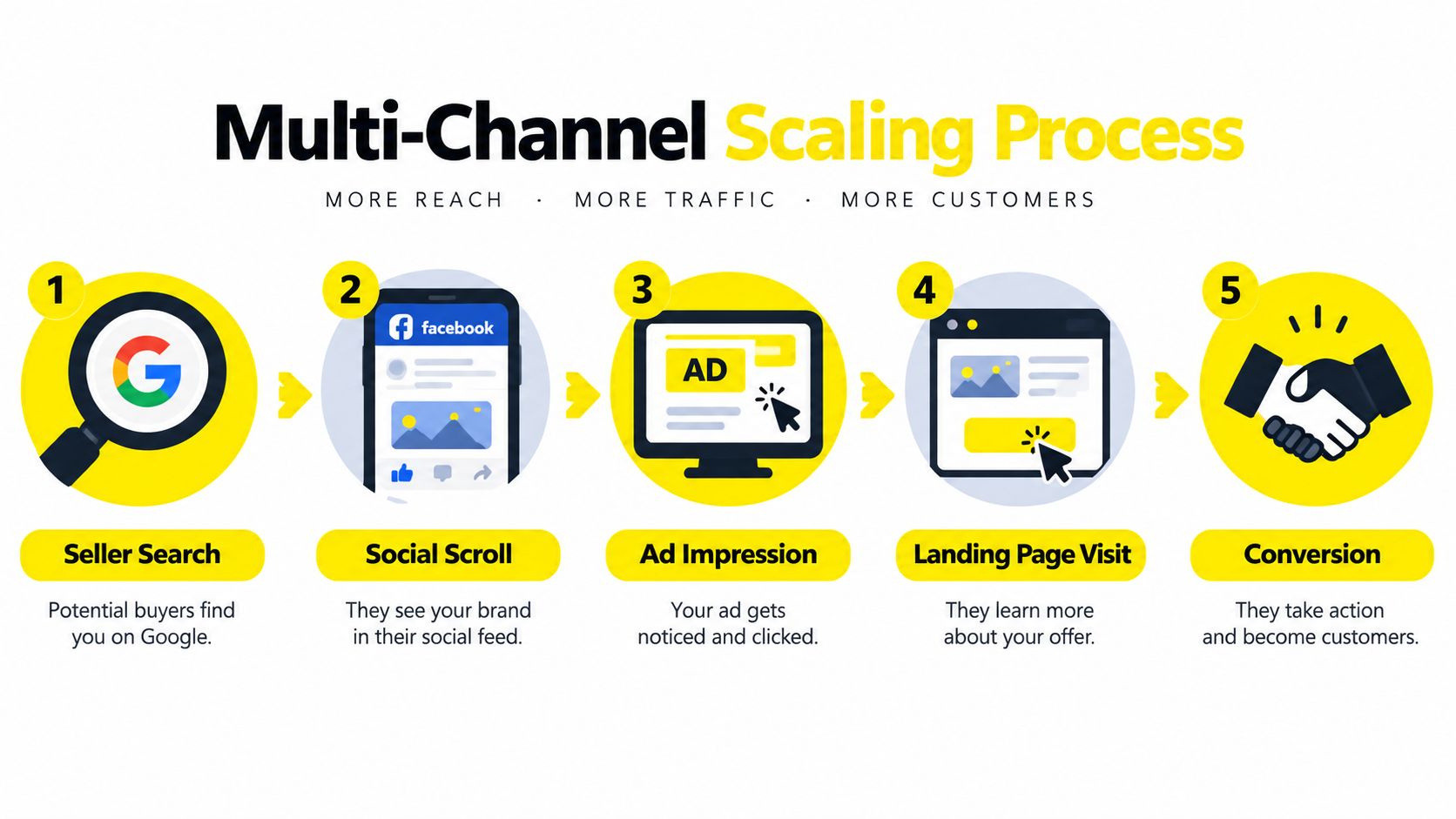
Retargeting should also do more than repeat the original ad. Show process proof, answer common objections, explain what an as-is sale involves, or invite the seller to call. The second message should resolve the reason the first visit didn't convert.
Your First 30 Days and the Mistakes to Skip
The first month should produce clean learning, not a pile of disconnected experiments. Start with the offer and the seller situations you can serve. Then make tracking and follow-up operational before you judge the ads.
Days one through seven
Define the geographic territory, buying criteria, offer language, qualification questions, and CRM stages. Install the pixels and analytics events, create UTM conventions, set up call tracking, and test every form on mobile. Review the copy for fair-housing restrictions, misleading urgency, unsupported guarantees, and consent requirements before spending.
Days eight through fourteen
Launch one focused Google campaign and one Meta structure built around a clear motivation. Keep the initial setup simple enough to identify what works. Confirm that calls route to a live person or a documented callback process, and make sure every lead receives the promised next step.
Days fifteen through twenty-one
Add creative variations that change one major idea at a time. Test a new pain-point hook, a different proof element, or a shorter qualification path. Watch search click-through rate, landing-page behavior, lead quality, and sales dispositions together. Don't declare a winner from a single cheap lead.
Days twenty-two through thirty
Pause ads that produce irrelevant inquiries or fail to generate meaningful downstream activity. Keep the strongest message, page, and audience combination, then expand carefully into a related test. Document why each change happened so the account doesn't become a random collection of edits.
Avoid stock photos of smiling couples, vague “sell fast” headlines, and forms that hide the purpose of the contact. Review the platform's housing-related advertising rules, state requirements, TCPA consent language, and any local restrictions before launch. For teams adding outbound calling to paid campaigns, resources such as this guide for agent lead generation can help inform the process, but your compliance review still needs to reflect your business, market, and communication method.
Your launch checklist is short: verified tracking, accurate UTMs, tested call routing, motivation-specific pages, clear consent language, documented qualification criteria, and a follow-up owner. Skip any of those, and your dashboard may report activity while the acquisition system loses money.
Wojo Media helps real estate investors connect offer strategy, conversion-focused landing pages, omnipresent Google and social campaigns, and backend KPI tracking instead of managing isolated ad placements. Visit Wojo Media to discuss a full-funnel investor advertising strategy built around qualified opportunities and profitable deal acquisition.
Comments