.png)
Business Marketing Websites: The Complete Guide for Growth

A website converting at 3% may look acceptable in isolation, but it's still roughly half the 6.6% median landing-page benchmark, which means it may be far from ready to scale without improving the offer, page, or traffic quality. The difference between a functional website and a profitable one is usually not more traffic, but more value extracted from the traffic you already pay to acquire.
Paid advertising makes this gap impossible to ignore. Every click arrives with a cost, an expectation, and a level of intent. If your ad promises a clear solution but your landing page introduces confusion, weak proof, or a vague next step, the budget keeps moving while the buyer disappears.
Business marketing websites now sit at the center of acquisition, not at the edge of it. In 2023, 71% of small businesses reported that their website was their primary source of new customer leads, up from 65% in 2022, while mobile devices accounted for about 54.8% of global website traffic and organic search drove about 53.3% of website traffic, as reported in this business website statistics overview. A website has to attract demand, explain the offer, build trust, and capture intent across devices and channels.
Why Your Business Marketing Website Is Leaking Money
The first leak is often hidden in plain sight. A business marketing website converting at 3% can feel healthy because leads or sales are still coming through. Yet Unbounce's dataset of 41,000 landing pages, 464 million visitors, and 57 million conversions found a median conversion rate of 6.6%, with the top 25% reaching roughly 10% or more and the bottom quartile falling below 3% (landing page benchmark data).
That comparison changes the question. Instead of asking whether the website converts, ask whether it converts enough to support profitable acquisition. A page can produce sales and still force you to overpay for every customer because the offer is unclear, the message doesn't match the ad, or the page makes visitors work too hard.
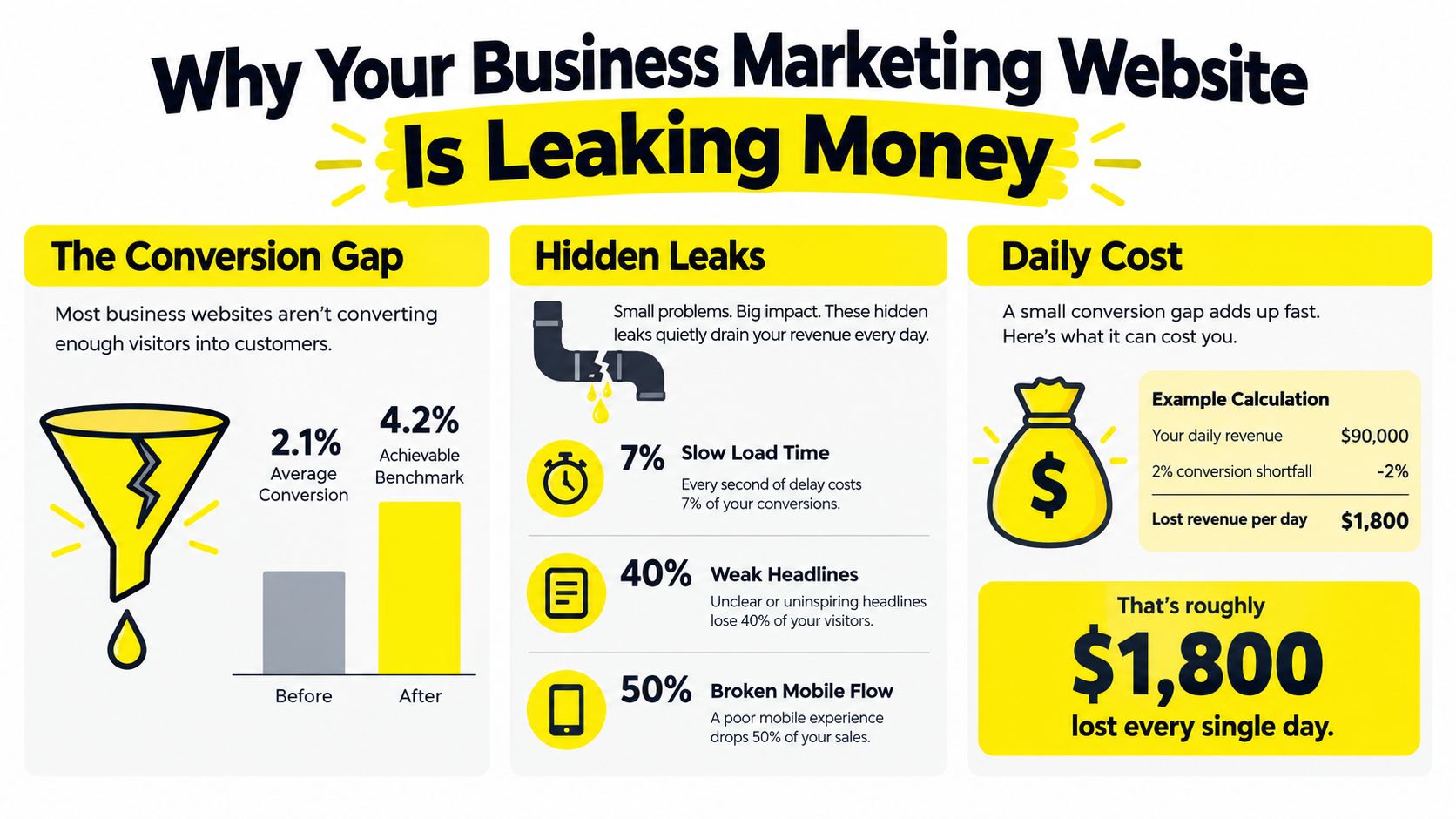
The real problem is misalignment
Most owners respond to weak conversion rates by commissioning a redesign. That can improve appearance, but a cleaner interface won't rescue an offer that lacks urgency or a campaign that attracts the wrong audience. Conversion problems usually come from misalignment between four things:
The promise: What the ad says the visitor will get.
The page: How quickly the landing experience confirms that promise.
The proof: Why the visitor should believe the claim.
The measurement: Whether the business can identify where the journey breaks.
A paid campaign magnifies every weakness. More traffic doesn't fix a confusing checkout, an unqualified lead form, or a headline that describes the company instead of the customer's desired outcome. It sends more people into the same leak.
Practical rule: Treat your website as part of the media buy. A click has no value until the page turns intent into a measurable business outcome.
This is also why website optimization belongs in broader business planning, not only in a designer's task list. For useful context on why business transformation matters, look at how operational changes affect the way a company creates and captures value. Your website is one of those operating systems. It determines whether your marketing investment produces a conversation, an order, or nothing you can act on.
The Four Pillars of a Scalable Marketing Website
Scalable business marketing websites rely on four connected pillars: offer, landing page, advertising, and data. Each affects the others. A strong ad cannot rescue an offer that feels weak, while a persuasive page cannot compensate for tracking that conceals profitable traffic or wasted spend.

Start with the offer
The offer includes more than the product or service. It covers the promise, mechanism, risk reversal, price framing, and next step. An e-commerce brand might pair a product with a useful bundle. A med spa could promote a defined consultation or treatment pathway instead of a generic “book now” message. A coach might make the first commitment a diagnostic session rather than a direct purchase.
Weak offers create expensive downstream work. The page needs extra explanation, the ad needs more aggressive creative, and sales staff must handle objections that should have been addressed before the click.
Build the page around a decision
A landing page should make the next decision obvious. Visitors need to understand what they get, who it suits, why it matters now, and what follows after they act. Navigation, secondary offers, and unrelated links can dilute that decision when the campaign makes a specific promise.
Paid search pages should reflect the intent in the query. Paid social pages need to establish context quickly because visitors may not have been actively seeking the offer. One homepage rarely performs equally well for both audiences.
Make ads and pages speak with one voice
Ad creative earns attention. The landing page earns the conversion. If a video emphasizes speed, the page should explain the delivery process. If an ad highlights a product benefit, that benefit should appear immediately after the click. Message continuity reduces friction because visitors do not need to reinterpret what they just saw.
Use data to close the loop
Tracking identifies which pillar needs attention. Strong clicks with weak qualified leads point toward the offer or page. Leads that fail to become customers require an examination of qualification, sales follow-up, and the promise made before the click. When one channel performs better than another, segment the experience before changing the entire site.
The operating model described in Wojo Media's published overview manages offer, pages, ads, and data as one performance system. That approach teaches a practical lesson: teams can improve the full customer journey instead of optimizing each pillar in isolation.
A short visual explanation of this connected approach appears below.
Building Landing Pages That Convert Paid Traffic
A landing page should continue the conversation started by the ad. It shouldn't make a visitor search for the promised benefit, decipher a clever headline, or choose between several unrelated actions.
The top of the page has one job: confirm relevance. Use a direct headline that states the primary outcome in plain language. Follow it with a subheadline that handles the first objection, then place the main call to action where the visitor can act without scrolling through a corporate history lesson.
A practical page sequence
A reliable structure moves from recognition to confidence to action:
Headline and subheadline: State the outcome and clarify the audience or mechanism.
Primary action: Use a form, purchase button, booking tool, or application step that matches the campaign.
Problem and consequences: Show that you understand the cost of leaving the problem unresolved.
Offer details: Explain what the buyer receives, how the process works, and what commitment is required.
Proof: Use relevant reviews, demonstrations, outcomes, credentials, or customer examples.
Objection handling: Address timing, price, suitability, logistics, guarantees, and support.
Repeated call to action: Return to the same next step without introducing a competing offer.
The right amount of information depends on the decision. A low-friction product page may need concise benefit-led content and strong visuals. A high-consideration service may need process detail and proof before the visitor is ready to speak with someone.
Business Type | Primary Goal | Key Page Elements | Typical CTA |
|---|---|---|---|
E-commerce | Complete a purchase | Product benefits, pricing, variants, delivery details, reviews, returns | Add to cart or buy now |
Local services | Capture a qualified enquiry or booking | Service area, availability, trust signals, process, contact options | Book an appointment or request a quote |
Coaching and courses | Establish fit and move the prospect into a sales path | Transformation, curriculum, authority, testimonials, application criteria | Apply, book a consultation, or enrol |
Match the page to the traffic
A Google visitor searching for a specific service should land on a service page that answers that need directly. A Facebook or TikTok visitor may need more education, stronger visual proof, and a lower-friction first step. Sending both audiences to the same generic homepage makes the business pay to create confusion.
Keep navigation restrained on campaign pages. Remove links that pull attention toward careers, press, or unrelated services. This doesn't mean hiding important information. It means arranging information around the decision the visitor came to make.
For a useful companion on how to build affiliate landing pages with higher CR, pay close attention to traffic intent, message matching, and the relationship between the first screen and the action. Those principles apply well beyond affiliate campaigns.
Writing Copy That Turns Browsers Into Buyers
A visitor rarely needs more clever wording. They need a clear answer to three questions: what problem does this solve, why should I believe you, and what happens after I act?
Copy loses conversions when it centres the company instead of the buyer. “We are a full-service agency with experienced professionals” describes the business's preferred message. “See which campaigns produce qualified opportunities and where your acquisition spend is leaking” describes the outcome the visitor is trying to understand. That shift matters because the website has to turn paid attention into a measurable commercial action.
Show the change and the mechanism
Effective copy makes the customer's movement visible:
Before: The visitor pays for clicks but cannot identify which audience or page produces profitable customers.
After: The visitor can follow the path from ad to landing page, tracked conversion, and revenue.
Bridge: A focused page structure and connected measurement system reduce the uncertainty between those two states.
The bridge must be believable. Explain how the offer works, provide relevant proof, and state what the buyer needs to do. Avoid guarantees that the evidence cannot support. A case study, product demonstration, process explanation, or specific testimonial usually does more work than another broad promise.
Edit every sentence against a practical test. Does it increase desire, answer an objection, explain the offer, or direct the next action? Sentences with no clear job should be shortened or removed. This keeps the page focused on decisions rather than filling space with brand language.

Adapt the argument to the business model
E-commerce copy should turn specifications into buying reasons. Explain how material, size, or technical features affect comfort, durability, use, or ownership. Place each benefit near the relevant product image, then answer practical concerns about delivery, returns, and suitability.
Local service copy must make proximity and trust obvious. Name the service area, explain what happens after an enquiry, show the team or facility, and make the booking process predictable. Prospects should know whether they are covered and whether contacting the business will lead to a hard sell.
Coaching and course copy should establish fit before building enthusiasm. Describe who the programme helps, what participants do, what support they receive, and who should not apply. Strong transformation stories explain the starting point, intervention, and resulting change instead of relying on vague praise.
Real estate copy should reduce uncertainty around the transaction. Explain the property or investment thesis, the next step, the relevant market context, and what information the prospect receives after submitting details.
Returning visitors converted at 2.9%, compared with 1.7% for new visitors, according to a 2026 benchmark based on 99 billion sessions across more than 6,000 sites (conversion benchmark analysis). The first visit therefore needs to earn a return, not only chase an immediate sale. Clear language, useful content, and a credible follow-up path give future buyers a reason to come back.
Tracking, KPIs, and Data-Driven Optimization
Paid acquisition becomes scalable only when the website connects traffic to qualified action and revenue. An analytics script cannot make that connection on its own. Your tracking setup must show which source produced the visit, what the visitor did, whether the outcome was commercially useful, and what the business earned.
Define the primary conversion by business model. E-commerce teams should track completed purchases with product and order data. A local service should distinguish a booked appointment from an unqualified form submission. For a coach or consultant, a completed application or attended sales call may matter more than a lead that never responds.
Build a KPI hierarchy that reaches revenue
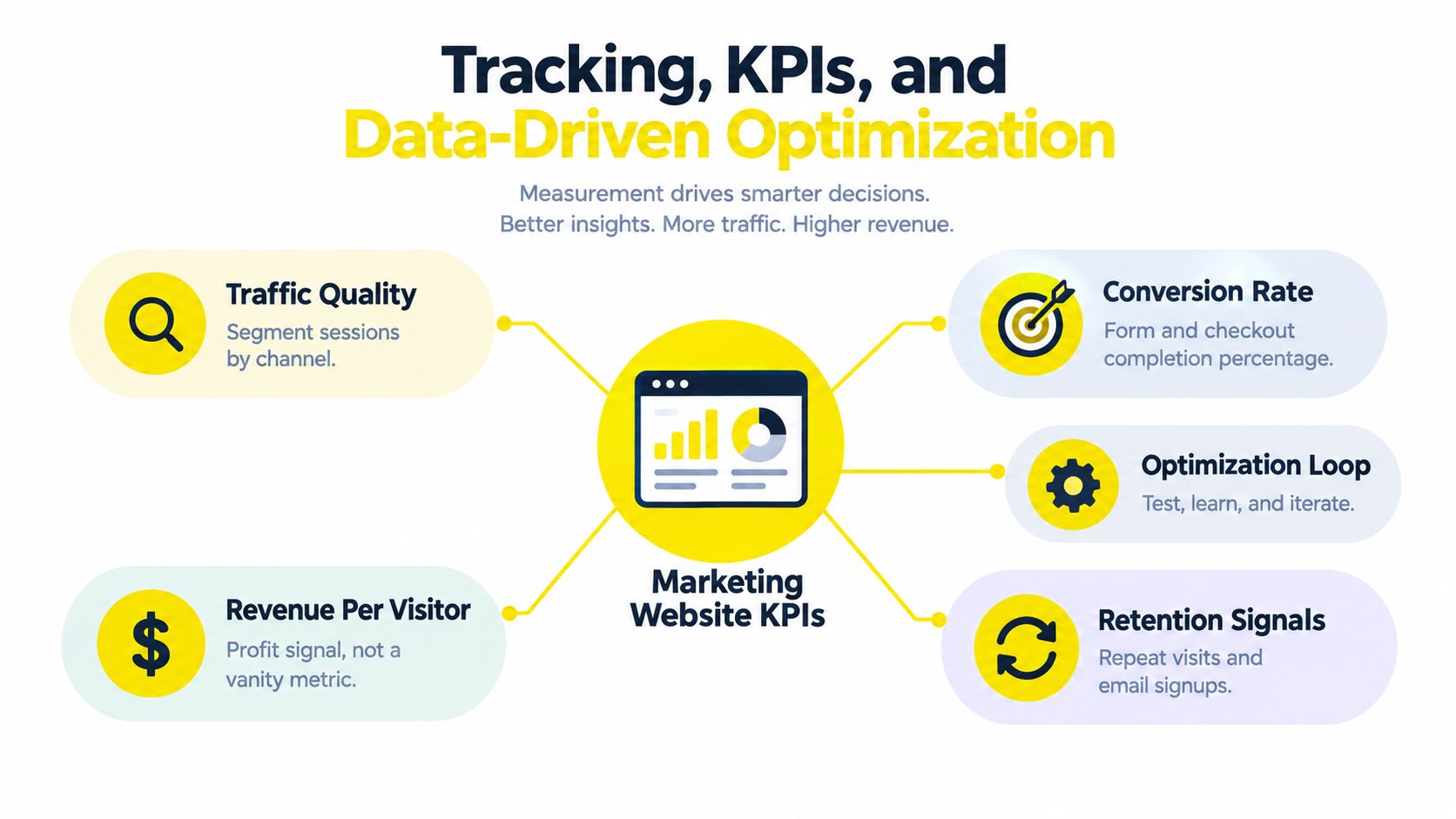
Organize reporting from visitor quality to acquisition economics:
Traffic quality: Segment visitors by source, campaign, audience state, device, and landing page. Paid search, paid social, email, and organic traffic should not share one blended view.
Conversion rate: Measure completion of the relevant checkout, booking, application, or form, not every click that looks positive.
Revenue per visitor: Connect sales value to sessions and campaigns. High traffic with no commercial outcome is a distraction.
Retention signals: Track repeat visits, purchases, qualified follow-up, and email signups when those actions support the business model.
Acquisition economics: Compare acquisition cost with customer value and contribution margin before raising media spend.
Benchmark ranges vary by offer, audience, and conversion definition. A 2026 benchmark reports the following figures (conversion optimization benchmarks for 2026):
Average site conversion: 2.5% to 3.5%.
E-commerce conversion: 2.1% to 3.2%.
B2B conversion: 2.3% to 4.8%.
Top-performing sites: 5.31% or higher.
Top 10% of sites: above 11.45%.
Use these figures for directional comparison, not as universal targets. A purchase, a qualified sales call, and a webinar registration signal different levels of intent.
Segment before you diagnose
A blended conversion rate can hide the actual constraint. Returning visitors may behave differently from new visitors. Paid search may bring stronger intent than organic social, while a campaign landing page may serve a different job from a product or service page.
Compare source, audience state, landing page, device, and downstream quality before changing the whole website. A high bounce rate is not automatically a problem if the page answers a narrow question. It becomes a commercial issue when visitors also fail to submit, purchase, book, or take another valuable step.
Channel-specific reporting makes the difference visible. One 2026 benchmark reported paid search conversion at 2.8% and organic social at 0.7% (channel conversion data). Treat those channels differently in budget decisions, landing-page design, and follow-up measurement. Optimize the pages paid campaigns use, not only the homepage.
A/B Testing Your Way to Higher Conversions
A useful test starts with a decision, not a design change. Changing the headline, offer, form, imagery, button, and page length at once may produce a different conversion rate, but it cannot show which decision caused the result.
Start with a specific hypothesis. Paid-search visitors may be ignoring a page because its headline names the service category instead of the problem behind their query. Test a headline and supporting subheadline built around that problem, while keeping the audience, offer, and measurement consistent. The cleaner the comparison, the more useful the result.
Offer framing deserves attention before visual polish. Test the package, promise, risk reversal, or first commitment. A stronger offer can change the economics of paid acquisition; a small styling adjustment rarely can.
Next, test message match between the ad, query, and first screen. Then examine the call to action, including its wording, placement, and level of commitment. Proof can follow, with comparisons of relevant testimonials, process evidence, demonstrations, or guarantees. Test page depth once you know whether visitors need more explanation or a quicker path. Leave visual details, such as imagery, spacing, colour, and component styling, until the commercial questions have clearer answers.
This sequence keeps a team from spending weeks refining a button while prospects still do not understand the purchase.
Testing discipline: Change one meaningful variable, record the hypothesis, and preserve the learning even when the variant loses.
Set the decision rules first
Define success before traffic reaches the test. An e-commerce page should be judged by completed purchases and revenue per visitor, not only product-button clicks. A local service should be measured by booked, qualified appointments rather than raw form submissions. A coaching funnel may need application quality and sales progression in the evaluation.
Early fluctuations are not a winner. Keep the traffic mix stable during the test and collect enough information for a responsible decision. An inconclusive result still narrows the hypothesis. It may show that the change was too small, the audience was too mixed, or the page needs a clearer question.
Record each experiment in a simple log: hypothesis, change, result, and next action. This prevents failed ideas from returning under slightly different names and gives future tests a useful starting point.
The strongest testing programme builds knowledge in sequence. It connects the offer, audience, ad promise, and conversion path, so paid traffic produces better commercial outcomes rather than just more clicks.
Your Implementation Roadmap and When to Get Help
Start with an audit, not a redesign. Review the business marketing website through the four-pillar lens and identify the single issue most likely to limit paid acquisition. A weak offer deserves attention before typography. A tracking gap deserves attention before a new campaign. A mismatch between ad and page deserves attention before adding more creative.
A focused implementation plan
First, capture the baseline. Record the current conversion event, traffic sources, landing pages, lead quality, sales outcomes, and revenue attribution. If the business can't define its primary conversion, solve that measurement problem first.
Next, repair the highest-friction page. Rewrite the first screen, clarify the offer, remove competing actions, add relevant proof, and check the experience on mobile. Don't make broad changes across every page before you know which journey matters commercially.
Then, connect the campaign. Match each important ad group or audience to a relevant page. Confirm that the promise, proof, form fields, follow-up, and reporting all describe the same customer journey.
Finally, establish a testing rhythm. Prioritize offer and message hypotheses, document every result, and review performance by source and downstream quality. Continuous improvement beats occasional redesigns because it creates a record of what works for your audience.
Handle straightforward offer and copy work internally when the team understands the customer and can measure the outcome. Bring in specialists when attribution spans multiple channels, lead quality is difficult to connect to campaigns, tracking is fragmented, or internal opinions have replaced controlled learning. Wojo Media provides campaign management, landing page development, creative, and backend KPI tracking as a connected paid acquisition service, which is one possible route for teams that need outside execution.
The objective isn't a perfect website. It's a system that makes the offer clear, turns qualified attention into action, and shows the business where to improve next.
Wojo Media helps businesses connect offer strategy, landing page development, omnipresent paid campaigns, and backend data so ad spend has a clearer path to profitable conversion. Review the approach and request a customized growth conversation through Wojo Media.
Comments