.png)
Performance Marketing for Ecommerce: A Complete Playbook

Most ecommerce advice still treats higher platform-reported ROAS as proof of better marketing. That shortcut is dangerous. A campaign can look excellent inside Meta or Google while taking credit for customers who were already searching for your brand, returning to your site, or ready to buy without the ad.
Performance marketing for ecommerce works when it creates predictable, profitable, incremental revenue. That requires more than campaign settings. Your offer, landing page, creative system, channel mix, and measurement model must work together. The brands that scale sustainably don't just buy more traffic. They build a revenue system that shows which spend creates new demand, which spend captures existing demand, and which spend only receives credit after the fact.
Rethinking Performance Marketing for Ecommerce
Last-click attribution answers the wrong question. It tells you which touchpoint received credit for an order, not whether that touchpoint caused the order to happen. The more useful question is direct: would this customer have purchased without the ad?
A 2026 incrementality benchmark reported that Google Brand Search produced 19x platform-reported ROAS, but only 5.7x after incrementality adjustment, with an incrementality factor of 0.30x. The same benchmark found Meta acquisition campaigns were understated by platform attribution, with a 1.13x incrementality factor. These figures don't mean branded search is useless or that Meta is always undervalued. They show that platform dashboards measure credited conversions within an attribution window, not causal lift. (Common Thread Collective's incrementality benchmark)
Practical rule: Treat platform ROAS as a diagnostic signal, not the final rule for allocating budget.
The discipline has changed because the measurement environment has changed. Performance marketing grew out of direct-response advertising, where clicks and sales could be connected to specific campaigns. The launch of the first banner ad in 1994, Google AdWords in 2000, and Google Analytics in 2005 made digital response easier to observe and optimize. (The history of performance marketing)
That measurement advantage never meant the data was complete. GDPR, CCPA, Apple's App Tracking Transparency, GA4, and browser changes have made user-level tracking less dependable. Your team now has to combine platform data with first-party customer records, analytics, controlled experiments, and commercial outcomes.
Revenue engineering instead of campaign management
A campaign manager asks whether an ad is producing conversions. A revenue operator asks whether the customer is profitable after product cost, fulfilment, discounts, returns, and future value. Those are different operating philosophies.
The practical shift is simple:
Stop optimising only for credited orders. Compare reported performance with blended revenue and contribution margin.
Separate demand capture from demand creation. Brand search and retargeting often reach people who already know you, while prospecting ads introduce the offer.
Use experiments to challenge your assumptions. If performance collapses when a market is held out from advertising, the campaign may be incremental. If sales remain stable, the platform may have claimed existing demand.
Pass better value signals into ad platforms. A high-revenue order isn't automatically a high-profit order.
Your goal isn't to make a dashboard look efficient. It's to create a system where every additional unit of spend has a defensible commercial reason.
The Four Pillars of Profitable Growth
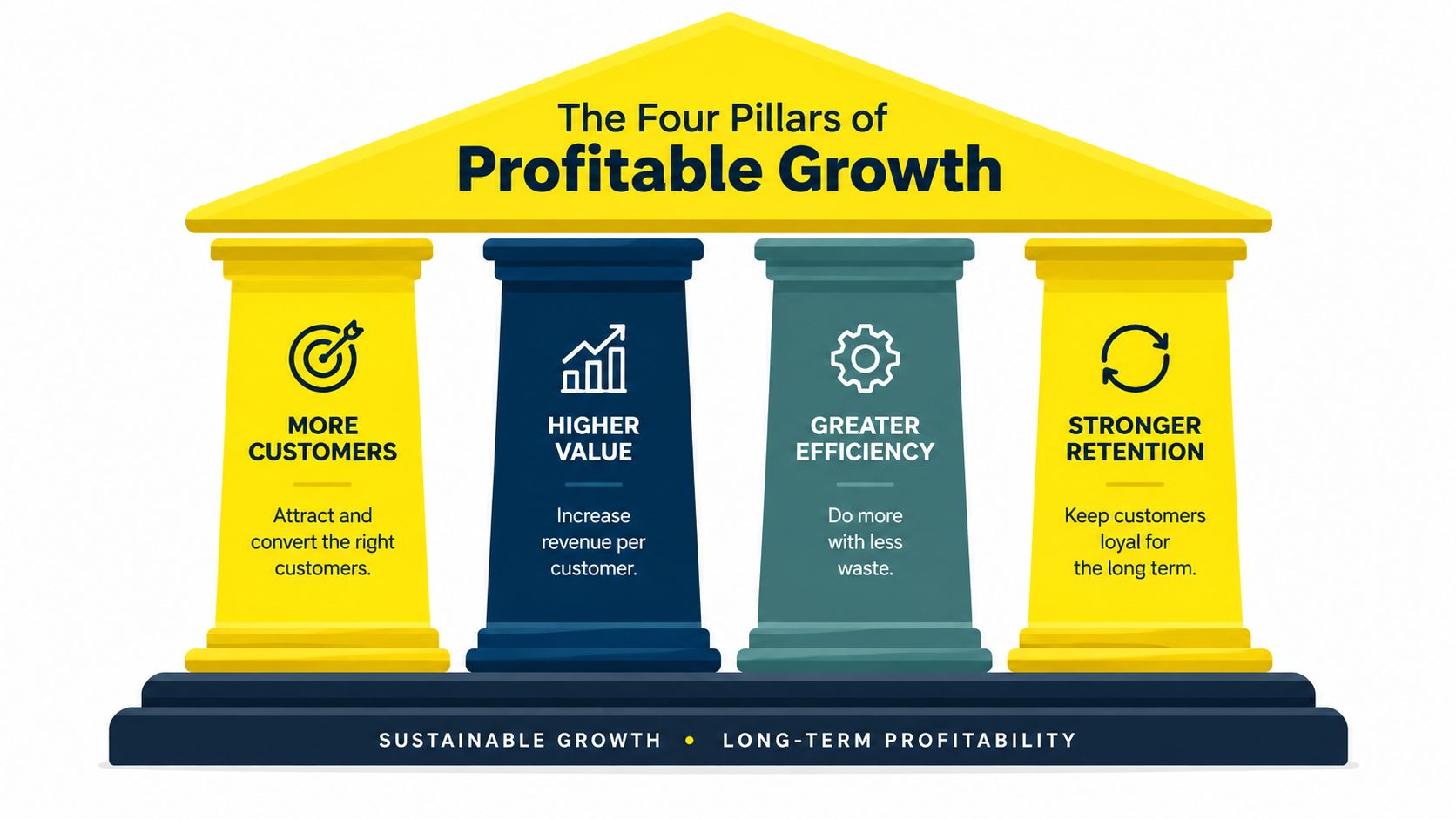
Profitable growth rests on four connected decisions: the offer, the landing page, omnipresent advertising, and data. Weakness in one pillar limits the others. Better targeting won't rescue an offer that feels interchangeable, and a strong ad can't compensate for a checkout experience that creates doubt.
The offer determines the ceiling
Your offer is more than the product and its price. It includes the promise, bundle, guarantee, proof, delivery terms, financing or payment options, and the reason to act now. If customers can't quickly understand why your product is a safer or more valuable choice, additional ad spend exposes the weakness to more people.
A strong offer answers four questions quickly:
Who is this for?
What problem does it solve?
Why is it different from the alternatives?
Why should the buyer trust the claim?
Discounting can increase response, but it can also train customers to wait and compress margin. Test bundles, bonuses, guarantees, subscriptions, and clearer product positioning before assuming a lower price is the answer.
The landing page turns interest into economics
Paid traffic doesn't convert in a vacuum. The landing page must continue the exact promise made in the ad. If a short video promises a solution for a specific use case, the destination should lead with that use case, show the product in context, address objections, and make the next action obvious.
Audit the page for message match, mobile load experience, product demonstrations, reviews, delivery information, returns, payment friction, and repeated calls to action. Don't judge the page only by its conversion rate. Compare conversion quality, average order value, refund behaviour, and margin by traffic source.
Omnipresence creates recognition
Meta, Instagram, TikTok, Google, and YouTube play different roles, but customers experience them as one brand. A prospect might discover your product in a TikTok demonstration, watch a YouTube explanation, search your brand on Google, and later return through a Meta retargeting ad.
That sequence doesn't require identical creative everywhere. It requires a coherent narrative. Prospecting introduces the problem and the product. Consideration content handles objections and demonstrates proof. Retargeting reinforces urgency, trust, and the cost of delaying the purchase.
Ecommerce brands increased digital ad budgets by 18% in 2024, while 74% planned to increase ad spend again in 2025. Performance marketing accounted for 62% of total ecommerce ad budgets, according to the cited industry report. (Ecommerce advertising trends) More budget makes the operating system more important, not less. If the offer, page, creative, and data don't connect, scaling magnifies waste.
Channel-Specific Tactics Across Social and Search
A blended conversion target hides important differences between platforms. Google usually captures people who already express intent through a search. Meta and TikTok often create demand before the customer has decided to investigate the category. YouTube can build understanding and trust through longer demonstrations, reviews, and education.
A 2026 benchmark found that ecommerce traffic from Google Ads converted at 3.05% for the top 25% of stores, compared with 1.42% on average. Facebook traffic converted at 2.08% for the top quartile, compared with 0.93% on average. (Ecommerce conversion benchmarks) The comparison doesn't make Google universally superior. It shows why each channel needs its own expectation, creative approach, and economic target.
Google captures existing demand
Search campaigns work best when your product solves a clearly articulated problem and customers already use language that reveals intent. Separate branded, non-branded, shopping, and performance automation activity where possible so you can understand what kind of demand each campaign is reaching.
Use product feeds carefully. Titles should reflect how shoppers search, images should show the product clearly, and landing pages should match the advertised variant. Feed errors, unavailable products, weak product photography, and imprecise titles can reduce performance before bidding becomes relevant.
Don't evaluate search by clicks alone. Track search-term quality, new-customer revenue, contribution margin, repeat purchase behaviour, and the share of sales that would likely have happened without brand coverage.
Meta and TikTok create the reason to care
Paid social reaches people who may not be actively shopping. The ad must therefore earn attention and establish relevance quickly. A product demonstration, customer objection, before-and-after explanation, creator testimonial, or problem-led narrative often gives the viewer a reason to continue.
TikTok rewards native pacing and an authentic point of view. Meta gives you room to test multiple angles across feeds, Stories, and Reels. In both environments, build separate creative concepts rather than changing only the headline on the same image.
The landing page may need more pre-selling for social traffic. Show the problem, demonstrate the mechanism, explain the outcome, and address the objection that stops the purchase. Resources on converting short-form video content can help teams develop a more deliberate structure for these assets.
YouTube connects discovery with proof
YouTube is useful when the product needs explanation. Longer reviews, comparisons, tutorials, founder stories, and use-case demonstrations can answer questions that a short social ad can't. Shorts can create discovery, while longer content can deepen conviction.
Judge each channel on the job it performs. Search should be assessed as demand capture. Social should be assessed on qualified traffic, assisted demand, new-customer economics, and incrementality. YouTube may need a longer evaluation window because its contribution can appear later through direct visits, branded search, or returning customers.
Measurement Beyond Platform ROAS
A reliable measurement stack begins with commercial truth, not a prettier dashboard. Start by defining the outcome that matters, such as contribution margin, new-customer revenue, or profit after fulfilment. Then make sure your ad platforms, analytics system, ecommerce platform, and customer database use consistent definitions.
Platform automation and privacy changes have made default attribution less reliable. Google has deprecated first-click, linear, time-decay, and position-based attribution models, while AI-driven campaign systems increasingly decide where and when ads appear. Recent coverage argues that incrementality, CAC, and LTV deserve more weight than ROAS alone. (Measurement trends in ecommerce marketing)
Build a measurement hierarchy
Use metrics at different levels instead of forcing one number to answer every question.
Diagnostic metrics: CPM, CPC, click-through rate, landing-page engagement, and checkout progression help identify creative or technical problems.
Channel metrics: conversion rate, customer acquisition cost, new-customer revenue, and contribution margin show how traffic behaves after the click.
Business metrics: total revenue, total marketing efficiency, repeat purchase rate, and cash contribution show whether the company is growing efficiently.
Causal metrics: incremental revenue and incremental ROAS estimate what advertising caused.
The hierarchy prevents a common mistake. A low CPC can coexist with poor customers, and a high platform ROAS can coexist with no meaningful lift in total sales.
Run tests that can change a budget decision
For paid social, create a geographic holdout where advertising is reduced or paused while comparable regions continue receiving spend. Compare the change in new-customer sales, total revenue, and margin between the test and control groups. Keep the audience definition, pricing, stock position, and promotional calendar as consistent as possible.
For branded search, test coverage in carefully selected markets or time windows. This is particularly important because brand demand can receive disproportionate platform credit. The earlier benchmark's gap between reported and adjusted brand-search ROAS illustrates why this test deserves a place in the operating calendar.
Larger brands can use media mix modelling to estimate the relationship between spend and business outcomes across channels. Smaller teams can still improve decision quality with holdouts, pre-period comparisons, customer surveys, and blended metrics. No method is perfect. A combination is stronger than any single dashboard.
Measurement standard: If a result can't change how you allocate the next budget, it isn't yet a decision metric.
Creative as the New Scaling Lever
Media buying used to be the obvious bottleneck. Platform automation has shifted more of the work toward the asset itself. Algorithms can distribute a strong ad across audiences and placements, but they can't turn a vague promise into a compelling demonstration.
Recent 2026 trend coverage emphasises competition on creative quality, creative volume, and creative velocity, with video outperforming static images across engagement, time on page, add-to-cart rate, and conversion rate. (Ecommerce creative trends) The operational lesson is clear: creative production needs a system, not occasional inspiration.

Build a production loop
Start with customer language. Pull objections from reviews, support tickets, sales conversations, search queries, and post-purchase surveys. Turn each recurring objection into a creative brief with one audience, one problem, one proof point, and one action.
Then produce variations by concept, not cosmetic detail:
A demonstration that shows the product solving the problem.
A comparison that explains why the product differs from alternatives.
A testimonial that handles trust concerns.
A founder or expert explanation that adds context.
A short-form hook that earns attention before the product reveal.
One strong shoot can feed Meta, TikTok, YouTube Shorts, product pages, and shopping campaigns, but each placement needs its own opening, crop, captioning, and pace. Reusing the idea is efficient. Uploading the same edit everywhere usually isn't.
Teams without an in-house video department can use tools that generate product videos with AI to create more starting points from product assets. Treat generated content as production support, not automatic proof of quality. A human still needs to check product accuracy, claims, brand voice, and whether the first seconds communicate anything meaningful.
Here is a practical explanation of how creative can function as a performance variable:
Review creative by spend, thumb-stop behaviour, qualified landing-page sessions, add-to-cart quality, conversion, and post-purchase economics. The winner isn't always the asset with the cheapest click. It is the concept that brings in customers who remain profitable after the sale.
Real-World Results and Case Examples
A useful case study explains why performance changed, not just what the dashboard reported. Identify the offer adjustment, page change, audience, creative concept, and follow-up step. Then check whether the result survived product costs, refunds, discounts, and customer quality. Platform ROAS can rise while true incremental lift remains weak if ads receive credit for purchases that would have happened anyway.
The same growth framework produces different operating decisions by business type. A local service campaign may reduce booking uncertainty, answer location and availability questions, and optimise for qualified appointments. An ecommerce campaign may use a bundle or guarantee, address product objections, and separate profitable orders from low-margin revenue. Its success depends on contribution after fulfillment, not revenue credited by an ad platform.
Coaching campaigns add a longer conversion path. The first action may be a consultation request or application, while the commercial outcome is a booked and qualified conversation. Creative must filter for fit, the page must set expectations, and follow-up must move interested prospects through the sales process. Cheap leads have little value if the team cannot respond clearly and promptly.
Case comparisons should also expose the production constraint behind scaling. A winning concept can produce several useful variations, but the team needs enough new hooks, demonstrations, objections, and proof to keep testing. Without that creative supply, budget increases often force platforms to recycle the same audience and assets.
The agency behind the portfolio described in the brief reports work across ecommerce, local services, real estate, and coaching, including multi-ROAS ecommerce outcomes, sub-$10 leads, and booked-out calendars. Its published track record covers 17,000+ campaigns, $145M+ in online revenue, and 1,320+ businesses over the stated period. Those figures come from Wojo Media's published company profile, so they represent company-reported results, not a forecast for every advertiser.
The practical lesson is to evaluate the full chain: offer, page, creative output, channel role, and post-click process. A reported ROAS number is only useful after testing whether the campaign created additional demand and profitable customers.
Your Ecommerce Performance Audit and Next Steps
Audit the business in the order a customer experiences it. Start with the offer, then inspect the page, creative system, channel roles, and measurement. This sequence keeps you from buying more traffic before you know whether the business can convert and retain it.
Check the offer and customer journey
Ask whether a new visitor can identify the customer, problem, product difference, proof, price, delivery terms, and risk reversal without searching through the page. Compare the promise in every major ad with the first screen of the destination page. If the message changes after the click, fix that before changing bids.
Then examine economics. Know contribution margin by product, the impact of discounts and returns, new-customer value, and the point at which additional acquisition becomes unprofitable. A revenue target without a margin threshold isn't a scaling plan.
Test the operating system
Use this audit list:
Tracking: Confirm that purchases, refunds, new customers, revenue, and consent signals pass accurately into the relevant systems.
Landing pages: Review mobile usability, page speed, proof, product demonstrations, objections, delivery information, and checkout friction.
Creative workflow: Maintain a backlog of customer objections and produce new concepts from those inputs rather than endlessly resizing old ads.
Channel roles: Separate demand capture from demand creation and give each platform a suitable conversion and profitability target.
Incrementality: Schedule holdouts or controlled tests that can validate whether paid social, brand search, and retargeting create additional revenue.
Reporting: Put platform results beside total revenue, customer acquisition cost, repeat purchases, and contribution margin.
Fix the largest constraint first. If conversion tracking is unreliable, don't trust optimisation data. If the offer is weak, don't blame creative fatigue. If the page converts but creative volume is low, build production capacity before expanding spend.
The best performance marketing for ecommerce is an operating discipline. It connects creative decisions to customer economics, and it treats attribution as a hypothesis that needs testing rather than a fact delivered by a dashboard.
Wojo Media offers paid advertising across Facebook, Instagram, TikTok, Google, and YouTube, supported by offer refinement, conversion-focused landing pages, creative production, and backend KPI tracking. Visit Wojo Media to book a free demo call and request a custom paid ads strategy for your ecommerce growth goals.
Comments