
8 Remarketing Ads Examples in 2026: Why They Work

Your cart abandoner audience refreshed overnight. Everyone on it added an item in the past week and left without paying. You push the same carousel you ran last quarter, keep the budget flat, and by Friday it's returning less than it costs while the cold prospecting set beside it outperforms.
The ad didn't get worse. The audience changed shape. Some of those people are waiting for a discount, some bought on a phone while your pixel was blocked, and a few stalled on the shipping calculator. One creative can't answer all three.
That's the whole game with remarketing. Two brands can show the same visitor a near-identical ad and get opposite results. The gap comes down to which signal built the audience, what the person was doing right before the ad loaded, and whether the creative matched that moment. Get those three aligned and modest creative still converts; miss them and a polished ad burns budget.
The eight formats below cover what I build across e-commerce, local service, coaching, and considered-purchase funnels. For each one you'll see the audience signal behind it, the creative logic that fits that signal, and the setup mistakes that drain spend. Find the one that matches how your buyers behave, and skip the rest.
1. Dynamic Product Retargeting (Catalog Ads)
Dynamic product retargeting is the one format where the creative assembles itself. You connect a product feed to a Meta catalog or Google Merchant Center, and the platform builds a carousel from whatever each visitor viewed, pulling current price and stock at every sync. On a 500-SKU store you get 500 ads without designing any of them.
Retailers lean on it because the ad carries the exact item instead of a logo. Microsoft reported that s.Oliver's impression-based remarketing campaign achieved a 27% conversion rate during the 2024 holiday season, per MediaPost's coverage. That's one fashion brand in one peak season, not a benchmark to budget against, but it shows what happens when personalization happens at the product level.
The three settings that decide whether it pays
Cap frequency before you touch budget. Three to five impressions per week keeps a product carousel persuasive. Uncapped, dynamic ads are the fastest way to teach a warm audience to scroll past you.
Segment by depth of intent. Cart abandoners, product page viewers, and category browsers need different offers and different budgets. Let the money follow the cart group.
Exclude purchasers at the catalog level. Re-selling a $200 item to the person who bought it on Tuesday is the most expensive mistake in this format, and it happens because the exclusion lives in one campaign instead of the catalog.
Practical rule: If a dynamic ad shows someone a product they already bought, the exclusion list is broken, not the creative.
The return visit is where the money lands, so make sure the landing page carries the same offer the ad promised. Free returns, a size guide, a stock warning: pick one and put it above the fold.
2. Abandoned Cart Retargeting Sequence
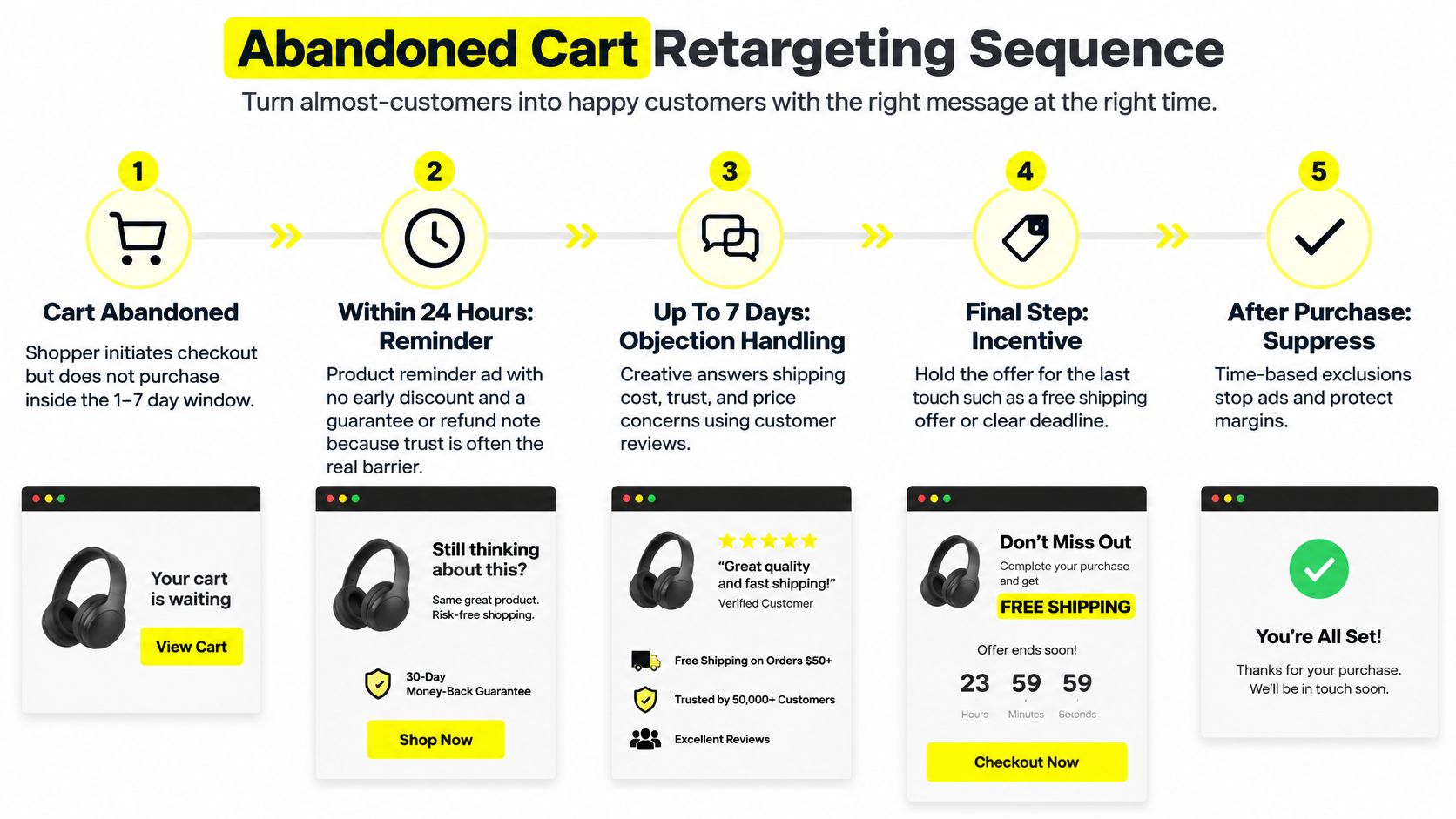
A shopper who reached checkout and stopped is the highest-intent audience you'll ever pay to reach, and most brands answer that signal with a single discount ad. A sequence works better because people stall for different reasons: shipping cost, trust, a declined card, or a deliberate wait for a coupon.
The job of the sequence is to answer each reason in order, cheapest fix first.
Build it in three windows
Hours 0 to 24, reminder with no discount. Show the cart contents, the product photo, and a free returns line. You're solving for distraction, not price.
Days 2 to 4, objection handler. Shipping thresholds, guarantee terms, review count. Objection-handling messages often recover carts without any discount at all, so let this stage run before you spend margin.
Days 5 to 7, incentive if the numbers allow. Free shipping or a small percentage off, served only to people who haven't purchased and haven't been hit with the earlier offers.
Discounting early carries a real cost, and it isn't only margin. A U.S. consumer survey published in October 2025 found that 25% of respondents said they add items to carts and abandon them to trigger follow-up offers, while 21% said they repeatedly revisit a product or site to prompt remarketing, per the U.S. Tariffs Consumer Impact Survey Series. A code in the first 24 hours trains exactly the behavior that survey describes. Keep the discount behind day five and let the reminder window do the sorting.
Run the ad sequence alongside your email and SMS flow rather than instead of it. If you want timing patterns that already work, browse abandoned cart email templates and mirror their spacing in the ad schedule.
3. Video Viewer Retargeting on YouTube and Social Platforms
Say a coaching business posts a 12-minute free training on YouTube and runs it as a view campaign. Many viewers who watch to the halfway mark never see another ad from that brand again. That's the leak this format plugs. You build an audience from watch percentage, then serve a direct-response ad to everyone who crossed your threshold.
Google's Analytics 360 case study of TalkTalk shows how the creative handoff works. The company used YouTube TrueView creative optimization and reported a 4% higher view rate and a 29% higher click-through rate among new-customer activity, according to the TalkTalk case study. Better creative pulled more people deeper into the video, which is exactly the pool a retargeting campaign draws from.
Where the thresholds should sit
75% or more watched. Closest to buying. Show the price, the booking link, the enrollment deadline.
25% to 75% watched. Interested, unconvinced. Lead with a testimonial or a case study cut.
Under 25% watched. Weak signal. Keep them in cheap awareness or drop them.
Treat the first video as the introduction and the retargeting ad as the specific ask. A viewer who spent eight minutes with your training doesn't need another explainer; they need a calendar link. Refresh audience membership on a 30-day window so people who watched in March aren't seeing the same follow-up in July.
4. Customer List Upload for Re-engagement and Cross-Sell
Your CRM already holds the strongest audience you own: people who paid you. Upload hashed emails or phone numbers, and Meta, Google, and TikTok match a meaningful share of them to accounts. That lets you sell replenishment and upgrades to buyers instead of paying to chase strangers.
The efficiency gap between customer audiences and cold traffic is wide. Google reported that TransUnion lifted conversion rate by 65% and average transaction value by 58% by pairing Analytics audience lists with customized ad text for previous visitors, and that existing customers generated 50% lower cost-per-click and roughly half the cost per transaction, per the Google Analytics blog. The platforms have changed since that case ran; the principle hasn't. A known customer costs less to reach and spends more per order.
Consumables make this format obvious.
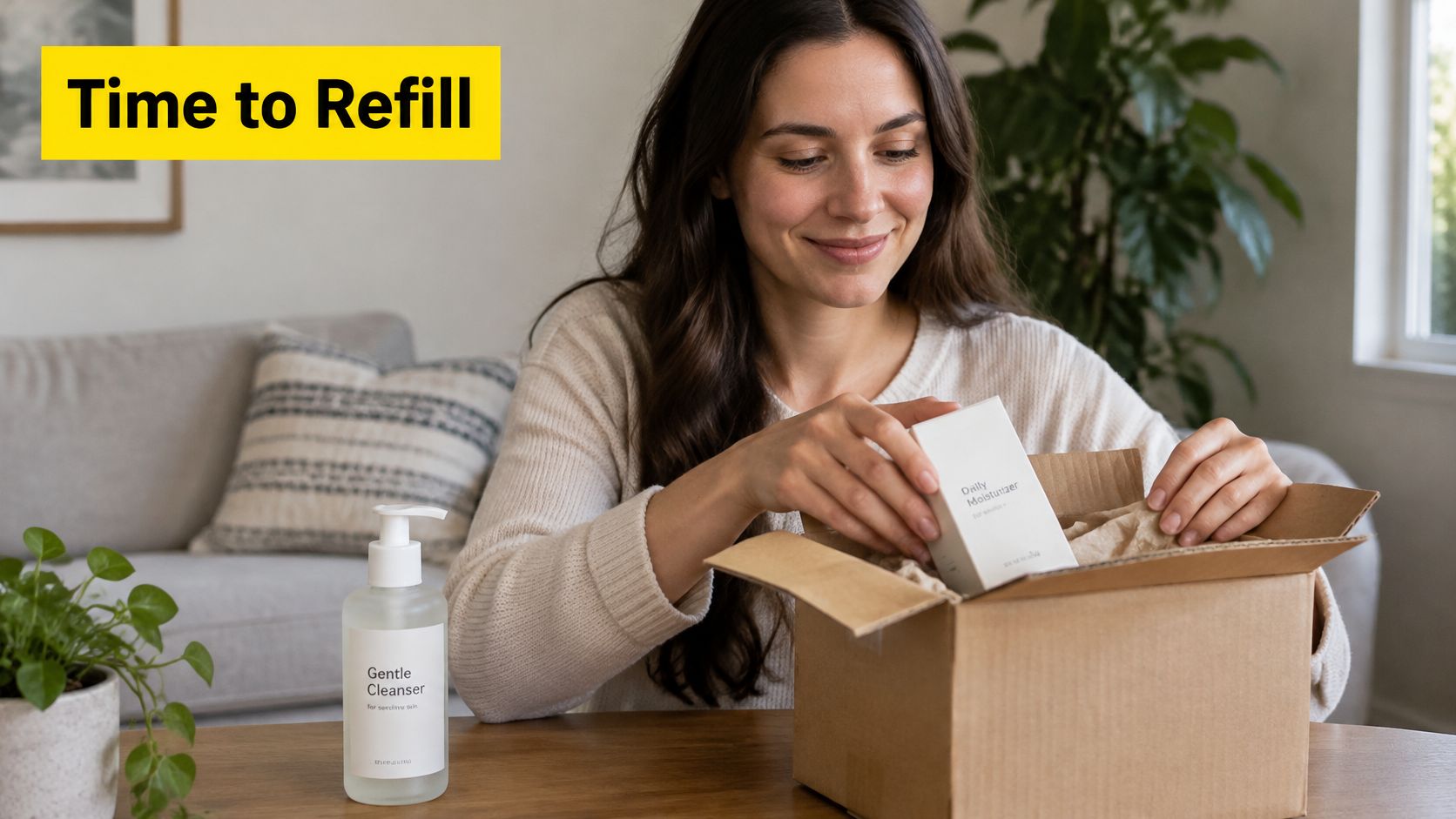
A skincare brand that knows the average bottle lasts 45 days can target buyers on day 40 with a refill reminder and a subscribe-and-save offer. No discount needed, because the timing does the persuading.
Upload hygiene that protects results
Segment by recency and value, not one flat list. Recent high-spend buyers and 18-month lapsed buyers deserve different offers and budgets.
Upload an exclusion list of recent purchasers. Pull it weekly so prospecting campaigns stop paying to re-acquire people who just checked out.
Refresh on a fixed cadence. Weekly for high-volume stores, monthly for longer cycles, so new buyers enter the sequence without manual work.
Confirm consent before anything uploads. Permissioned data is the only data that belongs in an ad account, and it's also the data that matches best.
5. Webinar and Event Attendee Retargeting
A webinar list is really three lists wearing one label. A registrant who never showed up, an attendee who watched to the end, and a viewer who left at minute twenty all arrived at different levels of intent, and each needs a different ad to move forward. This format suits funnels that run on live or recorded education: tax planners in filing season, consultants, course creators.
That research starts early. Registrants compare providers, read reviews, and check pricing on a laptop long before they commit to a call.

Three audiences, three different ads
No-shows get the replay first, framed around what they missed, then a booking invitation with a deadline attached to it.
Attendees who stayed to the end get the case study ad and a consultation link. They already heard the pitch, so they need proof rather than another round of education.
Partial viewers get a short clip of the section they dropped off at, plus the bonus or checklist you promised on the live call.
Two setup mistakes kill this format. The first is measuring registrations instead of booked calls: a campaign that fills a webinar and produces four calls isn't working, whatever the registration cost says. The second is vague urgency. Attach a real deadline or a real bonus, and keep the promise specific enough that you can deliver it. A tax advisor promising "audit-proof filing" is asking for a refund request.
6. Search Remarketing Lists for Search Ads (RLSA)
RLSA is the only remarketing format where the prospect raises their hand again. They type a query into Google, and because they're on your list you can bid more, write a different headline, or both. It's the closest thing to a phone call in paid search.
Tirendo Deutschland showed what a bid adjustment alone can move. The tyre retailer imported audiences collected through its display remarketing, then raised search bids when known visitors searched for tyres. Compared with its standard search campaigns, the RLSA setup increased conversion rate by 161%, cut cost per order by 43%, and lifted turnover by 22%, per Google's RLSA case study. Same keywords, same landing pages, different bids for people who already knew the brand.
Run it as an overlay, not a gate
Start with bid adjustments only. Restricting a campaign to list members slices your reach and hides performance. Add the audience, observe, then adjust.
Write headlines that reference the page they saw. "Still comparing mortgage rates?" beats a generic branded line for anyone who visited your pricing page.
Segment by page type. Pricing page, service page, and blog readers carry different intent and deserve different modifiers.
Use observation mode for two to four weeks before you judge anything. Search volume on a small list takes time to accumulate.
A local med spa is the clean use case. Bid up 20% to 30% on service and branded terms for anyone who viewed the treatment page in the last 30 days, keep new searchers at your base bid, and let the returning visitors pay for the campaign.
7. Social Proof and UGC Retargeting
Warm traffic doesn't need to be reminded what you sell. It needs a reason to believe you. Social proof retargeting swaps the product pitch for a customer who already wrestled with the exact objection your visitor is holding right now.
The trust link is measurable. A 2024 study of 386 e-commerce consumers in South India found that remarketing across email, display, social media, search engines, and video explained 86.2% of the variance in brand attachment, published in the International Journal of Economics, Business and Accounting. Brand attachment is the thing social proof creative is built to produce, so judge these ads on trust and downstream conversion, not on whether the discount got clicked.
Here's the format in motion, a short customer-story cut aimed at people who already visited.
Match the proof to the objection
Price hesitation: a testimonial that names the value, not the discount.
Trust hesitation: a before-and-after with a typical, verifiable result. Exaggerated outcomes convert once and refund twice.
Fit hesitation: a creator unboxing or a customer using the product in a real setting.
Rotate creative every two to three weeks for warm audiences; they see it far more often than cold traffic does. A barbershop can run one 20-second review clip and a booking link for a month and beat a polished brand spot, because a stranger saying the cut was worth it answers the visitor's question.
8. Frequency-Capped Engagement Retargeting on Instagram and Facebook
Instagram profile visitors, people who saved a reel, Facebook page engagers. These are soft signals, well upstream of a cart, and they behave nothing like website visitors. Treat them accordingly.
The usual mistake is intensity. Someone who watched one reel hasn't earned a hard sell, and if your engagement audience overlaps your site audience, that person is now seeing both at once. Overlap is what turns a helpful reminder into the ad everyone complains about.
Set the caps before you set the offer
One to two impressions per week per person across all overlapping ad sets. Check the overlap tool before you add another audience.
Lead with a free resource. A checklist, a treatment guide, a pricing calculator. Something that earns the click without asking for a card.
Exclude converters immediately. If they booked or bought, they leave the engagement audience today, not at the next refresh.
Merge or split lists on a schedule. Audience overlap grows over time; review it monthly and consolidate campaigns that chase the same people.
Soft signal, soft ask. A saved post is curiosity, so answer it with a lead magnet long before a demo request.
A med spa retargeting people who saved a treatment reel with a free consultation offer is the pattern that works, because the offer matches the level of interest. The same business asking a reel-saver to book a $600 package on first touch is guessing.
How the eight remarketing ad formats compare by audience source, channel, and trade-off
Item | Best For | Audience Source | Main Channels | Key Trade-off |
|---|---|---|---|---|
Dynamic Product Retargeting (Catalog Ads) | E-commerce brands with large product catalogs | Shoppers who viewed or added products to cart | Meta, Google Ads, Criteo | Requires clean product feeds and accurate tracking |
Abandoned Cart Retargeting Sequence | Recovering high-intent shoppers who left checkout | Cart abandoners who have not purchased | Meta, Google Ads, email, SMS | Discounts or repeated messages can hurt margins and annoy shoppers |
Video Viewer Retargeting on YouTube and Social Platforms | Moving engaged video viewers toward a conversion | People who watched a specified portion of a video | YouTube, Facebook, Instagram, TikTok | Audience size depends on video reach and consistent content |
Customer List Upload for Re-engagement and Cross-Sell | Re-engaging past customers and cross-selling | Hashed CRM or customer contact lists | Google Ads, Meta | Match rates vary; privacy compliance and list maintenance are required |
Webinar and Event Attendee Retargeting | Converting educational engagement into calls or enrollments | Webinar registrants, attendees, no-shows, and replay viewers | Meta, Google Ads, webinar platforms | Attendance may be limited, and tracking requires coordination |
Search Remarketing Lists for Search Ads (RLSA) | Reaching returning visitors who are actively searching | Previous website visitors searching on Google | Google Search | Limited to Google Search; bid increases can raise costs |
Social Proof and UGC Retargeting | Building trust with hesitant prospects | Website visitors and lead form abandoners | Meta, TikTok | Needs a steady supply of compliant customer content |
Frequency-Capped Engagement Retargeting on Instagram and Facebook | Nurturing social engagers with a focused call to action | People who interacted with social content or profiles | Instagram, Facebook, TikTok | Engagement may not indicate purchase intent; audience overlap can increase ad frequency |
Turning These Remarketing Ad Examples Into Your Next Campaign
Start with the audience you already have. Open your analytics, list every group that's already showing intent, and map each one to a format above. Cart abandoners go to the sequence. Product viewers go to the catalog. Video viewers get the direct-response follow-up. Past buyers get the list upload. Engagement audiences get capped, value-led ads.
Then build one sequence per group instead of one campaign for everyone. A single ad set covering "all site visitors" flattens intent, and flattened intent is why so many retargeting accounts look busy and return little. The brands getting compounding results from these remarketing ads examples run three or four narrow sequences at once, each with a message that matches what the person did last.
Set the guardrails before you scale anything. Frequency caps at three to five impressions per week for catalog and dynamic creative. Purchaser exclusions refreshed weekly. Holds on discounts until the objection-handling step has run. Budget shifts toward whichever segment is producing revenue, not whichever one is producing cheap clicks.
Measure the outcome you get paid for. Booked calls, completed purchases, revenue per thousand impressions. Click-through rate alone will flatter a weak audience and hide a strong one, because a modest click rate on high-intent traffic can still produce far better downstream economics. Compare your remarketing results against a holdout or a historical baseline, and suppress buyers fast enough that your reported return reflects new revenue rather than duplicated exposure.
If you're running the same static banner across every segment, fix that before you add budget. A five-creative rotation per sequence, refreshed every few weeks, is enough to keep warm audiences responsive. Publishers that cover creator-side ad formats have useful notes on building that rotation efficiently; these guides for content creators are worth a read if you produce your own assets.
If you'd rather hand the build to a team that runs these formats across Meta, Google, and TikTok every week, Wojo Media retargets prospects on all social platforms so they keep seeing your ads after they leave your site. A free demo call with Jason or a growth manager is the first step to a custom paid ad strategy built around your funnel.
Wojo Media runs omnipresent retargeting across Facebook, Instagram, TikTok, Google, and YouTube so your prospects keep meeting your offer after they leave, and the team produces the scripted video creatives and ad images those sequences need rather than leaving you to recycle one static banner. If your retargeting is running on a single ad set and a flat budget, visit Wojo Media to book a free demo call and leave with a custom paid ad strategy mapped to your audience segments.
Comments