.png)
Cross Sell Strategy: The 2026 Playbook for Ads & Email

Cross-selling can represent roughly 10% to 30% of e-commerce revenue, according to Salesgenie's cross-selling statistics summary. That's not a decorative recommendation widget. It's a revenue-mix decision that can determine whether growth comes from constantly buying new customers or from serving existing buyers more intelligently.
The mistake is treating every customer as ready for another product. A first-time buyer may still be deciding whether your core offer works. A second purchase may just be a reorder. The strongest cross sell strategy matches the offer to the buyer's maturity, intent, margin profile, and current context.
This playbook is built around that discipline. It covers catalog design, paid ads, onsite placements, email, post-purchase flows, measurement, and a practical third-purchase rule designed to lift AOV without damaging contribution margin or repeat-purchase intent.
What a Cross Sell Strategy Is
A cross sell strategy is a coordinated system for increasing the value of an existing customer relationship by presenting a relevant complementary product or service at the right moment. The goal is not to fill every available placement with recommendations. It is to improve order value while protecting contribution margin, customer experience, and the next purchase.
That distinction matters because buyer maturity changes the offer that can reasonably convert. A first-time customer may still be evaluating the core product. A second purchase may confirm product fit or function as a reorder. A complementary offer becomes more credible when the customer has enough experience with the original purchase to understand what would improve it.
Cross-selling allocates traffic, messaging, inventory, and customer data toward adjacent demand. The agency metrics behind that decision include AOV, contribution margin, attach rate, repeat-purchase rate, refund behavior, and support volume. A recommendation that raises checkout value but increases refunds or suppresses the next order is not a successful cross-sell.
The vocabulary matters
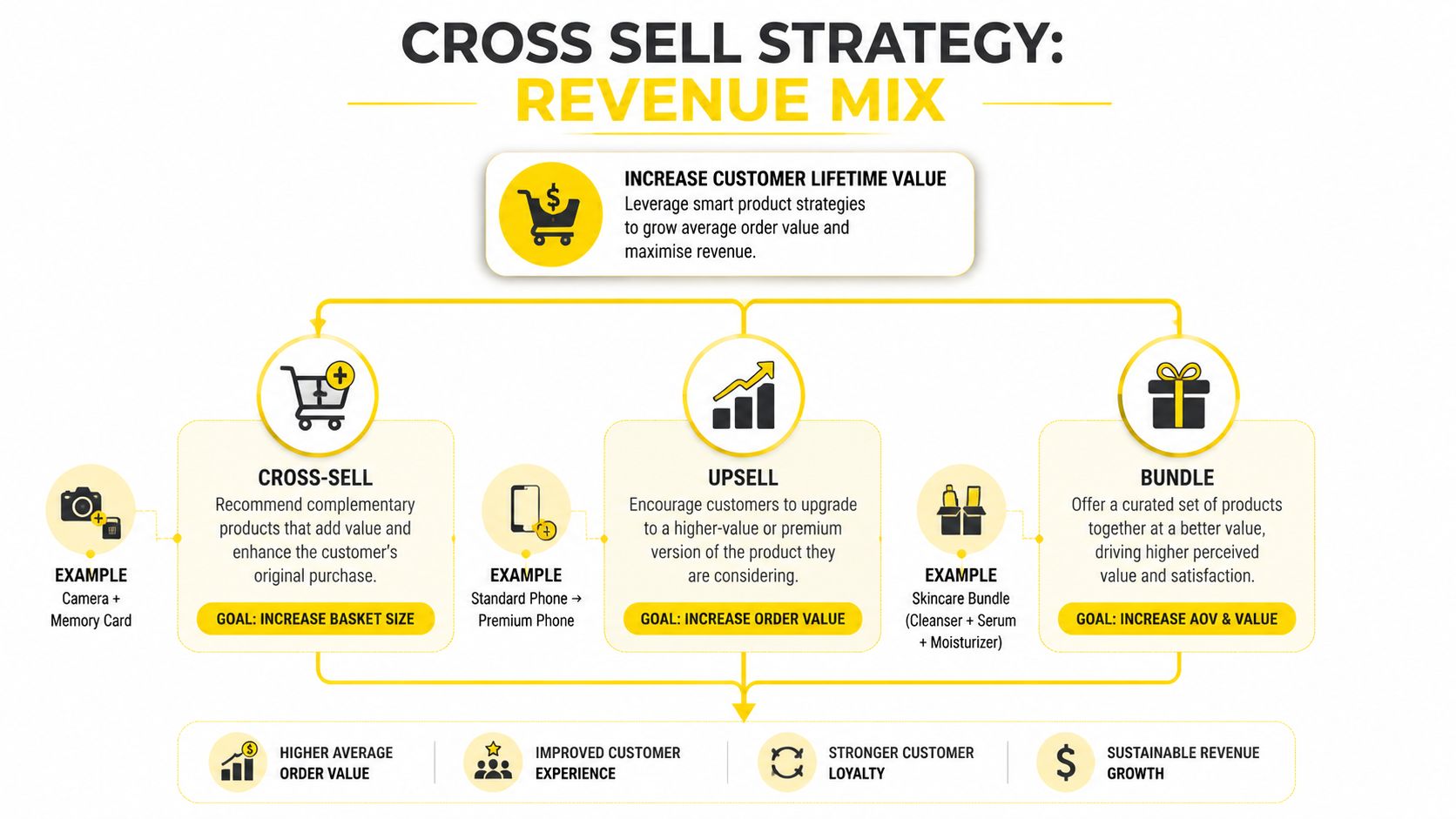
Cross-selling adds a related product that improves or completes the original purchase. A skincare brand might recommend cleanser with a face cream. A med spa might offer a membership after a treatment. A course creator might add an implementation workshop to a flagship program.
Upselling moves the customer to a higher-value version of the product they already want. Examples include premium fabric, a larger size, a higher software tier, or a treatment package with more included services.
Bundling combines multiple products or services into one packaged offer. A bundle can contain a cross-sell, an upsell, or both. Its defining feature is that the items are merchandised and purchased together as one unit.
Where the motion appears
Cross-sell opportunities can appear throughout the buyer journey:
Ad click: Show a complementary product to an existing customer and exclude that customer from prospecting campaigns.
Product detail page: Recommend products that complete the use case, not items grouped only by category.
Cart and checkout: Offer a simple add-on that needs little explanation.
Post-purchase: Introduce the adjacent product after the customer has received value from the first purchase.
Email and SMS: Use browsing, purchase, and replenishment behavior to set the offer and timing.
Account or service experience: Let support, success, or front-desk teams recommend the next logical step.
The third-purchase rule gives these placements a useful boundary. Earlier purchases should prove the core offer and establish fit. After the third purchase, complementary recommendations can become more relevant, provided the data supports them. A serious cross sell strategy raises order value without sacrificing margin or the customer's reason to return.
Auditing Your Catalog and Offers First
Most cross-sell programs fail before the first ad runs. The catalog contains products that don't belong together, discounts that erase profit, or add-ons that create fulfillment and support problems. A recommendation engine can only automate the inputs it receives. If the inputs are weak, automation scales the weakness.
Start with a product-pair map. Put every SKU, service, or program into one of three groups:
Complementary: The item makes the original purchase easier, more complete, or more useful. A phone case complements a phone. A maintenance plan complements an HVAC installation.
Substitute: The item solves the same job in a different way. This is usually an upsell or alternative, not a cross-sell.
Unrelated: The customer may like it, but there's no obvious reason to show it at the moment of purchase.
The distinction sounds basic, but many stores confuse “same audience” with “same use case.” A customer buying running shoes may need socks or a hydration belt. They don't automatically need an unrelated lifestyle product just because both products appeal to runners.
Score every offer before merchandising it
Give each potential add-on a practical score based on four inputs:
Affinity: Does the product naturally belong with the original purchase?
Contribution margin: After product cost, shipping, payment fees, discounts, labor, and expected support, does the add-on contribute profit?
Inventory health: Can the business fulfill demand without creating stockouts or substituting a weaker product?
Customer outcome: Does the add-on help the buyer use, maintain, or extend the value of the original purchase?
Then check historical order-line data. Look for products that already appear together in the same transaction, but don't treat co-purchase as proof of a good recommendation. A pair may sell together because of a temporary promotion, an inventory quirk, or a checkout default. Validate the reason behind the pairing.
Practical rule: A high attach rate doesn't rescue an offer with poor contribution margin.
The audit changes by business model. An e-commerce brand can analyze multiple SKUs per order and build recommendations around routine completion. A local service business might pair a first med spa treatment with a membership, or a barber appointment with a retail grooming product. A coach or course creator may pair a core program with implementation support, a workshop, or a community tier. In each case, the add-on should remove a predictable obstacle after the primary purchase.
Build the kill list
Create a separate list of offers that should not be promoted. Remove add-ons that require heavy servicing, carry weak margins, create confusing fulfillment, or attract buyers who are likely to request refunds. Also remove discounts that make the larger order look healthy while reducing contribution profit.
Your one-page audit should contain the original product, proposed add-on, customer job, margin status, inventory status, evidence of affinity, preferred placement, and an explicit keep, test, or kill decision. If the team can't explain why the pair belongs together in one sentence, it isn't ready for a cross-sell campaign.

Deploying Cross Sell Across Ads, Funnels, and Email
Cross-selling works best when each channel has a defined job. Paid ads create demand for a complementary outcome. The product page explains the relationship. Cart and checkout reduce the effort required to add the item. Email and SMS wait for stronger behavioral evidence.
Paid ads should sell the completed outcome
For existing customers, use catalog or dynamic product ads to show the next logical product. Exclude current customers from acquisition campaigns, then build a separate audience for buyers who are eligible for an adjacent offer. The creative shouldn't lead with “buy another SKU.” It should show the completed routine.
A customer who bought a cleanser might see creative for the moisturizer that follows it. A customer who completed a first med spa treatment might see the maintenance logic behind a membership. A course buyer might see the workshop that helps them implement the material rather than another abstract promise.
Keep the ad angle specific:
“Complete your morning routine.”
“Protect the result you already paid for.”
“Turn the plan into a repeatable process.”
“Add the tool that removes the next bottleneck.”
These messages give the add-on a job. Price-led creative often attracts discount seekers without establishing why the second product matters.
Onsite placements need rules
Use product detail pages for complementary products that require context. Use cart drawers for simple, low-friction additions. Reserve checkout for items that won't distract from payment or create delivery confusion. A post-add-to-cart modal can work when the offer is tightly connected, but it should never trap the customer or make the original purchase harder to complete.
For local services, the funnel may be conversational. A med spa can present membership benefits after the first treatment is booked, while a barber can recommend a styling product during the appointment when the customer has already experienced the service. A course creator can offer a workshop after the buyer understands what the flagship program includes.
Email and SMS should follow behavior
Browse-abandonment messages can feature a complementary item only when the customer has shown interest in the original category. Post-purchase messages should teach the customer how to get value from the first purchase before introducing a related offer. Replenishment flows can pair the reorder with an adjacent item, but the core replenishment message should remain easy to act on.
Teams that want to build this systematically can use marketing automation flows that lift revenue as a practical reference for lifecycle sequencing and triggered messaging.
Limit the number of prompts. One or two relevant cross-sell prompts per session beats six generic recommendations, because repeated interruptions make the customer work harder to understand what matters.
Channel | Placement | Typical KPI | Creative cue |
|---|---|---|---|
Paid ads | Customer-only catalog or dynamic ads | Incremental revenue and return on ad spend | Show the completed use case |
Product page | Complementary product module | Add-to-cart rate and attach rate | Explain why the items work together |
Cart | Drawer or inline add-on | Cross-sell transaction rate | Make the add-on quick to accept |
Checkout | Low-friction add-on | Incremental gross margin | Remove delivery and compatibility doubt |
Post-purchase or replenishment flow | Click-to-purchase and repeat rate | Teach before asking | |
SMS | Contextual trigger | Purchase rate and unsubscribe rate | Keep the message narrow and timely |
Service experience | Staff recommendation or account offer | Close rate and customer satisfaction | Tie the offer to the customer's stated need |
A channel earns its placement by producing profitable incremental behavior, not by making the funnel look more complex.
The Third-Purchase Timing Rule
The second purchase is often treated as the perfect cross-sell moment. That assumption is usually too aggressive.
A 2026 best-practices analysis from Prospeo's cross-selling guidance reports that cross-sells often work better on the third purchase or later, when the buyer has demonstrated trust and an established pattern. In the studied set, 77% of second purchases were reorders, which suggests that many customers returning for the second time are still replenishing the core product rather than exploring a new category.
That finding supports a maturity ladder:
First purchase means validation
The first order answers a basic question: does the product deliver what the customer expected? The post-purchase experience should reduce uncertainty, support successful use, and make fulfillment feel dependable. Aggressive cross-selling at this stage can compete with the trust-building job.
There are exceptions. A necessary accessory, compatibility item, or setup service can belong in the first transaction. The test is functional relevance, not the brand's desire to increase AOV.
Second purchase means habit formation
The second order often confirms that the customer wants the same product again. Prioritize the reorder, a larger quantity, or a same-category expansion. If the customer is still learning the core product, sending them into another category creates unnecessary cognitive load.
Many brands waste attention. They interpret repeat buying as broad product interest when it may only indicate satisfaction with one specific item.
Third purchase means adjacent exploration
By the third purchase, the customer has supplied stronger evidence of fit. That's the point to introduce an adjacent category, a complementary routine, or a service that deepens the original outcome.
Don't use purchase count as the only eligibility rule. Check repeat behavior, AOV trajectory, email engagement, browse depth, product education completion, and support history. A buyer who makes a second purchase and repeatedly browses the adjacent category may be ready earlier. A buyer who reorders without exploring anything else probably isn't.
Relevance and timing outperform volume. A customer who receives fewer, better prompts is easier to retain than one who gets every possible offer.
Use high-friction moments as triggers. A customer asking how to protect a product, replace a missing component, or get a better result has revealed a cross-sell opportunity. Post-fulfillment satisfaction can also create a safer window, provided the first product has arrived and the customer has had a reasonable chance to use it.
The operating rule is straightforward: cap cross-sell prompts at one or two per session, then let behavior determine the next offer.
Measuring Cross Sell Performance the Right Way
Attach rate is a starting signal, not a verdict. A campaign can add items to orders while reducing contribution margin, increasing support demand, or weakening the next purchase. Measure the customer's full economic response, not only the extra unit.
Build the KPI stack
Cross-sell transaction rate measures the share of transactions that include an added item:
Define attach rate at the item or order level before comparing campaigns. “Orders with any add-on” and “units attached to a core product” answer different questions. Combining them creates false wins.
AOV lift compares average order value before and after the cross-sell motion:
Use a suitable holdout when possible. AOV can rise because of a promotion or seasonal shift affecting the entire store, so the movement alone does not establish incrementality.
Cross-sell close rate also depends on its denominator. APQC defines cross-sell and upsell close rate as the percentage of inbound contacts that complete an additional sale, as described in Umbrex's retail effectiveness analysis. Track two versions:
Decided-only close rate: completed cross-sells divided by opportunities where the buyer made a yes or no decision.
True conversion: completed cross-sells divided by all eligible opportunities, including no-decision cases.
Put economics beside behavior
Track incremental gross margin, not incremental revenue alone:
Pair that result with 30-day repeat purchase rate, support-ticket volume, and NPS. A high immediate attach rate paired with weaker repeat behavior or heavier support demand calls for a pause, not a larger budget.
Industry benchmark guidance places decided-only cross-sell conversion for SMB and velocity motions at 40% to 65%, while enterprise add-on motions commonly fall at 25% to 45% because of legal, security, and integration friction, according to Umbrex's cross-sell conversion analysis. Treat these ranges as directional frameworks, not universal targets.
Motion | Decided-only close rate | True conversion | Common pitfall |
|---|---|---|---|
SMB and velocity | 40% to 65% | Usually lower once no-decisions are included | Transparent bundles can hide weak qualification |
Enterprise add-on | 25% to 45% | Usually lower once legal, security, and integration cases are included | Treating every account as ready |
Keep the dashboard to one screen. Place creative and placement at the top, transaction rate and AOV in the middle, then gross margin, repeat purchase, support volume, and NPS below. This structure connects buyer maturity and timing to the backend KPIs that determine whether a cross-sell motion is improving the business.
Diagnosing and Fixing a Stalled Program
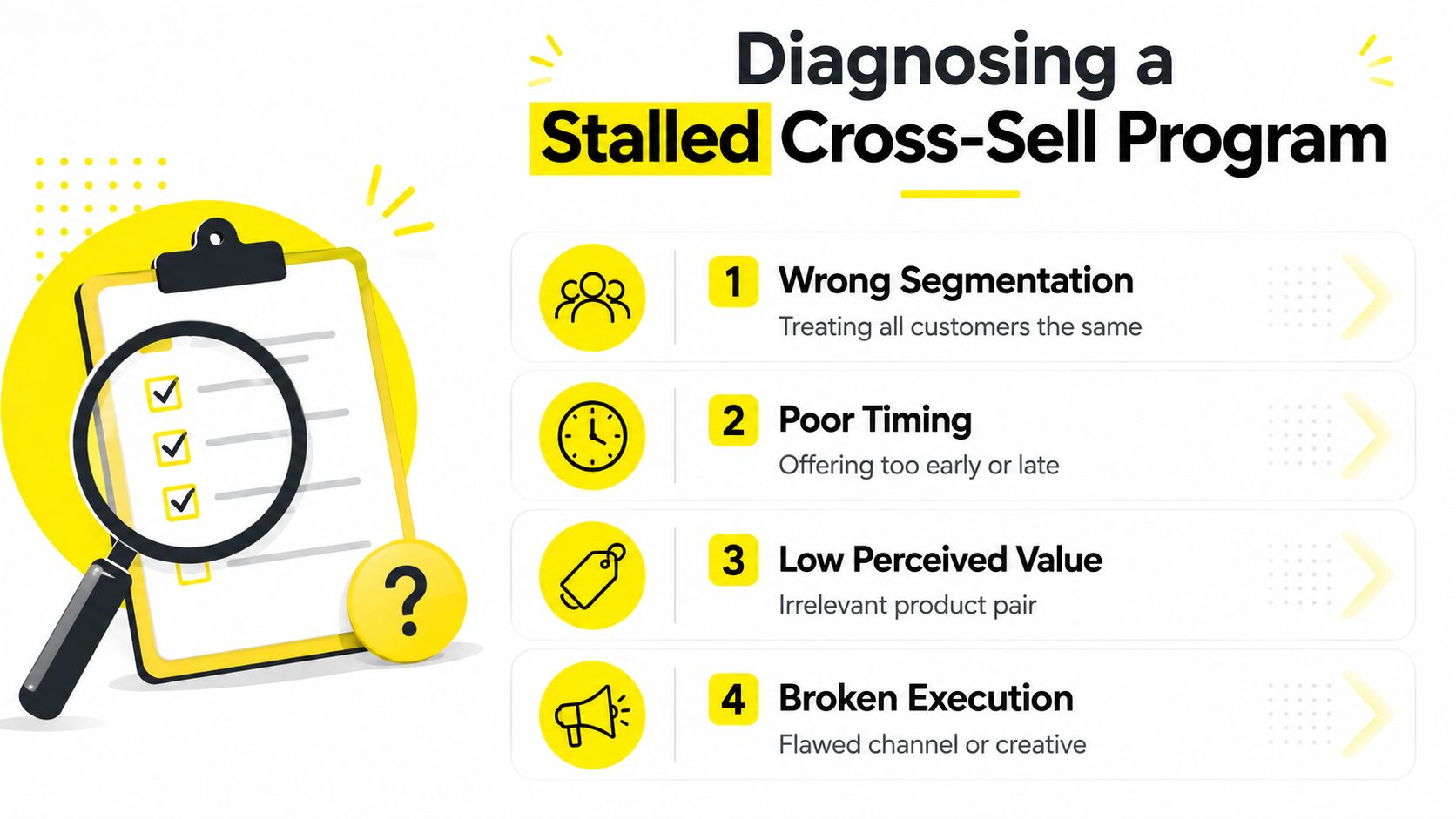
A stalled cross-sell program usually has a timing, economics, or message problem. Start by comparing eligibility rules, placement, creative, and contribution margin with the backend dashboard. A recommendation shown to every buyer can create activity without improving AOV or profit.
Wrong segmentation
Diagnostic question: Are customers eligible because they bought once, or because their purchase history and intent support the next offer?
Dashboard signal: Broad exposure, weak click-through, low true conversion, and uneven results across purchase cohorts.
One-week fix: Separate first-time buyers, reorder customers, mature customers, and shoppers showing adjacent-category intent. Apply the third-purchase rule where the data supports it. Suppress buyers who already own the proposed add-on.
Margin trap
Diagnostic question: Does the add-on remain profitable after discounting, shipping, labor, and service?
Dashboard signal: Attach rate rises while incremental gross margin falls.
One-week fix: Remove weak offers, reduce unnecessary discounts, and test a clearer value explanation instead of a lower price. A bundle that moves more units but creates costly support is not a healthy bundle.
Creative fatigue
Diagnostic question: Does the ad or email explain why the second product matters, or does it only display the SKU?
Dashboard signal: The pairing remains relevant, while engagement and conversion decline in placements that previously worked.
One-week fix: Create new messaging around the customer's next job. Show the routine, result, setup, protection, or implementation benefit. Keep the product relationship visible in the first frame and first sentence.
Unprofitable cross-buyers
A cross-sell offer can attract customers whose checkout value looks healthy but whose later economics are poor. The issue may sit in the audience, not the offer.
Diagnostic question: Which cross-buyers generate repeat profit after support and fulfillment costs?
Dashboard signal: Add-on buyers create refunds, tickets, discount dependence, or weak future value despite a strong initial transaction.
One-week fix: Add a profitability screen to eligibility. Suppress segments with poor contribution economics and redirect budget toward customers whose original purchase and service profile support the adjacent offer.
Run a monthly checklist:
Eligibility: Are maturity and intent rules still accurate?
Affinity: Does each pair solve a recognizable customer problem?
Profitability: Did costs, discounts, or servicing requirements change?
Creative: Has each major placement received a fresh reason to care?
Downstream quality: Are repeat purchase, support volume, and NPS stable?
Use the answers to decide whether to revise the offer, narrow the audience, refresh the message, or stop the motion.
Your 30-Day Cross Sell Rollout
A workable rollout doesn't need every channel. It needs a clean offer, a focused surface, persuasive creative, and reliable data.
Week one builds the commercial map
Audit the catalog, map complementary products, score contribution margin, check inventory, and create the kill list. Pull order-line data and identify pairs worth testing. Write the customer job for each pair in plain language.
Week two chooses the first surfaces
Start with two placements, such as a product-page recommendation module and a post-purchase email. Define who qualifies, who gets excluded, what happens after acceptance, and what happens after rejection. Keep the experience narrow enough that the team can read the result.
Week three sells the reason
Create ads, email modules, landing-page sections, and service scripts that explain the value of the add-on. Don't recycle a product image with a “you may also like” headline and call it strategy. Show how the second offer completes, protects, extends, or implements the first.
Week four instruments and reviews
Launch with event tracking for impressions, clicks, transactions, AOV, gross margin, and downstream behavior. Take a 14-day read on attach, AOV, and margin, then avoid premature conclusions when the purchase cycle is longer. The initial review should identify broken execution and obvious losers, not force a final lifetime-value judgment.
The four operating pillars stay consistent: offer, landing pages, omnipresent ads, and data. The offer determines whether the add-on deserves attention. Landing pages make the relationship clear. Ads bring the message to eligible customers across channels. Data decides whether the motion deserves more budget.
Cross-sell strategy isn't a one-time merchandising project. It's a recurring, margin-aware operating motion that gets sharper as the brand learns which buyers are ready for the next relevant product.
Wojo Media helps brands connect cross-sell offers to conversion-focused landing pages, omnipresent paid campaigns, and backend KPI tracking instead of relying on generic recommendation widgets. Visit Wojo Media to discuss a practical cross-sell growth plan for your e-commerce, local service, or course business.
Comments