.png)
Facebook Ads for Coaches That Actually Book Clients

You're probably in one of two spots right now. Either you've tried Facebook ads for your coaching business and got a pile of leads that never booked, never showed, or never bought. Or you haven't launched yet because every guide sounds like the same advice recycled: pick an audience, write some copy, send traffic to a lead magnet, hope for calls.
That's the wrong frame.
For most coaches, Facebook ads for coaches aren't a lead problem first. They're a quality problem. Meta can deliver names, emails, and form fills all day. The hard part is getting the right people to raise their hand, book, show up, and become clients without clogging your CRM with low-intent junk.
The accounts that scale usually aren't the ones with the cheapest leads. They're the ones with the cleanest full-funnel system. Better creative. Better qualification. Faster follow-up. Better tracking. Better feedback loops between ads, calendar bookings, and closed deals.
Why Most Coach Ad Accounts Stall Before They Scale
Most coach ad accounts don't fail because Facebook stopped working. They fail because the account is optimized for the wrong win.
If your campaign is built around the cheapest possible lead, Meta will find you the cheapest possible lead. That sounds obvious, but coaching funnels break. The platform isn't judging lead quality the way your sales process does. It's rewarding the event you feed it.
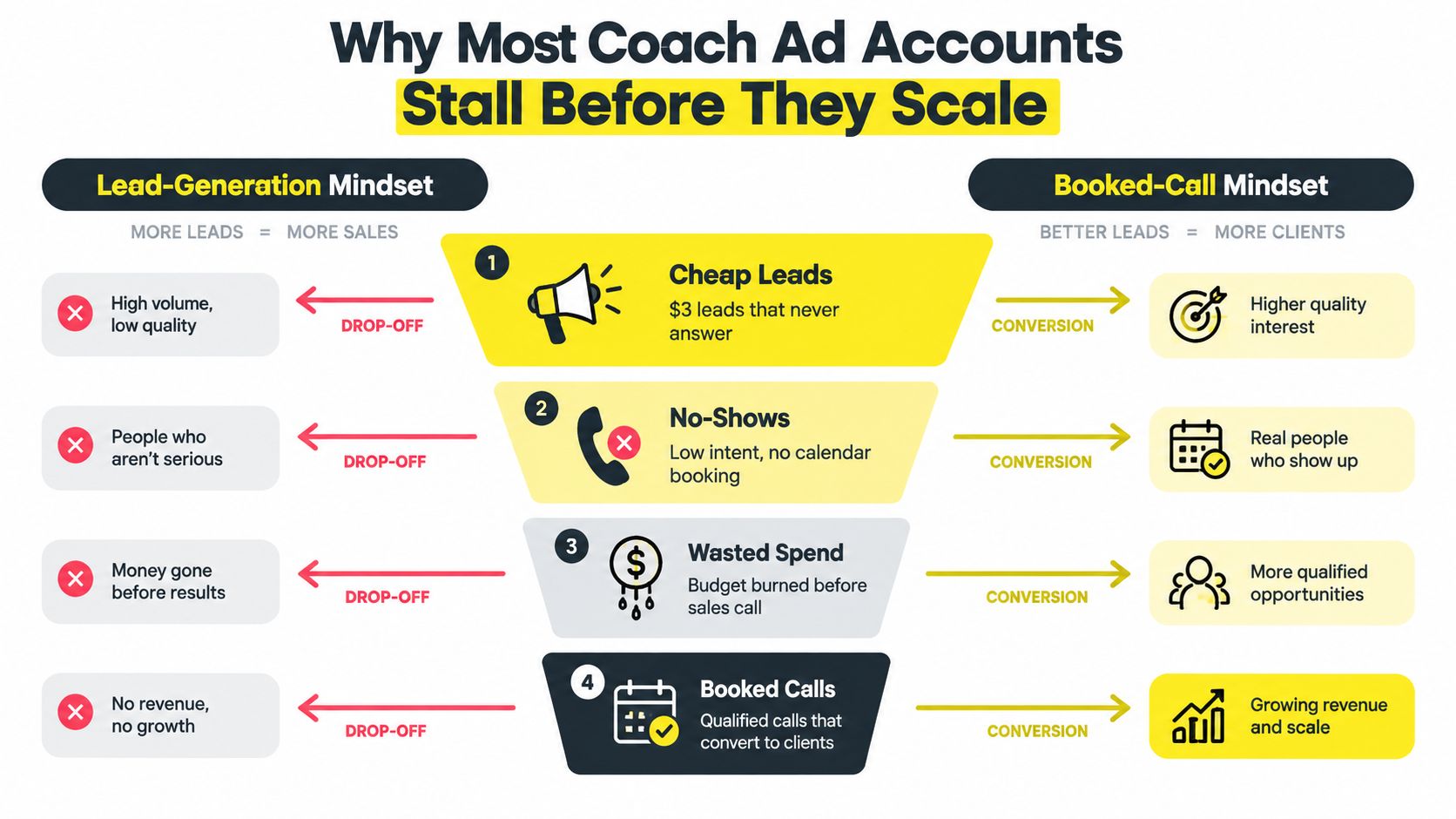
Cheap leads are often the wrong signal
A lot of coaches obsess over CPL because it's the first number they can see. That's how you end up with ads that generate curiosity clicks and soft opt-ins from people who liked the message but had no real buying intent.
The problem gets worse on cold traffic. Industry benchmark data shows prospecting CTR is typically only 0.6% to 1.0%, while retargeting can reach 1.2% to 1.8%. It also shows warm-traffic landing pages convert about 3% to 8%, while higher-intent Meta Instant Forms can reach 10% to 15% post-click conversion. Coaches who add 2 to 3 qualifying fields or questions usually cut wasted leads and improve sales-call quality, according to this Meta lead generation benchmark breakdown.
Practical rule: If your ad account rewards completed forms but your business makes money from attended calls, you're training Meta to solve the wrong problem.
The downstream damage is predictable:
Sales follow-up slows down because the team stops trusting inbound leads.
The CRM gets polluted with people who were never a fit.
Retargeting audiences get weaker because low-intent traffic dilutes your warm pools.
Creative decisions get distorted because ads are judged by CPL, not client acquisition.
The account has to revolve around booked calls
For coaches, the KPI stack that matters is usually simple: qualified applications, booked calls, show rate, close rate, and client acquisition cost. That's the business. The ad account should reflect it.
That also changes how you think about branding. The coaches who convert best on paid traffic usually already have a clear point of view, a clear promise, and proof that feels human instead of manufactured. If that part is still fuzzy, it helps to study how coaches build authentic brands, because ad performance often breaks where positioning is vague.
A coaching ad account scales when sales and media buying use the same definition of a good lead.
Recent coaching-focused guidance also points to the same bottleneck. The issue isn't just lead cost. It's downstream quality, follow-up speed, and whether the account tracks all the way to booked calls and revenue. That's exactly why this coaching analysis on low-intent Facebook leads emphasizes measuring beyond the lead and using complete tracking with Pixel plus Conversions API.
Lock In the Offer and Funnel Before You Spend a Dollar
Most ad problems are offer problems wearing ad-account clothing.
If the promise is muddy, the price is awkward, or the funnel asks for too much trust too early, no amount of targeting finesse fixes it. Before spending anything, coaches need to settle four decisions: what front-end entry point they'll use, what funnel matches the offer, what exactly they're selling, and how they'll filter the wrong people out.
Start with the front-end commitment
A free front-end can work when trust is low and the offer needs more education. A paid front-end can work when the audience already understands the problem and a small purchase acts as a commitment filter.
A business coach might use a low-ticket workshop to pre-qualify buyers for a group program. An executive coach selling a premium engagement usually doesn't need more free leads. That coach needs fewer, better applications from people with urgency, budget, and authority to buy.
Match the funnel to the offer
The funnel should fit the sales motion, not whatever template a guru sold last year.
Funnel Type | Best For | Front-End | Core Offer | Key Conversion Event |
|---|---|---|---|---|
VSL funnel | Higher-ticket coaching that needs mechanism and belief shift | Free training or direct-to-video page | Premium program or private coaching | Application submitted |
Webinar funnel | Group coaching with education-heavy sales process | Registration for live or evergreen webinar | Cohort-based or group program | Booked call or checkout |
Application funnel | High-trust 1:1 coaching | Direct response ad to application page | Private coaching engagement | Qualified call booked |
Instant Form funnel | Lower-friction lead capture | Native Meta form | Lower-ticket consult or nurture sequence | Qualified lead passed to CRM |
Define the core offer in plain language
Most coaches describe outcomes too vaguely. “Transform your life,” “step into alignment,” and “become your best self” are hard to buy from cold traffic because they don't anchor the problem or the mechanism.
Your offer needs four things:
A sharp problem statement: Who is stuck, and what are they stuck in?
A clear mechanism: What do you do differently from generic coaching?
A buying frame: Is this private coaching, a group container, or a structured program?
A qualification line: Who should not apply?
That last piece matters more than many coaches think. Good ads repel as much as they attract.
Build qualification into the funnel
The cleanest way to improve Facebook ads for coaches is often to make it harder for the wrong person to get through.
That can happen in several places:
In the ad itself, by speaking to a defined stage of awareness or income level.
On the landing page, by naming who the offer is for and who it isn't.
Inside the form, by asking fit-based questions.
On the calendar page, by setting expectations for the call.
If you need to “figure out” whether someone is a fit only after they book, the funnel is under-qualified.
Creative and targeting work best when the sales path is already coherent. If the offer can't persuade cold traffic with a believable promise and a sensible next step, ad spend just exposes the weakness faster.
Creative That Books Calls, Not Just Clicks
Most coaching ads fail at the same moment. They look like ads.
They're polished, abstract, brand-heavy, and full of language that sounds thoughtful but doesn't create urgency. Meta's environment has shifted hard toward short-form, native-feeling content, and coaching campaigns feel that shift more than most categories.

Recent independent coaching examples suggest testimonial-led or story-led Reels tend to outperform static images and polished brand videos, and most coaches should test for 4 to 6 weeks or at roughly EUR 300 to 500 per month before expecting optimization to settle, based on this 2026 coaching ad analysis.
Use a two-track creative system
The strongest coaching accounts usually run two different creative jobs at once.
Track A uses social-proof Reels
These are short, human, low-production clips. They don't need to look expensive. They need to feel believable.
A simple hook formula that works well in testimonial-style UGC is:
“I almost said no to [type of coaching] because…”
“I thought my issue was [surface problem], but it was [deeper problem].”
“I was skeptical because [objection], then I realized [insight].”
What matters is the before-state, the turning point, and the concrete shift in how the client thinks or acts now. Keep it specific. Keep it conversational.
Track B uses direct-response video
The coach addresses the problem more directly. A good structure is hook, diagnosis, mechanism, invitation.
For a relationship coach, that might sound like this:
Hook: “If every disagreement in your relationship turns into the same fight, the issue usually isn't communication.”
Diagnosis: “Most couples are trying to solve tension at the surface, after resentment has already built up.”
Mechanism: “What changes things is learning how to catch the pattern earlier and interrupt the loop before it escalates.”
CTA: “If you want help rebuilding trust without another circular conversation, apply for a call.”
What to test inside the creative
Don't test everything at once. Test the variables that change buyer response.
Hook angle: Pain, aspiration, objection, or myth-busting
Actor: Coach, client, or creator-style spokesperson
Story frame: Personal story, client perspective, or tactical teaching
A simple review standard works well. If an ad can't hold attention, create qualified clicks, or produce meaningful downstream behavior, it doesn't deserve more budget.
Here's a solid walkthrough on building performance creative for paid traffic:
Good coaching creative doesn't try to impress cold traffic. It makes the right prospect feel understood fast.
Audience Structure for Coaching Campaigns
Audience structure matters, but not in the way most coaches think. You usually don't need dozens of tiny interest stacks and endless exclusions. You need a clean system that separates scale traffic from intent traffic and lets you read performance by audience temperature.
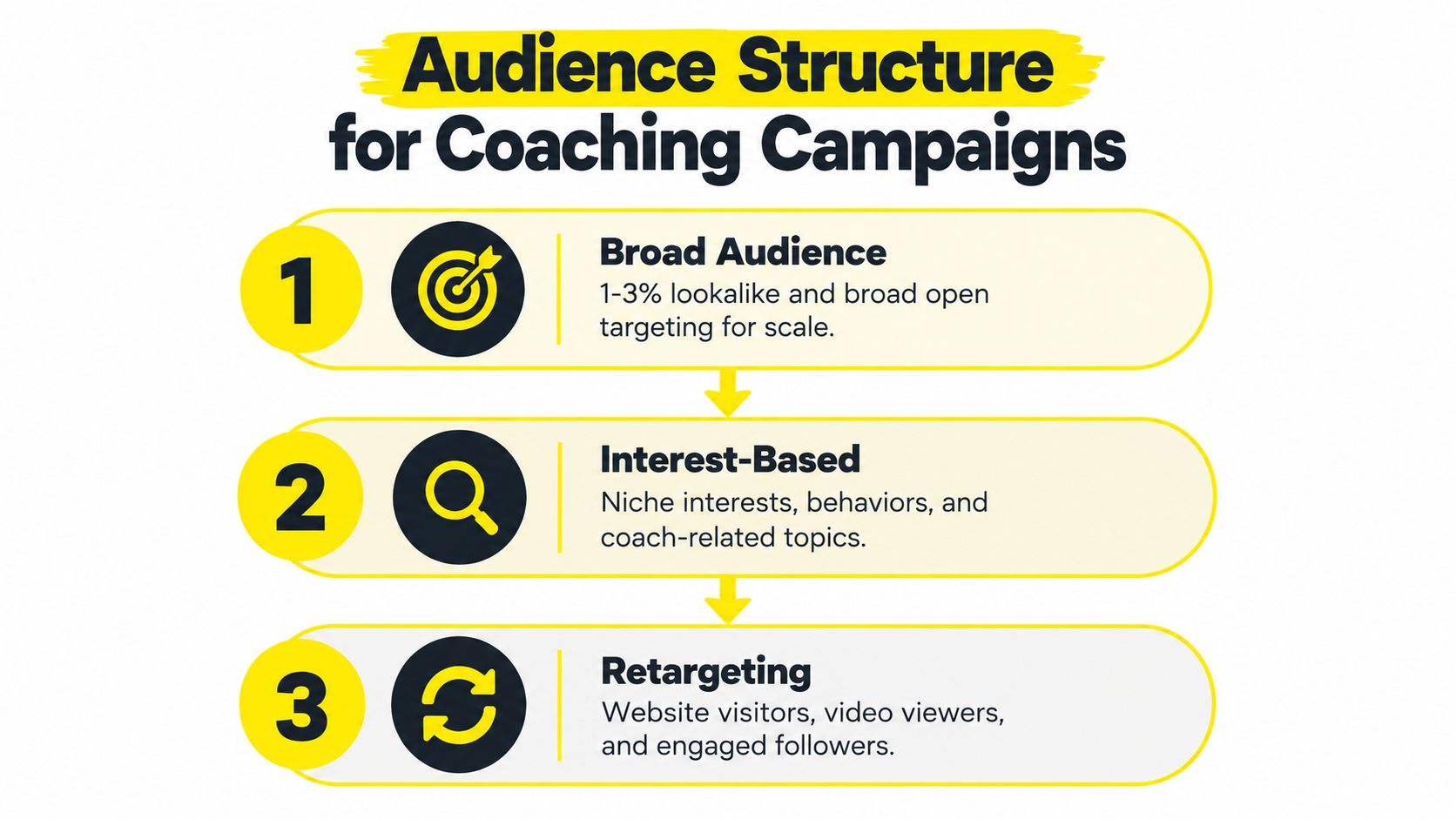
Run three audience layers in parallel
Start with a top layer for scale, a middle layer for directional targeting, and a bottom layer for retargeting.
Broad and lookalike at the top
Use broad geo, age, and gender parameters that match the offer. Add lookalikes seeded from your best first-party conversion data when you have it. For coaches, that usually means booked calls, attended calls, or buyers. Email-list lookalikes are weaker when the list contains freebie seekers and old contacts.
Keep this layer simple. Broad often outperforms overbuilt targeting when the creative and conversion signal are strong.
Interest stacks in the middle
Interest targeting still has value in coaching when it reflects the buyer's actual world, not just famous names. Some examples:
Business coaches: Entrepreneur media, business education, founders, sales training
Health coaches: Fitness apps, wellness brands, habit-change content, nutrition tools
Relationship coaches: Dating platforms, relationship educators, marriage content, communication themes
Executive coaches: Leadership development, management training, decision-making, career advancement
Use interest stacks to create hypotheses, not identity. If an audience works, it's because the message met intent.
Build a retargeting waterfall
Retargeting is where many coaching campaigns recover efficiency because the audience already knows the face, offer, or idea.
A simple waterfall works well:
Retargeting Tier | Audience | Goal |
|---|---|---|
Tier 1 | Video viewers with deeper engagement | Move interested people into the funnel |
Tier 2 | Landing-page visitors from recent traffic | Recover drop-off before booking |
Tier 3 | Form openers, leads, or email engagers who haven't booked | Push action with urgency and objections |
Exclusions matter just as much as targets.
Remove current clients so you don't waste spend.
Exclude recent bookers from booking campaigns.
Filter obvious poor fits where relevant, such as job seekers applying to executive coaching that's meant for leaders and operators.
Name campaigns so the data stays usable
Use a naming system that tells you three things at a glance: offer, audience tier, and creative angle. If you can't audit spend by funnel stage and traffic temperature quickly, scaling gets messy fast.
Budgets, Bidding and Realistic 2026 Benchmarks
A lot of frustration with Facebook ads for coaches comes from bad expectations. Coaches compare their account to screenshots from unrelated niches, then assume the platform is broken when their economics don't line up.
The better move is to plan around category benchmarks and work backward from client value.
A 2025 benchmark cited in industry reporting found that Facebook lead campaigns averaged a cost per lead of $27.66, up from about $22.87 the year before, with an average cost per click of $1.92 and a conversion rate of 7.72%, according to this Meta benchmark summary for business coaches. For coaches, that matters because the traffic is still measurable, but it's more expensive than many people expect.
A coaching-specific 2026 benchmark reported executive coaching campaigns on Meta at a 0.88% click-through rate, a 3.2% conversion rate, a 2.1x return on ad spend, and an average cost per acquisition of £72 for optimized campaigns. The same source listed a broader coaching range of 1.1% to 1.5% CTR, 2.5% to 4.0% CVR, and 3.4x ROAS for life and career coaching, while noting the all-industry Meta median at 1.72% CTR and $1.18 CPC, in this 2026 coaching benchmark report.
What these numbers actually mean
The takeaway isn't that you should chase benchmark parity. It's that coaching is sensitive to positioning, creative, and funnel quality. Small changes in message or qualification can move outcomes materially because the category sits close to trust, identity, and discretionary buying.
That also means niche matters. Executive coaching and broader life or career coaching don't behave the same. One often asks for more trust and larger commitments from a narrower buyer pool.
Set budgets around signal, not hope
A practical budgeting framework looks like this:
Niche | Target CPL | CTR (link) | Show Rate | Close Rate | Effective CPA |
|---|---|---|---|---|---|
Executive coaching | Qualify for higher CPL expectations based on benchmarked acquisition costs | Use the 0.88% CTR benchmark from the linked source | Track internally | Track internally | Calculate from your own booked and closed data |
Life or career coaching | Aim within your own historical range while comparing against broader coaching benchmarks | Use the 1.1% to 1.5% CTR range from the linked source | Track internally | Track internally | Calculate from your own funnel data |
Broad coaching campaigns | Sanity-check against the $27.66 CPL benchmark for lead campaigns | Compare with your own account data | Track internally | Track internally | Calculate from qualified calls through sales |
If you're early, start with a budget you can sustain long enough to get usable feedback. That usually means resisting the urge to make dramatic budget jumps after one good day.
Operator note: Scale the ad set that produces booked calls and attended calls. A cheap lead source that poisons the sales pipeline is not a winner.
Keep bidding simple at first
Start with Meta's default optimization unless you have enough stable downstream signal to constrain delivery intelligently. Cost controls can help later, but they don't rescue weak offers or weak conversion events.
The more useful budget question is this: can your sales process absorb and convert the lead volume you're buying? If the answer is no, scaling spend just magnifies operational waste.
Tracking the Path From Click to Paying Client
Most coaches can tell you what they spent and how many leads came in. Far fewer can tell you which ad produced booked calls, which lead source created show-ups, and which campaign turned into revenue.
That gap is where a lot of ad spend disappears.
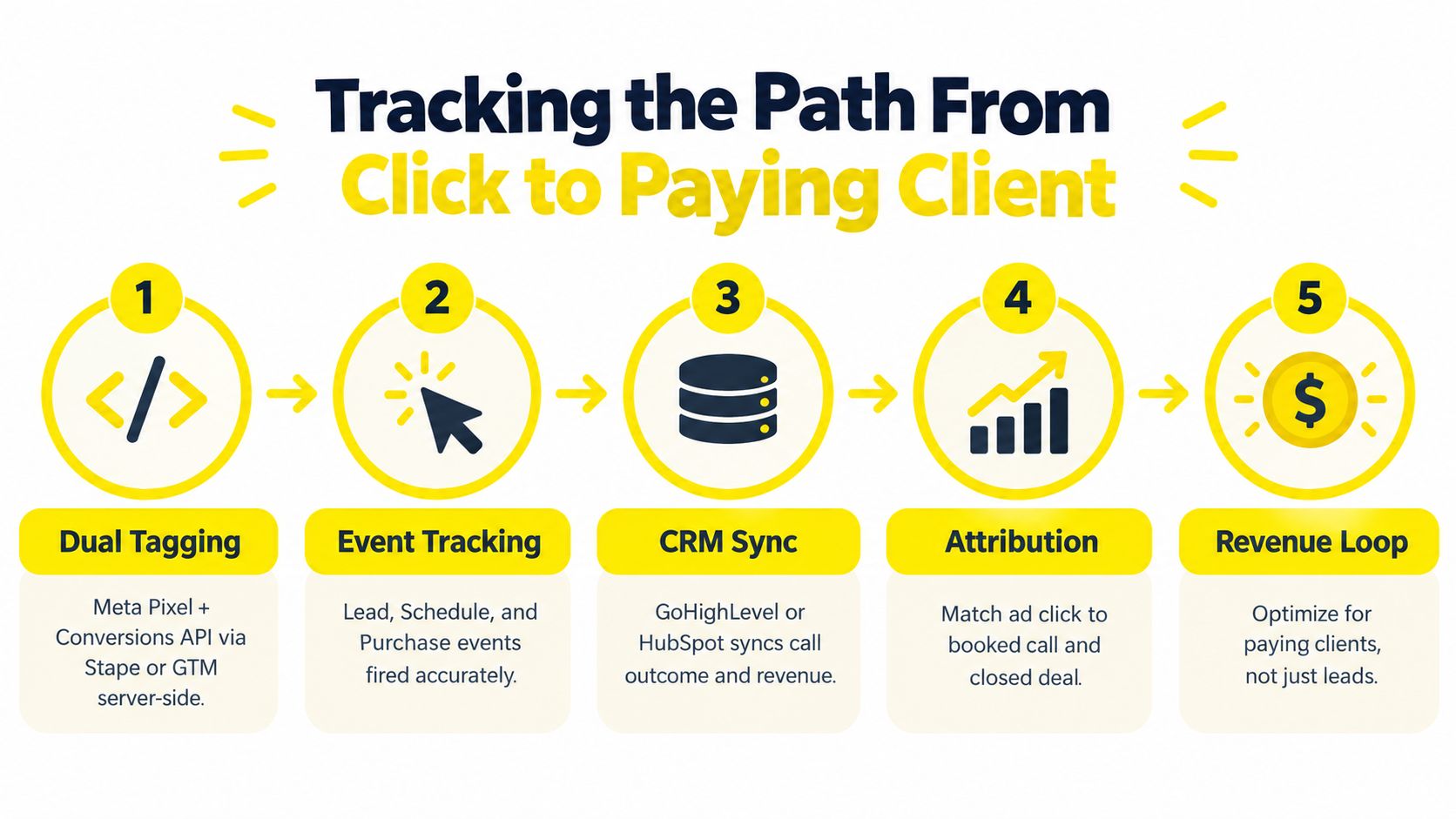
Use dual tracking, not browser-only tracking
For coaching funnels, the baseline stack is Meta Pixel plus Conversions API with proper event deduplication. Browser-only setups miss too much, especially when the funnel involves multiple devices, delayed bookings, or privacy-restricted sessions.
That setup can run through native integrations, a server-side Google Tag Manager configuration, or platforms like Stape. The tool matters less than accuracy. What matters is sending the same core events cleanly: lead, qualified lead, booked call, attended call, and sale.
Choose the conversion path based on the offer
Instant Forms usually win on friction. Landing pages usually win on context and qualification.
A practical rule:
Use Instant Forms when the offer is simpler and the sales threshold is lower.
Use landing pages when the offer needs belief-building, filtering, and stronger pre-frame before a call.
Whichever path you use, tag it properly. Standard UTMs should identify source, medium, campaign, and creative variant so the CRM can tie outcomes back to ad-level decisions.
Sync the CRM to the ad account
This is the missing piece in most coaching setups. If booked calls and closed deals stay trapped inside Calendly, GoHighLevel, HubSpot, or another CRM, Meta never gets the feedback it needs.
Your system should push key downstream milestones back into the ad ecosystem. That can happen through native CRM integrations, Zapier, or a managed setup. Agencies and operators that build full-funnel systems, including teams like Wojo Media, generally focus here because media buying without CRM feedback tops out fast.
A weekly dashboard should include:
Spend and delivery metrics
CTR and lead quality indicators
Booked calls
Show rate
Close rate
Revenue by source
Return on ad spend
The fastest way to improve a coaching funnel is often to connect what sales knows to what the ad account can learn.
Your 6-Week Testing Roadmap and Final Checkpoints
Most coaches either judge ads too early or keep weak campaigns alive too long. A better approach is a short, disciplined testing window with clear checkpoints. Not endless tinkering. Not blind patience.
Weeks 1 and 2 focus on clean inputs
In the first stretch, launch a small set of variables, not a sprawling campaign structure. Use distinct audience layers, a modest creative mix, and one clear funnel path per offer.
Your priorities are operational:
Confirm tracking works: Every lead, application, and booking must pass cleanly into the CRM.
Watch the click quality: Don't just look at traffic volume. Read the lead forms, application answers, and booking behavior.
Check creative fit: If the ad attracts the wrong conversation, the message is off even if the click price looks acceptable.
At this point, don't scale winners aggressively. Verify that they're real winners.
Weeks 3 and 4 shift budget toward intent
Once you have enough signal to compare paths, move budget toward the combinations producing the best downstream behavior. That means booked calls and attended calls, not vanity lead volume.
Use this stage to test sharper variants of what's already working:
Test Area | What to Change | What to Keep Stable |
|---|---|---|
Hook | First line, first visual, first promise | Offer and CTA |
Proof | Client story angle or testimonial framing | Audience and page |
Qualification | Form questions or page copy | Core ad concept |
If bookings stall even when leads look qualified, the problem is usually follow-up, pre-call expectation setting, or calendar-page friction.
This is also when broadening can help. If a winning angle holds up across adjacent audiences, you've got the start of a scalable pattern.
Weeks 5 and 6 answer the real business question
By the end of the test window, you should be able to answer a simple question: is this offer fit for paid acquisition on Meta right now?
If yes, document the baseline:
Which creative angle produces qualified demand
Which audience tier converts best
What the lead-to-booking path looks like
What sales has to do for the economics to stay healthy
If not, don't force it. Facebook can be the wrong channel when the offer needs too much education, the niche is too narrow, the buying cycle is too long, or the coach still hasn't nailed a clear promise.
A few common calls to make at this stage:
If lead quality is weak: tighten qualification and rewrite the ad to repel bad fits.
If leads are good but calls don't book: fix the handoff, page flow, and call framing.
If calls book but deals don't close: revisit the offer before touching media.
If nothing stabilizes: shift energy into organic authority, webinars, partnerships, or an omnichannel retargeting approach.
Facebook ads for coaches still work. But they work best when you stop treating them like a lead vending machine and start running them like a full-funnel client acquisition system.
If you want help building that kind of system, Wojo Media works on the parts most coaches usually miss: offer refinement, conversion-focused landing pages, creative, paid traffic, and backend tracking tied to real revenue. If your ads are generating leads but not enough qualified calls or clients, they can help audit the funnel and tighten the full path from click to close.
Comments