.png)
Data driven digital marketing services: scalable growth that converts

Let's be honest, marketing used to feel like a bit of a crapshoot. You’d spend a ton of money on a campaign, cross your fingers, and hope for the best. Data-driven digital marketing is the answer to that uncertainty.
It’s about using real customer data, analytics, and performance numbers to make sharp, evidence-based decisions. This approach swaps guesswork for a predictable system, ensuring your marketing dollars are put to work on campaigns proven to deliver measurable results and a clear return on your investment.
What Are Data Driven Digital Marketing Services?
Think about trying to navigate a new city. Old-school marketing is like using a creased paper map. It gives you a general idea of the layout, but it can’t tell you about the traffic jam up ahead, the unexpected road closure, or the faster route that just opened up. It’s based on assumptions that might be totally out of date.
Data-driven digital marketing, on the other hand, is your live GPS. It uses a constant flow of real-time information to make smart adjustments on the fly, rerouting your campaigns for the most efficient path to your goals. This is a massive shift away from the hopeful 'spray and pray' tactics of the past and toward precise strategies that create predictable outcomes.
Moving Beyond Guesswork to Predictable Growth
The whole idea is simple but incredibly powerful: every single marketing decision should be backed by data.
Instead of guessing which ad creative will connect with your audience, you test several versions and let the numbers tell you which one wins. Instead of assuming you know who your ideal customer is, you dig into real user behavior to build detailed, accurate audience profiles.
This completely changes the game, turning marketing from a mysterious expense into a scalable growth engine. For a business owner, this means you can finally get confident answers to the big questions:
Which of my marketing channels are actually bringing in the most valuable customers?
How much does it really cost me to get a new customer, and is that profitable?
What specific message or offer makes people stop scrolling and actually take action?
How can we drive more sales without just throwing more money at ads?
By zeroing in on real-world performance data, you build a system that delivers results you can measure, scale, and take to the bank.
A data-driven approach allows you to stop spending money on what might work and start investing in what demonstrably does work. It turns your marketing budget into a direct driver of revenue, not just a cost center.
So, what’s the real difference in practice? This table breaks down how outdated marketing methods stack up against a modern, data-driven approach. The advantages become pretty clear, pretty quickly.
Traditional vs Data-Driven Marketing at a Glance
Aspect | Traditional Marketing (Guesswork) | Data-Driven Marketing (Predictable Growth) |
|---|---|---|
Decision Making | Based on intuition, "gut feelings," and old habits. | Based on real-time data, analytics, and A/B testing. |
Targeting | Broad, demographic-based audiences (e.g., "women 25-40"). | Hyper-specific, behavior-based segments (e.g., "people who visited the pricing page twice this week"). |
Budgeting | Often allocated without clear ROI tracking or justification. | Optimized based on hard performance metrics (ROAS, CPA, LTV). |
Results | Unpredictable, inconsistent, and difficult to measure. | Measurable, repeatable, and scalable for consistent growth. |
Once you see the contrast, it's hard to imagine going back. Relying on data isn't just a trend; it's the foundation of smart, sustainable business growth in today's world.
The Core Components of a Data-Powered Strategy
A genuinely data-driven strategy isn’t just one thing—it's a complete, interconnected system. Think of it like a high-performance engine where every single part has a critical job. For this engine to deliver predictable growth, all these components have to work together in a powerful loop, constantly learning and refining your marketing.
The whole point is to turn raw data into smart, decisive action. Instead of guessing what might work, this structure lets us scientifically discover what actually drives results, ensuring every dollar you spend is an investment, not a gamble.
This concept map really nails the shift from old-school guesswork to a modern data-driven approach. It shows how data acts as a GPS, guiding your marketing straight to its destination.
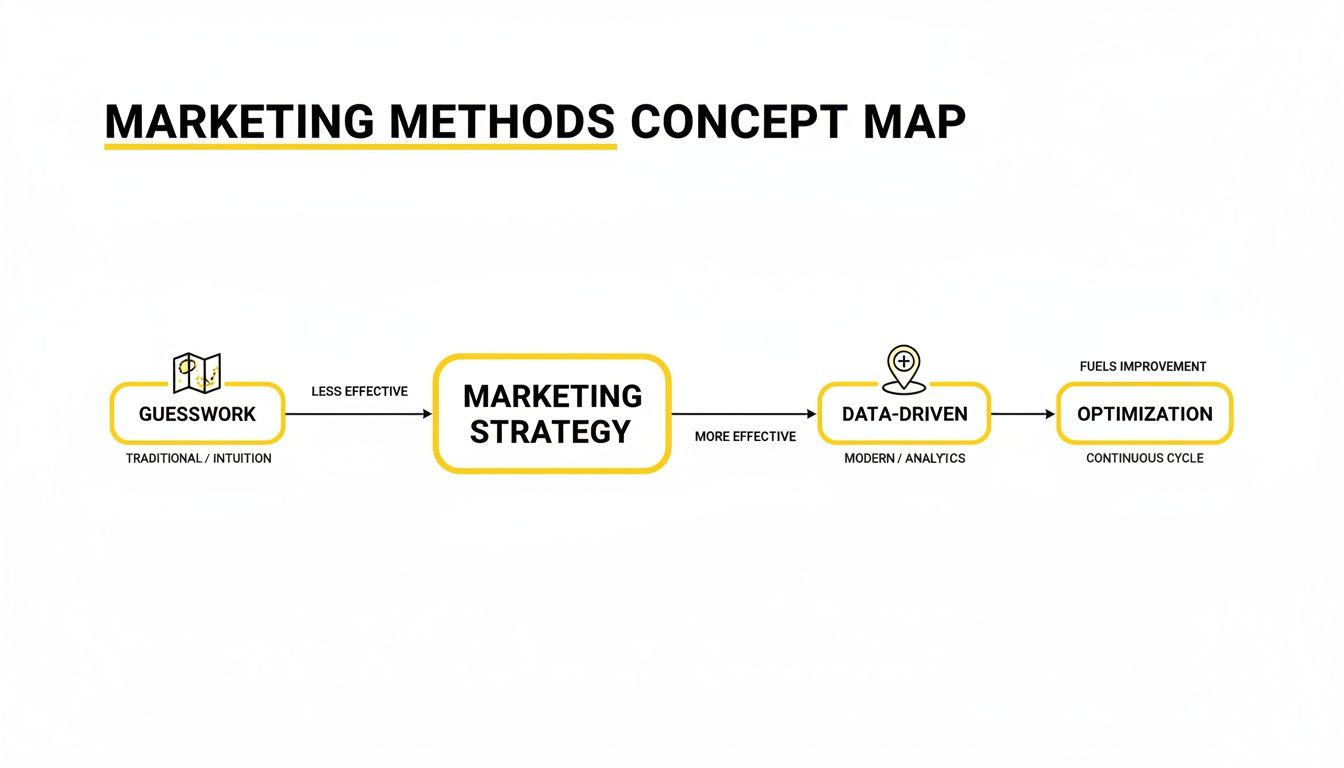
As you can see, guesswork leads to dead ends and wasted money. A data-first approach, on the other hand, carves out a clear, optimized path toward continuous improvement and outcomes you can actually count on.
Advanced Tracking and Analytics
The foundation of it all? A solid diagnostic system. We call it advanced tracking and analytics. It’s all about installing the digital equivalent of sensors throughout your entire sales process to monitor every click, signal, and metric.
Trying to market without proper tracking is like trying to fix an engine without knowing which part is broken. It’s a mess. We install pixels and set up analytics tools to capture critical information at every touchpoint, from the first ad a person sees to the final sale. This is step one to getting total clarity.
This relentless focus on data is what sets modern marketing apart. The global digital ad spend is projected to blast past $800 billion by 2026, a massive shift fueled by strategies that demand precision. This is how agencies thrive today—by tracking backend KPIs on giants like Facebook, Instagram, TikTok, and Google. You can find more on the industry's explosive growth over at Entrepreneurs HQ.
Audience Segmentation and Personalization
Once you have clean data flowing in, the next piece of the puzzle is audience segmentation and personalization. Think of this as the engine’s fuel injection system—its job is to deliver the perfect message to the right person at the perfect time.
Generic, one-size-fits-all marketing just doesn't cut it anymore. We use the data we’ve gathered to group your audience into hyper-specific segments based on what they do and what they’re interested in.
Website Visitors: We can create a campaign specifically for people who checked out your pricing page but never booked a call.
Past Purchasers: We can target high-value customers with offers for complementary products they'll actually want.
Engaged Followers: We can identify social media users who watch your videos and hit them with a special offer.
Personalization is about making your audience feel like you get them. When a message connects on that level, conversion rates skyrocket because the ad feels less like an interruption and more like a genuinely helpful solution.
Creative Testing and Optimization
Next up is the fine-tuning process. With creative testing and optimization, we scientifically figure out which combination of words, images, and videos packs the biggest punch. It’s a methodical way to stop guessing and find out what your customers really respond to.
We never assume we know best. Instead, we run multiple ad variations against each other in controlled A/B tests and simply let the data pick the winner. We analyze metrics like click-through rates and conversion costs to see what works. This process might test:
Headlines: Does asking a question work better than making a bold statement?
Images: Does a clean product shot outperform a lifestyle photo?
Ad Copy: Is short and punchy text more effective than a detailed story?
Calls-to-Action: Does "Shop Now" get more clicks than "Learn More"?
Through this constant cycle of testing, your campaigns get smarter and more efficient with every dollar spent.
Attribution and ROI Measurement
Finally, attribution and ROI measurement is your dashboard. It tells you exactly how fast the engine is running and how efficiently it's using fuel—your ad spend. This component answers the one question every business owner cares about: "Is my marketing actually making me money?"
Attribution models help us figure out which touchpoints deserve credit for a sale. Was it the Google search, the Facebook ad, or the email campaign? By accurately assigning value, we can confidently double down on the channels delivering the highest Return on Investment (ROI). It removes all the doubt and gives you a clear picture of your performance.
Focusing on Metrics That Actually Drive Revenue
Likes, shares, and follower counts can feel good, but they're often just vanity metrics. Think of them as a loud engine that sounds impressive but doesn't actually move the car forward. Real data-driven digital marketing services cut through this noise, zoning in exclusively on the key performance indicators (KPIs) that directly translate to profit and sustainable business growth.
It’s all about shifting from metrics that look good on paper to metrics that make a real financial impact. This means moving beyond surface-level engagement and digging into the numbers that reveal the true health of your marketing efforts. When you understand these core figures, you can make strategic decisions with total confidence.

This approach isn't just about tracking sales; it's about understanding the entire economic engine of your customer's journey from start to finish.
The KPIs That Really Matter
To build a predictable growth machine, we need to demystify the essential metrics that tell the complete story of your profitability. Instead of getting bogged down in complex definitions, let’s look at them through practical scenarios that make sense for any business owner.
Here are the big three that every solid, data-driven strategy is built upon:
Customer Acquisition Cost (CAC): This is simply what it costs you to get one new customer. If you spend $1,000 on ads in a month and land 20 new customers, your CAC is $50. Knowing this number is the first step to making sure your marketing is actually profitable.
Lifetime Value (LTV): This metric shows you the total revenue you can expect from a single customer over their entire relationship with your business. If your average customer buys from you four times at $100 a pop, their LTV is $400.
Return on Ad Spend (ROAS): This is the most direct measure of your ad profitability. It tells you exactly how much revenue you generate for every single dollar you put into ads. For example, if you invest $500 in a campaign and it brings in $2,500 in sales, your ROAS is 5x.
Understanding the relationship between these three numbers is where the magic really happens. A profitable business makes sure its LTV is significantly higher than its CAC, creating a healthy margin that fuels more growth.
Making Sense of the Numbers
Data is completely useless without clear interpretation. A great agency doesn't just hand you a spreadsheet full of numbers; they turn complex data into a straightforward story of your business's growth. We do this through clear, transparent dashboards and reporting.
Instead of getting lost in jargon, you get insights you can actually use.
A great data dashboard should answer critical business questions at a glance: Is our ad spend profitable? Are we acquiring the right kind of customers? Which campaigns should we scale, and which ones should we cut?
This clarity allows you to see exactly how your investment is performing and what adjustments are being made to improve results, week after week. The goal is to move beyond just generating leads or traffic and focus on the ultimate objective: profitable revenue. To make sure your marketing efforts translate into tangible returns, it's vital to understand different content monetization strategies and how they plug into your bottom line.
From Data Points to Strategic Decisions
Interpreting these KPIs allows for smarter, faster business decisions. When you know your numbers inside and out, your strategy becomes proactive instead of reactive.
Here’s how this plays out in the real world:
Optimizing Ad Spend: If you see one campaign has a 6x ROAS while another is struggling at 1.5x, the decision is simple. You shift the budget from the underperformer to the winner, instantly making your overall ad spend more efficient.
Improving Offers: A high CAC might be telling you that your offer isn't compelling enough. Data gives you the hard evidence needed to test new guarantees, bundles, or price points to find what really clicks with your audience.
Enhancing Customer Retention: If your LTV is low, it signals a huge opportunity to focus on repeat business through things like email marketing or loyalty programs. This turns one-time buyers into valuable long-term customers.
Ultimately, focusing on revenue-driving metrics provides the roadmap for scalable success. It removes emotion and guesswork from the equation, replacing them with a reliable system for building a more profitable business.
How Data-Driven Services Fuel Growth in Your Industry
Knowing the principles of data-driven marketing is one thing, but the real magic happens when you apply them to your specific industry challenges. This is where businesses either stagnate or find explosive growth. Using data-driven digital marketing services isn’t about chasing vanity metrics; it’s about solving unique problems with surgical precision and turning raw insights into measurable results.
Let's dive into how a data-first approach creates real-world wins across different fields—from e-commerce stores and local med spas to high-ticket business coaches. Each scenario breaks down how specific data points fuel strategies that reliably generate leads, book appointments, and drive sales.

E-commerce Brands Selling High-Value Products
Picture an e-commerce brand selling premium skincare. They face a classic problem: high ad costs are chewing up their profit margins. The solution isn't just more traffic. It’s about attracting the right customers—the ones who come back again and again.
A data-driven agency jumps in by analyzing purchase history and on-site behavior. They don’t just see what’s selling; they hunt for the products that act as a gateway to high Lifetime Value (LTV). The data might show that customers who buy the $75 anti-aging serum first are 300% more likely to make another purchase within 60 days than someone who buys a cheap cleanser.
Boom. That one insight changes everything.
Campaign Focus: The ad strategy immediately pivots to feature the anti-aging serum as the hero product.
Audience Targeting: Ad platforms are now tasked with finding "lookalike" audiences—fresh prospects who mirror the digital habits of the brand's most valuable existing customers.
Retargeting Efforts: A smart follow-up campaign targets first-time serum buyers, tempting them with a special offer on a complementary night cream to lock in that crucial second purchase.
The result is a finely tuned machine. Ad spend is focused squarely on acquiring customers with the highest LTV potential. This sends the Return on Ad Spend (ROAS) through the roof and gives the brand the confidence to scale its budget without guessing.
Local Service Businesses Filling Appointments
For a local med spa, the mission is simple: get qualified clients on the calendar. Success hinges on reaching affluent households in a tight geographic area. Throwing ads out to the general public just brings in price-shoppers who won't book premium treatments.
Here, a data-driven strategy uses geography and demographics to zero in on the perfect client.
First, the agency maps out a 10-mile radius around the spa. But that's just the start. They layer on more data to sharpen the targeting, focusing on people based on:
Income Levels: Pinpointing households in higher-income zip codes.
Interests: Finding users who follow luxury brands or show interest in wellness and beauty content.
Behavioral Signals: Targeting people who recently searched for competing med spas or related services.
By combining these data layers, the med spa’s ads are shown almost exclusively to people who are geographically close, financially qualified, and actively interested in their services. This eliminates wasted ad spend and dramatically increases lead quality.
This approach transforms the spa's marketing from a shot in the dark into a precise client-acquisition engine, drawing a straight line from ad dollars to a fully booked schedule.
Business Coaches Acquiring High-Ticket Clients
A business coach selling a high-ticket mastermind program often relies on a webinar funnel. The big challenge? Figuring out which of the hundreds of registrants are serious buyers and which ones are just kicking tires for free info.
Data analysis holds the key. By tracking how users engage throughout the funnel, a clear picture of prospect quality starts to form. An agency will monitor crucial behavioral metrics:
Webinar Watch Time: Did they stick around for the full 60 minutes or bail after five?
Poll Engagement: Did they actively participate in polls and the Q&A?
Offer Click-Through: When the application link was presented, did they click it?
Someone who watched the whole thing, answered polls, and clicked the offer is a red-hot lead compared to someone who left after 10 minutes. This data allows the coach to segment their follow-up. The sales team can now focus its precious time on the most promising prospects, while automated email sequences nurture the rest.
These examples show just how versatile data-driven insights are. Another massive piece of this puzzle is Search Engine Optimization (SEO), with the global SEO market projected to hit $106.9 billion by 2025. Considering that 93% of online experiences start with a search engine and marketers consistently rank organic search as their highest ROI channel, a rock-solid SEO foundation is non-negotiable for coaches, e-commerce stores, and local businesses alike. You can explore more powerful trends in these digital marketing industry statistics.
Working With an Agency to Implement a Data-Driven Approach
Making the switch to a genuinely data-driven model isn't a leap of faith; it’s a structured, collaborative process. When you partner with a performance agency, you're essentially streamlining this journey, turning your big-picture business goals into a clear, actionable plan. It’s all about building a solid system from the ground up, starting with a foundation of accurate information and aiming for predictable results.
Think of this partnership as adding a growth engine to your brand. An expert team plugs into your operations, bringing the tools, strategies, and hands-on experience needed to build a revenue stream you can actually count on. The whole process is methodical and transparent, so you’re always in the loop.
Starting With Strategy and Technical Setup
The journey kicks off with a deep-dive strategy session. This isn’t just some generic kickoff call. It's where we map your specific business objectives directly to a data collection strategy. The main goal here is to make sure every single action we take is tied to the KPIs that actually matter to your bottom line, like Customer Acquisition Cost and Return on Ad Spend.
From there, we get into the technical setup. This is the absolute bedrock for any data-driven digital marketing services. The agency will install and configure all the essential tracking tools, like the Meta Pixel and Google Analytics conversion tracking.
This technical groundwork ensures that every user action is captured, giving us the clean, reliable data we need to make smart decisions. Without this step, any attempt at optimization is just a shot in the dark.
The Cycle of Constant Optimization
Once the tracking infrastructure is live, the real work begins: a continuous cycle of launching, measuring, and optimizing. It’s a feedback loop designed to make your campaigns progressively smarter and more efficient over time. We aren't looking for a single "magic bullet" ad; we're building a system for systematic improvement.
The process follows a clear, repeatable rhythm:
Launch & Gather Data: We roll out the initial campaigns based on our strategy, designed to test specific audiences, creatives, and offers. The primary objective here is to get that first wave of performance data.
Analyze & Find Insights: The team dives into the incoming data, looking for the winners and losers. They’ll pinpoint which ad creative is driving the lowest cost per lead or which audience segment is bringing in the highest ROAS.
Optimize & Scale: Based on what we learn, the budget gets reallocated. We shift ad spend away from the underperformers and double down on the proven winners to maximize your return on investment.
This methodical process pulls emotion and ego out of marketing decisions. The data tells us what to do next, ensuring every adjustment is a step toward better profitability and efficiency.
Reporting and The Client Partnership
Clear and consistent communication is the backbone of any successful agency partnership. You should never be left wondering what’s happening with your marketing budget or how your campaigns are performing. When building a data-driven approach, a good marketing agency reporting guide can help make sure everyone is on the same page about the value being delivered.
A professional agency provides transparent, easy-to-digest reports that cut through the noise. These reports translate complex metrics into a clear story of business growth, focusing on the numbers that directly impact your revenue. This transforms the agency-client relationship into a true partnership, with both sides locked in on the one goal that matters: building a predictable, scalable growth machine for your business.
Your Next Steps Toward Predictable Growth
We've covered a lot, but the main takeaway is this: data-driven marketing is the only reliable way to break free from the rollercoaster of unpredictable revenue. When you stop making assumptions and start relying on hard evidence, you finally put an end to wasteful ad spend. You get to know your real customers and build a marketing machine that actually gets smarter over time.
This isn't just about running better ads. It's about transforming your marketing from a nagging expense into your most powerful tool for generating profit. The benefits aren't abstract; they hit your bottom line directly.
Total Clarity: You'll finally know exactly which campaigns are driving results and why, letting you put your budget where it counts with total confidence.
Improved Efficiency: Your ad spend starts working harder for you as data points you directly to your most profitable audiences and ad creative.
Sustainable Scaling: Growth is no longer a mystery. You get a repeatable process for bringing in new customers at a cost that makes sense.
See Your Custom Growth Plan in Action
Understanding the concepts is one thing, but seeing how they can be applied directly to your business is what really matters. The best next move is to see a custom paid ads strategy built just for you—whether your goal is a fully booked calendar, profitable e-commerce sales, or a steady stream of high-quality leads for your coaching program.
Data-driven marketing isn’t just about running ads; it’s about building a predictable engine for revenue. The right partner won't just talk about it—they'll show you a clear, data-backed roadmap from where you are today to where you want to be.
I'd like to invite you to book a free demo call with our team. This isn't a high-pressure sales pitch. It's a genuine strategy session where we'll dive into your business and show you firsthand how a data-powered approach can solve your biggest growth challenges and deliver the results you've been looking for.
Your Questions, Answered
Jumping into the world of data-driven marketing can bring up a few questions. We get it. Here are some clear, straight-to-the-point answers to what business owners usually ask, so you can make a decision with total confidence.
How Long Until I See Real Results?
This is always the first question, and the honest answer is: it depends. But let's be clear—while profits don't happen overnight, a data-backed approach gets you there much, much faster than traditional marketing.
The first month is all about learning. In the first 30 days, we're purely focused on collecting data, launching initial campaigns to see what the market tells us. This gives us the baseline we need to start making smart moves.
From there, the real optimization begins. Most of our clients start seeing a serious shift in the right direction—think lower lead costs and higher ROAS—within 60 to 90 days. The system just gets smarter and more efficient with every dollar spent.
What's the Real Difference Between a Standard Agency and a Data-Driven One?
A typical digital marketing agency often gets caught up in surface-level activities. They'll talk a big game about clicks, impressions, and how many new followers you have. These are "vanity metrics." They look nice on a report but don't necessarily put money in your bank account. Their campaigns are often based on a creative whim or a generic "best practice."
A data-driven agency, on the other hand, is a true growth partner. The difference is night and day.
We Focus on What Matters: Profit. We're obsessed with the numbers that actually drive your business, like Customer Acquisition Cost (CAC), Lifetime Value (LTV), and Return on Ad Spend (ROAS).
We Test Everything. Guesswork has no place here. Every decision comes from a methodical process of A/B testing ads, audiences, and landing pages to find out what is scientifically proven to work for your business.
You Get Total Transparency. Our reports are simple and clear. They draw a straight line from our actions to your revenue growth, cutting out all the fluff and ambiguity.
How Much Should I Plan to Invest?
Your investment really has two parts: our management fee for running the whole operation, and the ad spend that goes directly to platforms like Meta or Google. A solid starting ad budget varies by industry, but you need to commit enough to gather the data required for intelligent optimization.
But you should stop thinking of it as a "cost." It's an investment in a predictable growth machine.
A well-executed data-driven campaign is designed from day one to be profitable. The goal isn't just to spend money; it's to get to a point where every dollar you put into ads brings back multiple dollars in revenue. Once we hit that point, the only question is how fast you want to scale.
Ready to stop guessing and start building a predictable revenue engine? The team at Wojo Media is here to show you how a custom, data-powered strategy can deliver the scalable growth you've been searching for. Book your free demo call today to see it in action.
Comments