.png)
Lead Generation vs Demand Generation Explained for Growth

They don't have a lead problem. They have a funnel diagnosis problem.
They celebrate a strong month because forms went up, booked calls looked decent, and the ad platform kept finding cheap conversions. Then sales says the pipeline feels soft, close rates slip, and revenue doesn't move the way the dashboard implied it would. That's the moment the confusion shows up. The business has been treating lead generation and demand generation like the same job.
They aren't.
If you mix them together, you usually overvalue what's easy to count and undervalue what makes future conversions cheaper and cleaner. You push harder on capture before the market trusts you. You ask cold traffic to book a call before they understand why they should care. Then you blame creative, landing pages, or the sales team when the issue is that the prospect wasn't ready.
In paid acquisition, this happens constantly across e-commerce, local services, coaching, and real estate. A campaign can produce leads and still weaken the business if those leads are low-intent, slow to contact, or poorly qualified. A lighter lead volume with better sales readiness often beats a bigger list of people who only wanted the freebie, the quote, or the curiosity click.
That's why lead generation vs demand generation matters right now. Costs are too high, buyer attention is too fragmented, and follow-up discipline matters too much to keep lumping everything into one “marketing” bucket.
Introduction Why This Comparison Matters Right Now
A familiar scenario plays out every week. The ad account looks healthy, the CRM fills up, and everyone feels productive for about ten days. Then the sales team starts picking apart the lead list. Bad emails. Weak intent. Slow replies. Prospects who downloaded something but never planned to buy.
That's where a lot of companies make the wrong move. They ask for more leads.
More leads won't fix a trust gap. More leads won't fix weak qualification. More leads won't fix a slow sales handoff. They usually make those problems more expensive.
The real cost of mixing them up
Lead generation and demand generation sit in different parts of the buyer journey, so they need different expectations. One is built to capture existing intent. The other is built to create familiarity, trust, and preference before intent becomes visible.
When a team treats demand generation like it should perform like lead gen, they kill upstream programs too early. When they treat lead gen like a pure volume game, they flood the pipeline with names sales can't work properly.
Practical rule: If your reporting makes a webinar, a retargeting form, a branded search lead, and a cold paid social download all look equivalent, your reporting is lying to you.
A lot of the waste isn't in ad spend itself. It's in what happens after the click. If the business can't respond fast, can't separate curiosity from buying intent, or can't track what becomes revenue, the funnel starts rewarding noisy conversions.
What actually matters
The cleaner way to think about this is simple:
Demand generation asks, “Are we building enough trust and attention with the right audience?”
Lead generation asks, “Can we turn that attention into qualified pipeline efficiently?”
That sounds obvious, but the budget, the offers, the creative, and the KPIs change once you accept that they're different jobs.
What Lead Generation and Demand Generation Actually Mean
A buyer watches three of your videos, reads a service page twice, then leaves without filling out anything. A week later, they search your brand name, book a call, and close. If the team only credits the form fill, they call that lead gen success. In practice, both systems did their job at different points.
Demand generation builds recognition and trust before contact. Lead generation captures intent once someone is ready to take the next step.
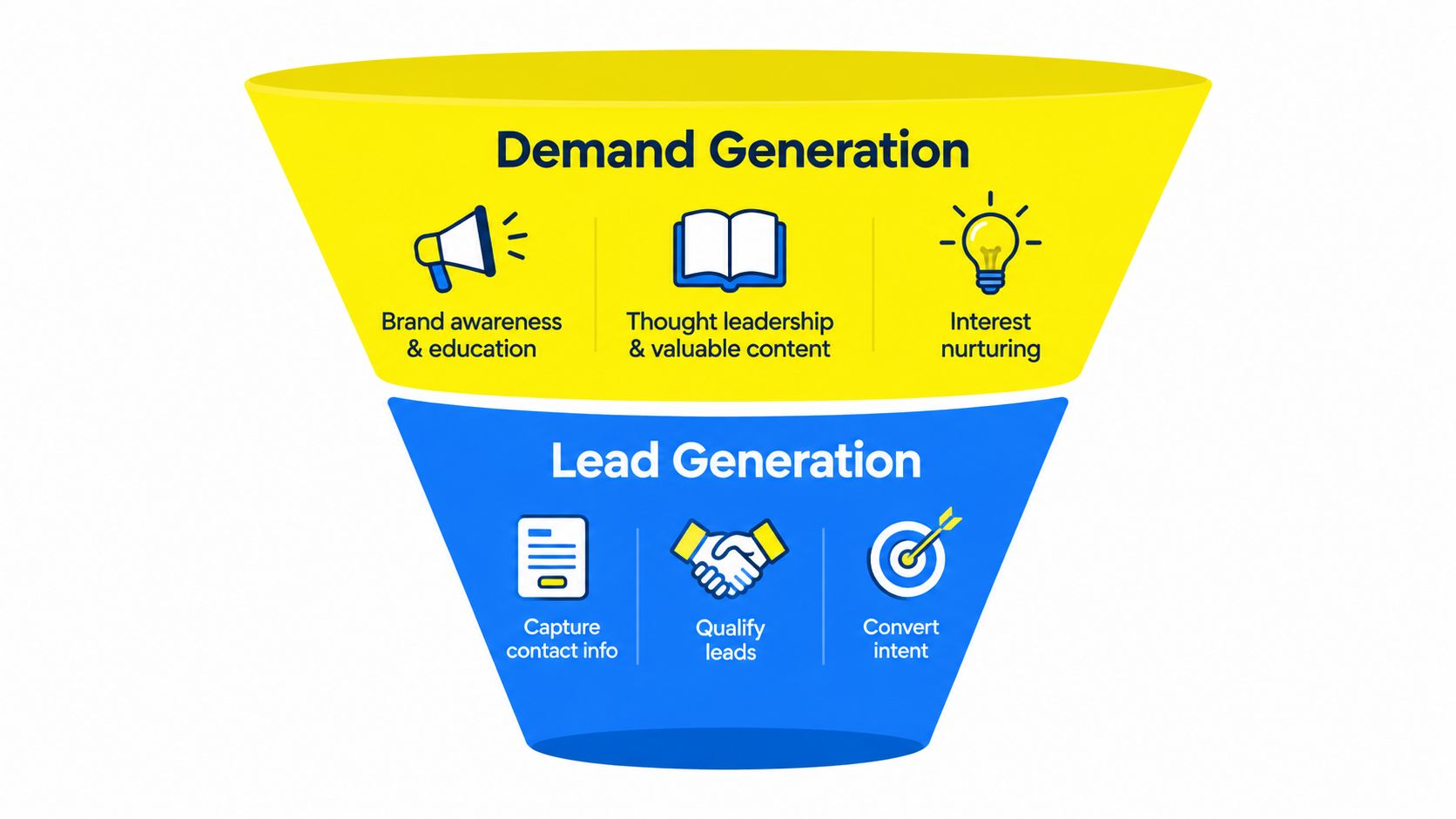
Lead generation is the capture and qualification layer
Lead gen asks for action now. Submit the form. Request the quote. Book the call. Start the application.
That makes it a lower-funnel function, but the core job is not collecting as many names as possible. The core job is collecting contactable, sales-ready opportunities that can move through follow-up fast. Speed-to-lead matters here because even strong intent decays when the handoff is slow or the CRM is full of low-fit inquiries.
This is also where teams get themselves into trouble. A cheaper lead is not automatically a better lead. If broad targeting, weak offers, or low-friction forms flood the pipeline with unqualified submissions, MQL volume goes up while SQL efficiency drops. In a lot of accounts, the fix is to make capture harder on purpose. Add better qualifying questions. Remove low-intent offers. Ask for the call only after the buyer understands the value.
Data quality matters too. If bad emails enter the system, sales wastes time and automation performance gets worse. A tool like an Email Validation API helps verify contact data before junk records distort response rates and follow-up reporting.
Demand generation is the trust and preference layer
Demand gen works earlier. It helps the right buyer know you, understand the problem, and remember your brand before they want a demo or quote.
That work usually includes ungated educational content, useful webinars, buyer-focused SEO, social content that repeats the same message clearly, and paid campaigns built for reach and recall instead of instant form fills.
The mistake I see often is forcing lead capture too early. If a prospect is still comparing options, still skeptical, or still trying to define the problem, pushing a form can lower total pipeline quality even if conversion rate looks acceptable in-platform. A better move is to let them consume content, revisit, and self-qualify. You get fewer raw leads, but the leads you do get tend to move faster once sales engages.
A simple test helps separate the two. If the campaign's primary goal is contact capture, it is lead gen. If the campaign's primary goal is attention, education, and repeated exposure with the right audience, it is demand gen.
Both matter. They just solve different bottlenecks.
How Lead Generation and Demand Generation Compare Across Goals and KPIs
The easiest way to clean up the debate is to compare the systems side by side. Most confusion disappears once you separate goals, metrics, timelines, and handoff expectations.
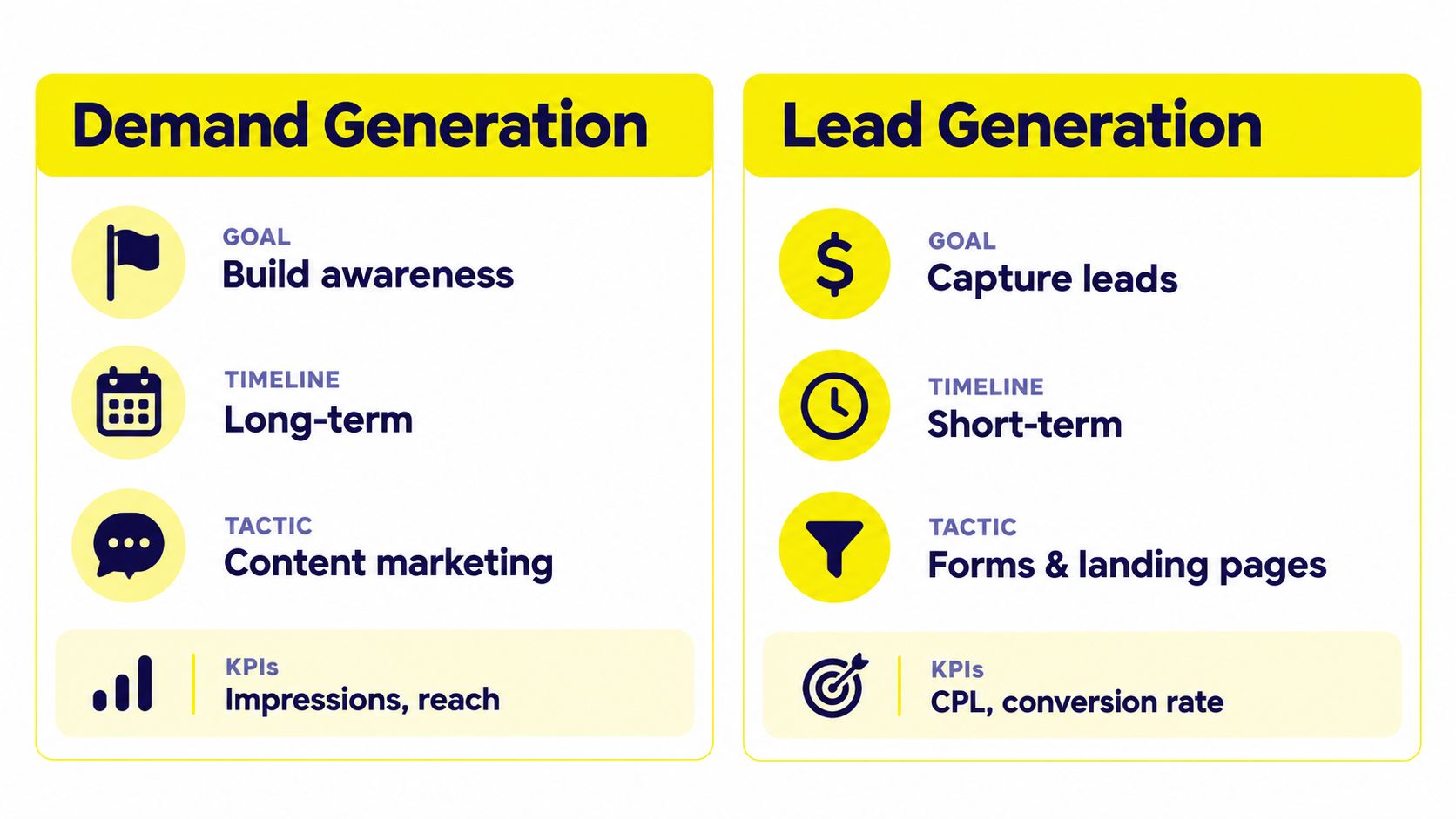
Lead Generation vs Demand Generation At a Glance
Criteria | Lead Generation | Demand Generation |
|---|---|---|
Primary job | Capture and qualify existing intent | Create awareness, trust, and category interest |
Funnel position | Mid to lower funnel | Upper to mid funnel |
Typical action | Form fill, booked call, demo request, quote request | Content consumption, webinar attendance, repeat visits, brand engagement |
Main KPI style | Immediate conversion and sales handoff | Upstream attention and influenced pipeline |
Time horizon | Shorter | Longer |
Core risk | Low-quality volume | Harder attribution |
Best use case | Buyers already problem-aware | Buyers still researching or skeptical |
A lot of marketers say they're doing demand gen when they're really running lead capture with softer creative. If the campaign still pushes for the form first, it's still lead gen.
Goals and success metrics aren't interchangeable
Lead-generation programs are usually judged at the contact-to-opportunity layer. Mid-market B2B benchmarks commonly use speed-to-lead under 5 minutes, MQL-to-SQL or SAL conversion of 20 to 40%, SQL-to-opportunity of 40 to 60%, and opportunity-to-win of 20 to 35%, according to Pedowitz Group benchmarks for demand generation. That's a very different scorecard from top-of-funnel awareness.
Demand-gen programs are normally evaluated through upstream and lagging indicators such as brand search growth, share of voice, content engagement, inbound pipeline from organic or content, and intent-signal lift, with later-stage conversion often improving materially. One benchmark set reported inbound from demand-gen-influenced content converting to closed-won at 27 to 35%, compared with 18 to 24% for inbound demo requests and 9 to 14% for outbound SDR-sourced leads in 2025 benchmark data on demand gen vs lead gen.
Lead gen asks whether you can convert the click. Demand gen asks whether the market trusts you enough to click in the first place.
That's the operational difference. One lives or dies on response speed, qualification, and handoff. The other shapes how warm the audience is before they ever convert.
A lot of teams improve this by tightening how they read landing page behavior, assisted conversions, and on-page intent. If you need a practical framework for that, these CRO measurement methods are useful because they force you to inspect behavior instead of just form totals.
Here's a helpful explainer if you want a quick visual walkthrough before changing your reporting.
What each side tends to optimize
Lead gen teams usually optimize things like:
Cost per lead
Lead-to-appointment rate
MQL-to-SQL movement
Speed of first contact
No-show and close-rate quality by source
Demand gen teams usually optimize different signals:
Share of voice in the category
Repeat exposure across channels
Organic and content-assisted pipeline
Webinar engagement
Brand familiarity before sales outreach
If both teams report into one bucket without segmentation, bad decisions follow quickly. The company often cuts what's building trust and doubles down on what's easiest to measure.
Budget Allocation and Performance Benchmarks That Shape ROI
A team can spend six figures on lead capture, hit its CPL target, and still miss revenue because sales is sorting through weak-fit inquiries. I've seen the opposite too. Fewer form fills, higher close rates, and a healthier pipeline because the budget spent more time warming demand before asking for contact details.
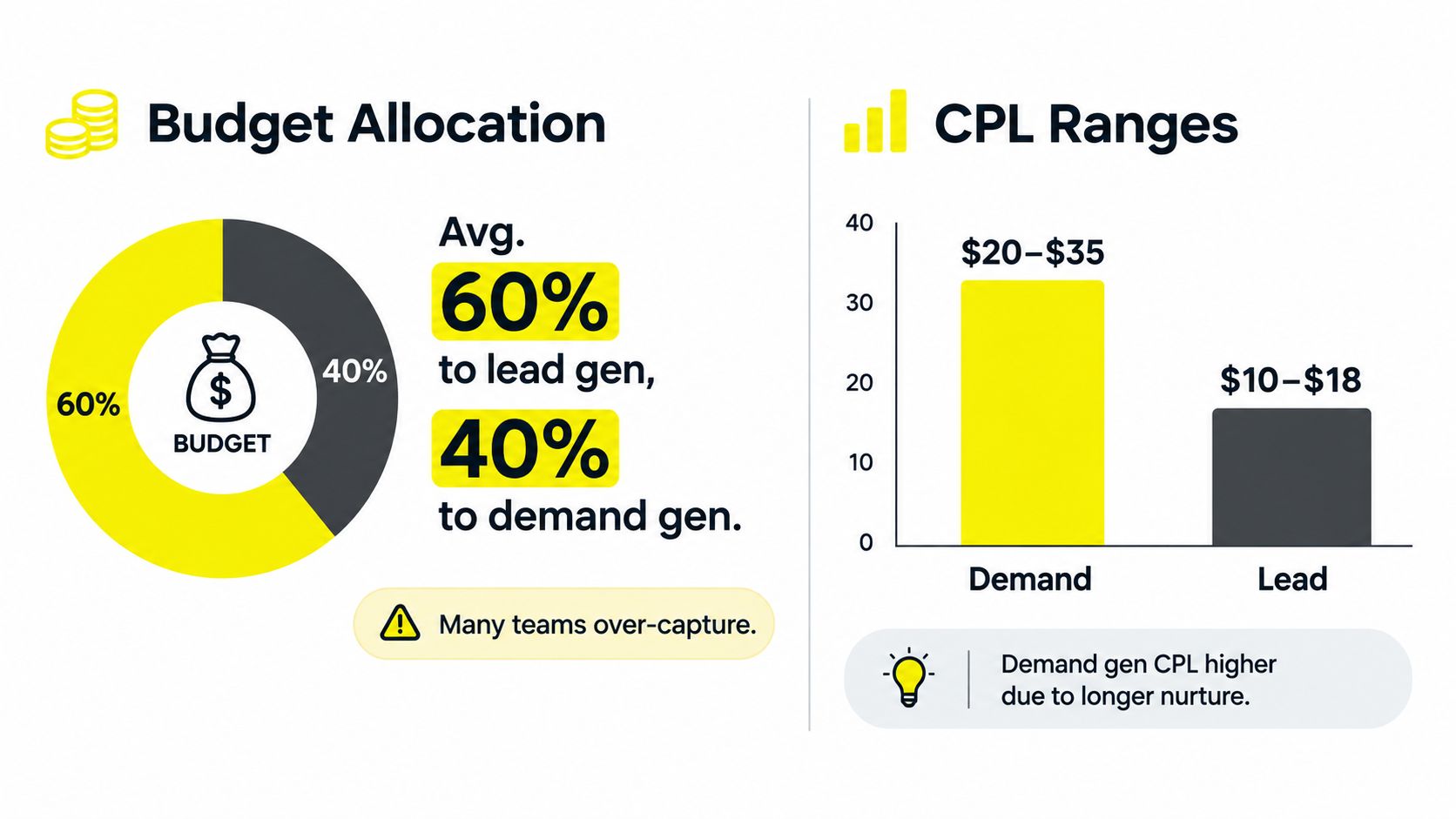
Where teams are placing budget
Analysts at Digital Applied reported an average split of 37% demand creation and 63% demand capture in B2B lead generation statistics and 2026 data points. That budget pattern matches what a lot of operators do under pressure. Spend follows the metric that shows up fastest in-platform, even when the CRM says those leads stall after the MQL stage.
That same report found top-quartile demand-gen teams convert MQL to SQL at more than twice the median rate and pay roughly half the cost per lead for the same pipeline. That trade-off matters more than raw lead volume. If upstream trust is doing its job, sales spends less time chasing low-intent names and more time working opportunities that can close.
In practice, that often means reducing lead capture on cold traffic. Gated assets, aggressive pop-ups, and early demo asks can inflate volume while dragging down speed-to-lead efficiency because reps are forced to triage noise. A cleaner pipeline usually starts with better audience warming, clearer offers, and later conversion asks.
The benchmarks that matter in practice
CPL ranges vary hard by category, deal size, and buying friction. HubSpot's overview of average cost per lead by industry is a better reference point than generic screenshots passed around in Slack, because it at least frames CPL by vertical instead of pretending one target applies to everyone.
Demand generation benchmarks need the same filter. Grand View Research's demand generation software market size report shows continued investment in demand-gen infrastructure, which tracks with how buying behavior has changed. More research happens before the form fill. More validation happens off-site. More deals are influenced by repeated exposure long before attribution gives that credit.
The mistake is treating those inputs as soft metrics. They affect hard outcomes such as MQL-to-SQL rate, sales cycle length, and close rate by source.
Where ROI gets won or lost
The biggest ROI gaps usually show up in four places:
Channel-to-offer fit: Cold social traffic rarely responds like branded search traffic. Budgeting them the same creates false comparisons.
Lead capture timing: Asking too early lifts top-line lead count and lowers downstream efficiency.
Sales capacity: Fast follow-up only helps if the team can work the volume coming in.
Attribution discipline: If qualified pipeline is not tied back to source, teams keep funding channels that look cheap but close poorly.
If email is part of your nurture or sales follow-up, this email deliverability guide is worth reviewing. A strong campaign can still miss pipeline targets if follow-up emails land in spam or never reach the lead.
When to Use Each Approach for Ecommerce Local Services Coaches and Real Estate
Different business models break in different places. That's why blanket advice around lead generation vs demand generation usually underdelivers.

Ecommerce
E-commerce brands usually need both, but not in equal amounts all the time.
If the product is impulse-friendly, easy to understand, and already sits in an established category, direct response lead capture or direct purchase campaigns can carry more weight. Branded retargeting, offer pages, quiz funnels, SMS opt-ins, and product-page conversion work matter more.
If the product needs explanation, social proof, or category education, demand generation does the heavy lifting first. UGC on Meta, educational YouTube creative, creator whitelisting, and non-promotional TikTok content build familiarity before the conversion ask.
A practical rule is simple. If shoppers need to understand why this product exists, start with demand gen. If they already know what they want and need a reason to choose you, push lead capture or direct conversion harder.
Local services
Local services often chase booked calls too aggressively. That works for some emergency-intent categories. It works far less cleanly for higher-trust services where the customer compares reputation, responsiveness, and proof.
Use lead gen first when the prospect already knows the service and wants help now. Think quote requests, booking forms, call extensions, and tightly matched Google search campaigns.
Use demand gen first when trust decides the sale. Med spas, higher-ticket cosmetic offers, legal-adjacent advisory services, and premium home services usually benefit from educational short-form video, testimonial sequencing, FAQ content, and retargeting that answers objections before the form.
Coaches and consultants
This category breaks when people ask for the application too early.
Webinars, authority clips, long-form explanation, email nurture, and problem-aware content are classic demand gen tools here. They create context. They let the audience decide whether the coach's method, philosophy, or framework fits.
Lead gen comes later through application funnels, strategy call pages, qualification surveys, and event registration. If applications are high but show-up or close quality is weak, the market usually needs more trust-building before the ask.
Real estate
Real estate is never just one funnel.
Investors, agents, lenders, and home-service adjacencies all have different readiness windows. A seller lead from Google search behaves differently from someone who watched neighborhood content for a month on Instagram or YouTube.
Use lead gen heavily for active intent. Home valuation forms, cash offer pages, mortgage inquiries, and appointment requests fit here.
Use demand gen when you need to own mindshare in a geography or niche. Market updates, local authority content, educational reels, neighborhood walkthroughs, and trust-first YouTube content shape preference before a person submits anything.
In real estate and local services, the brand people recognize often gets the lead form they trust enough to complete.
Why More Leads Can Hurt and When to Prioritize Demand Generation
The belief that more leads automatically means more growth causes a lot of damage.
A bigger lead count can create slower response times, lower contact rates, worse sales morale, and noisier attribution. That gets expensive fast when the business confuses activity with pipeline quality.
Signals that lead gen is backfiring
Watch for these signs:
Sales says leads aren't ready: The issue may be timing, not volume.
Response speed is slipping: More submissions become less useful if the team can't react quickly.
CPL swings wildly: The channel may be fishing too broadly or attracting low-fit traffic.
Trust is weak at first contact: Prospects recognize the offer but not the credibility behind it.
A 2025 demand-gen survey reported 42% of marketing leaders said trust-building matters more than lead generation in The Marketing Geeks demand gen survey discussion. That lines up with what many operators see firsthand. Form fills don't mean much when the prospect still doubts the business.
When reducing capture is the smart move
Sometimes the best fix is to throttle lead capture on purpose.
That can mean ungating more educational content, shifting creative from “book now” to “learn why,” or using retargeting to warm traffic before asking for contact details. It can also mean removing broad lead magnets that attract curiosity instead of purchase intent.
This isn't anti-lead gen. It's anti-waste.
Cut lead capture when the pipeline is full of names and empty of conviction.
If you're seeing low sales readiness, it usually makes more sense to sharpen positioning, proof, and nurture than to buy another wave of form fills. Better demand often produces fewer leads at first, then better conversion later.
Choosing and Sequencing the Right Strategy for Predictable Growth
Most businesses don't need to choose one forever. They need to sequence them correctly.
A practical decision filter
Prioritize demand generation first when:
The market doesn't know you
The offer needs explanation
Sales conversations start with basic education
The brand has weak proof or weak recall
Prioritize lead generation first when:
Buyer intent already exists
The team can follow up immediately
The offer is clear and easy to evaluate
Tracking from lead to revenue is already reliable
If both matter, run them in sequence. Build attention with educational and trust-building assets. Then capture the ready slice with strong landing pages, fast follow-up, and clean qualification.
One option for businesses that want that full system is Wojo Media, which works on four operational pieces that affect both sides of the funnel: offer positioning, landing pages, omnipresent ads across major channels, and backend KPI tracking. That setup makes sense when the business doesn't just need more traffic, but a tighter connection between ad spend, lead quality, and closed revenue.
The key is to stop asking one campaign to do every job. Awareness, trust, capture, qualification, and close are connected, but they aren't interchangeable. When you line them up properly, the funnel gets simpler to read and much easier to scale.
If your team is generating leads but not turning them into predictable pipeline, that's usually a demand, qualification, or follow-up problem disguised as a traffic problem. Wojo Media helps brands tighten the full system around offers, landing pages, omnipresent paid ads, and backend KPI tracking so lead generation and demand generation work together.
Totally agree with the author, this topic is super relevant right now. Some time ago I came across https://silukr.org and now I often use it as a reference for finding useful information. For related questions, I also occasionally check https://whatiscfdtrading.org/ which is another solid source. Has anyone else used them? What do you think of their content? Personally, it saves me a ton of time.