.png)
Ecommerce Paid Ads Agency: Your 2026 Growth Partner

You increase the daily budget, watch orders rise, and expect profit to follow. Instead, the ad account spends more, the blended return gets harder to explain, and your finance report shows that growth has stalled. The agency says the campaigns are learning. Your team sees higher costs, weaker cash flow, and a checkout that still loses buyers.
That situation rarely has a single cause. An auction can become more expensive, creative can lose attention, attribution can over-credit one channel, or the landing page can waste demand that the ads created. An effective ecommerce paid ads agency treats media buying as part of a connected profit system, not as an isolated traffic purchase.
Why Scaling Paid Ads Often Stops Working Before It Should
A common pattern starts with a simple win. A brand launches a product campaign, finds a responsive audience, and adds budget while orders arrive at an acceptable cost. The team then increases spend again, but the next group of buyers is less efficient. CPM rises, the same people see similar ads too often, and the original creative no longer earns enough attention to support the larger budget.
The temptation is to blame the media buyer. Sometimes the account structure or bidding strategy is the problem. Often, the bottleneck sits later in the journey. A prospect clicks a strong ad, lands on a slow or generic product page, discovers shipping costs at checkout, or finds that the mobile form is difficult to complete. The campaign can look healthy at the click and add-to-cart level while the business loses money after payment, returns, discounts, and fulfillment costs.

Read the symptoms before changing the budget
Use the pattern in your data to locate the likely constraint:
CPM rises while conversion rate holds: Auction pressure, audience saturation, or creative fatigue may be limiting scale.
Clicks remain strong but add-to-cart rate falls: The ad promise and landing-page experience may no longer match.
Add-to-cart activity looks healthy but purchases weaken: Shipping disclosure, payment errors, account requirements, or checkout complexity deserve attention.
Platform ROAS looks stable but contribution profit falls: Discounts, returns, product margin, and attribution may be masking the underlying economics.
One channel claims most conversions: Branded search or retargeting may be collecting demand created elsewhere.
The U.S. e-commerce market gives brands a substantial opportunity, but it also raises the cost of getting the system wrong. The U.S. Census Bureau's fourth-quarter 2025 e-commerce report records online sales at 16.6% of total U.S. retail sales, approximately $316.1 billion on a seasonally adjusted basis, with e-commerce representing 16.4% of full-year 2025 retail sales. The Bureau includes orders initiated through internet-connected systems even when payment happens elsewhere, so agencies need to account for assisted and digitally initiated purchases rather than treating every sale as an immediate checkout event.
Practical rule: Don't scale the ad account until you know whether the largest loss happens in the auction, on the landing page, in checkout, or in the margin calculation.
A full-funnel review doesn't mean changing everything at once. It means isolating the highest-impact leak, fixing it, and then judging the next budget increase against completed orders and profit. That shift prevents a capable media team from being held responsible for a broken offer, and it prevents a weak buying process from hiding behind a well-designed storefront.
What an Ecommerce Paid Ads Agency Actually Does
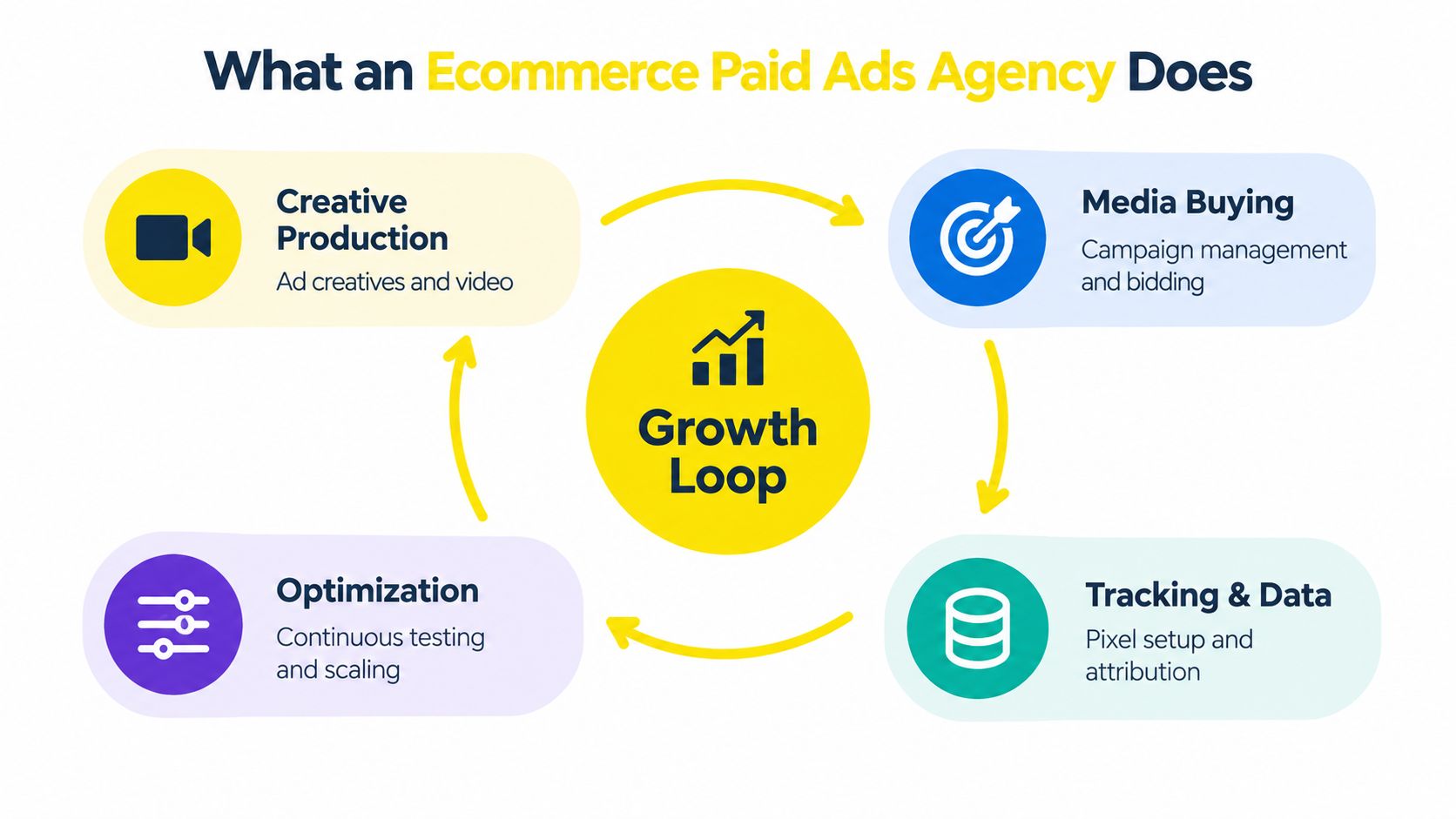
An ecommerce paid ads agency should run a repeating operating loop. It turns commercial strategy into an offer, turns the offer into creative, sends qualified traffic to a relevant page, measures what happens after the click, and feeds the resulting evidence back into the next round of decisions.
The simplest mental model is a four-part growth loop:
Offer and conversion path: Clarify the product promise, guarantee, price logic, bundles, shipping message, and landing-page experience. The agency should know what the ad is asking the prospect to believe and where that belief is tested.
Creative production: Develop static ads, demonstrations, creator content, testimonials, product comparisons, hooks, and iterations for each platform. A single winning concept can weaken when audiences see it repeatedly, so production needs a testing system rather than occasional redesigns.
Media buying: Select channels, audiences, placements, budgets, bidding approaches, and campaign structures. Search captures existing intent, while Meta, TikTok, YouTube, and other discovery environments can create or influence demand.
Tracking and optimization: Connect platform events with analytics, order data, refunds, product costs, and customer cohorts. The team then tests creative, pages, offers, audience allocation, and budget pacing using agreed business metrics.
The work behind the dashboard
A media buyer still performs important daily tasks. They monitor spend, search terms, delivery, frequency, creative fatigue, placement quality, and budget pacing. They also make sure automated bidding has enough reliable conversion information and isn't optimizing toward an event that doesn't reflect profitable demand.
The difference is coordination. A creative strategist may turn customer objections into new hooks. A copywriter may revise the product-page promise. A designer or UGC creator may produce a new demonstration. A CRO specialist may simplify the purchase path. The tracking lead may reconcile the ad platform's purchase event with the store's order, refund, and margin data.
A useful agency behaves like a racing pit crew. It doesn't only press the accelerator. It tunes the engine, checks the tires, watches the instruments, and changes the setup when the track conditions shift. An agency that only adjusts bids is closer to a traffic supplier than a growth partner.
You should also expect a defined feedback rhythm. Every test needs a hypothesis, a primary decision metric, a time or data threshold, and a next action. “We optimized the campaigns” isn't a deliverable. A useful update says which audience, creative angle, page element, or offer changed, what evidence supported the decision, and what the team will test next.
How Agencies Should Prove Real Profit, Not Just Platform ROAS
Platform ROAS answers a narrow question: how much tracked revenue did a platform assign to its advertising cost? It doesn't automatically answer whether the sale was incremental, profitable after product costs, or likely to have happened without the ad.
Last-click reporting can make branded search appear exceptionally efficient because it receives credit after another channel created awareness or intent. The reverse problem also occurs. A prospecting campaign on Meta, TikTok, or YouTube may introduce the product, while the eventual purchase happens through branded search, direct traffic, or email. A dashboard can then make demand creation look unprofitable and demand capture look indispensable.
The attribution problem has practical consequences. A 2025 analysis of Black Friday spending from PPC Land reported that last-click attribution labeled several social and video channels as loss-making, while a unified approach combining multi-touch attribution and marketing-mix modeling found each channel above break-even. In that analysis, the unified model credited TikTok with 4.5 times and YouTube with 7.4 times the revenue assigned by last click. The same source cited independent research that attributed TikTok campaigns with 35% greater incremental impact than last-touch attribution.
Use a margin-aware decision table
Consider two channels with these simplified platform reports:
Metric | Last-Click Platform View | Unified Model View |
|---|---|---|
Channel A reported ROAS | 4.0 | 2.1 |
Channel B reported ROAS | 1.4 | 2.4 |
Returns and discounts | Not fully reflected | Included in contribution calculation |
New-customer and repeat value | Often separated or omitted | Cohort value tracked |
Budget decision | Favor Channel A | Compare incremental contribution |
These figures are an illustrative example, not a market benchmark. The point is that the better-looking dashboard result isn't automatically the better economic result. Channel A may harvest branded demand that would've converted anyway, while Channel B may create additional customers whose first order looks modest but whose cohort economics are stronger.
The agency should calculate contribution margin after discounts, payment costs, fulfillment, returns, and product costs. It should also separate new-customer acquisition from repeat purchases and show how inventory limits or cash-conversion timing affect allowable acquisition cost. Founders who need to establish that threshold can use this guide to calculate break-even ROAS for ecommerce founders before negotiating targets with an agency.
Ask for experiments, not just attribution
A credible measurement plan may combine platform reporting with first-party analytics, server-side events, geo-holdout tests, lift studies, or marketing-mix modeling. The right mix depends on spend, sales volume, geographic structure, customer cycle, and data quality. No method eliminates uncertainty, so the agency should explain confidence limits and how a test will change the budget decision.
A strong monthly report includes:
Reported performance: Spend, tracked revenue, purchases, and channel-level platform results.
Business performance: Contribution margin, new-customer CAC, refunds, returns, and cohort value.
Incrementality evidence: Test design, comparison groups, timing, and the limitations of the result.
Actionable decision: Which channel receives more, less, or unchanged budget, and why.
A ROAS screenshot is a measurement output. It isn't a profit argument until the agency connects it to margin and incremental demand.
Pricing Models and Typical Agency Deliverables
Agency pricing makes more sense when you separate media management from growth-system work. A retainer for campaign management may cover account structure, pacing, optimization, and reporting. It may not include landing-page development, creator sourcing, video editing, analytics implementation, or ongoing CRO.
A monthly retainer fits a brand that wants predictable access to a team and a defined operating cadence. It works best when the scope lists the platforms managed, meetings, reporting, testing responsibilities, creative volume, landing-page work, and response expectations. The fee shouldn't quietly expand because the agency later discovers that the tracking is incomplete or the product catalog needs restructuring.
A performance-based fee can align incentives, but the contract needs careful definitions. If compensation rises with platform-attributed revenue, the agency may benefit from harvesting branded demand, increasing discounts, or pushing spend into channels that report conversions generously. A hybrid model, a base retainer plus a performance component tied to agreed business outcomes, can balance capacity and incentives when the measurement rules are transparent.

Match the scope to the bottleneck
Scope | Usually includes | Check before signing |
|---|---|---|
Media management | Campaign setup, budget pacing, bid adjustments, routine reporting | Who creates new creative and fixes the landing page? |
Full-funnel partnership | Media buying, creative strategy, tracking, offer work, testing roadmap, CRO coordination | Which tasks are implemented by the agency versus approved by your team? |
Creative sprint | Concept development, scripts, static assets, video or creator production | Are usage rights, revisions, and platform adaptations included? |
Analytics project | Event audit, data reconciliation, dashboards, measurement design | Which source of truth governs invoices and performance decisions? |
Creative can be a separate line item because production requires strategists, editors, designers, creators, and approvals. If a fashion brand needs an efficient content workflow, a resource such as AI video production for fashion brands can help inform the production conversation, but the agency still needs to explain how those assets will be briefed, tested, licensed, and evaluated.
Budget for costs outside the headline fee. These may include media spend, creator compensation, content licensing, software, analytics tools, developer time, product samples, landing-page implementation, and internal approval time. Ask whether the agency owns the ad accounts and creative files, how cancellation works, and what happens to tracking access when the engagement ends.
Red flags include vague deliverables, guaranteed ROAS without margin context, fees tied only to attributed revenue, and reports that never show spend against contribution profit. A lower fee isn't a bargain if your team must supply every brief, edit every asset, diagnose every tracking error, and implement every page change.
How to Choose the Right Ecommerce Paid Ads Agency
Start with the product, category, and economics, not the agency's logo wall. A recent win in a high-margin impulse category may tell you little about a considered purchase, a regulated product, a subscription, a luxury item, or a business with high return rates. Ask to see examples with comparable price points, buying cycles, fulfillment constraints, and customer expectations.
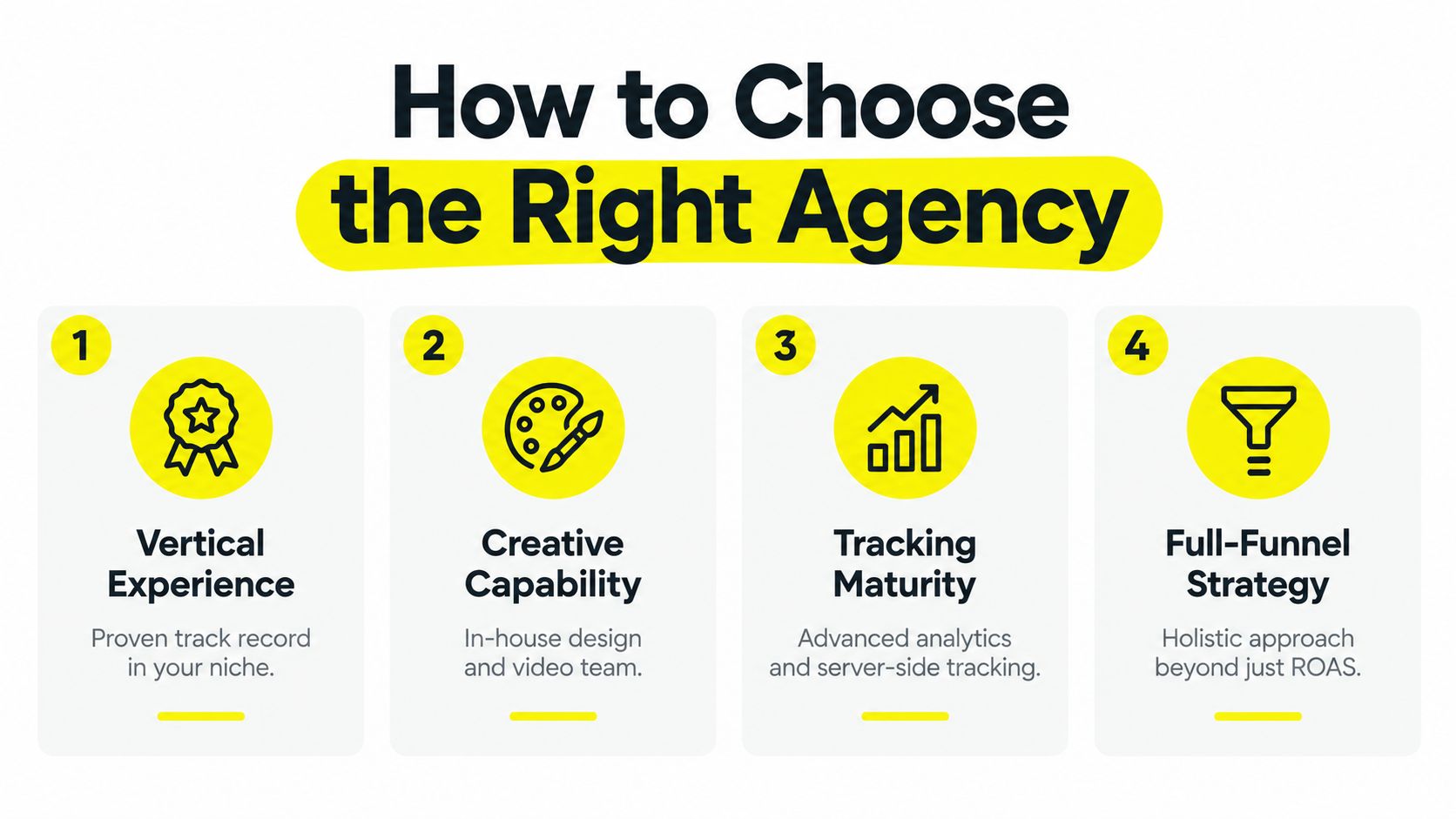
Four checks for the discovery process
Vertical experience should show up in the questions the agency asks. Does it understand your competitors, claims, merchandising calendar, inventory risk, and repeat-purchase behavior? Ask which category-specific constraint changed a past client's media plan.
Creative capability needs evidence beyond a portfolio of polished advertisements. Ask to see the briefs behind recent tests, the range of hooks and formats produced, and how customer reviews, objections, demonstrations, and creator content become new concepts. Find out who writes scripts, who edits, who owns approvals, and how the team handles fatigue.
Tracking maturity is visible in the measurement conversation. Ask how the agency reconciles Meta, Google Ads, TikTok, Shopify, analytics, refunds, returns, and finance data. Ask which event the algorithm optimizes toward, how it handles browser or consent limitations, and how it distinguishes a reported conversion from an incremental one.
Full-funnel behavior separates a media vendor from an operating partner. Ask for a post-click optimization example. The agency should be able to discuss product-page relevance, mobile experience, shipping disclosure, checkout progression, payment success, and offer testing without treating those subjects as someone else's problem.
Questions that expose operating quality
Use the vendor call to test how the team thinks under uncertainty:
Profit definition: “Will you report contribution margin after returns, discounts, fulfillment, and product costs?”
Attribution: “How do you reconcile conflicting platform and first-party results?”
Experimentation: “What does a normal testing cycle look like, and what makes you stop or extend a test?”
Creative ownership: “How many concepts can your team develop, and which production costs are separate?”
Checkout diagnosis: “What do you inspect when clicks and add-to-carts look healthy but purchases weaken?”
Team structure: “Who will manage the account day to day, and who makes strategic decisions?”
Commercial incentives: “What happens to your fee if platform-attributed revenue rises but contribution profit falls?”
Request a sample report with sensitive information removed. It should show decisions, not only charts. Ask for the agency's first-month audit checklist and the data it needs before making a forecast. Be cautious if the sales process promises certainty before the team has reviewed margins, product feed quality, tracking, landing pages, and historical cohort data.
The strongest agency interview feels like an operating review, not a pitch presentation.
Common Misconceptions That Waste Ecommerce Ad Spend
Lower CPC means better advertising. A cheap click can come from a weak placement, a broad audience with little purchase intent, or a message that attracts curiosity instead of buyers. Judge the click by what follows it, including landing-page engagement, add-to-cart behavior, checkout progression, completed orders, and contribution margin.
A fixed ROAS target works at every budget level. Benchmark averages vary by category, channel, audience mix, margin, and measurement method. The IAB and PwC report on U.S. digital advertising revenue recorded $258.6 billion in digital advertising revenue in 2024, with search at $102.9 billion, social at $88.8 billion, and commerce media at $53.7 billion. Those market totals explain the scale and complexity of the ecosystem, but they can't establish a universal target for your store.
A useful target starts with break-even economics. A brand with strong gross margin and meaningful repeat purchases can tolerate a different first-order CAC from a low-margin business with frequent returns. As spend expands, the next customer may also cost more than the first customer because the easiest demand has already been captured. That doesn't automatically make scaling bad. It means the decision should use marginal contribution, customer quality, cash timing, and inventory capacity.
An agency can repair a broken checkout by sending more traffic. It can't. Baymard reports that approximately 70.19% of online shopping carts are abandoned globally, based on its checkout usability research. The same research finds that 65% of sites have mediocre-or-worse checkout performance and identifies around 32 potential checkout improvements for the average large ecommerce site. Baymard estimates that checkout usability improvements alone could produce a 35.26% conversion-rate increase.
The causes are often operational rather than media-related. Baymard's research identifies excessive additional costs, forced account creation, slow delivery, payment-security distrust, and a complicated checkout among preventable abandonment drivers. Before increasing spend, inspect shipping disclosure, guest checkout, form length, payment options, error handling, and mobile completion.
Even the product-development stack affects acquisition indirectly. Teams managing apparel launches may compare tools in a guide to the best tech pack software to reduce production confusion, but the marketing team still needs accurate availability, product details, delivery promises, and creative inputs before campaigns scale.
Paid acquisition works when the business treats every click as the first step in a measurable profit path. Ask an agency to identify the largest leak, prove what changed, and tie the next budget decision to incremental contribution rather than a flattering dashboard.
Wojo Media offers ecommerce paid advertising across Facebook, Instagram, TikTok, Google, and YouTube, combined with offer refinement, landing-page work, creative production, and backend KPI tracking. If you want a partner to evaluate the full funnel before scaling spend, visit Wojo Media and request a strategy conversation.
Comments