.png)
Performance Marketing Services: The Complete Playbook

Performance marketing services are paid advertising strategies where you pay for measurable results such as clicks, leads, or sales, operating within a $258.6 billion U.S. digital advertising market that grew 14.9% in 2024. The core challenge isn't generating a platform report, it's proving that advertising created profitable growth that wouldn't have happened otherwise.
The popular advice says to find a channel, lower your cost per lead, and increase the budget. That approach can produce attractive dashboards while filling a sales team with weak prospects, overstating revenue through attribution, and turning profitable campaigns into expensive demand capture. A serious performance program connects the offer, customer journey, advertising, consented data, and backend revenue.
That distinction matters because measurable advertising is expanding across more formats, audiences, and buying environments. The agencies worth evaluating aren't just traffic vendors. They're responsible for making better commercial decisions with imperfect information.
Rethinking What Performance Marketing Services Actually Deliver
Performance marketing isn't just pay-per-click advertising. PPC is one buying mechanism, but a complete performance program may coordinate paid search, paid social, video, retargeting, landing pages, creative testing, CRM feedback, and revenue reporting.
The market itself reflects that broader definition. The IAB and PwC Internet Advertising Revenue Report recorded $258.6 billion in U.S. digital advertising revenue in 2024, up 14.9% from the prior year. Search remained the largest category at $102.9 billion, or 39.8% of total digital advertising revenue, while social advertising generated approximately $88.8 billion and digital video reached $62.1 billion. Those channels don't operate as isolated silos for most buyers, and agencies shouldn't manage them that way.
The outdated definition creates bad decisions
A click is an event, not a business result. A lead is an opportunity, not revenue. Even a reported purchase may include demand that came from email, organic search, referrals, previous exposure, or an existing customer relationship.
Modern performance marketing services should manage four connected questions:
What should the customer buy? The offer must make the value, risk reduction, urgency, and next step clear.
Where does the customer convert? The landing page, checkout, booking flow, or application needs to match the promise made in the ad.
How does the message reach the market? Search captures existing intent, while social and video can create or develop demand.
What happened after the conversion? CRM status, gross margin, attended appointments, closed revenue, and repeat purchases determine whether acquisition was worthwhile.
An agency that reports only clicks and platform conversions is measuring activity. An agency that connects advertising to qualified pipeline and contribution margin is managing acquisition.
Practical rule: Never approve a scaling decision from a channel metric alone. Ask what happened to the customer after the tracked conversion.
The Four Pillars of High-Performance Campaigns
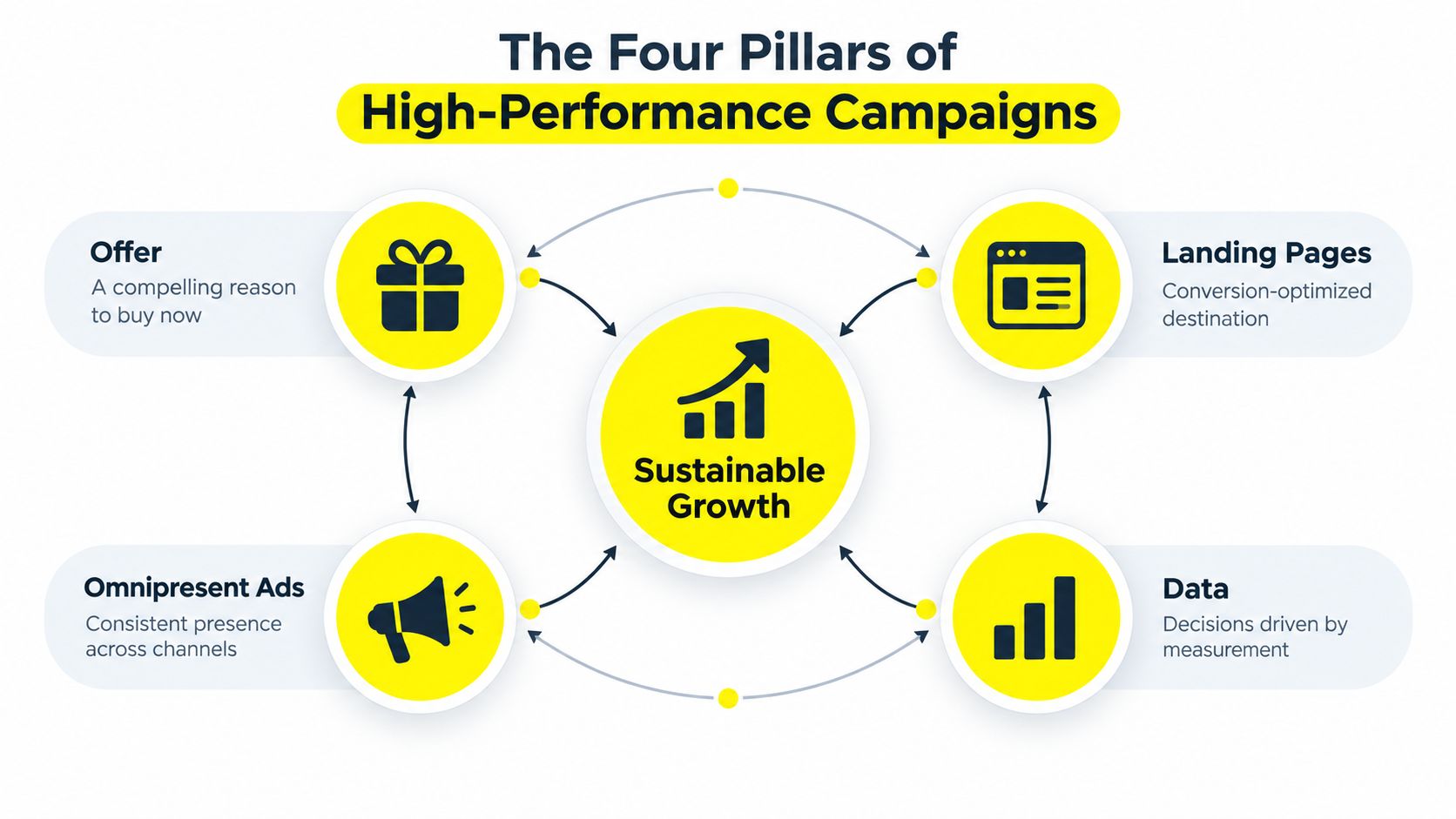
Sustainable campaigns depend on the interaction between offer, landing pages, omnipresent ads, and data. Weakness in one pillar creates pressure on the others. A great ad can't rescue an unattractive offer, and precise tracking can't make an unconvincing sales process profitable.
Offer
The offer answers the buyer's immediate question, “Why this, and why now?” It combines the product or service with positioning, proof, risk reversal, pricing logic, and a clear action. A local business may need a specific consultation promise rather than a generic “contact us” message. An e-commerce brand may need a bundle, guarantee, or education angle that distinguishes the product in a crowded feed.
Media buying can't compensate for a vague reason to act. Before launching new audiences, review the offer against actual objections from sales calls, customer service conversations, and abandoned checkout sessions.
Landing pages
The landing page should continue the ad's argument, not restart it. Match the headline to the campaign promise, show the next step clearly, remove unnecessary distractions, and make the form ask only for information the sales process can use.
This is also where conversion quality starts. A shorter form may increase submissions, but a more deliberate qualification step can produce fewer yet more valuable opportunities. The correct choice depends on the team's capacity and the economics of a qualified customer.
Omnipresent ads
Cross-platform presence doesn't mean copying one ad everywhere. Google captures active intent, Meta can develop demand through visual and social formats, TikTok supports rapid creative testing, and YouTube can explain a complex product in more depth. Retargeting then gives interested prospects a relevant next message instead of showing the same introduction repeatedly.
Creative variation matters more than increasing frequency. Test different hooks, demonstrations, objections, testimonials, formats, and calls to action while preserving a consistent commercial position.
Data
Data closes the loop. Track the event that matters to the business, then send that signal back to the buying system with enough context to distinguish a cheap conversion from a valuable one. For lead generation, that may mean separating an inquiry from a booked appointment, attended consultation, signed contract, or collected revenue.
A dashboard should help answer three questions: which audiences create qualified demand, which messages improve conversion quality, and where does margin disappear? If it only ranks campaigns by reported cost per conversion, it isn't yet a profitability system.
Understanding Performance Marketing Pricing Models
Pricing affects behavior. A fee structure that rewards volume may encourage an agency to pursue inexpensive leads, while a structure tied too closely to reported ROAS can encourage aggressive attribution claims or underinvestment in longer-term demand creation.
The right model depends on what you can measure reliably, how quickly revenue arrives, and whether the agency controls the parts of the funnel that determine the result. A business should also define the conversion event before discussing the fee. “Lead” could mean a form submission, a qualified conversation, a booked appointment, or a closed customer, and those outcomes have very different economic value.
Model | How It Works | Best For | Key Risk |
|---|---|---|---|
Cost per acquisition | The agency receives a fee for each defined acquisition event. | Businesses with a consistent, verifiable conversion process. | The agency may favor cheap volume over qualified demand. |
Cost per click | Payment is based on traffic delivered. | Early testing, traffic acquisition, or campaigns where conversion data is still developing. | Clicks can rise without a corresponding increase in revenue. |
ROAS-based arrangement | Compensation is linked to a reported revenue-to-ad-spend ratio. | E-commerce businesses with reliable purchase and margin data. | Platform attribution may not represent incremental or profitable sales. |
Monthly retainer | The client pays a fixed fee for strategy, execution, creative, reporting, and optimization. | Businesses needing broad funnel support and ongoing testing. | The agency can get paid without a clear outcome framework. |
For a deeper look at the economics behind acquisition fees, this guide to cost per acquisition for Shopify offers useful context. The important point is that a benchmark shouldn't replace account-specific unit economics.
CPA can work when the event is valuable and difficult to manipulate. For a service business, paying for a qualified appointment may be sensible. Paying for every form completion is less useful if the sales team can't contact the person or the person doesn't fit the offer.
CPC is easier to audit but places more performance responsibility on the client. It can be appropriate during discovery, especially when an agency is testing demand or building a measurement foundation. It shouldn't be treated as evidence of profitability.
Retainers often make sense when the agency is responsible for creative production, landing pages, analytics, and strategic planning in addition to media buying. Whatever the model, require account ownership, transparent spend reporting, agreed conversion definitions, and a documented process for changing targets.
How to Evaluate and Select the Right Agency
Start with evidence, not presentation quality. A polished pitch can demonstrate communication skills, but it doesn't prove that the agency understands your sales cycle, contribution margin, customer quality, or operational constraints.
Ask questions that expose operating depth
Use the discovery call to test how the team thinks:
“Which business outcome will define success?” Look for an answer that goes beyond clicks, impressions, or form volume.
“What conversion event will you optimize toward?” The agency should ask about lead qualification, booked appointments, sales status, refunds, margin, or repeat purchases.
“What would make you reduce spend?” A responsible partner should identify quality thresholds, cash-flow constraints, creative fatigue, or weak downstream economics.
“How will you test incrementality?” The answer may involve holdouts, geographic experiments, blended reporting, or a deliberate comparison of platform data and business results.
“Who owns the accounts and data?” You should retain access to advertising accounts, analytics, creative files, landing pages, and reporting history.
Verify the case studies
Ask for the starting context, campaign objective, spend scope, time period, conversion definition, and revenue source. A case study that says “ROAS increased” without explaining whether the number came from platform reporting, blended revenue, or incremental testing doesn't provide enough evidence.
Request a walkthrough of the dashboard rather than a screenshot. Confirm that you can reconcile spend, tracked conversions, CRM outcomes, refunds, and sales records. If an agency won't explain what didn't work, its testing claims deserve caution.
Inspect the working relationship
You need a clear owner for strategy, creative approvals, tracking issues, and weekly decisions. Find out how often the team reviews performance, what information you must provide, and how quickly it can act when sales quality changes.
A capable agency won't promise certainty. It will show you how it manages uncertainty, tests assumptions, and protects the economics of the account.
The Hidden Gap Between Reported and Real Returns
Reported ROAS answers a narrow question: how much revenue did a platform attribute to the ads under its selected rules? Incremental ROAS asks a harder question: how much additional revenue did advertising cause compared with what would've happened without it?
Those figures can diverge in either direction. A platform may miss conversions because identity signals are unavailable, causing it to understate a campaign's contribution. It may also claim credit for customers who were already likely to buy because of brand awareness, email, organic search, referrals, or repeat purchasing.
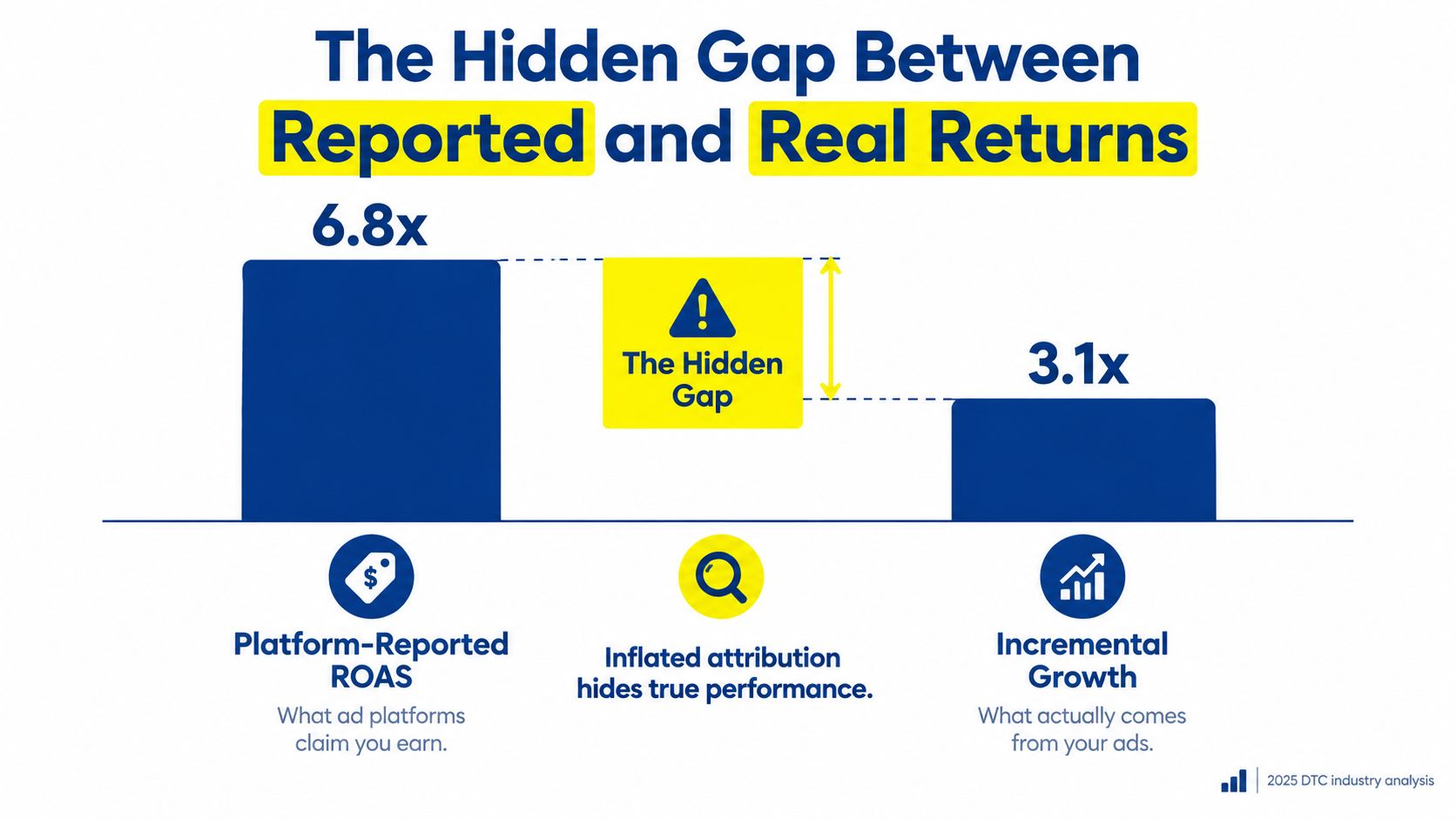
A 2025 analysis of 46 geo-based incrementality studies among direct-to-consumer brands found average platform-reported ROAS of 2.37 compared with incremental ROAS of 2.87, producing an average incrementality factor of 1.21, as reported in this incrementality analysis. The result isn't a universal rule that platform reports are always too low or that every ad campaign creates more revenue than reported. It demonstrates why the measurement method changes the budget decision.
Use different measures for different decisions
Platform ROAS can help with day-to-day optimization, especially when conversion volume and tracking quality are stable. It shouldn't be the only measure used to decide whether the business can afford to scale.
A stronger measurement stack includes:
Blended MER: Compare total marketing investment with total relevant revenue.
New-customer revenue: Separate acquisition from repeat purchases and existing demand.
Contribution margin: Account for product costs, fulfillment, discounts, refunds, and agency fees.
Customer payback period: Check how quickly acquisition investment returns through customer economics.
Holdout or geographic tests: Compare exposed and controlled markets when the account has enough operational stability to support a test.
If reported ROAS and incremental ROAS disagree, don't automatically choose the larger number. Investigate audience overlap, conversion windows, branded search, retargeting exposure, repeat buyers, and changes in the broader sales environment. The agency's job is to turn that disagreement into a budget decision, not hide it inside a blended dashboard.
The video below provides another way to frame the difference between attribution and actual growth.
Performance Marketing Playbooks by Industry
The same campaign structure won't work across every business model. A purchase is usually immediate and observable for e-commerce, while a local service may need a conversation, an appointment, and a completed job before the advertising decision can be judged.
E-commerce brands
Start with product economics, not a channel target. Define acceptable contribution margin after product cost, shipping, discounts, payment fees, returns, and advertising. Paid social can introduce products through demonstrations, comparisons, creator content, and problem-aware hooks. Search can capture shoppers already looking for a solution.
Separate prospecting from retention in reporting. A retargeting campaign may appear efficient because it reaches people who already know the brand, but that doesn't mean it deserves unlimited budget. Test product pages, bundles, offer framing, checkout friction, and creative angles alongside audience and bid changes. For teams exploring creator-led formats, using Nim for product video ads can support a broader creative testing process, provided the resulting claims and customer data use are reviewed carefully.
Local services
Optimize for qualified appointments and completed revenue, not form volume. A med spa, barber shop, contractor, or home-service company should connect ad leads to call outcomes, booking status, attendance, job value, and close rate.
Local campaigns need operational alignment. Ads may generate demand that staff can't answer promptly, while a low-quality offer can attract people outside the service area or budget range. Use location controls, service-specific landing pages, call tracking, and CRM imports, then let the sales team label lead quality in a consistent way.
Coaches and consultants
The funnel often needs more education before a prospect is ready to buy. A webinar, workshop, assessment, or consultation can qualify interest, but each step should have a defined purpose. Track registration, attendance, sales conversations, show rate, close rate, and collected revenue rather than treating registrations as the final outcome.
Creative should address the prospect's problem, desired change, objections, and level of awareness. A broad promise may produce attention but attract people who aren't a fit for the program.
Real estate professionals
Investors, agents, and mortgage lenders need a follow-up system that can handle longer consideration periods. Separate seller, buyer, refinance, investor, and first-time-buyer messaging instead of sending every audience to the same generic form.
Judge campaigns by contact rate, conversation quality, appointment progression, and eventual transaction value. Lead volume alone can mislead when prospects are unreachable, outside the target market, or far from a realistic transaction.
Privacy-First Measurement as a Competitive Advantage
Privacy-safe measurement isn't merely a legal task delegated to a developer. It determines which signals an algorithm receives, which leads a team can trust, and whether customers understand how a business uses their information.
The case for first-party data is becoming more practical. Nielsen's 2025 marketing research reported that 42% of marketers globally identified changing privacy rules and the shift toward cookieless browsing as major factors affecting marketing. The operational response isn't to collect everything. It's to collect the minimum consented data needed to connect an ad interaction with a meaningful business outcome.
Build the measurement path deliberately
Google Ads Enhanced Conversions can use consented customer identifiers such as email address, phone number, name, or postal address. The values are normalized and hashed with SHA-256 before transmission, and Google can compare them with hashed information from signed-in accounts. Google's Enhanced Conversions documentation also specifies that conversion data and hashed first-party data can be sent through its API after a conversion, with a window of up to 24 hours.
A sound implementation includes a sitewide Google tag or Google Tag Manager, a clear consent process, deterministic normalization, HTTPS transmission, and reconciliation against CRM or order records. For lead-generation businesses, import qualified appointments, attended consultations, closed revenue, and other meaningful stages instead of stopping at the form submission.
Better signals create better discipline
Privacy restrictions can expose lazy optimization. If a team can't rely on every browser event, it has to define the events that matter and verify them against backend records. That usually produces a cleaner hierarchy of signals and makes cheap, unqualified leads harder to mistake for progress.
Consent language should be clear and proportionate. AI-generated creative should avoid exposing customer information or making unsupported personal claims. The strongest privacy-first programs treat customer trust, data minimization, and revenue accuracy as connected performance requirements.
Your Action Plan for Getting Started
Begin with a measurement brief before comparing agencies. Write down the offer, target customer, sales process, gross-margin constraints, current conversion events, CRM stages, and the business outcome that would justify more investment. If these definitions are unclear, a new media buyer will only create faster ambiguity.
Use the first call to ask:
What will you optimize first? Require a specific event and an explanation of why it represents business value.
How will you validate lead quality? Look for CRM feedback, sales-stage imports, call review, and reconciliation with revenue records.
What will you test in the opening period? The answer should cover offer, landing page, creative, audience, and measurement assumptions without promising a predetermined result.
How will you report uncertainty? Ask how the agency handles missing conversions, modeled data, attribution overlap, and discrepancies between platform and backend figures.
What do you need from us? A serious plan identifies response-time requirements, sales feedback, creative approvals, tracking access, and inventory or capacity limits.
Before signing, request the scope of work, account-access terms, ownership of creative and landing pages, reporting examples, conversion definitions, testing cadence, communication schedule, cancellation terms, and data-handling practices. Ask the agency to identify which results are platform-reported and which are independently verified.
For the opening period, track implementation quality before judging scale. Confirm that tags fire correctly, consent choices are respected, CRM stages reach the reporting system, sales teams classify outcomes consistently, and the dashboard reconciles with financial records. Then review the first set of creative and landing-page tests against qualified outcomes, not just cheap traffic.
Choose a partner that can explain what it will stop, what it will continue, and what evidence would change the plan. That standard protects your budget better than a guarantee built around a metric the agency controls.
Wojo Media offers paid advertising across Facebook, Instagram, TikTok, Google, and YouTube, with support for offers, landing pages, creative, retargeting, and backend KPI tracking. If you want to evaluate performance marketing services against qualified outcomes and profitable growth, visit Wojo Media to request a strategy conversation.
Comments