
Facebook Ads for Med Spas: A Local Lead Playbook

79% of U.S. med-spa clients had skipped booking because contacting the business or booking online was too difficult, according to a consumer statistic cited in Axiobench's med-spa industry coverage. That reframes Facebook ads for med spas: generating interest isn't enough if the clinic makes the next step difficult.
A profitable campaign needs more than an appealing treatment video. It needs an eligible audience, defensible claims, privacy-conscious measurement, available appointments, and someone responsible for turning inquiries into attended consultations. Judge the whole process by paying clients, not the cheapest form submissions.
Med Spa Facebook Ad Benchmarks to Budget Against
A form fill can cost real money before your receptionist has spoken to anyone. In 2025, Beauty & Personal Care Facebook lead-generation campaigns had a median cost per lead of $51.42, according to WordStream benchmarks cited by MoonSauce Agency.
That's a category-level planning reference, not a med-spa-specific quote. Your city, treatment mix, competition, offer, and qualification requirements will affect what you can acquire profitably.
Facebook ad benchmarks for beauty and personal care
Metric | Benchmark | What it means for a med spa |
|---|---|---|
Median cost per lead | $51.42 | Budget for form submissions, then evaluate their quality |
Median click-through rate | 2.55% | A lower result warrants checking creative, audience, and offer alignment |
The 2.55% median click-through rate also comes from 2025 WordStream Beauty & Personal Care Facebook lead-campaign benchmarks, as cited by Webtonic. Falling below that reference doesn't prove your audience is wrong, but it gives you a reason to inspect the opening visual, treatment explanation, and relevance of the offer.
Work backward from paying clients
Neither benchmark tells you how many people will book or attend. Track those rates in your CRM rather than borrowing unsupported industry averages.
Use this calculation:
Monthly media budget = new paying-client goal ÷ lead-to-booking rate ÷ show rate ÷ consultation-to-treatment conversion rate × cost per lead.
If your goal is attended consultations rather than paying clients, leave out the treatment-conversion factor. Don't label an attended consultation a new client before that person purchases.
Also distinguish advertising spend from total acquisition cost. Creative production, campaign management, and intake labor belong in your profitability assessment, even if they aren't included in Ads Manager.
Before launch, enter your own booking, attendance, and purchase rates into the calculation. If you don't have them, use explicitly labeled planning assumptions and replace them as actual outcomes arrive. A budget that only works when nearly everyone books and buys isn't a sound starting point.
Meta Policy Rules That Shape Every Med Spa Ad
An ad asking whether someone is unhappy with their wrinkles can create a policy problem before the offer gets a fair test. The issue isn't mentioning wrinkles. It's implying that the viewer has an undesirable physical attribute.
Meta's health-and-wellness advertising guidance lists services including dermal fillers, chemical peels, microneedling, skin rejuvenation, and laser treatments within its policy framework, and requires applicable cosmetic-treatment advertising to target people aged 18 or older. Permissible services still need compliant messaging, imagery, and campaign settings.
Risky ad wording and compliant replacements
Risky wording | Compliant replacement | Why it matters |
|---|---|---|
Are you unhappy with your wrinkles? | Explore wrinkle-treatment options with a licensed provider | The original implies a personal defect |
Painless results with zero downtime | Ask your provider about recovery expectations for your treatment | Absolute comfort and recovery claims need substantiation |
Clinically proven permanent results | Describe the treatment and provide relevant, provider-supported evidence | Objective claims require competent, relevant support |
Before-and-after imagery that shames the viewer's appearance | Use provider-led education or neutral treatment imagery | Appearance-negative framing is restricted; a disclaimer doesn't cure it |
Treat the replacements as safer drafting directions, not guaranteed approvals. Meta evaluates the full advertisement, and a neutral headline won't compensate for a shaming image or an exaggerated landing page.
Build a pre-launch approval file
Separate the responsibilities. Your campaign manager checks platform settings and presentation; the clinical reviewer verifies treatment descriptions, qualifications, and evidence.
Map objective claims to documentation. Record the exact wording, supporting material, limitations, and reviewer. Don't approve a broad promise because a device brochure contains a narrower finding.
Rewrite personal-attribute questions. Describe available services instead of diagnosing the person scrolling.
Verify audience eligibility. Check the actual ad-set controls, not just the intended audience in a planning document.
Remove appearance criticism. Review captions, thumbnails, close-ups, and destination-page imagery together.
Save dated approvals. Keep the approved copy, creative, audience settings, and evidence together so later edits don't introduce unsupported claims.
Practical rule: Approval is a checkpoint, not proof that an advertisement satisfies every legal or professional obligation.
A launch-ready ad set has a defined service, an eligible local audience, neutral creative, documented claims, and a destination that keeps the same promise. If an ad is rejected, inspect the stated reason and correct the underlying issue rather than repeatedly resubmitting cosmetic variations.
Targeting and Lead Forms That Reach Local Clients
Start with travel behavior, not an elaborate interest stack. A prospect who likes skincare but won't drive to the clinic isn't a useful lead.
Use your appointment records and local road network to define a practical service area. Congestion, bridges, parking, and provider availability can matter more than a neat circle on a map.
This graphic illustrates the setup components, but treat its mileage and narrow-interest suggestions as test ideas, not universal rules.
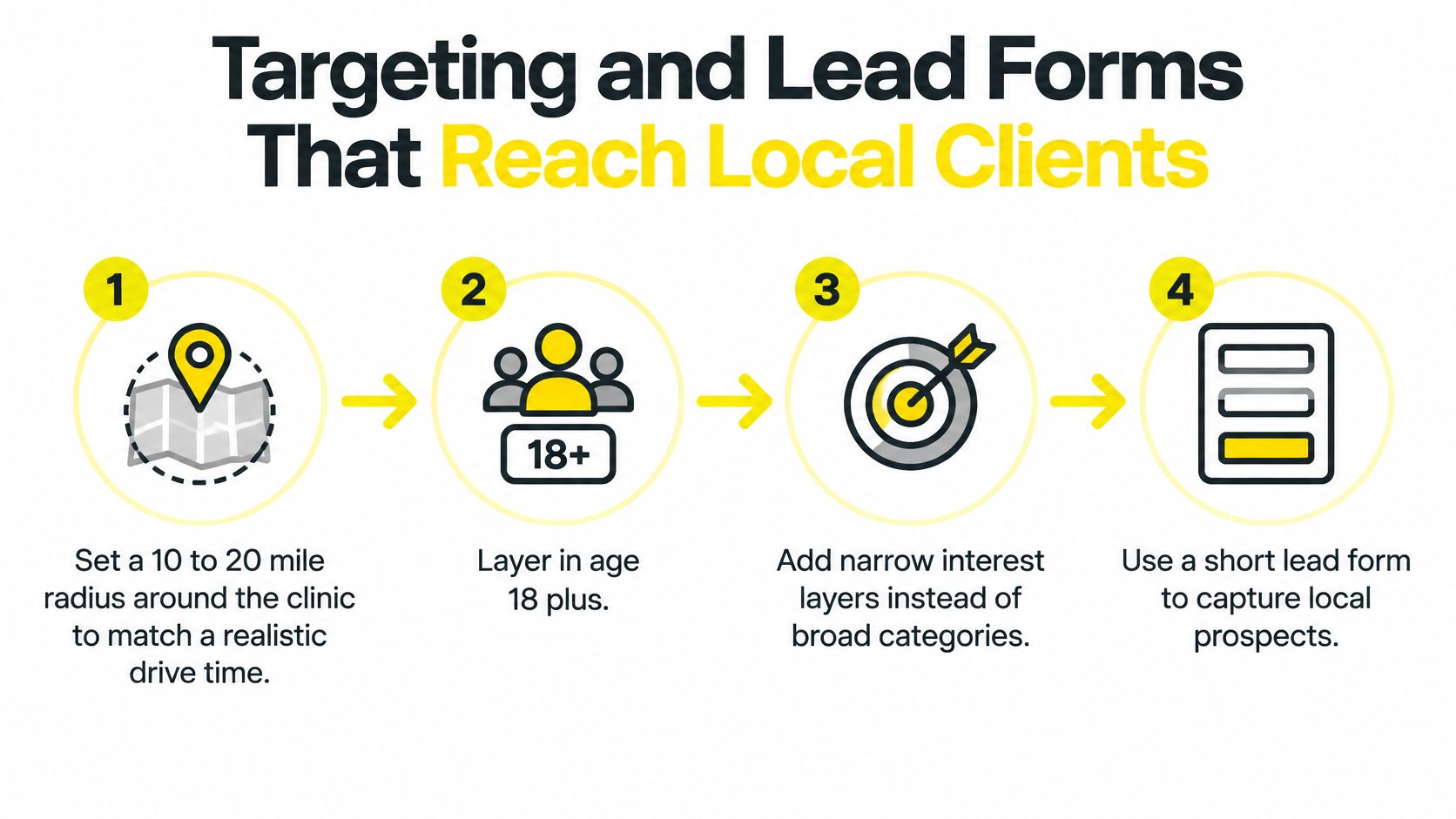
Build the audience and intake route
Choose serviceable geography. Start where the clinic can realistically attract and retain clients. Don't widen coverage merely to make the audience estimate look healthier.
Separate meaningful treatment journeys. Give distinct services their own message and routing when their economics or consultation requirements differ. Avoid splitting a modest budget into numerous nearly identical audiences.
Keep the form operational. Collect name, phone, appointment preference, and only a broad service category where permitted. Avoid condition-specific wording and free-text invitations to disclose medical history.
Explain contact permissions. Match the consent language to your privacy notice and intended communication channels. Tell prospects who will contact them and what happens next.
Assign an owner. Route submissions into the CRM and notify a named coordinator, with backup coverage when that person is unavailable.
Meta's Advertising Standards restrict personal-attribute messaging and sensitive information collection in lead ads without prior permission. Medical intake belongs in an appropriately protected clinic system, not an advertising form.
Local relevance also needs to continue after the click. ProMD Health Bel Air's resource on non-surgical rejuvenation close to Fallston offers a concrete example of connecting a service with a nearby community. Build that geographic clarity into your own destination without implying that you know a viewer's treatment needs.
Watch delivery without overreacting
I would start with broad local delivery rather than assume a complex stack of interests improves qualification. Test additional restrictions only when you have a specific hypothesis and enough budget to compare outcomes.
Watch reach and frequency alongside qualified bookings. Repeated exposure to a small audience, weakening response, and rising acquisition costs together suggest you should revisit constraints or creative. Frequency alone doesn't establish fatigue.
Don't build treatment-page visitor audiences by default. Such audiences can expose sensitive interests, and technical availability isn't permission to use them.
Offers and Creative That Pass Review and Earn Clicks
Lead with a consultation people can understand, not a transformation you can't guarantee. A consultation-led offer lets the clinic explain suitability, recovery, and treatment options before asking someone to commit to a procedure.
A free assessment can be appropriate if it's free and its scope is clear. A paid consultation can also work when the value and terms are explicit. Deep discounts aren't automatically wrong, but they can reduce margin and attract people whose main qualification is interest in the lowest price.
Provider-led creative makes the consultation experience tangible.

Replace the promise, not just the adjective
Consider a chemical-peel campaign.
Risky draft: A painless chemical peel for permanent skin transformation.
Provider-led rewrite: Explore chemical-peel options with a licensed provider. Discuss suitability, expected recovery, and aftercare during your consultation. Request an appointment.
The rewrite gives the prospect a specific next step without guaranteeing comfort or permanence. It also gives the coordinator a clear expectation to continue during follow-up.
The FTC's Health Products Compliance Guidance says advertisers must possess adequate substantiation before publication, with competent and reliable scientific evidence supporting health-related claims. Evidence must fit the advertised treatment and claimed benefit, not merely a related technique or product.
Test distinct reasons to book
Provider video: Explain what the consultation covers and what the clinician evaluates. Use captions and placement previews in Meta Ads Manager.
Treatment-room image: Show the actual environment with a clear service description and consultation invitation.
Authorized testimonial: Preserve the person's meaning, review implied outcome claims, and include appropriate disclosures. A disclaimer doesn't make an unsupported promise acceptable.
Before publishing, check headline accuracy, absence of appearance criticism, and whether the call to action names a real action. Confirm that the page and booking screen don't introduce stronger promises.
Start with a small, manageable set of different concepts. Don't mistake changing background colors for testing a new reason to book, and don't launch more variants than your budget can meaningfully evaluate.
Landing Pages and Fast Follow-Up That Book Consults
The booking-friction finding at the start points to a practical problem: you can pay to create interest and then lose the appointment through an unanswered phone or confusing calendar. Fixing that handoff may be more useful than adjusting targeting again.
A landing page should continue the exact service and consultation offer from the ad. Put the provider's credentials, location, material terms, and booking action where a mobile visitor can find them without navigating a general service menu.
Use the funnel below to audit the handoffs, rather than treating its geographic example as a required targeting setting.
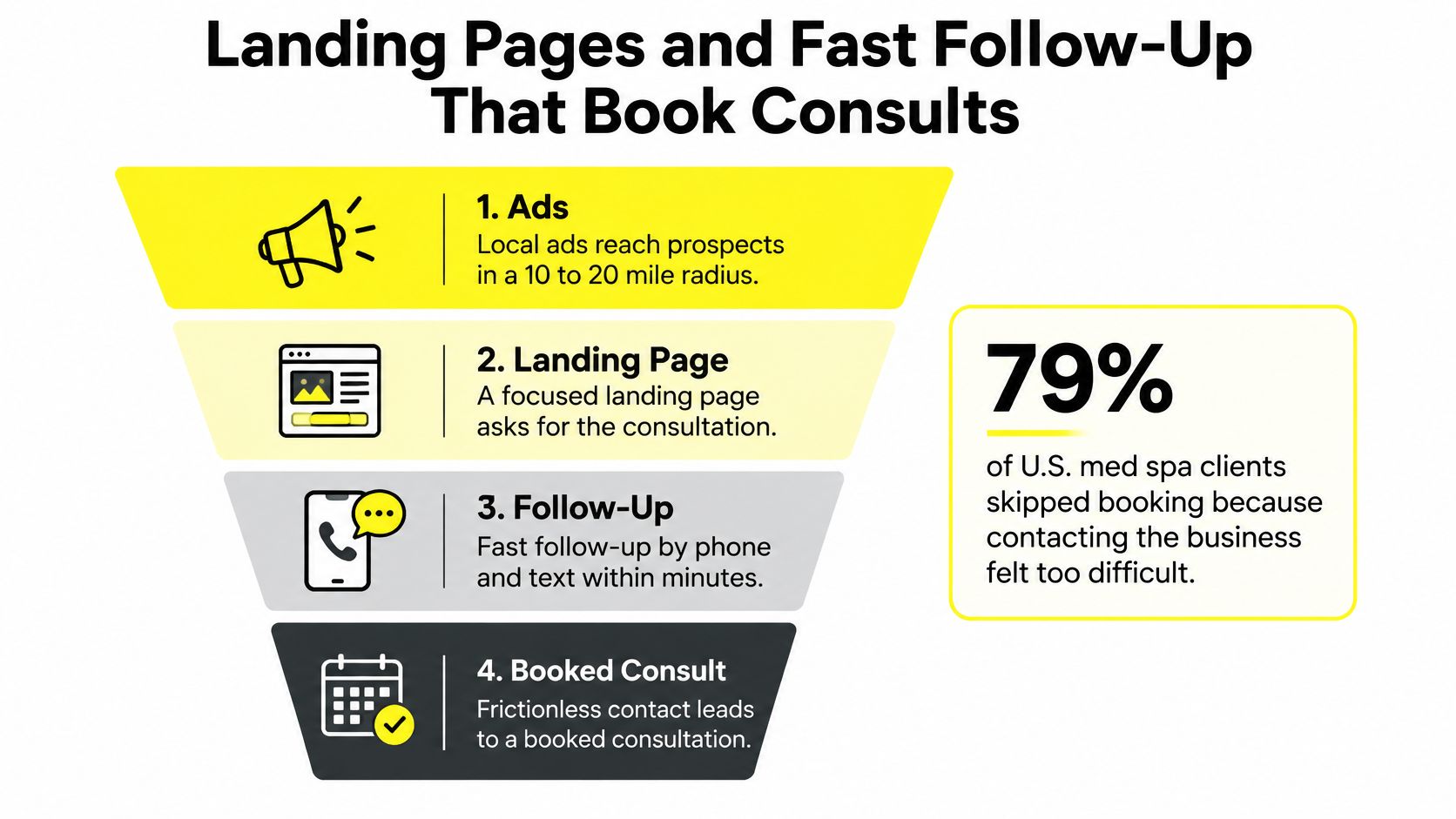
Make scheduling the easiest action
Online booking should display real consultation availability and explain what the appointment includes. If clinical screening is necessary before scheduling, say so plainly and provide a straightforward request path.
Don't send someone through a long form only to reveal that no appointments are available. Match campaign volume to the calendar the coordinator can offer.
Match the promise. Keep the treatment name, offer, and next step consistent across ad, page, and confirmation.
Respond promptly. Set a realistic internal response target during staffed hours and measure actual performance.
Offer concrete availability. Give the prospect specific appointment choices rather than asking an open-ended scheduling question.
Confirm the visit. Send the location, arrival instructions, relevant preparation details, and rescheduling route through approved channels.
Record the result. Distinguish unreachable contacts, scheduling conflicts, bookings, cancellations, and clinical-review needs in the CRM.
A missed call is an intake event to resolve, not evidence that the advertising audience was wrong.
If staffing is the constraint, MedicalVirtual's Hire Medical Virtual Assistants resource is a place to explore administrative support. Evaluate training, access controls, privacy obligations, and escalation procedures before granting anyone access to clinic systems.
Use this video as an additional discussion resource when reviewing the lead-to-booking process with your team.
After-hours acknowledgment can explain when a coordinator will respond and provide a booking route. It shouldn't imply that a clinician is available or substitute for medical advice.
Scale only when staff can maintain follow-up quality and the clinic has capacity to honor the consultation offer.
Measuring Booked Consults Without Oversharing Data
A form submission and an attended consultation aren't interchangeable outcomes. If your reporting treats them alike, you can't tell whether an inexpensive campaign creates clients or administrative work.
Meta's Conversions API documentation describes server-side event transmission from systems such as websites, CRMs, and offline processes. Where permitted and supported by the account's configuration, downstream signals can help measurement and optimization reflect qualified prospects rather than submissions alone.
Say a campaign generates inexpensive forms but few reachable prospects. Feeding an eligible qualified-lead signal back into optimization gives Meta a different success criterion. That isn't a guarantee of better performance, and sensitive clinical details aren't necessary to describe the operational milestone.
Send less information deliberately
Keep detailed treatment and revenue analysis inside the clinic's controlled reporting environment. Decide separately which events, if any, may lawfully and appropriately leave it.
Deduplicate events. Use stable event identifiers when browser Pixel and server integrations report the same action.
Audit the complete payload. Inspect URLs, query parameters, event names, custom fields, and identifiers.
Use neutral milestones cautiously. A consultation-booked label reduces explicit detail but doesn't automatically make an event nonsensitive.
Review before deployment. Consent, platform terms, jurisdiction, and the clinic's regulatory status all matter.
Meta's policy framework makes health-and-wellness advertising a constrained environment. Don't assume hashing, server-side transmission, or a neutral label makes disclosure acceptable; obtain a specific privacy review and keep medical intake out of advertising integrations.
Med spa campaign KPIs in decision order
Metric | What it shows | Decision it drives |
|---|---|---|
Cost per qualified lead | Cost of reachable prospects who meet defined nonclinical qualification criteria | Whether creative and audience attract useful inquiries |
Booked consultation rate | Share of leads that schedule | Whether follow-up and the offer support booking |
Show rate | Share of bookings that attend | Whether reminders, scheduling, and reservation policies need work |
Treatment conversion rate | Share of attended consultations that purchase | Whether fit, consultation quality, or pricing needs review |
Customer acquisition cost | Total acquisition spend per paying client | Whether scaling is economically justified |
Reconcile CRM records with appointments and collected payments. Handle duplicates, refunds, memberships, and repeat visits consistently rather than counting every transaction as a newly acquired client.
CPL alone never decides whether to scale. Use acquisition cost alongside contribution margin and capacity, with a consistent definition of the client and revenue being counted.
Launch Your First Local Campaign This Month
Launch when the clinic can fulfill the offer, handle inquiries, and measure outcomes responsibly. Delay when any of those foundations is missing, even if the creative is ready.
Use a straightforward launch order rather than trying to advertise the entire treatment menu.
Approve the offer and evidence. Select a service with available capacity, document material terms, and finish the dated claim-review file.
Configure local delivery. Choose serviceable geography and verify eligibility controls. Separate treatment campaigns only where the business distinction justifies it.
Test the booking journey. Submit a test inquiry from a phone, inspect the coordinator notification, and complete the scheduling process.
Validate measurement permissions. Confirm CRM stages, deduplication, and the exact outbound data. Keep restricted information internal.
Schedule a weekly business review. Read qualified-lead cost, booking rate, attendance, treatment conversion, and acquisition cost in sequence. Fix the earliest broken handoff before increasing spend.
Set a clear go-or-no-go standard
For a wider small-business planning perspective, Veo3 AI on measurable advertising goals is a useful companion resource. For a med spa, translate the goal into appointments the clinic can serve and acquisition costs its margins can support.
Launch standard: A test inquiry reaches an accountable person, receives an appropriate response, and can become a real appointment.
Don't increase spend because the dashboard turns green. Increase it when the clinic can preserve service quality while accommodating more qualified inquiries.
We work with both local and online businesses, but a med spa's local calendar creates a firm operational limit. Before the first ad goes live, answer this question: Can your team promptly reach a new lead and offer a suitable consultation during opening hours? If not, assign coverage and test the handoff before launching.
Wojo Media connects offers, landing pages, paid advertising, and backend KPIs so med spa campaigns can be judged beyond form fills. Visit Wojo Media to book a free demo call with Jason or a growth manager, the first step toward building a custom paid ad strategy around your consultation goals and clinic capacity.
Comments