
First Click vs Last Click Attribution: Which to Trust

The usual advice is to pick one model and fund the channel that wins. That advice is the expensive part. First click vs last click attribution only moves credit. It does not measure how many sales a channel caused. The same buyers can make prospecting video look essential in one report and branded search look essential in the other, while the journeys stay identical.
Treat both reports as boundary cases. Pull them for the same dates, mark the channels that swing, and hold a test before you move real money. The rest of this piece shows the credit rule, the budget traps, and the point where a holdout should override the dashboard.
First Click vs Last Click at a Glance
First click gives 100% of a conversion's credit to the first observed touchpoint. Last click gives 100% to the final non-direct interaction before the sale or lead. Every other touch gets nothing.
Aspect | First click | Last click |
|---|---|---|
Credit rule | 100% to first observed touchpoint | 100% to final non-direct touchpoint before conversion |
Question it answers | Which channel started the path? | Which interaction closed the sale or lead? |
Channels that usually win | Prospecting video and paid social | Branded search, retargeting and email |
Main blind spot | Credits introductions that never assist the sale | Credits closers that captured demand created earlier |
Reporting effort | Low: one touch per conversion | Low: one touch per conversion |
Read the rows as a decision filter, not a scorecard.
Credit rule. One conversion, one winner. You can explain either number in a meeting without a formula.
Question. First click asks where recorded demand entered. Last click asks which click sat next to the purchase or form.
Channels. Prospecting on TikTok, Facebook, and YouTube usually leads the first-click view. Branded Google search, retargeting, and email usually lead the last-click view.
Blind spot. An opener can get full credit for a buyer who would have found you anyway. A closer can get full credit for demand a prospecting ad created days earlier.
Effort. Both stay cheap to run because you never split a conversion.
The choice matters because the customers do not change. Only the winner does. A media buyer who scales the first-click leader and cuts the last-click leader is scaling two different stories about one path.
Practical rule: Export first-click and last-click channel shares for the same 30 days and circle every channel that moves. Those are the lines where the model choice changes the budget.
Club and venue teams hit the same split between awareness posts and the click that books a tee time. A guide to marketing attribution for club managers walks that membership path in plain language if your funnel mixes content, search, and a booked visit.
How Credit Moves Along a Real Customer Path
Say a buyer clicks a TikTok prospecting ad on Monday, an Instagram retargeting ad on Wednesday, then searches the brand on Google and buys on Friday.
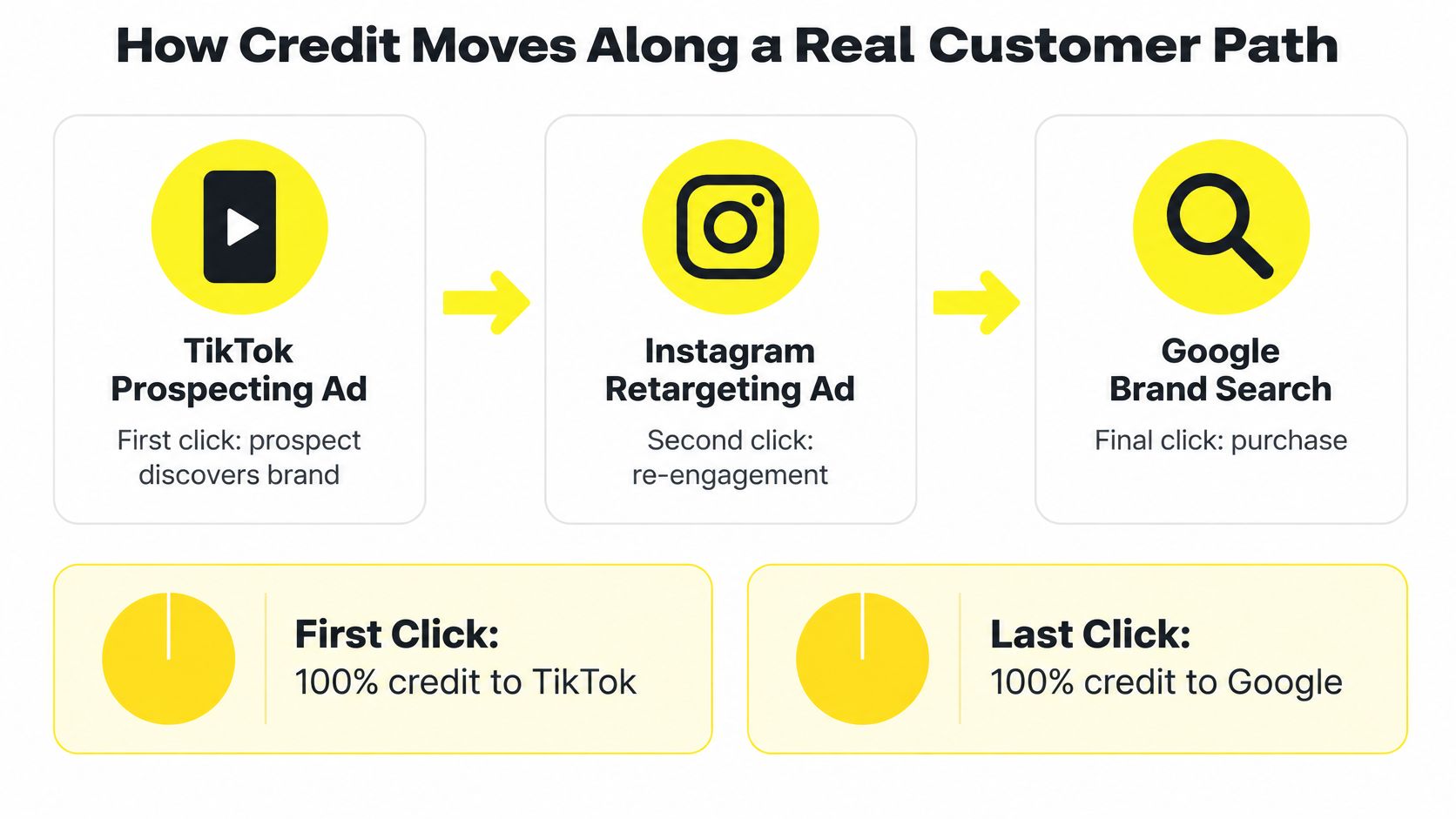
Under first click, TikTok receives 100%. Under last click, the Google brand click receives 100%. Instagram receives 0% in both reports. The middle ad did real work. The rule throws it out.
Google's Analytics help describes these as the "First Interaction" and "Last Interaction" models. In Google Ads and Search Ads 360, first click credits the first-clicked ad or keyword, and last click credits the last-clicked ad, keyword, or other biddable item. First click is built to spot demand creation. Last click stresses the interaction closest to the purchase or lead. Neither spreads value down the path, so a three-touch journey still leaves two touches at zero. A five-touch path still leaves three at zero.
Same spend, opposite ranking
Picture an account that spends $10,000 on TikTok prospecting and $2,000 on branded search, and every sale follows that three-click pattern. First click ranks TikTok first. Last click ranks branded search first. Spend did not move. The verdict flipped.
Legacy Google docs also set position-based credit at 40% to the first interaction, 40% to the last, and 20% across the middle. That split at least admits the Instagram click exists. It is still a rule, not proof the middle ad changed the sale.
Direct visits complicate the closer. Because last click looks for the final non-direct interaction, a typed URL at the end can hand credit back to the Google click instead of "direct." Write that rule on the report or the two views will not match.
Before you trust the dashboard, write your last three converting paths touch by touch. Apply both rules by hand. If the sheet and the platform disagree, fix the path definition before you touch bids.
Where Each Model Misleads Budget Decisions
First click inflates channels that introduce people. Last click inflates channels that catch buyers who already intended to purchase. Any cut made on one report inherits that bias.
Channel role | First click reading | Last click reading | Budget risk |
|---|---|---|---|
Paid social prospecting (Facebook, TikTok) | Inflated | Undercounted | Cutting it on last-click data starves future demand |
Instagram or YouTube retargeting | Undercounted | Inflated | Looks like the winner while taking credit created earlier |
Branded search | Undercounted | Inflated | Captures demand that other channels created |
Direct traffic | Often unassigned | Inflated | Hides the paid path that preceded the visit |
Email nurture | Undercounted | Inflated | Overstates late timing and understates the lead source |
The costliest miss is paid social prospecting. A last-click report can show Facebook or TikTok with a thin share while branded search looks efficient. Pause the prospecting line and the branded searches it was feeding often thin out over the following weeks. The report never shows that dependency, because it deleted the early click.
What multichannel research shows about credit
Peer-reviewed multichannel research in the Journal of Marketing Research shows that last-click rules can credit direct and search visits for demand that earlier referral or display touches created.
That is the budget risk in miniature. Last click can pay branded search, direct visits, or remarketing for harvesting demand that prospecting built. First click can pay an awareness ad that introduced someone and then played no role in the purchase. Both models make channel CPA and ROAS easy to calculate, and both assign the entire sale to one touch while discarding the rest of the path. Neither measures incremental revenue.
Last click rewards the harvest. First click rewards the introduction. Neither tells you the harvest would have failed without the introduction.
Sort every active channel into prospecting or capturing. Flag any line with a high first-click share and a low last-click share, and flag the reverse. A high-opener, low-closer flag becomes a holdout candidate: keep the channel dark in one region or audience while the rest runs as usual, and watch whether revenue drops. That test answers the question both reports skip. The gap between the two views also widens when Facebook, Instagram, TikTok, Google, and YouTube share one long consideration window, because more of the path sits outside whichever single touch you keep.
Choosing the Model That Matches Your Decision
Start with the decision you are about to make. The model is only the lens for that decision.
A new Meta or TikTok prospecting campaign. Judge whether it creates demand on first click. Then open last click and see whether those buyers show up later on branded search. If first click is strong and last click is empty, you have an opener, not a closer. Keep it only if later capturing channels still convert those people.
Whether to keep branded search. Last click shows what sits next to the sale. It does not show whether those buyers would have typed the brand anyway. Run a holdout before you cut or scale that line. Cutting a capturer that is incremental hurts revenue now. Cutting one that only collects demand created elsewhere frees budget for the opener.
Ecommerce with a one- or two-day path. Last click is usually enough for daily bids, because few touches fall out of the window. Still glance at first click once a week so a creative test that only opens journeys does not get killed for a weak closer score.

Coaching, real estate, and tax planning. Weeks can sit between the first click and a qualified lead. Report both models next to conversion lag. A single model hides the gap between introduction and close, and a media buyer will "fix" a channel that is only slow.
Local services that take calls. Use last click for daily optimization of Google Ads and call campaigns. Cross-check the credited channel against call logs before you move money, because a booked job often starts on social and ends on a branded search or a saved number.
First click asks where demand started. Last click asks what closed it. Neither answers how much a channel caused.
Setting Up Both Views for Paid Social and Search
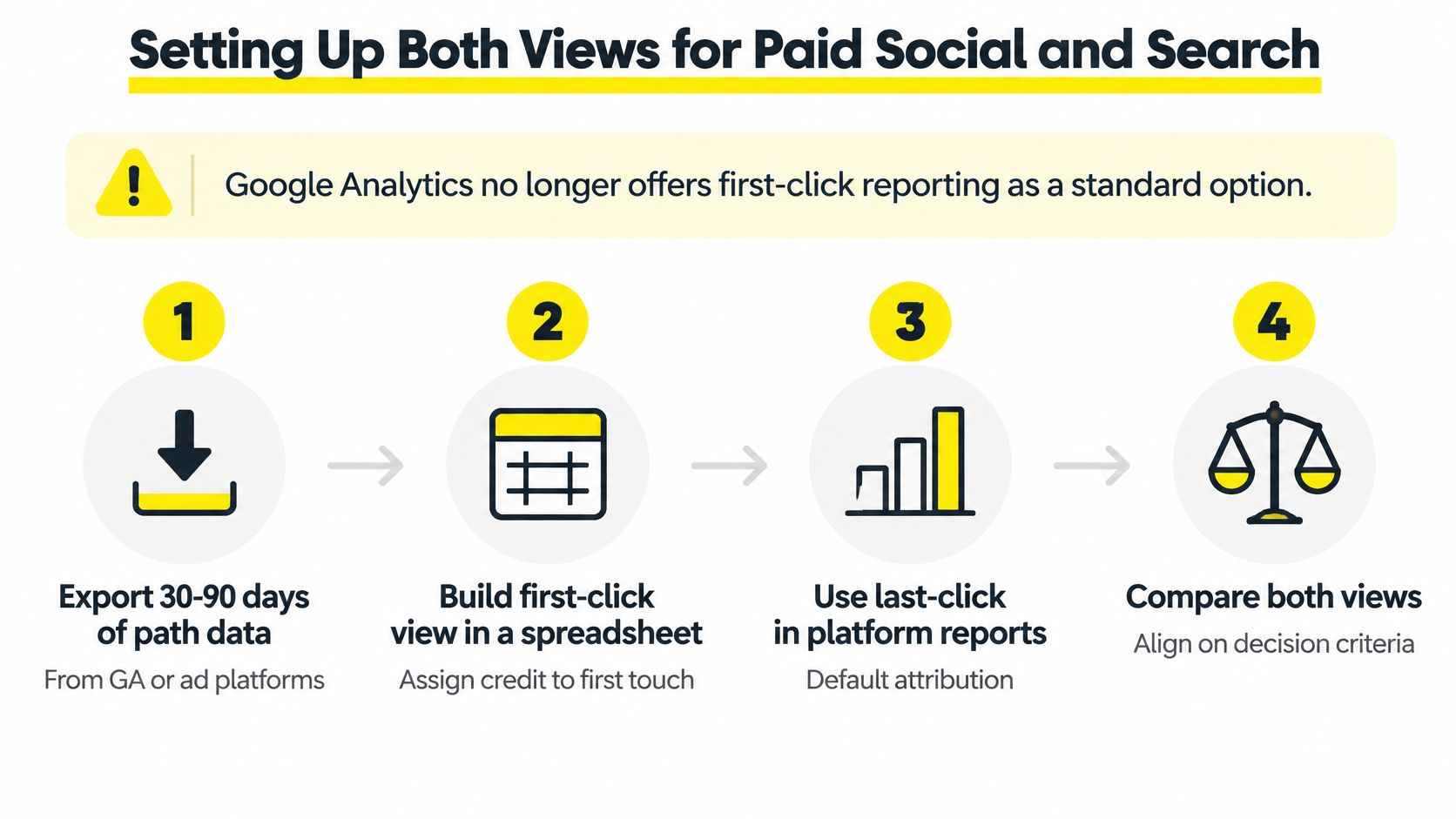
Google Analytics no longer offers first click as a standard report, so you build that view from exported paths. Google's current attribution documentation states that first-click, linear, time-decay, and position-based models were discontinued in November 2023. Reports now emphasize data-driven attribution and last-click variants. Paid-and-organic last click assigns 100% of key-event value to the last channel clicked and excludes direct traffic unless the path is entirely direct. Analytics attribution data runs from June 14, 2021 onward. Google Ads conversions based on key events still use last click for applicable conversions, even when you pick another model in Analytics.
Model choice can change reported volume and channel value without changing a single journey. A first-click export may favor awareness. A last-click report may favor branded search, retargeting, or email.
Build both views the same way
Export 30 to 90 days of converting paths with date, channel, campaign, touch order, and conversion value. Shorter windows bounce around. Longer ones mix old offers with new ones.
Lock one conversion event and use it in both views. Otherwise you will argue about goals when you meant to argue about credit.
Set click and view lookback windows to your sales cycle, and use those windows in both views. A seven-day social window next to a 30-day search window is not a fair comparison.
Calculate each channel's share of conversions and of value under both rules, plus CPA under each. Share shows the swing. CPA shows what you paid for the swing.
Flag any channel whose share moves more than 10 points. Investigate those lines before you change budget.
Write down how direct visits are treated. If last click drops direct unless the whole path is direct, say so on the sheet or the views cannot be compared.
Save the rule set in a shared sheet and rebuild both views from it each month. A quiet change in filters is how two analysts end up with two winners.
We use tracking and AI tech to shift ad spend toward the better areas and platforms, but the shift still starts with these two aligned views. If the exports disagree with the ad platform, trust the path file until you know which click the platform dropped.
Hybrid and Multi-Touch Options When One Touch Is Not Enough
Approach | Credit rule | Best for | Main limit |
|---|---|---|---|
Position-based | 40% first, 40% last, 20% across middle touches | Paths with a clear opener and closer | Middle weights are arbitrary |
Linear | Equal share to every touch | Long multi-channel paths | Gives a retargeting click the same weight as a first ad |
Time decay | More credit to touches near conversion | Short sales cycles | Penalizes early prospecting in long cycles |
Data-driven | Credit estimated from observed conversions | Accounts with high conversion volume | Observational; cannot prove incrementality |
Incrementality test | Exposed group compared with holdout | Testing large budget shifts | Costs budget and time; needs enough volume |
Position-based is the sensible default when finance wants one number and the path has a real opener and a real closer. The middle 20% is still a guess. Linear is fairer on long paths and unfair on short ones, because a late retargeting click weighs the same as the ad that introduced the buyer. Time decay fits a two-day ecommerce cycle and punishes prospecting when the sale takes weeks. Data-driven attribution estimates shares from conversions you already observed. It still cannot prove a touch caused the sale. An incrementality test can, because it compares people who saw the ads with people who did not.
The first click you recorded may not be the first click
Many reports assume the tracker saw the whole journey. Attribution research on fragmented journeys notes that identity gaps, browser limits, device switching, offline sales, and delayed conversions often make the recorded first interaction only the first observable one. Effects also fade as the gap between exposure and conversion grows, so order alone can bias a long cycle. That shows up in real estate, tax planning, coaching, and expensive ecommerce, where the first click may land weeks before a qualified lead.
Report three different facts, not one blended "first touch":
First observable touch: the earliest click your tags stored.
First known touch: the earliest click after you stitch devices and CRM identity.
First incrementally effective touch: the earliest touch a holdout says changed outcomes.
Put conversion lag, assisted revenue, lead quality, and closed-won revenue next to clicks and form fills. A webinar funnel for tax advisors or a listing funnel for agents should be judged on pipeline, not on the click that opened the path. A hybrid stack does that with platform data, CRM stages, server-side or first-party events, and periodic tests. Neither single-touch model is the ground truth in that stack.
Decide Which Model to Trust Before Your Next Budget Shift
Neither first click nor last click measures incremental revenue. A swing in channel share between the two reports is a hypothesis. Switching the dropdown does not make the next budget more accurate.
Marketing-measurement research defines the right target as the incremental effect a touchpoint caused, not the touch that happened to sit first or last. Multi-touch models spread credit across the path and can still confuse correlation with causation. Controlled treatment-versus-control tests estimate causal lift; attribution reports have no holdout, so they cannot.
Treat the two reports as a disagreement detector. Where they agree, the channel's role is probably stable. Where they diverge sharply, a channel sits on the boundary between opening paths and closing them, and that channel is the one a naive budget shift will cut or double first.
Set the override rule before you look at the numbers. When a channel's spend is about to change by more than a threshold you fix in advance, such as 20%, validate the move with a geo holdout, an audience holdout, a conversion lift test, or a platform experiment.
When the numbers disagree, split the trust:
Holdout: decides whether you spend more or less.
CRM: holds the revenue and pipeline totals.
Platform attribution: explains which click the ad system counted rather than whether the click was causal.
Run the override in four steps
Pick the one channel whose share moves most between the two models.
Hold out a region or an audience for two to four weeks. Keep budget and creative the same everywhere else.
Compare conversions and pipeline between the exposed group and the control group.
Reallocate only if the lift is clearly larger than the normal week-to-week swing in that account.
A free demo call with Jason or a growth manager is the first step when you want that test designed around your offer instead of a generic platform default. This week, pull the two channel-share exports for the same 30 days, mark the channel that moved most, and put a holdout start date on the calendar before the next budget change.
Wojo Media plans paid campaigns across Facebook, Instagram, TikTok, Google, and YouTube and pairs that work with offer, landing page, and backend KPI improvements, so a budget shift should follow a test rather than a single dropdown. Book a strategy conversation at Wojo Media and bring the two channel-share exports so the first call starts from the channel that moved.
Comments