
How to Advertise an Online Course: The 2026 Playbook

You've launched the course, connected the ad account, and started paying for traffic. People click, some watch your videos, and a few subscribe. But the enrollments aren't coming, and you can't tell whether the problem is the ads, the price, or the course itself.
Learning how to advertise an online course starts with a less exciting question than which platform to use: What can you afford to pay for a student? Answer that first, then build an offer, funnel, and measurement system that can acquire students within that limit.
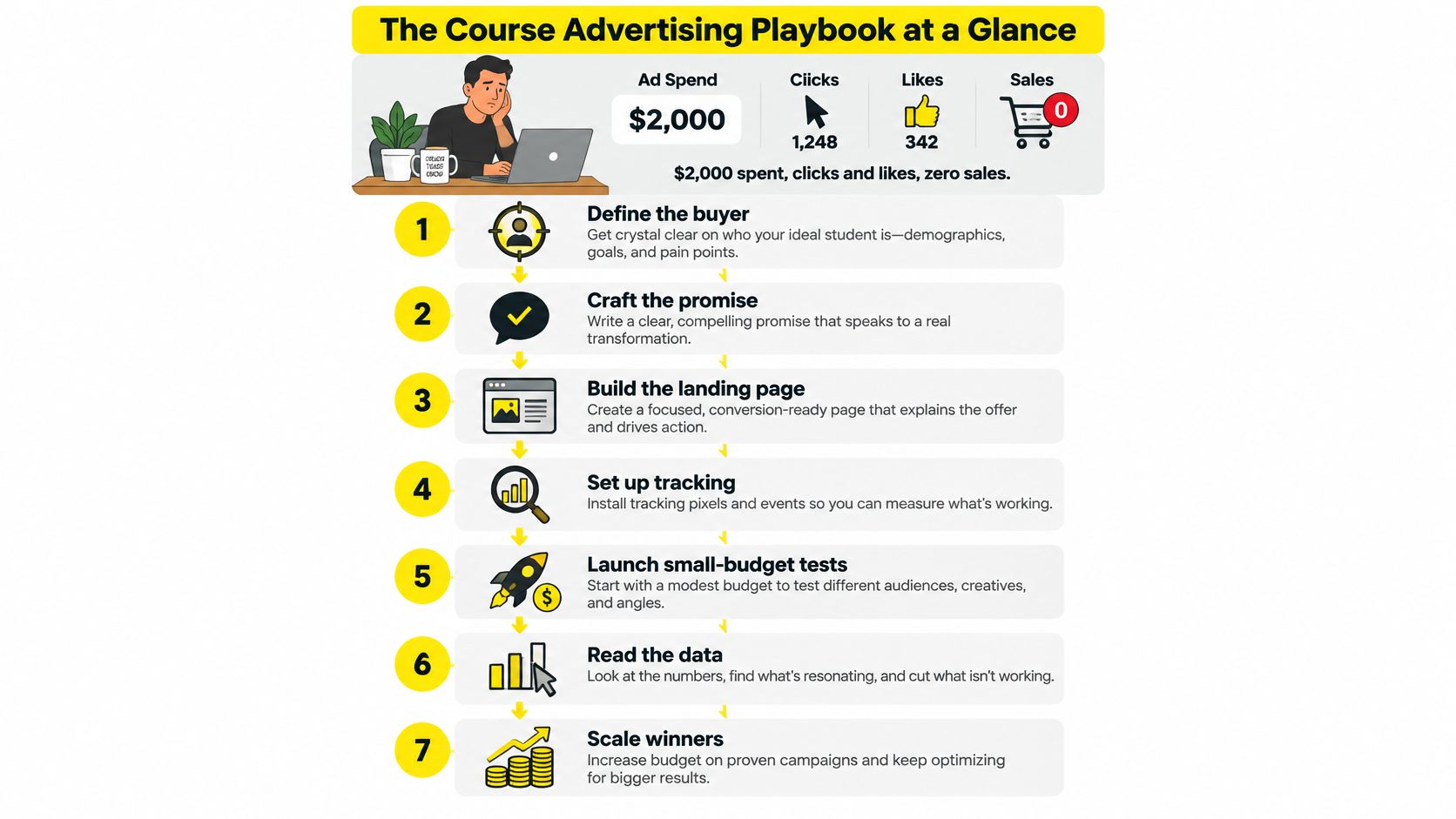
The Course Advertising Playbook at a Glance
Say a creator launches ads before checking whether prospective students will pay for the promised outcome. The campaign generates attention but no purchases. Replacing the video might improve engagement, but it won't fix an offer buyers don't understand or a checkout they don't trust.
Course advertising works as a connected system. Follow this sequence:
Define the buyer and the paid outcome. Identify the learner's starting point, desired result, and reason to act. A topic isn't an offer.
Set pricing and allowable acquisition cost. Work from the money you retain after delivering the course, not the headline selling price.
Choose the entry offer. Decide whether prospects should buy, watch a lesson, attend a webinar, or apply for a conversation.
Pick platforms around buying behavior. Reach people where they already research the skill or discover relevant instructors.
Create native ads and persuasive copy. Demonstrate the teaching, address an objection, and make the next action clear.
Build a focused landing page and checkout. Match the advertisement's promise and remove unnecessary friction.
Track the funnel and scale profitable acquisition. Judge campaigns by qualified enrollments and retained revenue, not likes or inexpensive registrations.
Use this visual as a launch checklist rather than a menu of optional tasks.
Practical rule: Don't buy traffic to discover what your offer means. Use buyer conversations to clarify the offer, then use advertising to test whether you can sell it economically.
The sequence matters. If the promise is vague, the platform receives weak conversion signals. If the margin is inadequate, a campaign can generate sales while leaving you with less cash.
Validate the Offer, Set a Budget and Choose the Funnel
Find the outcome buyers will pay for
A course can attract clicks and still lose money if its promise doesn't match what buyers will pay to achieve. Before choosing a funnel, check the offer against real student needs and calculate the acquisition cost your margins can support.
Ask past students, prospective buyers, and people who considered the course but didn't enroll what they wanted to accomplish, what they had already tried, and what held them back. Listen for practical differences: a beginner may need a guided starting point, while an experienced practitioner may value feedback, certification preparation, or a portfolio-ready project. Each calls for a distinct promise, even if the course subject stays the same.
Competitor reviews can expose recurring gaps, such as outdated demonstrations, missing prerequisites, limited instructor access, or lessons that don't translate into usable work. Use those complaints to identify a problem you can credibly solve, not to copy another course's positioning.
Write the offer in this form:
Help a specific learner achieve a concrete outcome through a clearly defined learning process.
Include a timeframe only if the curriculum and student evidence support it. Avoid promises of employment, earnings, or mastery unless you can substantiate them. For a preproduction checklist, Fundl explains how to validate a course idea before recording. Test willingness to pay, not just enthusiasm for free information.
Calculate the acquisition ceiling
Start with contribution margin, not the course's headline price:
Collected course revenue − payment fees − expected refunds − variable delivery and support costs − payment-plan losses = contribution before advertising
Subtract the contribution you need to retain for overhead and profit. The remainder is your allowable acquisition cost per enrollment.
Count costs that rise with each student, including instructor feedback, community moderation, sales commissions, and onboarding. Keep fixed production expenses separate from the enrollment calculation, but account for recovering them in the business's overall economics.
Payment plans can strain cash flow. A signed agreement is not collected revenue, and ad bills may arrive before installments do. Set a payback requirement that reflects when cash comes in.
Planning input | What to enter | Why it matters |
|---|---|---|
Net collected revenue | Expected receipts after refunds and defaults | Excludes money you won't retain |
Variable fulfillment | Support, feedback, commissions, and delivery | Shows contribution per student |
Required retained contribution | Cash needed for overhead and profit | Keeps break-even from becoming the target |
Allowable acquisition cost | Contribution before ads minus required retained contribution | Sets the spending ceiling per enrollment |
Payback requirement | When acquisition spending must be recovered | Protects working capital |
Don't count hypothetical upsells to justify a high acquisition cost. Include later revenue only when comparable student cohorts have produced it.
Use benchmarks without confusing leads and students
Benchmarks can help estimate traffic costs, but they don't predict your course's sales. An ad platform may count a form submission as a conversion, while your business needs to know how many leads become paying students.
2026 online course advertising benchmarks
The Google Ads average column uses Search Influence's education benchmark. The education-and-training figures come from a separate sample, so treat the columns as planning references rather than a like-for-like comparison.
Metric | Google Ads average | Education and training sample |
|---|---|---|
Cost per click | $6.23 | $5.98 |
Click-through rate | 5.74% | Not reported |
Conversion rate | 11.38% | 5.0% |
Cost per lead or acquisition | About $54.75, calculated from CPC and conversion rate | $119.55 overall; $214.96 search only |
The Benchmarking education Google Ads dataset illustrates the difference between click costs and lead costs: 100 clicks at $4.81 cost about $481 and generate roughly 13 leads at a 13.14% lead conversion rate, where a conversion is a demo or sales-call request.
Those leads still have to enroll. Use your own qualified-lead-to-enrollment rate to set the lead target:
Allowable cost per lead = allowable cost per enrollment × lead-to-enrollment rate
Use a rate from the same offer and acquisition source. Combining referral conversions with cold webinar leads can make the forecast too optimistic.
Choose an entry offer that fits the decision
The right funnel depends on how much proof or interaction a buyer needs before purchasing. An inexpensive technical course may still require substantial proof, while an established instructor might sell a higher-priced course directly to an engaged audience.
Buyer situation | Entry offer to test | Main trade-off |
|---|---|---|
Clear problem, understandable solution, low perceived risk | Direct course purchase or sample lesson | Short path, with less room to resolve objections |
Buyer needs to experience your teaching | Focused workshop or webinar | More persuasion, but attendance adds a conversion stage |
Buyer is unsure about readiness | Diagnostic lesson or assessment | Helps qualify interest if the result connects to the course |
Significant investment or personalized support | Application and fit call | Stronger qualification, with added sales labor |
Buyer needs ongoing product experience | Carefully structured trial | Demonstrates value, but requires clear onboarding and cancellation terms |
A webinar should teach a complete, useful step rather than hold back all value for the pitch. Follow-up can address buying questions, show the curriculum in use, and explain who should not enroll.
Native lead forms are another possible entry point. The SEO Works education-marketing statistics report a 10.05% education conversion rate for Meta lead campaigns. That figure measures lead generation, not paid enrollment.
A lower lead cost matters only if enough purchase intent survives to reduce the eventual cost per student.
Make lead magnets specific enough to qualify learners. A broad productivity checklist may attract subscribers who won't buy specialist training. A diagnostic exercise based on the course's core problem gives you a more useful signal.
Set a test budget you can afford to complete. If it won't support meaningful observation across many campaigns, test fewer audiences and offers instead of spreading the spend thin.
Match Platforms and Creative to Your Buyers
Where to advertise an online course in 2026
Platform | Best for | Funnel role | Formats to launch first |
|---|---|---|---|
Facebook and Instagram | Coaches, consultants, and broad interest audiences | Awareness, lead capture, and retargeting | Short video, carousel, lead form ads |
TikTok | Younger learners and visual or lifestyle skills | Discovery and retargeting | Native-style short video, Spark Ads |
YouTube | High-consideration learners who research before buying | Education, proof, and retargeting | In-stream ads, Shorts, bumper ads |
Google Search | Buyers searching course, certification, or career terms | Bottom-funnel capture | Search ads to dedicated landing pages |
Choose the channel where you can make the strongest case to a qualified buyer. Don't divide a limited launch budget across every available platform.
The Search Influence education advertising benchmarks report average Google Ads figures of $6.23 CPC, approximately 5.74% CTR, and 11.38% conversion rate, supporting the Google averages used in the planning table. The operational lesson is to protect each paid click with strong intent matching, not assume that increasing bids will fix a weak offer.
Match search terms to the next action
Separate educational discovery from commercial intent. Someone researching how to learn a skill may want a tutorial; someone searching for a certification course is evaluating structured training.
Build keyword groups around those differences. Send certification searches to a page explaining preparation, prerequisites, curriculum, and the exact status of any credential. Send problem-focused searches to an offer that resolves that problem.
Review the search terms report and exclude irrelevant intent. Queries seeking free downloads, jobs, or unrelated software can consume budget without bringing suitable students.
Make social creative demonstrate the product
For Facebook and Instagram, show a learner problem and the teaching method used to solve it. A screen recording with clear narration can be more useful than an elaborate promotional video that never reveals what students will do.
On TikTok, use native pacing, captions, and an immediate demonstration. Spark Ads can promote suitable existing posts, but organic engagement alone doesn't establish purchase intent.
For YouTube, test instructor-led explanations, worked examples, and credible student stories. Use short formats for a concise insight and longer formats when the buyer needs to understand a method before taking action.
Apply these copy rules across channels:
Lead with a usable outcome. Describe what the learner will be able to do, not just what the course contains.
Make proof relevant. Show a project, exercise, or result that matches the advertised promise.
Answer a real objection. Address prerequisites, time commitment, software, feedback, or access.
Use a single next action. Don't ask viewers to subscribe, book, download, and buy in the same advertisement.
Test different arguments. Compare a demonstration, an objection-led explanation, and a student story rather than cosmetic edits alone.
Use specific numbers only when you can substantiate them. Precise claims without evidence don't make copy stronger; they create a mismatch between buyer expectations and the product.
Optimize the Landing Page and Checkout
The landing page should continue the conversation the advertisement started. If the ad promises help completing a practical project, the page shouldn't open with a broad biography or a catalogue of unrelated courses.
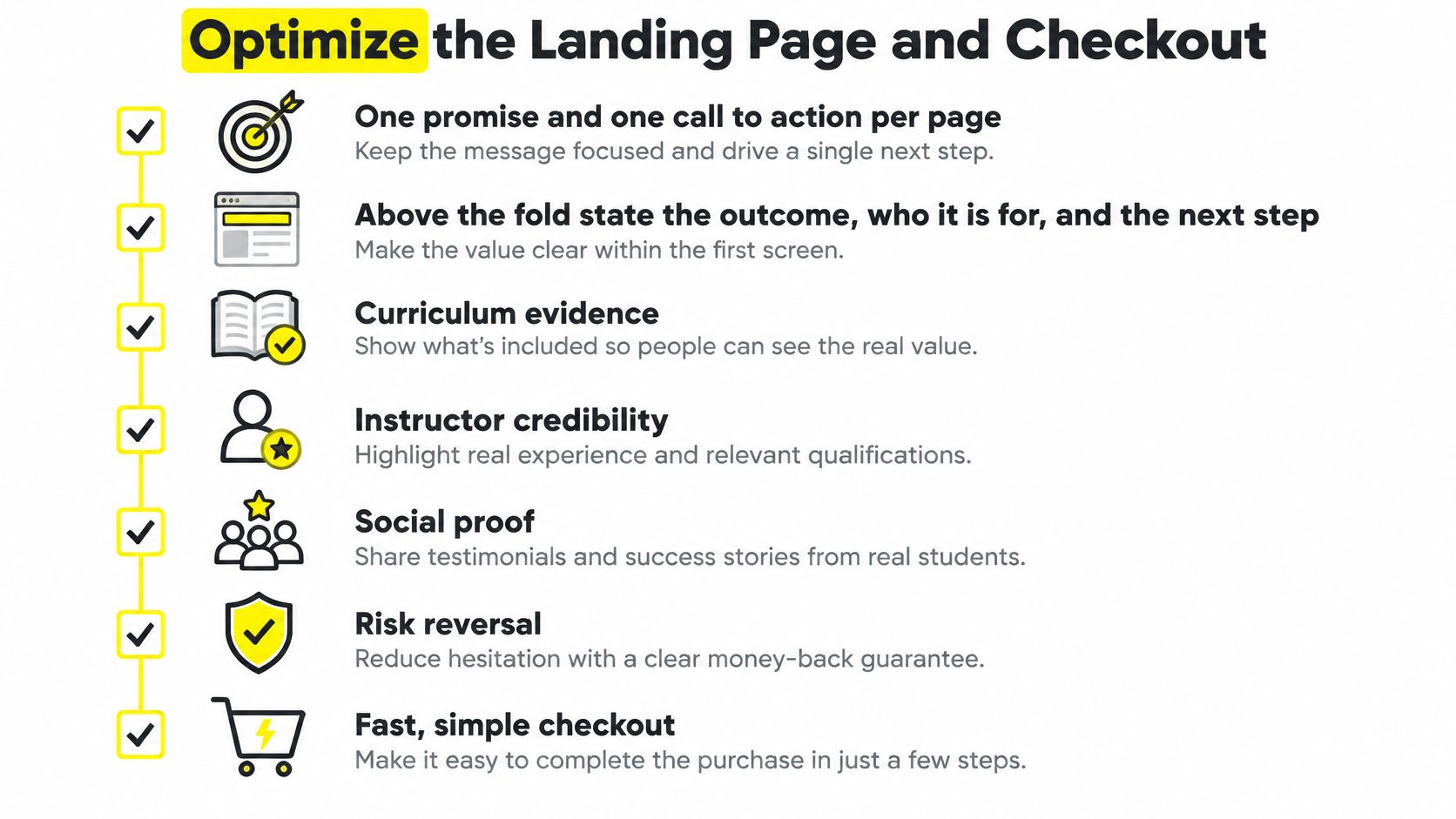
Use this checklist to review the buying path.
Put the decision-making information in order
Above the fold, state the outcome, intended learner, and next step. Keep the primary call to action consistent throughout the page.
Then give buyers the evidence they need:
Curriculum evidence. Show lesson previews, assignments, or a finished project instead of module names alone.
Instructor credibility. Explain the experience relevant to teaching this particular skill.
Specific social proof. Use permissioned testimonials describing the student's starting point and result, without implying everyone will achieve the same outcome.
Transparent pricing. Explain what's included, payment obligations, access terms, and any additional software requirements.
Clear risk reversal. State the actual refund or guarantee conditions in plain language. Don't invent a guarantee you can't support.
A simple checkout. Remove unnecessary fields and make payment errors easy to understand.
Test the entire purchase path on a phone, including confirmation messages, account creation, and course access. A successful payment followed by confusing onboarding still creates support costs and refund risk.
Treat speed and testing as acquisition work
Compress images, avoid loading large videos automatically, and remove scripts that don't justify their cost. Check the page on a cellular connection, not only an office network.
The Cookiebees landing-page performance guide recommends a sub-three-second loading target and reports an education landing-page median conversion rate of 3.40% for demo or sales-call requests. That's a lead benchmark, not a course-purchase target.
Use PageSpeed Insights and browser developer tools to identify slow assets, then verify that fixes haven't broken forms or payment tracking.
For a video resource alongside the checklist, use the player below.
Keep a stable traffic source while testing the headline, proof format, call to action, or price presentation. Change a major variable deliberately and record what changed.
Evaluate qualified leads, attendance, completed purchases, refunds, and revenue per visitor. A page that collects more emails but attracts fewer suitable students isn't necessarily better.
Track the Full Funnel and Fix What's Broken
Start with a measurement stack that connects advertising activity to collected money. Install the Meta pixel and Conversions API, configure the Google tag and enhanced conversions, and implement each with appropriate consent controls.
Use consistent UTM naming for platform, campaign, audience, creative, and offer. Define separate events for page views, registrations, attendance, checkout initiation, purchases, and refunds. Don't label every action a conversion and then optimize toward the easiest one.
Give each system a clear job
Your payment processor records transactions. Your CRM records lead status and sales progress. Advertising platforms help optimize delivery and report attributed outcomes.
Connect those systems through stable lead and transaction identifiers. Deduplicate browser and server events, import eligible offline purchases, and send accurate transaction values rather than a fixed value for every sale.
The Coursera audience and attribution analytics course addresses the attribution discipline relevant to this problem: evaluating acquisition requires more than accepting a platform's reported return.
Consent choices, browser restrictions, ad blockers, and cross-device purchases leave gaps. Server-side tracking can improve signal quality, but it doesn't restore every missing interaction or remove consent obligations.
Treat platform attribution as an optimization aid, not a bank statement.
Last-click reporting can give branded search credit for demand created elsewhere. Platforms can also claim overlapping credit for the same purchase. Don't add their attributed revenue totals together and call the result business revenue.
Diagnose the stage that actually failed
Course ad campaign symptoms, causes and fixes
Symptom | Likely cause | Fix to test first |
|---|---|---|
High clicks, few leads | Ad-to-page mismatch, weak page promise, or slow loading | Match the opening promise and remove loading bottlenecks |
Leads but few sales calls or show-ups | Unqualified traffic or weak follow-up | Add a qualification question and timely reminder emails |
Calls but no enrollments | Offer, price, fit, or proof problem | Review call objections and strengthen relevant evidence |
Platform ROAS looks fine but deposits do not | Overlapping attribution, refunds, or uncollected installments | Reconcile CRM records with settled payments and test a holdout |
Cost per enrollment rises after scaling | Audience saturation, creative fatigue, or delivery changes | Inspect new traffic quality and test fresh creative before expanding again |
Group leads by acquisition period and source, then follow each cohort through enrollment, collected revenue, refunds, and subsequent purchases. Compare cohorts at the same age so a mature group doesn't automatically look better than a recent one.
Use cohort cost per enrollment, contribution after advertising, and payback period when attribution is incomplete. Track learner completion and support demand too, because poor-fit acquisition can create costs after checkout.
Don't make purchase-level decisions from an arbitrary click count. The observation window needs to accommodate the buying cycle, and the sample needs enough relevant outcomes to support the decision.
Set a spending stop based on your allowable loss, investigate technical failures immediately, and avoid rebuilding a functioning campaign because of a bad day.
Scale Profitably and Choose Your Next Step
Scaling means acquiring additional students while preserving acceptable contribution and cash flow. A campaign that looks profitable at a small budget hasn't proved that every additional audience will respond the same way.
Use a controlled expansion process rather than treating a budget increase as a reward for good results.
Increase spending deliberately. Keep the offer, audience, and creative stable while observing the effect of a budget change. Avoid changing every major input together.
Refresh the argument before exhausting it. Watch for declining response, worsening lead quality, and repeated exposure. Produce new demonstrations and objections-based concepts rather than endless variations of the same opening.
Expand from a proven position. Test adjacent audiences or suitable lookalikes before introducing an unfamiliar platform with different creative requirements.
Check whether remarketing adds sales. Where practical, use a holdout group or comparable geographic test to examine incremental enrollments rather than relying only on attributed purchases.
Use the visual below as a reminder of the scaling decisions, not as a substitute for your campaign's actual response.
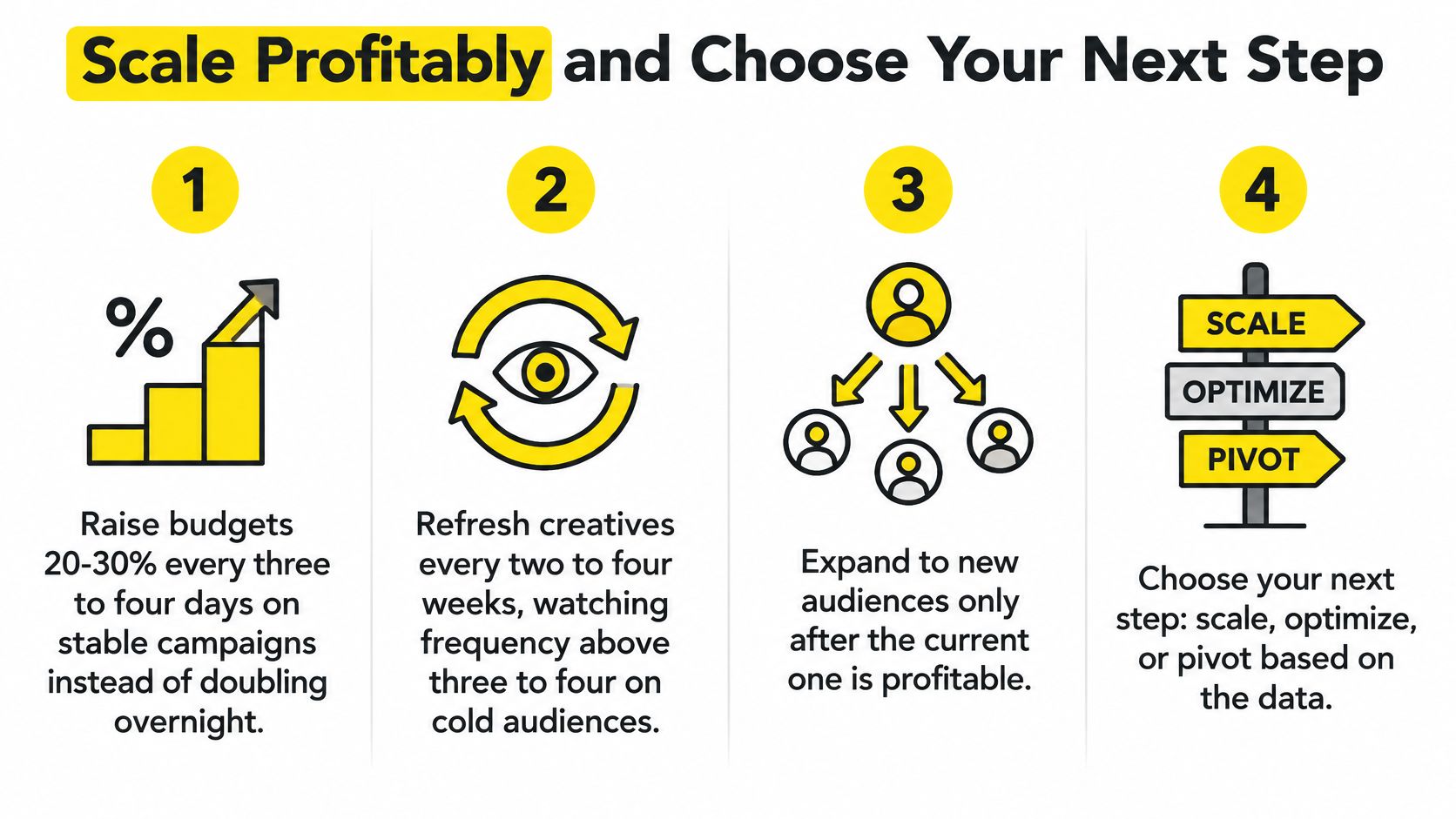
Decide whether to scale, optimize, or pause
Scale when newly acquired cohorts retain acceptable contribution, the sales process can handle demand, and cash arrives quickly enough to fund continued advertising.
Optimize when buyers show interest but a specific stage underperforms. Weak attendance calls for a different intervention than abandoned checkouts or excessive refunds.
Pause acquisition when the offer cannot support the observed cost per enrollment. More spending won't solve an economic mismatch, and cheaper traffic may produce more unsuitable prospects.
Before changing bids, examine the buying proposition. Better onboarding, clearer prerequisites, useful feedback, and a more credible demonstration can change what buyers are willing to pay. Payment plans may improve accessibility, but assess collection risk and support costs before treating them as a margin improvement.
Give the next test a written decision rule
Write down the hypothesis, primary conversion event, acquisition ceiling, expected buying delay, and conditions for stopping. Assign responsibility for checking payments, lead handling, and course access before launch.
Your next action is to calculate your own acquisition allowance, choose the entry offer that fits the buyer's decision, and launch a focused platform test. Keep enough budget available to learn whether the complete path works, not merely whether an advertisement attracts attention.
At Wojo Media, we build paid advertising strategies around the offer, landing pages, omnipresent ads, and backend KPIs, using tracking and AI technology to help direct spending toward stronger opportunities. Visit Wojo Media to book a free demo call with Jason or a growth manager and discuss a custom paid ad strategy for your online course.
Comments