
Facebook Lead Ads vs Landing Page: Which Converts Better

A cheap lead and a cheap customer are two different purchases. Cost per lead measures only what happens at the form, and Leadgen Economy's comparison of Facebook Lead Ads and landing pages notes that landing page funnels often convert fewer visitors while producing stronger downstream qualification. That's the trap in most Facebook Lead Ads vs landing page debates. You're not buying submissions. You're buying contacted prospects, booked appointments, attended calls, and customers.
The format that wins at the form can lose at the cash register, and the format that looks expensive can turn cheap once sales follow-up capacity enters the math. The evidence below doesn't crown a universal winner. It shows where each format earns its advantage, where that advantage shrinks, and how to test the choice on your own price per qualified customer.
Lead Ads and Landing Pages Side by Side
Neither format wins every front-end number. Facebook Lead Ads convert more clicks into leads in the largest head-to-head dataset available here, but landing pages came out cheaper per action in that same dataset. That split result is your first warning against judging either format on a single metric.
Headline Benchmarks for Lead Ads and Landing Pages
Metric | Facebook Lead Ads | Landing Page | Dataset and Note |
|---|---|---|---|
Click-to-lead conversion rate | 12.54% | 10.47% | WordStream, 3,000+ campaigns, older analysis |
Cost per action | $17.98 | $13.26 | WordStream, same dataset |
Click-through rate | 2.59% | No landing page value reported | Ad Spend, 726 U.S. Meta Leads campaigns, Apr 2024 to Jun 2025 |
Conversion rate | 7.72% | No landing page value reported | Ad Spend, same dataset, platform-level figure |
WordStream's analysis of more than 3,000 campaigns and approximately $9.5 million in ad spend found Lead Ads converting clicks at 12.54% versus 10.47% for landing pages, a 2.07-percentage-point advantage for native forms. Yet landing pages showed a lower average cost per action at $13.26 versus $17.98. Native forms filled more often, but they didn't fill cheapest.
Read the table across rows, not down columns. The datasets differ in year, market, and objective, and WordStream's head-to-head is older than the U.S. Meta Leads dataset, so you can't rank a 2019 era conversion rate against a 2024 to 2025 platform figure as if they measured the same thing.
A Middle Reference Point
WordStream's 2024 Facebook Ads benchmarks reported an average lead campaign conversion rate of 8.78% across 2,946 campaigns running from February 2023 through April 2024. That figure sits between the two datasets above, which tells you more about sample and year than about format superiority.
Front-end numbers show which format is cheaper to fill. They don't show which one fills your pipeline.
Carry these figures forward as starting costs, not conclusions. The right comparison adds cost per qualified lead, contact rate, booked and attended appointments, customer acquisition cost, and revenue.
How Each Format Moves a Prospect to a Lead
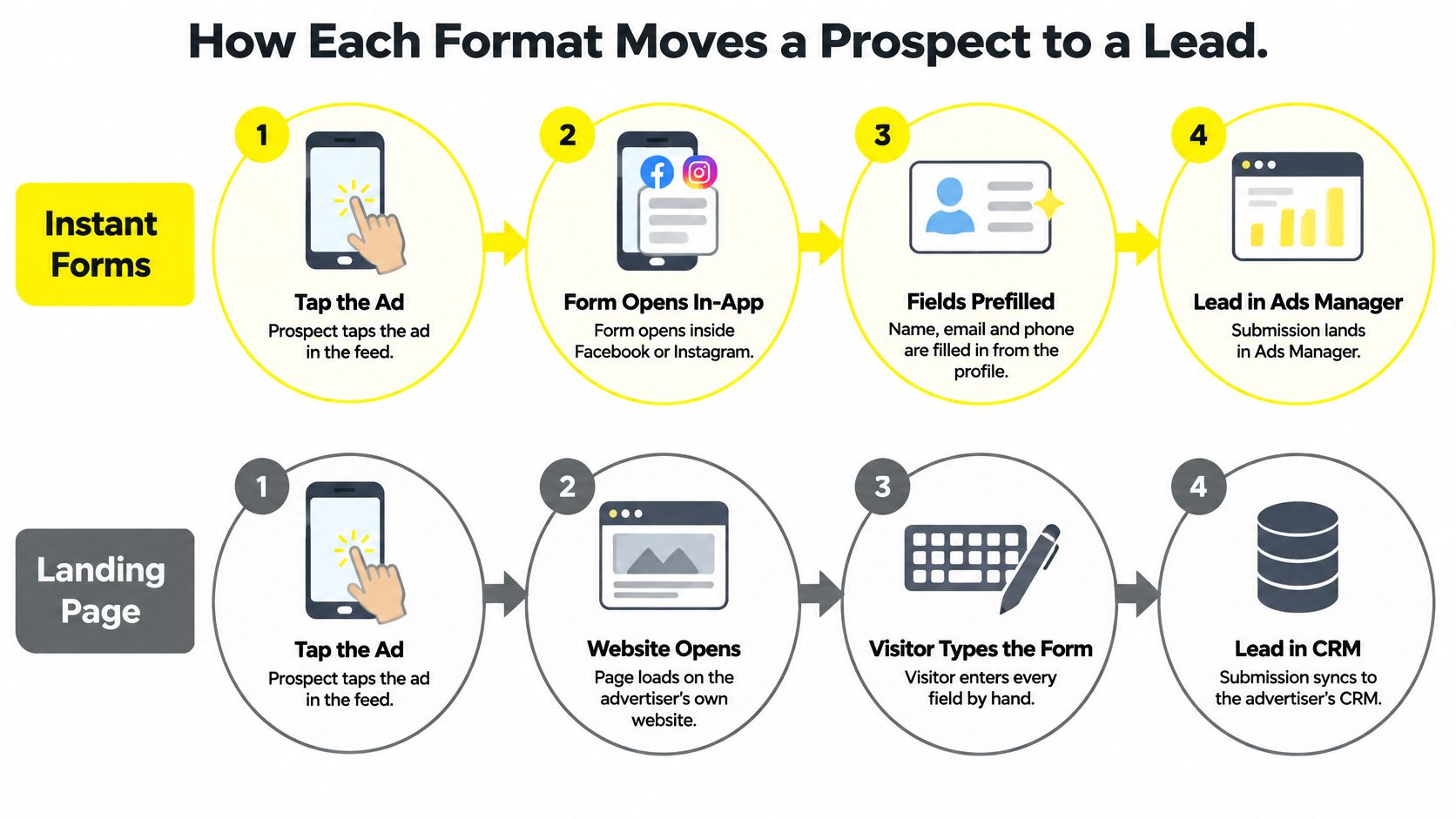
Say a homeowner taps an ad for a free quote. With Instant Forms, the form opens inside Facebook or Instagram, fields arrive prefilled from the profile, and the submission lands in Ads Manager and your CRM. No external page loads. No new tab, no waiting on a mobile connection, no typing an email address character by character.
The visual below maps both journeys step by step.
The Ad Spend's 2025 dataset covering 726 U.S. campaigns using Meta's Leads objective from April 2024 through June 2025 reported a 2.59% click-through rate and a 7.72% conversion rate for Facebook lead campaigns. That 7.72% is a platform-level benchmark for submitted forms. It isn't a prediction of qualified appointments or revenue for your offer.
The Landing Page Path
The same homeowner tapping a landing page ad waits for your page to load, reads the offer, and checks proof before typing anything. Case studies, guarantees, pricing context, and eligibility language all do screening work before the form. Anyone who wants to structure that screening well can borrow from best practices for B2B landing pages, which treat page copy as a qualification step rather than decoration.
That extra click and page-load dependency cost you volume. They also buy you two assets the native form doesn't create in the same way.
Informed submitters: The prospect knows the price range, process, and requirements before handing over contact details.
Retargetable visitors: Page visitors who don't convert can be retargeted directly, while Instant Form measurement doesn't fire a landing page event, so you lean on in-platform engagement audiences instead.
The short video walkthrough below shows the native form flow in practice, so you can see how little a submitter encounters before converting.
Format determines what a prospect knows at the moment of submission. A local service advertiser chasing rapid volume and a high-ticket advisor who needs pre-sale education aren't buying the same lead, even when Ads Manager labels both with the same word.
Why Cheaper Leads Can Cost More Per Customer
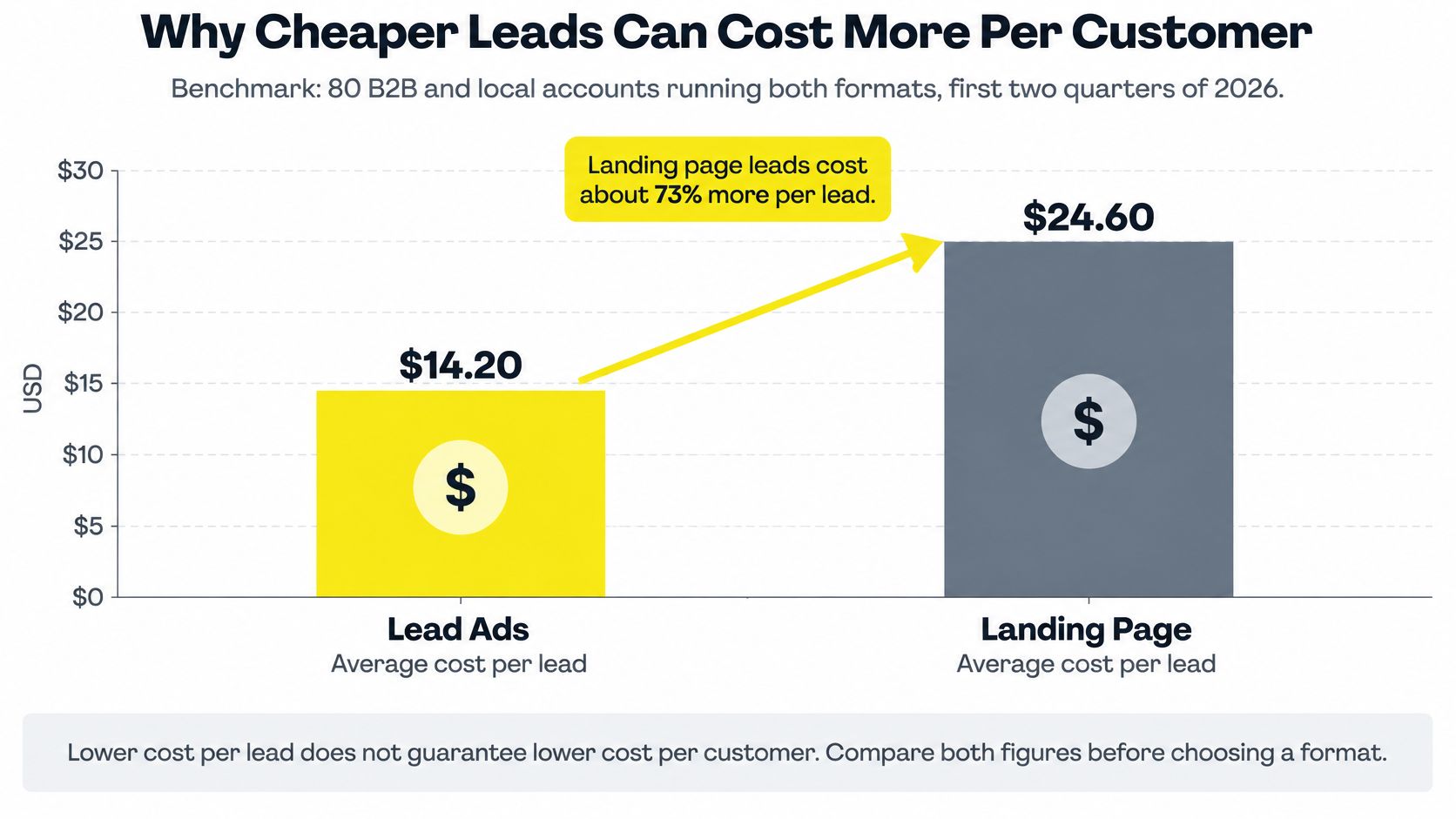
CPL screenshots end the comparison one step too early. AdRiseLab's 80-account benchmark of B2B and local advertisers running both formats during the first two quarters of 2026 reported average CPL of $14.20 for Meta Lead Ads versus $24.60 for landing-page forms, a 42% lower CPL for Instant Forms. The same benchmark reported lead-to-MQL conversion of 38% for Lead Ads compared with 64% for landing-page forms, with effective cost per MQL at $37.40 versus $38.40.
Cost Per Lead and Cost Per MQL by Format
Stage | Lead Ads | Landing Page | Reading Note |
|---|---|---|---|
Average cost per lead | $14.20 | $24.60 | Lead Ads 42% cheaper at the form |
Lead-to-MQL conversion | 38% | 64% | Landing pages convert about 68% more leads to MQLs |
Effective cost per MQL | $37.40 | $38.40 | Near parity once quality is counted |
Cost per closed customer | $37.40 divided by your MQL close rate | $38.40 divided by your MQL close rate | Measure with your own close rate |
The division is the whole argument. $14.20 divided by 0.38 gives about $37.40 per qualified lead, and $24.60 divided by 0.64 gives about $38.40. A 42% front-end saving shrinks to roughly a dollar once qualification is counted, and that dollar flips direction depending on whose follow-up hours you price in.
The chart below isolates the front-end gap, which is real but incomplete.
What 100 Leads From Each Format Actually Means
Run the benchmark rates through a fixed workload. One hundred Instant Form leads yield 38 qualified leads. One hundred landing page leads yield 64. Per qualified lead, your team sorts about 2.6 raw leads from Instant Forms against about 1.6 from landing pages.
To match those 64 qualified leads through Instant Forms alone, you'd need roughly 168 raw leads, about 1.7 times the follow-up volume for the same qualified output. Ad spend per qualified lead stays near parity. Labor per qualified lead doesn't. Calls, texts, disposition notes, and CRM cleanup all scale with raw submissions, and every hour spent disqualifying a lead is an hour not spent closing one.
Capacity rule: Cheap volume is only cheap if someone has the hours to work it. A team with idle follow-up capacity can exploit a lower CPL. A saturated team pays for it in unworked leads and slower response times to the good ones.
That logic flips with ticket size and staffing. A high-volume operation with setters and fast speed-to-lead can rationally prefer the format most analysts would call lower quality, because sorting cost stays below the value of the extra at-bats. A solo advisor returning calls between client meetings should weight qualification rate far more heavily, since every unqualified conversation displaces a real one. Neither answer comes from the benchmark itself. Both come from multiplying it by your own close rate and your team's available hours.
Lead Quality and Friction Trade-Offs
The lazy conclusion is that native forms always produce worse leads. WebLeveling's report of a parallel test by Jon Loomer found instant forms generated 392 leads while website forms generated 238, yet quality rates were nearly identical at 29.1% for instant-form leads versus 29.0% for website leads. The website sample is smaller, so this doesn't establish that native forms always match, but it suggests they are not inferior in themselves when qualification design does its job.
One test at one spend level can't settle the format question. What it does is shift the burden of proof. If your Instant Forms underperform, examine what the form asks before blaming where it lives.
The Levers That Actually Move Quality
Lever | Instant Form | Landing Page | Why It Matters |
|---|---|---|---|
Prefilled profile fields | Name, email, phone auto-populated | Visitor types every field | Prefill speeds completion but can carry stale contact details |
Mobile completion path | Stays inside Facebook or Instagram | Depends on your page load speed | Fewer steps raise volume on weak connections |
Qualification questions | Custom questions plus review screen | Multi-step forms with branching | Screening before submission protects sales time |
Pre-sale proof and pricing | Intro section only, limited space | Full case studies, guarantees, pricing context | Informed prospects self-select out early |
Retargeting audiences | In-platform engagement audiences | Pixel and server events on your domain | Page visitors form warmer, more portable audiences |
Consent control | Platform form with your privacy policy link | Your own disclosures and consent wording | Direct control simplifies documentation |
Treat the table as a design menu. Every row is a dial you can partly compensate for, and the prefill row shows why: faster completion lowers cost per lead, but a stale phone number turns that cheap lead into wasted dial time. The apparent Instant Form advantage shrinks in follow-up, which is why both formats deserve to be judged on cost per qualified customer and on how usable the submitted data is in practice. A native form with strong screening can outperform a vague landing page, and a landing page with one generic headline and no proof wastes its format advantage entirely.
Making an Instant Form Earn Its Volume
Build the native form to work like a short interview.
Three to five screening questions: Ask budget, timeline, and one eligibility question specific to your offer, such as service area or property ownership.
A review screen before submission: Use the higher intent option so prospects confirm their details instead of tapping through on autopilot.
Conditional logic where available: Route answers so disqualified prospects see a different thank-you message and don't consume setter time.
Immediate CRM delivery: Push every submission into your CRM in real time with an automated first text or email, because native leads go cold fastest.
Some offers still need a page. Long-form proof, detailed eligibility screening, pricing that requires context, and multiple conversion paths, such as a webinar registration beside a direct booking, exceed what an intro section and a few questions can carry. If a prospect can't understand your offer in under a minute, the form is the wrong classroom.
Quality follows qualification design more than form placement. The same audience, shown the same ad, can produce a weak Instant Form and a strong one. What changed was what you asked before accepting the lead.
Data Ownership, Consent and Lead Routing
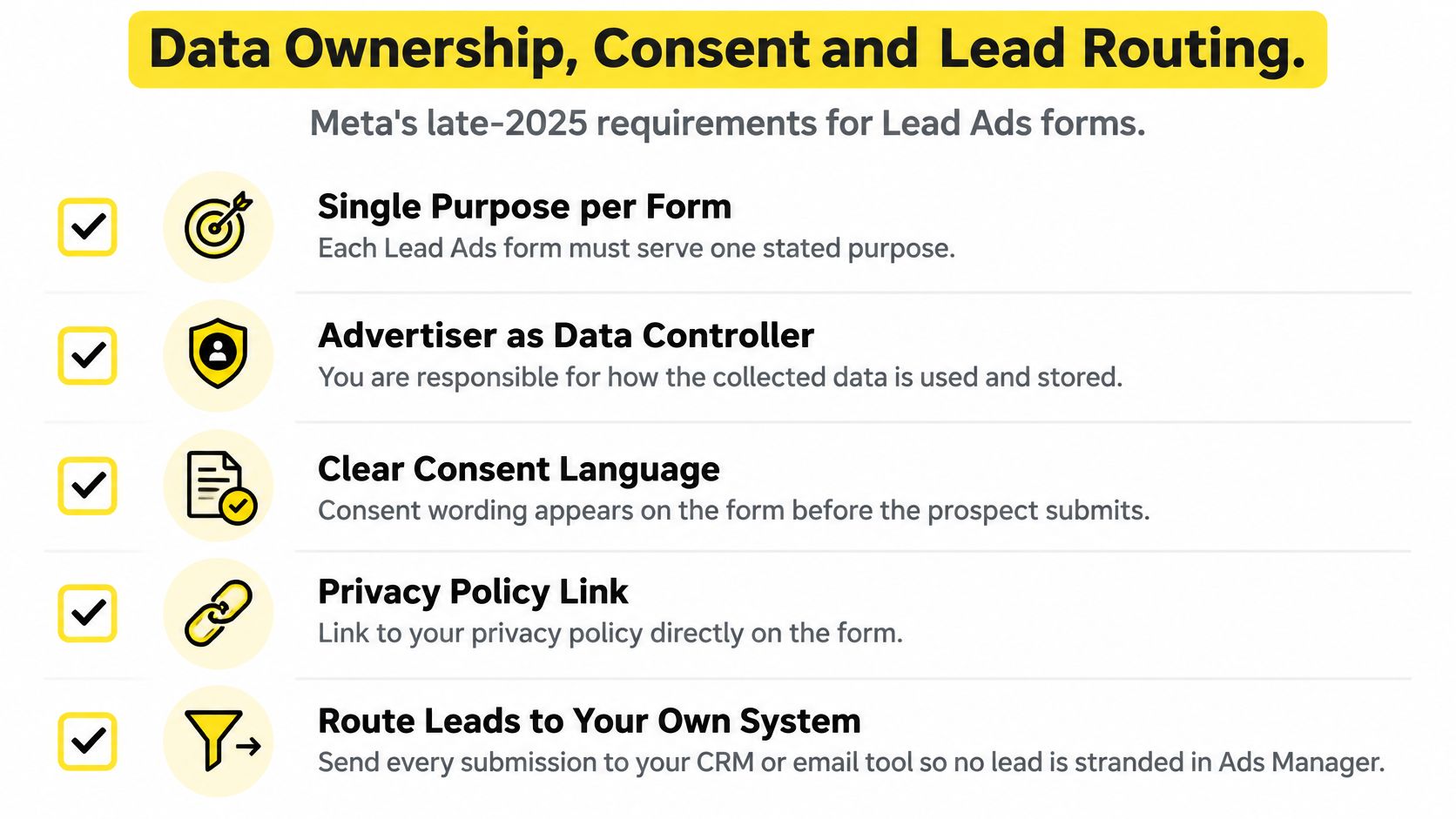
Most format comparisons stop at conversion rate and ignore what happens to the data afterward. That omission now carries regulatory weight. Curve Compliance's reporting on Meta's late 2025 Lead Ads changes states that each form must state a single purpose, advertisers are explicitly treated as data controllers, and collected data requires appropriate safeguards.
The checklist below summarizes the operational duties that follow from that change.
If your leads flow into a CRM, a call center, WhatsApp, or email automation, you need documented answers to practical questions. Can you show what each prospect consented to, where the record went, and how you'd honor a deletion or opt-out request? For teams handling European contacts through chat or messaging follow-up, GDPR requirements for live chat offer a useful primer on how consent and retention duties apply once a conversation starts.
Control Points Differ by Format
Landing pages give you direct control over disclosures, consent wording, field validation, tracking tags, and progressive profiling across visits. They don't remove compliance duties. They put the controls on infrastructure you own, which makes audits and fixes simpler to execute.
Validation at entry: Reject malformed phone numbers and emails on your own form instead of discovering them in a CSV export.
Deduplication: Match repeat submissions on phone or email so one eager prospect doesn't inflate your lead count and trigger duplicate outreach.
Closed-loop feedback: Send verified contact, booked appointment, attended call, and revenue outcomes back to the platform so optimization targets customers rather than cheap submissions.
The overlooked test isn't Instant Form versus page. It's which setup produces trustworthy consent, deduplicated records, fast follow-up, and revenue data you can optimize against.
Treat this as operational guidance, not legal advice. Confirm your specific obligations with counsel, especially if you advertise across regions with different privacy regimes. A funnel that converts well but can't document consent is a liability wearing a good CPL as camouflage.
Which Format Fits Each Vertical
Defaults save testing budget when they're grounded in how a purchase really gets decided. High-consideration offers need education and screening before a sales conversation. Urgent, local, low-ticket services need speed and a booking step. Match the format to the decision, then judge it on the metric closest to revenue.
Recommended Format by Vertical
Vertical | Default Format | Qualifiers to Include | Judge By |
|---|---|---|---|
Real estate (agents, investors, mortgage lenders) | Landing page for consultations; Instant Form for valuations | Budget, timeline, property type | Cost per booked consultation |
Local services (med spas, barbershops, home services) | Instant Form into a booking step | Service, area, urgency | Cost per booked appointment and show rate |
Coaches and course creators | Landing page with webinar or application | Revenue range, goal, commitment | Cost per sales call and enrolled client |
Tax planners and advisors | Landing page with pre-sale education | Income band, entity type, tax situation | Cost per booked discovery call |
Real Estate and Local Services
A seller consultation involves budget, timeline, and trust, so the landing page earns its friction with comparable sales proof and a clear process. A free home valuation is a curiosity click, and an Instant Form captures it before interest cools. Local services invert differently again. A med spa or plumber lead decays in hours, so the native form feeding straight into a booking step usually wins, provided service, area, and urgency questions filter out the merely curious.
Coaches, Course Creators and Tax Advisors
These buyers purchase expertise they can't evaluate from an ad alone. A webinar or application page lets you teach enough to make the sales call productive, and it lets prospects disqualify themselves on revenue range or income band before they take a calendar slot. Tax planning adds entity type and filing situation, details that determine whether your strategy even applies. Skipping that screening to save a click just moves the rejection into an expensive discovery call.
The hybrid funnel resolves most borderline cases. Run Instant Forms for top-of-funnel demand capture, then retarget form openers and submitters to a landing page carrying deeper proof and a booking option. Agencies such as Wojo Media build and manage both halves of that structure, pairing Instant Form campaigns with conversion-focused landing pages, and it's a sensible model to replicate whether you hire help or run it in-house.
One exception overrides every default above. Limited sales capacity doesn't automatically rule out the cheaper volume format. If follow-up is fast and your qualifier questions really screen, a well-built Instant Form can deliver booked appointments at a cost a landing page can't match. Capacity plus question quality beats vertical stereotypes.
Run a Split Test Before You Commit
Benchmarks tell you what's plausible. Only a controlled test on your offer tells you what's true. Run it as an experiment with one variable, one follow-up standard, and one decision metric agreed before launch.
The four-stage outline below captures the logic before the detailed steps.
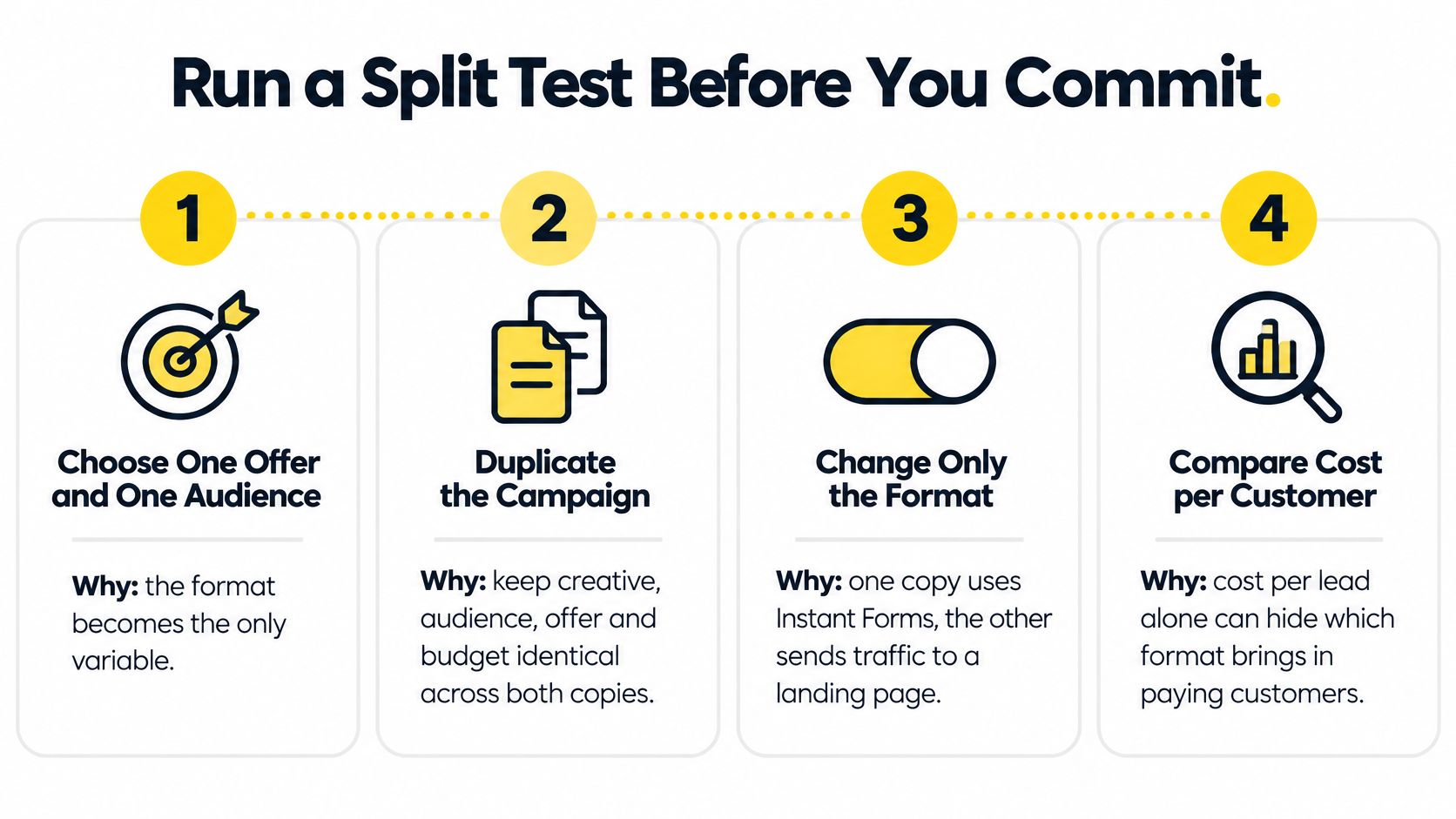
Choose one offer and one audience, so format becomes the only variable and you aren't comparing a discount against a consultation.
Duplicate the campaign and keep creative, placements, and budget identical. If creative quality is shaky in either arm, fix that first using proven methods to improve B2B ad creative performance before blaming the format.
Split the budget evenly with the same attribution window on both arms, then change only the destination, Instant Form in one, landing page in the other.
Set one follow-up standard for both, such as first contact attempt within a fixed time and the same number of call and text attempts, because faster follow-up on one arm rigs the result.
Track every lead through contacted, qualified, booked, attended, and closed, using the consent capture and CRM routing you established for your data controls, and return those outcomes to the platform.
Wait for roughly 50 qualified outcomes per arm before comparing, since smaller samples swing wildly on a handful of good or bad leads.
Compare cost per qualified customer and cost per booked appointment, not cost per lead. CPL is a diagnostic here, never the verdict.
Apply a simple decision rule at the end. If the cheaper format's cost per qualified outcome lands within a small margin of the other, keep it for volume and spend your optimization effort on follow-up speed. If one format is clearly lower on cost per qualified customer, scale it and retire the loser without sentiment.
If neither format separates itself, that result is still information. It usually means your offer clarity or follow-up process, not form placement, is the binding constraint. Run the hybrid, native form for demand capture with retargeting to the proof-heavy page, and fix the constraint your stage-by-stage tracking exposed.
Stop choosing between Instant Forms and landing pages on cost per lead, and start choosing on cost per qualified customer with tracking that proves it. Wojo Media builds the full system behind that decision, from offer and landing page design to omnipresent ads across Facebook, Instagram, TikTok, Google, and YouTube, measured against backend KPIs instead of platform vanity metrics. Visit Wojo Media to book a free demo call and get a custom paid ads strategy for your market.
Comments