
Performance Marketing Network Explained: Types and Metrics

Your store's advertising dashboards look healthy, but the bank balance tells a less convincing story. Suppose the platforms claim hundreds of orders, an affiliate wants commission, and your agency recommends increasing spend. You need to know who brought in customers, who claimed credit for customers already coming, and what profit remains after everyone gets paid.
What a Performance Marketing Network Does
A performance marketing network is the set of partners, platforms, tracking tools, and payout rules connecting an advertiser to paying customers, with success defined by a measurable action such as a sale, qualified lead, or booked call.
Think of a freight broker. The broker matches a shipper with a carrier, records the shipment, and checks proof of delivery before settling the bill. Matching matters, but verification makes the arrangement trustworthy.
Your acquisition setup needs the same discipline. A publisher's referral, a search click, and a customer's purchase must connect through records you can inspect, not just a dashboard total.

The working parts behind a reported sale
Follow a hypothetical purchase through the system:
The advertiser and offer. Your store defines the product, price, guarantee, and acceptable acquisition cost.
The media source. A search ad, social platform, creator, or publisher introduces the offer.
The tracking layer. Click identifiers, referral links, and event records connect the interaction to the customer journey.
The conversion event. The customer purchases, submits an eligible lead, or books a call.
The payout rule. An agreed rule determines which partner receives credit and what you owe.
The IAB/PwC Internet Advertising Revenue Report benchmarks advertising through information supplied by internet advertising sellers and publicly available corporate data. Your own network needs a more granular equivalent: records showing where money went and which outcomes followed.
Unlike a placement bought for exposure, a performance arrangement has an explicit action and an evaluation rule. However, performance optimization doesn't guarantee performance-based billing. You may still pay a platform for impressions or clicks while optimizing toward purchases.
That distinction prevents a costly misunderstanding. Paying for measurable traffic isn't the same as paying only for verified customers, and neither automatically proves that advertising caused the sale.
If a setup can't show the advertiser, media source, tracking layer, conversion event, and payout rule, treat it as an ad buy rather than an accountable network.
Types of Performance Marketing Networks Compared
Performance marketing network types at a glance
Network Type | Who Gets Paid | Typical Pay Model | Best Fit |
|---|---|---|---|
Affiliate network | Publisher or influencer on a sale or lead | CPA, CPL, or revenue share | E-commerce brands with healthy product margins |
Ad-platform performance campaigns | Platform through auction | CPC, CPM, or CPA bidding | Brands with a proven offer and landing pages |
Full-service performance agency | Agency through retainer plus separate ad spend | Retainer or percentage of spend | Businesses without in-house media buyers |
Creator and UGC network | Creators producing permissioned content | Flat fee, commission, or hybrid | Brands needing diverse ad creative |
Lead-generation network | Lead source per qualified lead | Cost per qualified lead | Local services, real estate, and coaching |
Choose the trade-off, not the label
Affiliate networks make the commercial exchange explicit: a partner earns a commission for an eligible action. The risk is paying for interception rather than introduction. Examine whether coupon and cashback partners appear only after shoppers have already decided to buy, and separate those partners from publishers introducing new prospects.
For businesses comparing action-based arrangements in that market, Otter A/B's guide to CPA networks for UK advertisers provides a starting point for evaluating options. Compare qualification and reversal rules before comparing headline commissions.
Ad-platform campaigns give your team direct access to bidding, audiences, and creative testing. They don't give you ownership of the platform's audience data. Keep your business's customer records and account administration under your control, and distinguish a CPA bidding target from a contractual promise to charge only for acquisitions.
Full-service agencies supply operational capacity: media buying, creative coordination, landing-page work, and reporting. The trade-off is delegation. Establish who can change budgets, approve claims, and pause campaigns before handing over execution.
Creative supply and lead supply need different checks
A creator and UGC network supplies content as well as distribution. Specify editing permissions, paid usage, account authorization, and renewal terms before commissioning work. A useful video can support paid acquisition even when the creator's own referral link produces few sales.
With a lead-generation network, define the product you're buying. An inquiry, a reachable prospect, a qualified booking, and an attended consultation are different deliverables. Contracts should identify service area, intent, duplicate handling, and rejection evidence.
Control: Decide which decisions stay with your team.
Cost: Include fees, commissions, production, and media, not just the advertised acquisition price.
Data access: Confirm whether you receive usable customer-level records or only aggregate reports.
A fast launch isn't a bargain if you can't inspect what you're buying. Choose the model whose records and incentives match the outcome your business can monetize.
How Tracking Keeps Every Network Payout Honest
Start with a customer journey, not a software subscription. You need to preserve enough information to connect an eligible interaction to an accepted business outcome.
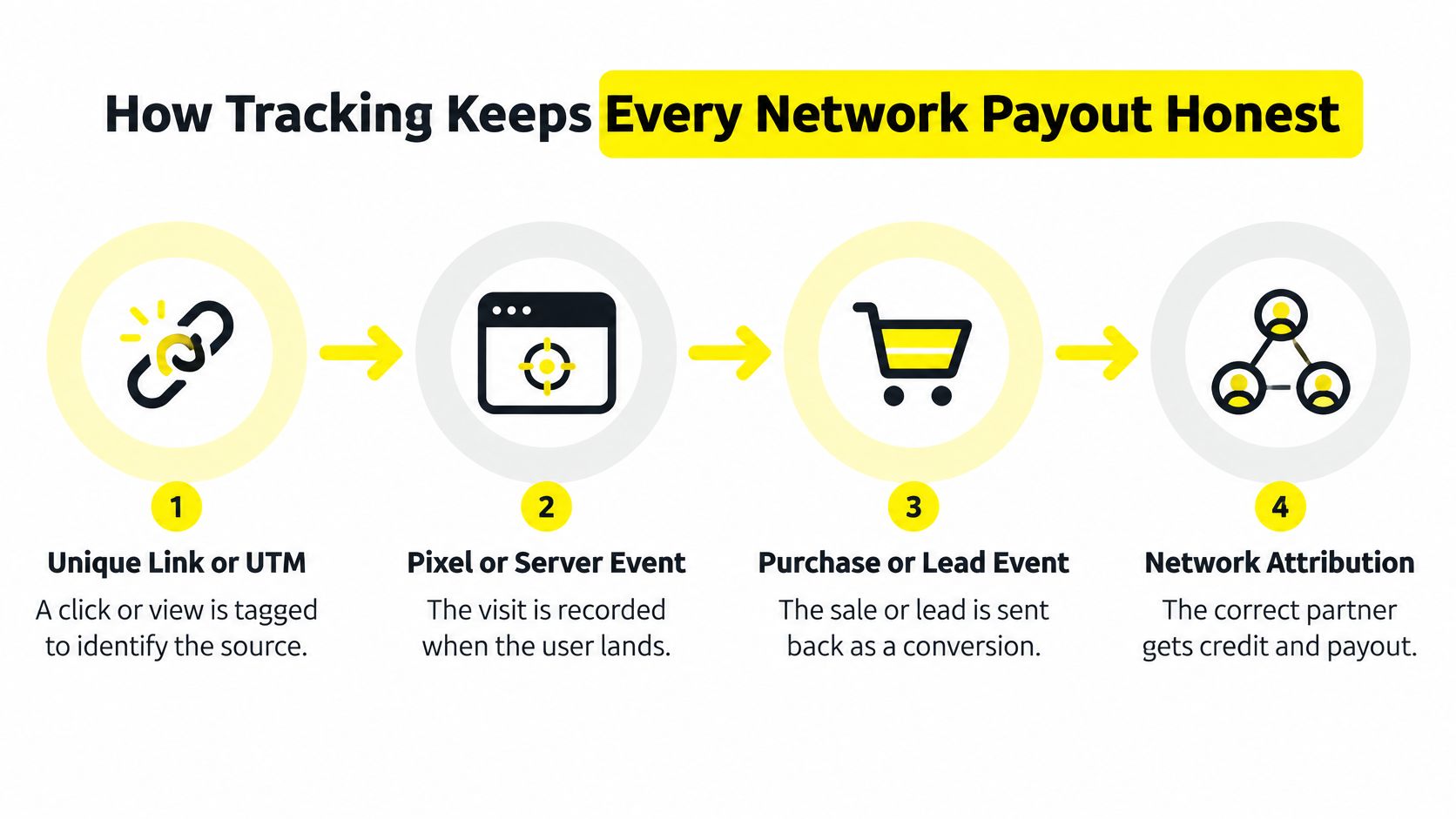
The tracking flow should make that connection inspectable.
Build a record you can reconcile
Identify the source. Use unique referral links, consistent UTM parameters, and available platform click identifiers. UTMs describe tagged visits, not every ad view.
Record the event. Use browser pixels or server-side events with appropriate consent controls. When both send the same event, deduplicate them using a shared event identifier.
Return the business outcome. Send the accepted purchase or lead event, including a stable order or lead ID. For sales-led businesses, preserve later qualification and closed-deal status.
Apply the credit rule. Document attribution windows, eligible interactions, refund treatment, and partner precedence.
Reconcile platform reports against order records or your CRM weekly. Investigate duplicate events, time-zone differences, canceled orders, and mismatched conversion definitions before changing bids.
If you're selecting software, use the campaign tool recommendations from Keywordme to organize the shortlist. Test each candidate against your actual reconciliation workflow rather than buying another dashboard.
Separate attribution from causation
Google Ads Conversion Lift randomly separates eligible users into a treatment group that can see ads and a control group that can't, then estimates incremental conversions from the difference in outcomes. Compare against the control-adjusted baseline, accounting for the experiment's group allocation.
Consider the hypothetical distinction described in that guidance: a campaign reports 1,000 attributed purchases, but the exposed group produces only 120 purchases above the control-adjusted baseline. The economically relevant estimate of additional purchases is 120, not every purchase the attribution system claimed.
That doesn't make the remaining orders fake. It means attribution and experimentation answer different questions: which interactions qualified for credit, and what changed because advertising ran.
This video provides an additional reference while you review your measurement setup.
Operating rule: Use attributed CPA and ROAS to steer daily execution. Use randomized lift tests to check whether the budget is creating additional business.
Don't revise payout obligations retroactively because a lift test disappoints. Contractual attribution rules determine what you owe; experiments inform what you should buy next.
Key Metrics and the Blind Spots Each One Hides
No single number settles a network's value, so read each metric as an answer to a specific question.
Core network metrics, formulas and blind spots
Metric | Formula | What It Signals | Blind Spot |
|---|---|---|---|
CPA | Ad spend divided by conversions | Cost to acquire one customer or lead | Can count conversions that would've happened anyway |
ROAS | Attributed revenue divided by ad spend | Revenue returned per dollar | Ignores margin, refunds, and returns |
CTR | Clicks divided by impressions | Creative and offer relevance | A click isn't a buyer or a lead |
Contribution margin per order | Order revenue minus product, fulfillment, and allocated ad cost | Contribution remaining per sale | Needs accurate cost data from finance |
Payback period | Acquisition cost divided by monthly gross profit per customer | Months to recover acquisition cost | Weak for one-time purchases without repeat data |
Lead-to-close rate | Closed deals divided by qualified leads | Lead quality for real estate and coaching | Requires clean CRM records and consistent qualification |
Start with the misleading winners
CPA looks decisive because it expresses acquisition as a cost. But the denominator needs inspection: are conversions purchases, form submissions, or accepted opportunities? Compare cohorts using the same event definition, and distinguish media-only CPA from acquisition cost including agency fees and creative production.
ROAS can flatter low-margin products and heavily discounted orders. Recalculate using recognized revenue after cancellations, then inspect the remaining contribution. For marketplace businesses, agentcentral's guide to interpreting Amazon seller performance metrics is a useful companion when separating advertising indicators from seller-account performance.
CTR is an attention signal, not a commercial verdict. Test whether a stronger hook also improves qualified conversion rate. If clicks increase while accepted leads decline, the creative may be attracting curiosity rather than suitable buyers.
Connect efficiency to business economics
Contribution margin isn't net profit. Add payment fees, commissions, return handling, and other variable costs where applicable, then keep fixed overhead separate so finance can see what remains to cover it.
For subscription or coaching offers, use realized customer gross profit to calculate payback rather than assuming every customer stays indefinitely. For lead-to-close reporting, compare mature cohorts so recently acquired prospects aren't penalized before the sales cycle finishes.
Google's Quality Score documentation describes the 1–10 score as a diagnostic rather than a direct auction input. Use its expected click-through rate, relevance, and landing-page assessments to locate problems, not as a substitute for business results.
Efficiency: Choose CPA or ROAS according to the conversion being managed.
Profit: Add contribution margin or realized payback.
Quality: Include accepted-lead rate, close rate, or another downstream outcome.
A channel report should let you explain why spend is efficient, profitable, and commercially useful. If one of those is missing, the report isn't ready to support expansion.
Where Performance Networks Pay Off by Business Type
Your business model determines the useful conversion. An online purchase can settle quickly; a property inquiry may need substantial follow-up before its value becomes clear.
Primary metric and channel mix by business type
Business Type | Main Channels | Metric That Decides Success | Working Signal |
|---|---|---|---|
E-commerce brand | Search, Meta, TikTok, YouTube | Contribution margin per order | Profit rises after returns and ad cost |
Local service business | Google Ads, Meta lead forms | Cost per qualified booking | Calendar fills at a stable cost per booking |
Coach or course creator | Meta, YouTube, webinar funnels | Payback period | Customers recover acquisition cost within the agreed months |
Real estate professional | Google Ads, Meta, lead forms | Lead-to-close rate | Qualified leads convert to signed clients consistently |
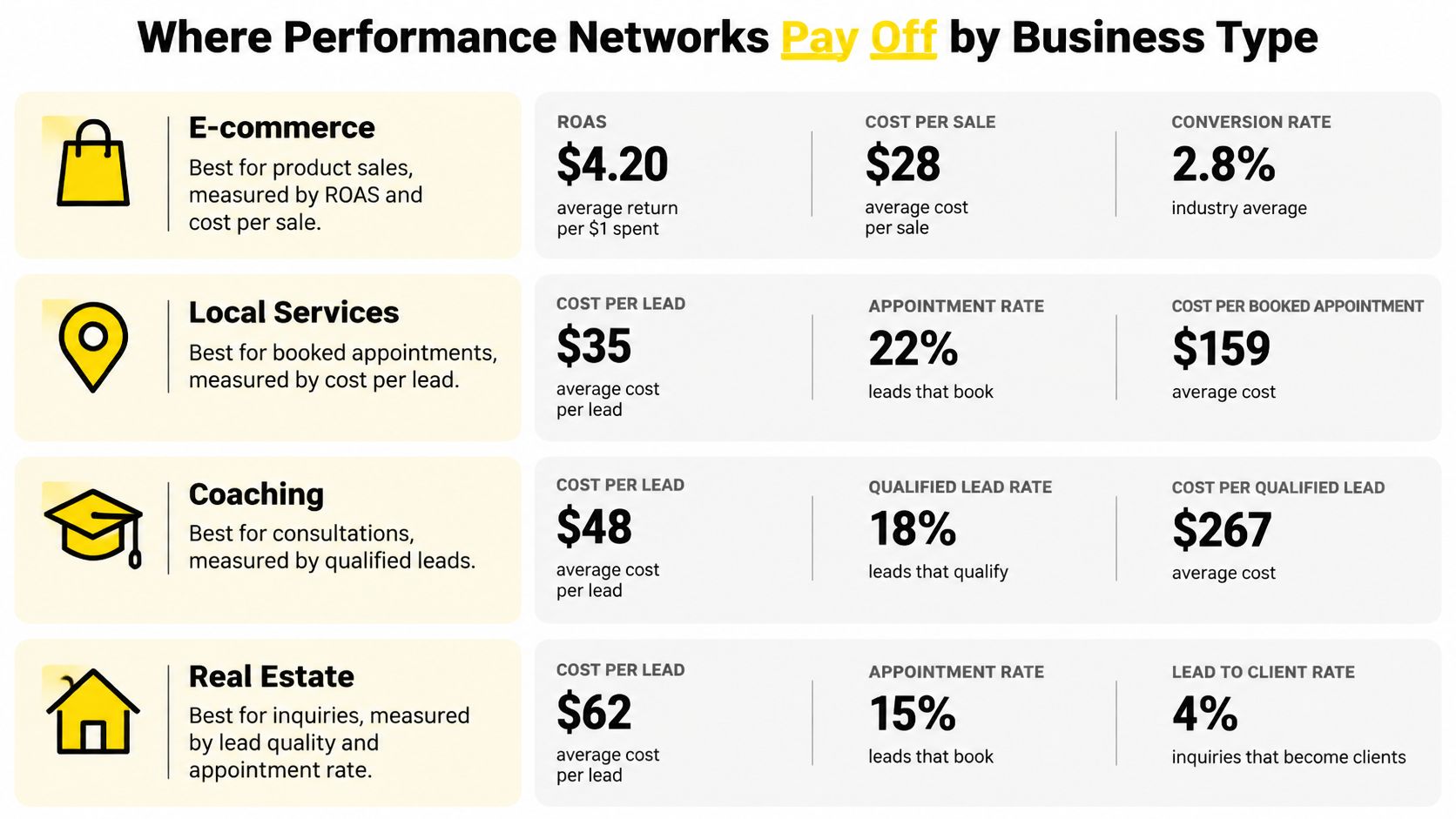
The visual summarizes common front-end outcomes. Use the table's downstream measures to decide whether those outcomes are worth buying.
Product sales and local bookings
For e-commerce, assign channels different jobs instead of demanding identical dashboard results. Search can capture expressed demand, while social and video can introduce products and demonstrate their use.
In the United States, the IAB/PwC annual benchmark reported $258.6 billion in internet advertising revenue in 2024, including $102.9 billion in search revenue. That scale provides context for channel selection, not evidence that your store should spend in the same proportions.
Our e-commerce client moved from 0.8x ROAS to 3.52x ROAS with Wojo Media on Facebook ads. That's an attributed outcome, not a substitute for checking the client's product economics or proof that another advertiser will reproduce it.
For local services, attach qualification to the booking: suitable service, service area, availability, and genuine contact details. Our custom LED landscaping business client received $35 per qualified call with Google Ads. The business decision still requires knowing which calls become completed, profitable jobs.
Longer sales cycles need cohort reporting
A coach or course creator should connect webinar registration to attendance, consultation, purchase, and collected payments. Build payback reporting around cash collected, with refunds and payment failures accounted for. An attractive registration cost doesn't establish an affordable customer acquisition cost.
A real estate professional needs consistent lead dispositions and a record of follow-up. Separate unreachable inquiries, unsuitable prospects, active opportunities, and signed clients before judging a source.
Choose channels against your own margin, sales cycle, and delivery capacity. A competitor's channel mix isn't a financial model.
Misconceptions That Inflate Network Results
Cheap leads are automatically good leads
A low front-end CPA proves value. It doesn't if the sales team can't turn those contacts into paying customers. Say one source supplies inexpensive inquiries outside your service area, while another supplies fewer prospects who book and complete profitable work.
Judge the sources using accepted opportunities and collected contribution, not form submissions alone. Keep your follow-up process comparable during the test, or you'll confuse sales execution with source quality.
A large audience makes a creator a good buy
Follower count is the right creator selection criterion. A creator with a smaller audience may produce clearer demonstrations and more usable paid-ad variations than a larger creator whose content doesn't explain the offer.
The IAB creator-economy report identifies attribution, consistent reporting, creator vetting, audience authentication, and fraud prevention as improvement areas. Those are practical buying checks, not reasons to assume creator spending will work.
Evaluate the actual content and permissions:
Hook strength: Does the opening identify a relevant problem without misleading the viewer?
Usable rights: Can you edit, test, and amplify the asset under the agreement?
Commercial evidence: Do content cohorts generate qualified visits, assisted purchases, or stronger paid-ad outcomes?
Strong platform results justify immediate expansion
Excellent attributed ROAS proves a channel deserves more budget. A retargeting campaign can look strongest because it reaches shoppers nearest to purchase. Meanwhile, prospecting creative may introduce customers who later convert through another source.
Before reallocating, define an eligible audience or geographic holdout and a primary outcome. Keep the offer, measurement rules, and sales process stable, and document promotions or other changes that could distort the comparison.
Choose the test duration and control allocation using baseline conversion volume, outcome variability, conversion delay, and the smallest improvement worth acting on. Don't impose an arbitrary calendar deadline on an underpowered experiment.
If the estimate is uncertain, retain that uncertainty in the decision. Extend a suitable test or avoid a major budget move rather than labeling a noisy result a win.
Evaluate a Network or Agency Partner
A partner should be able to explain the commercial arrangement before asking you to trust the reporting. Use this checklist against the proposed contract and a sample report, not just a sales presentation.
Inspect the agreement and the evidence
Fee structure. Identify retainers, spend-based charges, production fees, and commissions. Confirm whether outcome-based charges use attributed events, verified records, or accepted leads.
Data ownership. Keep administrative ownership of your advertising accounts, customer lists, tracking assets, and contracted creative deliverables. Put export and handover requirements in writing.
Reporting access. Require order-level or lead-level records that can be matched to your systems. Dashboard screenshots aren't enough to resolve disputed outcomes.
Tracking method. Request a diagram of identifiers, browser events, server events, and offline outcome imports. Have the partner explain how duplicate credit is handled.
Test design. Review a proposed holdout or lift-test plan, including eligibility, primary outcome, uncertainty, and the decision it supports.
Contract terms. Read the commitment, termination notice, minimum spend, renewal provisions, and restrictions on other partners. Identify who retains access when the agreement ends.
Affiliate payout rules. Confirm commissionable revenue, attribution window, refund reversals, duplicate referrals, prohibited traffic, and fraud-review procedures.
Make the sample report earn your confidence
Request references relevant to your vertical and ask how the partner handled disappointing results. A useful reference can explain communication, access, and decision-making, not merely repeat a revenue headline.
The sample report should connect spending to accepted business outcomes and explain unresolved discrepancies. It should also distinguish observed results from projections and recommendations.
Before signing: Ask the partner to trace a sample conversion from its original interaction through verification and payment.
Apply the same standard to Wojo Media as to any other option. A recognizable agency name doesn't remove the need for clear ownership, inspectable reporting, and an agreed decision process.
Choose Your Network Model and Next Step
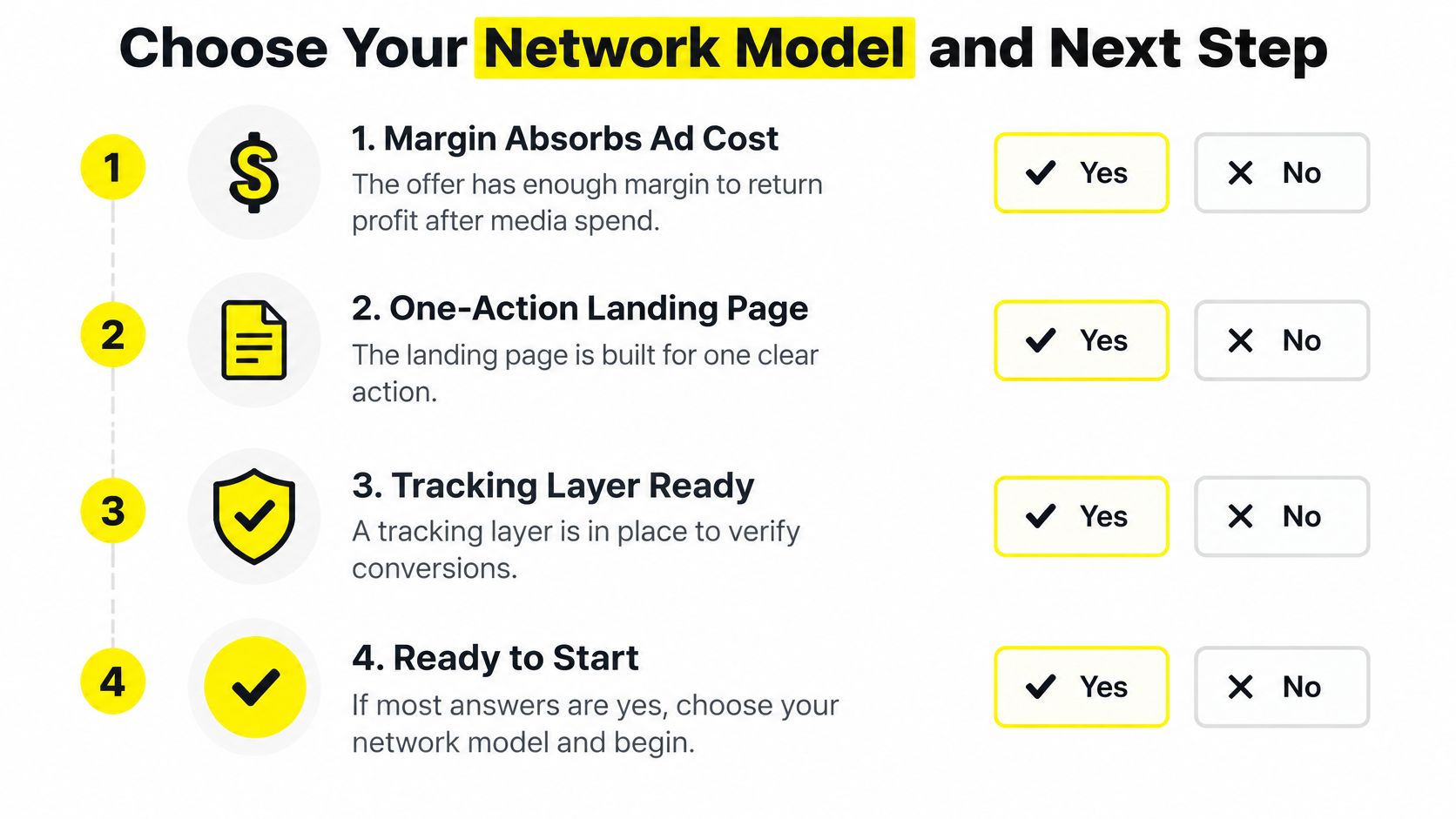
Before choosing a partner, mark each readiness item yes or no. Treat this as an operational review, not a score designed to push you toward buying media.
Margin is available: The offer can absorb acquisition costs, returns, and delivery costs while leaving acceptable contribution.
The landing page has a clear action: Visitors understand the offer and what to do next.
Records can be reconciled: Platform events connect to orders or CRM outcomes.
An experiment is feasible: You can define a credible control and collect enough outcomes to inform a decision.
Creative production is sustainable: Someone can consistently supply fresh concepts, permissions, edits, and approvals.
Use the checklist to identify blockers before committing spend.
Build internally or delegate execution
Build in-house when you can support media buying, creative production, landing-page development, and analysis. You keep direct operational control, but you also own hiring, coverage, quality assurance, and the work required when results deteriorate.
Work with an agency when those capabilities are missing or your team needs execution capacity. You'll pay for that capacity and delegate decisions, so define approval boundaries and reporting responsibilities before launch.
Wojo Media is an agency option, not an exemption from that evaluation. Our team optimizes a client's offer and guarantee, then builds a landing page and ad copy to match. That process addresses readiness, but the resulting campaigns still need to meet your business's financial standards.
Make the next decision testable
If margin or reconciliation is unresolved, fix it before adding another acquisition source. More traffic won't repair an offer that loses money or records that can't establish what happened.
This week, select a channel and write a holdout-test brief: eligible audience, control method, contribution-based outcome, conversion delay, and expansion rule. Launch only when the design is feasible, then decide whether to expand from the measured business effect rather than attributed ROAS alone.
Wojo Media offers paid advertising supported by offer development, landing pages, creative, and backend KPI tracking. Visit Wojo Media to book a free demo call with Jason or a growth manager and begin building a custom paid ad strategy around your acquisition economics. Bring your current spend, customer outcomes, and margin assumptions so the conversation starts with what profitable growth needs to look like.
Comments