.png)
Profitable Home Services Lead Generation

The most popular advice about home services lead generation is also the least useful: lower your cost per lead. A cheap form submission doesn't pay the truck, the technician, or the office staff. If the caller isn't qualified, the team can't reach them, or the business can't turn the inquiry into a booked job, that “low-cost” lead is an operating expense disguised as marketing performance.
The profitable approach connects four parts of the business: the right offer, service-specific advertising, a fast response system, and closed-revenue tracking. Homeowners may discover a contractor through Google, compare reviews on Maps, watch social content, and call after hours. Your marketing has to stay visible through that journey, while your operations make it easy to become the company they choose.
Rethinking the Economics of Contractor Leads
A contractor shouldn't ask, “How cheaply can we generate a lead?” The better question is, “What can we afford to pay for a qualified opportunity that becomes a profitable job?”
That distinction matters because the market isn't a single pool of identical inquiries. Harvard's Joint Center for Housing Studies projected approximately $519 billion in U.S. homeowner improvement and repair expenditures through mid-2027, and professional contractors performed 64% of those projects, according to reported homeowner improvement and repair data. Demand includes urgent repairs, planned replacements, maintenance, and larger remodeling decisions. Each category requires different creative, qualification, scheduling, and follow-up.
A homeowner with a failed water heater isn't evaluating your brand the same way as someone researching a roof replacement. The first prospect wants reassurance, availability, and a clear next step. The second may need proof of workmanship, financing information, project timelines, warranty details, and several estimate comparisons before making contact.
Practical rule: Optimize for gross-margin revenue per lead, not the lowest visible acquisition cost.
Replace the cheap-lead scoreboard
A raw lead count hides the costs that appear after the ad click. Sales staff spend time on unreachable contacts. Dispatchers deal with out-of-area requests. Technicians arrive at jobs that were never properly qualified. Meanwhile, a campaign can look efficient because its forms are inexpensive.
Build the economics around the stages that matter:
Inquiry quality: Does the prospect need a service you provide in a territory you can serve?
Contact quality: Did somebody speak with the homeowner, rather than merely receive a form?
Booking quality: Did the inquiry become a scheduled estimate, inspection, or service visit?
Job quality: Did the appointment produce a completed job with acceptable gross margin?
A documented contractor lead generation system can help teams connect acquisition, qualification, and follow-up instead of treating advertising as an isolated activity. The system doesn't replace judgment about service profitability. It gives the business a structure for seeing where profitable opportunities disappear.
Match spend to the work you want
Start with the service lines that have clear economics. Define the average revenue, labor burden, material exposure, close rate, and geographic constraints for each one. You don't need perfect forecasting to make better decisions. You do need to stop treating an emergency repair, a replacement project, and a low-margin maintenance request as interchangeable conversions.
A campaign for high-urgency work may justify stronger phone coverage and more aggressive scheduling. A campaign for planned remodeling may need educational content and a longer nurture sequence. The ad budget should follow the type of work the operation can deliver profitably, not just the audience that submits the most forms.
The market is large, but large demand doesn't guarantee good acquisition. A profitable contractor lead generation strategy makes the booked appointment the primary conversion, then works backward to determine which lead sources, response workflows, and service categories deserve more budget.
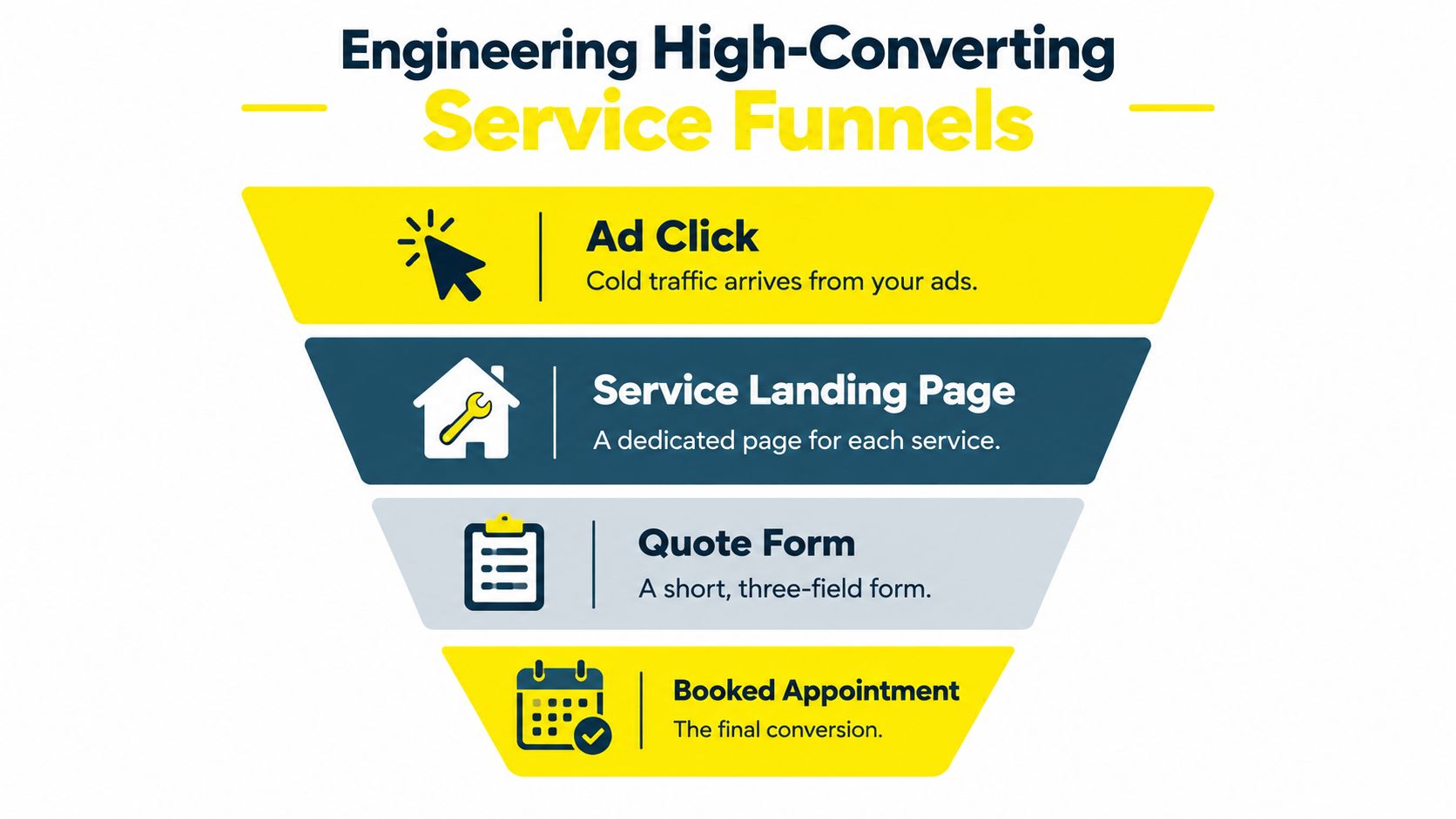
Engineering High-Converting Service Funnels
A generic homepage is a poor destination for a paid search or social visitor. It asks the homeowner to interpret your entire business before finding the service, location, proof, and action that match the reason they clicked.
A high-converting funnel narrows the conversation immediately. Someone searching for drain repair should land on a page about drain repair, not a general plumbing menu. Someone researching replacement windows should see relevant examples, process details, qualification questions, and a scheduling path built for that project.
Build the page around the visitor's decision
The opening screen should answer three questions quickly: Can you solve my problem? Do you serve my area? What should I do next? Use a headline that names the service and location, followed by a concise promise grounded in your actual operation. Avoid claims about response times, guarantees, or availability unless the business can consistently deliver them.
The page should then remove uncertainty in a deliberate order:
State the service fit. Explain the problem you handle, the property types you serve, and the locations covered.
Show evidence. Add relevant reviews, technician credentials, project photos, and before-and-after examples. A generic five-star badge is weaker than proof connected to the specific service.
Explain the process. Tell visitors what happens after they call or submit the form, including qualification, scheduling, arrival, and estimate steps.
Make the action obvious. Place click-to-call, request-estimate, and scheduling options where the visitor expects them. Keep the form focused on information the team will use.
Forms shouldn't be long just because the business wants more data. Ask for the essentials, such as name, phone, location, service problem, urgency, and preferred appointment window. Use conditional questions when the answer changes routing, but don't turn an urgent request into an administrative interview.
Use transparency as a qualification tool
Pricing deserves careful handling. A rigid quote on a page can create disputes when the property condition, access, parts, permits, or scope varies. A useful alternative is an honest explanation of what affects price, supported by a realistic range when the business can defend it. For planned projects, include financing or payment information if it is available.
Trust elements should also serve qualification. A warranty explanation can reduce anxiety, while service-area language prevents out-of-territory inquiries. A scheduling integration can filter prospects by availability before a salesperson spends time on the phone.
The landing page shouldn't merely persuade people to contact you. It should help the right people self-select and give your team the context needed to respond well.
Track every page by service and market. Use a distinct phone number or dynamic call tracking pool, consistent campaign parameters, and CRM fields that preserve the visitor's service request. If a page produces forms but few conversations, the problem may be qualification or response coverage rather than the ad itself.
Deploying Omnipresent Paid Ad Campaigns
Homeowners rarely move from first impression to contractor selection in one step. A 2025 survey of more than 150,000 homeowners found that 51.61% spent one to five hours researching projects, while nearly 30% expected to spend more than 10 hours before committing, as reported in the homeowner research behavior survey.
That research time creates room for a coordinated advertising system. Google Search captures explicit demand. Facebook and Instagram introduce the offer and provide social proof. YouTube demonstrates the work. TikTok can expose a company through short, useful project content. Retargeting keeps the brand familiar while the homeowner compares options.

Give each channel a job
Omnipresence doesn't mean copying one ad everywhere. It means coordinating messages around the prospect's level of intent.
A search ad should be direct and tightly matched to the query. It can emphasize service availability, location, proof, and a clear call to action. Social ads can create demand with problem-led videos, technician explanations, customer stories, and visual demonstrations. Retargeting should answer objections that appeared after the first visit, such as project disruption, warranties, financing, or how estimates work.
UGC works best when it feels specific rather than staged. A technician can explain a common failure pattern from a real service context. A customer can describe what made the scheduling process easy. A project walkthrough can show the condition before the work, the decision made, and the finished result. The script should establish the problem quickly, demonstrate competence, and direct the viewer to one next step.
Control the feedback loop
Use audience groups based on behavior, not just demographics. Separate recent site visitors from video viewers, form starters from completed forms, and existing customers from new prospects. Exclude people who already booked when the objective is new acquisition, then place them into review, referral, maintenance, or repeat-service campaigns.
A paid campaign dashboard for marketing partners can make cross-channel review easier, but the dashboard should not become the strategy. The important question is whether each message moves people toward a qualified conversation and booked work. Reach, impressions, and clicks describe exposure. They don't prove profitability.
Use creative variation without losing the offer. Test different openings, proof formats, service problems, and calls to action. Keep the destination relevant to each ad. A polished video sent to a vague homepage creates the same friction as a weak ad sent to a strong landing page.
The strongest ecosystem combines intent capture and demand creation. Search finds the homeowner who is ready. Social and video help the researching homeowner remember, trust, and eventually choose you.
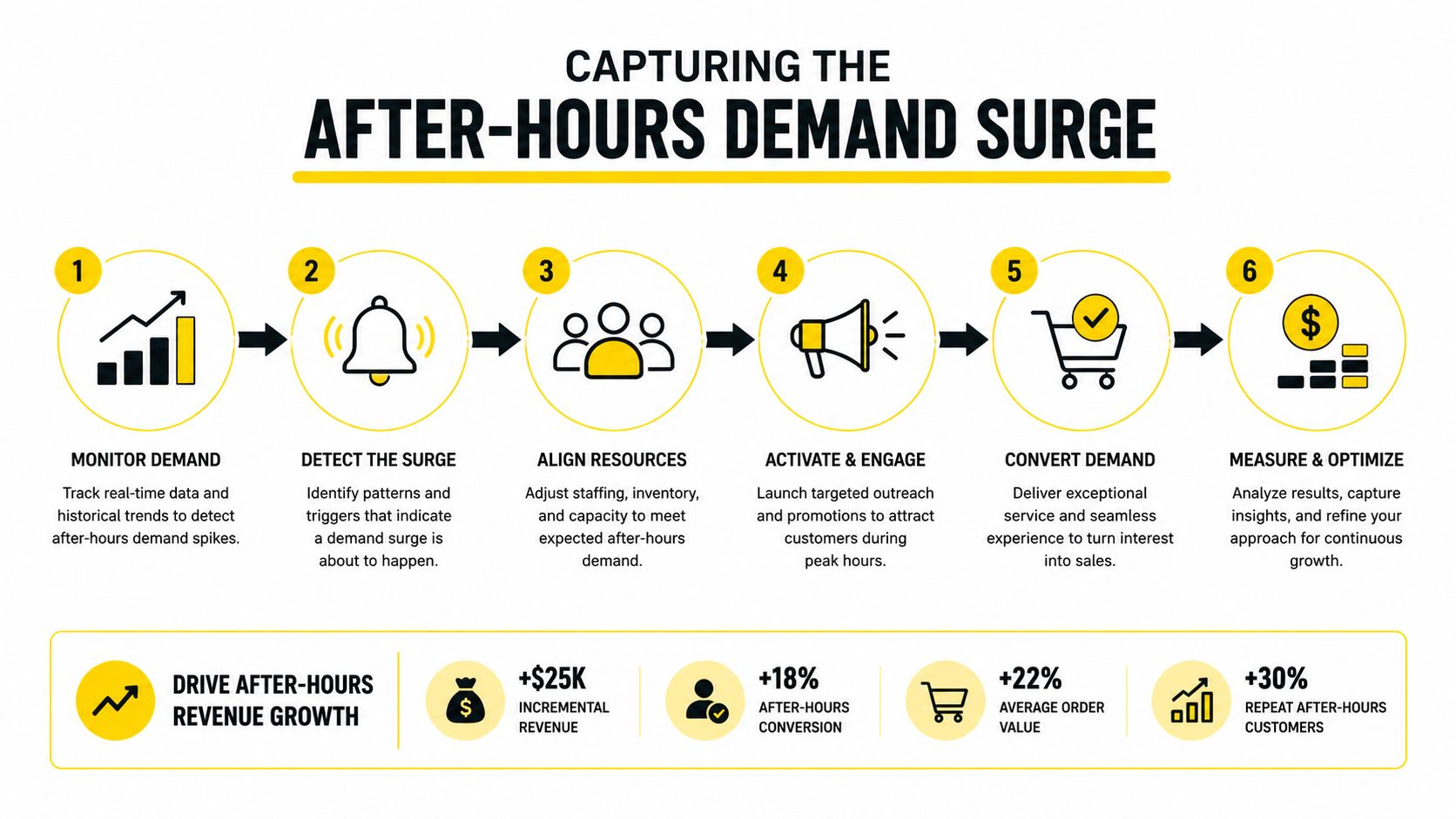
Capturing the After-Hours Demand Surge
Marketing performance often fails after the lead arrives. Available 2025–2026 industry reporting indicates that 68.3% of home-service inquiry calls arrive outside standard business hours, while 62% of consumers contact multiple businesses at once and tend to hire whoever responds first, according to reported home-service response behavior.
Those figures change the operating question. The issue isn't whether a contractor should automate every response. It's which inquiries deserve immediate human escalation, which can receive transparent scheduling automation, and how the business measures the difference.
Separate urgency from research
An emergency plumbing call, a heating failure, and a planned bathroom remodel shouldn't enter the same queue. The first step is to capture service type, urgency, ZIP code, property type, and requested timing at the initial contact. A CRM should store those fields alongside the campaign, source, timestamp, consent status, and contact details.
High-intent emergencies need a path to an on-call human. If the team can't answer immediately, the system should acknowledge the request, explain what happens next, and escalate according to the service rules. Lower-urgency inquiries can receive an SMS or email with a booking link, useful project questions, and a clear statement about when a representative will respond.
A good workflow isn't a robotic wall of messages. It sounds like a helpful office coordinator and gives the prospect control. Confirm the request, avoid promising an unavailable technician, and offer a calendar only when the available slots are real.
Design the first-hour workflow
Use this operating sequence:
Capture every channel: Send calls, forms, chats, and messages into one CRM rather than leaving them in separate inboxes.
Acknowledge immediately: Trigger a concise SMS or email that confirms receipt and identifies the service requested.
Route by value and urgency: Escalate emergencies and high-margin opportunities to an on-call representative, while assigning lower-urgency work to a structured nurture path.
Make repeated contact deliberate: Use several call attempts across the first hour, with voicemail and text language that makes the next step clear.
Record the human response: Store the time of the first real conversation, not only the time an automation fired.
Measure the outcome: Compare contact rate, qualified rate, booked jobs, revenue per lead, and response time by channel and after-hours status.
A specialist contractor call answering service may support coverage, but outsourcing the phone isn't a substitute for service-area rules, escalation criteria, and CRM dispositioning. The answering team needs a usable script and a way to distinguish a genuine emergency from a homeowner gathering information.
After-hours coverage should be evaluated by trade, territory, and margin. If a service cannot be delivered overnight, the message should say what the business can do now, such as triage, secure an appointment, or provide a safe next step. The objective is not instant automation for its own sake. It's a response machine that protects high-value opportunities without wasting staff time.
Tracking Full-Funnel Attribution and KPIs
A campaign isn't scalable if the business can't connect the final job to the original marketing source. Tracking a form submission tells you what happened at the top of the funnel. It doesn't tell you whether the lead was answered, qualified, booked, completed, and profitable.
Available home-services benchmark data reports that only 52% of callers speak with a person, while 38% of calls from digital marketing are identified as leads and 45% of those leads convert during the call, according to the 2026 home-services lead conversion benchmark report. Because that report's definitions and sample may differ from your operation, use it as a diagnostic reference and validate the stages against first-party CRM and call-recording data.
Build the data path before increasing spend
Every inquiry should carry enough information to answer five questions: where did it originate, what service did it request, where is the property, when did it arrive, and what happened afterward?
Use dynamic call tracking to preserve keyword, ad, device, geography, and first-touch details. For forms and chats, pass campaign parameters into the CRM. Deduplicate repeat calls and link multiple interactions to the same opportunity. Then send offline outcomes back to the relevant advertising platforms, using booked appointments and completed jobs rather than treating every inquiry as equal.
The weekly review should look like a waterfall:
Inquiries → answered contacts → qualified opportunities → scheduled estimates → completed jobs → gross-margin revenue
Segment every stage by service, campaign, technician territory, business hours, and response-time bucket. A campaign with fewer inquiries may deserve more budget if it produces better booked-job economics. Conversely, a channel with strong form volume may need a lower budget if the office can't reach or service the people it attracts.
Use one diagnostic table
Funnel Stage | Primary Metric | Optimization Goal |
|---|---|---|
Inquiry | Qualified inquiry rate | Improve service, location, and urgency fit |
Answered contact | Live-answer rate and time to first human response | Expand coverage and reduce delay |
Qualified opportunity | Qualification rate | Improve questions, routing, and audience targeting |
Scheduled estimate | Booked-job rate | Remove calendar friction and strengthen the offer |
Completed job | Completion rate | Improve scheduling reliability and expectation setting |
Revenue | Gross-margin revenue per lead | Shift budget toward profitable service and market combinations |
Don't optimize a disconnected dashboard. Reconcile ad-platform data with call recordings, CRM dispositions, appointment records, and job-cost information. A missed call should have a disposition. A duplicate inquiry should not inflate the campaign's lead count. A canceled appointment should not remain classified as a successful conversion.
The measurement standard is simple: marketing earns more budget when it produces profitable completed work. Everything before that is a clue, not the final answer.
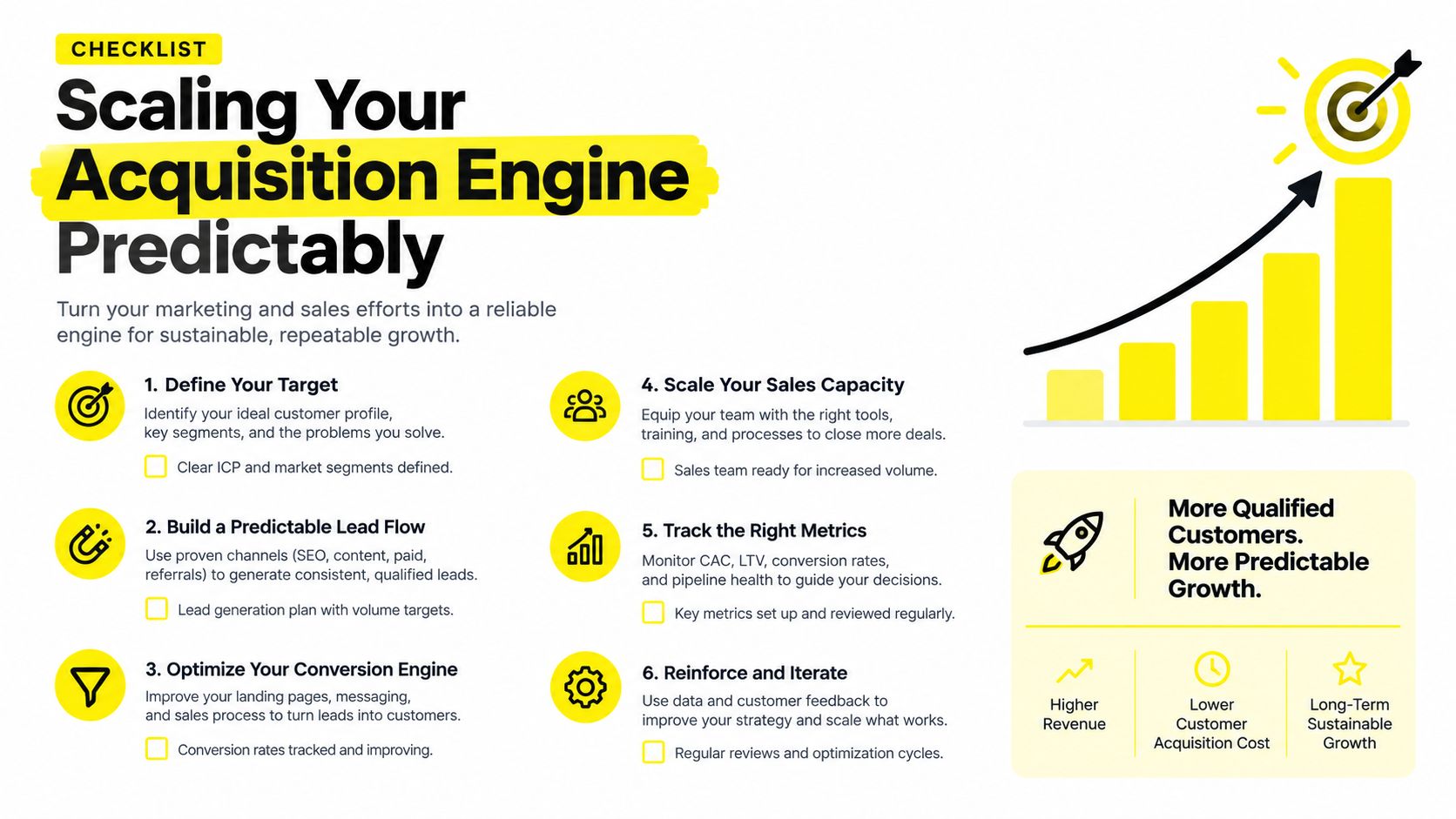
Scaling Your Acquisition Engine Predictably
Scaling paid acquisition before fixing the backend usually magnifies waste. More traffic exposes landing-page weaknesses. More inquiries overwhelm the office. More missed calls make the campaign look worse than it is, while poor attribution encourages the team to cut channels that may have been producing valuable demand.
A controlled expansion starts with the weakest link. If the ads attract the wrong service, fix the offer and targeting. If the landing page receives clicks but few inquiries, fix relevance, proof, and friction. If inquiries arrive but appointments don't, fix contact coverage, qualification, and scheduling. If jobs close but margins disappoint, change the service mix, geographic boundaries, or offer economics.
Expand only what already works
The safest growth pattern copies a proven operating model into adjacent opportunities. That may mean another service category, a nearby territory, a new audience segment, or a different seasonal message. The infrastructure stays consistent, while the landing page, creative, qualification fields, and routing rules reflect the new service.
Use a staged review cycle:
Audit the offer: Confirm that the service has a clear customer problem, defensible economics, and an appointment path the team can fulfill.
Audit the funnel: Match each ad promise to a dedicated page, relevant proof, and a practical conversion option.
Audit response coverage: Review unanswered calls, first-human-response time, after-hours routing, and calendar availability.
Audit attribution: Verify that source data survives from click or call through CRM, job status, and revenue.
Audit capacity: Check technician territory, staffing, materials, scheduling limits, and the maximum volume the office can handle.
Scale in controlled increments: Increase exposure only after the previous level has stable contact, booking, completion, and margin performance.
The common mistake is to expand geography while the original territory still has unworked demand. A contractor may buy more traffic even though existing leads sit in an unattended inbox or the schedule has no practical availability. That isn't growth. It's a larger queue of disappointed prospects.
Make the next ninety days operational
Use the opening period to install the CRM fields, call tracking, landing-page structure, and funnel waterfall. Then review service-level performance by business hours, response bucket, and source. The final phase should focus on reallocating spend, improving the highest-value creative, and testing one adjacent service or market only when the operation can support it.
Keep the ad account and the field operation connected. Sales staff should report recurring objections. Technicians should identify the questions homeowners ask before approving work. Dispatch should flag geographic or timing patterns that advertising doesn't reveal. Those insights should improve the next landing page, script, and audience rather than remaining trapped in a weekly meeting.
The durable acquisition engine is not built from cheaper inquiries. It comes from profitable offers, relevant pages, coordinated visibility, rapid response, and closed-revenue feedback. Once those pieces work together, increasing spend becomes a measured operating decision instead of a gamble.
Wojo Media builds home services campaigns around offers, focused landing pages, omnipresent paid ads, and backend tracking tied to calls, forms, CRM outcomes, and booked jobs. If your team needs to turn after-hours demand and scattered channel data into a more accountable acquisition system, visit Wojo Media to discuss a paid advertising strategy.
Comments