
How Much Do Ad Agencies Charge: 2026 Pricing Guide

Expect percentage-of-spend fees of roughly 10% to 30%, with the rate falling as monthly media spend climbs, and monthly retainers from about $500 to $15,000 or more depending on scope. Those two structures cover most of what you'll be quoted, and neither one tells you the whole cost.
A century ago the question had a single answer. Advertising agents took a 15% commission on media, so a $100,000 buy produced $15,000 in agency revenue and a $1 million buy produced $150,000, as the UCLA Anderson Review's account of the middleman commission lays out. That model tied agency income to media scale rather than to labor hours or campaign output, and the trade standardized it by the early 1890s.
Modern quotes are messier, and not because agencies got greedier. Direct response, digital production, website builds and specialized creative don't price cleanly as a slice of media. The result is a market where two proposals can carry the same headline percentage and deliver completely different amounts of work. What separates a fair quote from an expensive one is what sits outside the percentage, and how fast the fee grows when your budget does.
Typical Ad Agency Costs at a Glance
Fee ranges move with three things: how much you spend on media, which services you buy, and how much of the work the agency keeps in-house. The table below is the fastest way to sanity-check a proposal before you read the fine print.
Spend level or service | Fee model | Typical range |
|---|---|---|
Under $5,000 monthly ad spend | Percentage of spend | 20-30% of spend, plus setup charge |
$5,000-$25,000 monthly ad spend | Percentage of spend | 15-20% of spend |
$25,000-$50,000 monthly ad spend | Percentage of spend | 12-18% of spend |
Above $50,000 monthly ad spend | Percentage of spend | 10-15% of spend |
Social media management retainer | Monthly retainer | $500-$3,000 per month |
Full-service performance management | Monthly retainer | $5,000-$15,000+ per month |
Campaign setup or audit | Project fee | $1,500-$7,500 one time |
Read every range as a starting point. Market, platform mix and scope move the number, often by more than the range itself is wide.
Do the arithmetic before you react to a percentage. A 15% fee on $10,000 of monthly media is $1,500 in agency revenue before a single asset gets produced. If the same engagement needs landing pages, video edits and a tracking rebuild, the effective cost to you lands well above the fee line.
Ask for the floor and the setup charge first. Agencies commonly enforce a monthly minimum, and on small budgets that minimum outweighs the percentage entirely. One-time setup fees for account audits, tracking implementation and creative production sit on top of month one. A quote that looks cheap at 20% can cost more in month one than a 25% quote with an onboarding credit.
Service type shifts the number as much as budget does. In a 2024 SE Ranking survey of agency pricing, 64% of agencies charged less than $1,000 per month for SEO retainers, while 13% charged $2,000 to $5,000 per month, according to SE Ranking's SEO pricing study. Search optimization is a different cost structure from paid media, so don't benchmark one against the other.
Creative volume is where the table above breaks down most often. If a quote balloons because of video and static production rather than media management, it's worth understanding when to hire AI video specialists instead of paying agency rates for asset volume. The next sections explain the models behind these figures, and how a low headline percentage can still hide real cost.
Choosing the Right Pricing Model
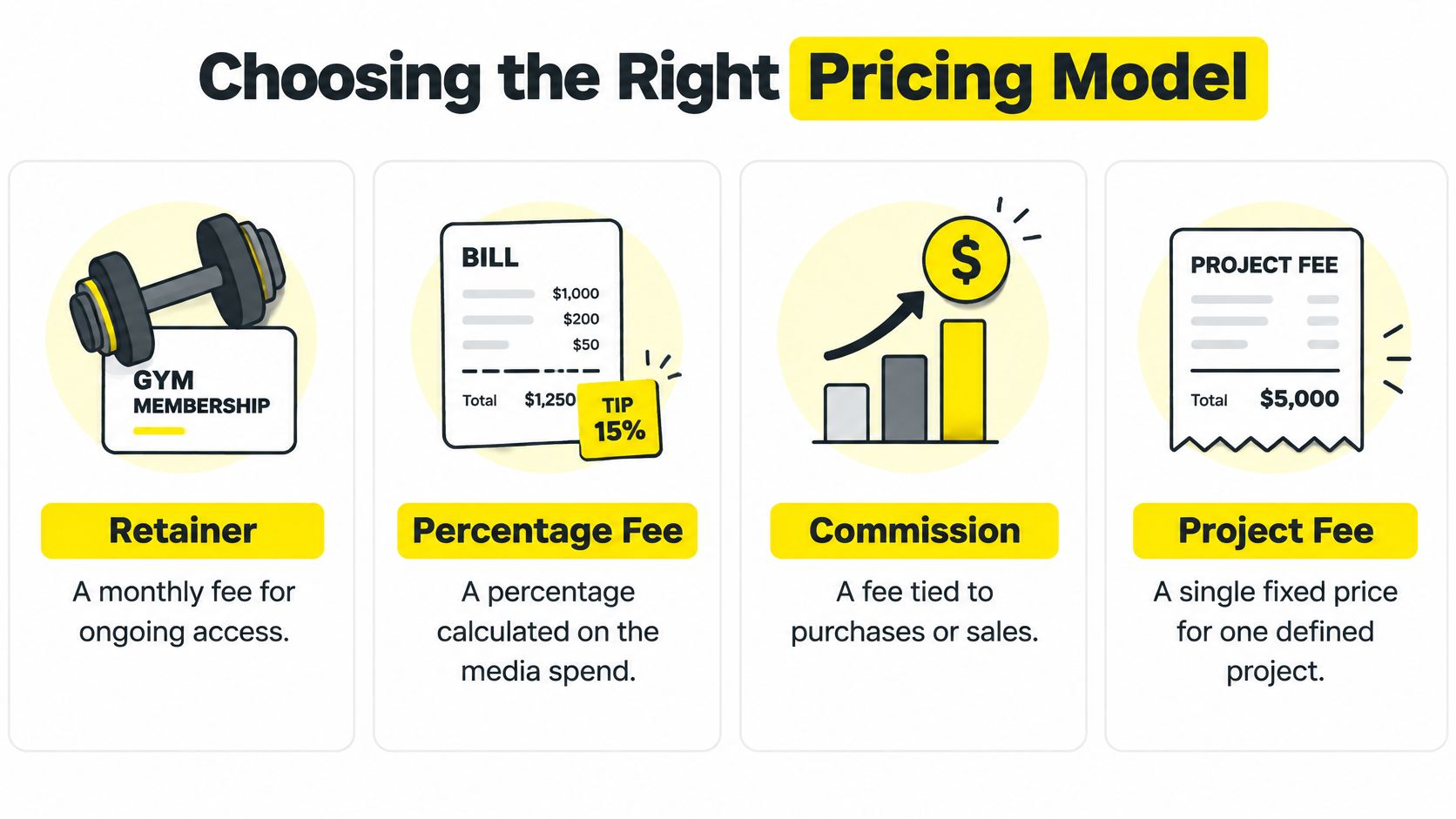
Four structures cover nearly every proposal you'll receive, and each behaves like something you already pay for. Learn the analogy first, then the risk.
Retainer, like a gym membership. You pay a fixed monthly fee for ongoing access to a team, a scope and a reporting cadence. Predictable for both sides, and worth it when you need continuous management rather than a one-off build.
Percentage of spend, like a tip calculated on the bill. The fee is a share of the media budget, and it climbs automatically whenever the budget does. Simple to forecast, less simple to justify when the workload stays flat.
Commission, like a sales bonus. A base fee plus a share of revenue or a per-lead payment. It aligns incentives on paper, then runs into arguments about which leads were qualified and which sale gets credited.
Project fee, like a contractor's fixed quote for a finished kitchen. One price for one defined deliverable such as a funnel build, an account audit or a launch. Clean scope, clean handoff, no ongoing management.
Practice is mixed. In Ignition's 2025 pricing and cash-flow study, 28% of agencies billed hourly, 28% used productized or subscription packages, 25% used project-based pricing and 10% used retainers. Anyone who tells you there is one standard model hasn't read enough proposals.
Which structure fits your risk
Match the model to how predictable your scope is, not to which one sounds cheapest.
A fixed fee suits a defined, repeatable scope where you already know the deliverables. Percentage of spend suits flexible media management with stable budgets, because the fee flexes with the media plan without renegotiation. A hybrid with a capped base fee plus a performance bonus suits fast-scaling brands and volatile campaigns, since it pays for the base capacity and rewards agreed business KPIs rather than raw spend.
Thrad's breakdown of programmatic agency pricing puts the same split plainly: fixed fee for predictable scope, percentage of spend for flexible media management, and a capped hybrid tied to agreed metrics. It also notes the tiering that most pricing pages skip, with percentage fees falling as spend rises, alongside monthly minimums and setup charges.
Where percentage pricing breaks down
Percentage pricing creates an uncomfortable conflict. The agency earns more when you spend more, including on the months when extra spend isn't profitable. That's fine when budgets are modest and stable, and unsuitable when you're scaling fast or your performance swings month to month.
Small advertisers face the toughest challenges. At the top of the tier ladder, they pay the highest rate for the least media. Brands that need a hard spend cap feel the same pressure in reverse, because every increase in budget raises the fee with no corresponding increase in work.
Contracts carry the risk. Attribution windows, lead-quality rules, refunds and cancellation terms, tracking ownership, and what happens when campaigns pause all decide whether a performance clause ever pays out. Cheap leads can still be commercially worthless in local services, coaching, real estate and tax-advisory funnels, where a $4 lead that never books an appointment costs more than a $40 lead that closes.
Model | How it is billed | Best fit | Main risk |
|---|---|---|---|
Retainer | Fixed monthly fee for a defined scope | Brands wanting steady management and reporting | Fees continue even when results dip |
Percentage of ad spend | Share of media budget, usually 10-30% | Advertisers with predictable budgets | Cost rises with spend, not results |
Performance or commission | Base fee plus bonus or share of revenue or leads | Advertisers wanting pay tied to outcomes | Disputes over attribution and lead quality |
Flat or project fee | Fixed price per deliverable, such as a funnel or audit | One-off launches, audits or rebuilds | Scope creep when requests grow |
If the creative load is what's inflating the proposal, tools like create videos with Seedance 2 can bring per-asset production cost down before you negotiate the management rate.
The clause that matters more than the price: Read the overage and cancellation terms the way you'd read a phone plan. The monthly figure is marketing; the per-unit charge when you exceed the plan is the actual cost.
For a side-by-side walk through how these models interact in real negotiations, the walkthrough below is worth watching before you sit down with a proposal.
What the Fee Covers and What It Leaves Out
Every quote answers two questions at once: how much, and for what. Most pricing comparisons answer only the first, which is why a 12% quote and a 12% quote can be thousands of dollars apart in real value.
Transparency is the persistent problem. Only 48% of surveyed brands reported full visibility into their agency costs, while 89% still believed their agencies delivered value, according to industry research on agency cost visibility. Buyers trust the work and can't audit the invoice, and both things are true at once.
The line items that move in and out of a headline fee
Most of these are negotiable, and all of them should be written down.
Strategy and planning: usually inside a retainer, frequently billed separately in a media-only deal.
Account management: inside the fee, but check whether you get a named strategist or a shared coordinator.
Trafficking, bidding and optimization: the core of a percentage fee, and the part you're most clearly paying for.
Creative production: often outside, priced per asset, per video or per batch of variants.
Landing pages: outside, or a one-time project fee that may exclude copywriting.
Tracking and analytics setup: usually a setup charge, sometimes excluded from reporting entirely.
Testing and iteration: bundled thinly at low tiers and priced as a retainer line at higher ones.
Creator or UGC content: almost always extra, including usage rights.
Platform and software fees: pass-through in many contracts, bundled in others.
Community management sits in the same grey zone when social is part of the buy, so budgeting for ecommerce comment moderation belongs in the same conversation as creative and reporting rather than six months later.
The exclusions to check before you compare two proposals
Ask four questions about every quote. How many creative revisions are included, and what does revision five cost? What happens to price when you request something out of scope? Is there a monthly minimum if you pause spend? And who owns the ad account, the pixel and the creative files when the engagement ends?
A fee is a scope-and-capacity contract, not a number. If the proposal doesn't name who builds the ads, who owns the account and who pays for production, the price isn't comparable yet.
How Percentage Fees Scale With Your Budget
Percentage fees grow in dollars even when the work doesn't. At a flat 15%, $20,000 of monthly media produces $3,000 in fees and $100,000 produces $15,000. The deliverables list is identical in both cases.
Monthly media spend | Fee at 15% | Increase over prior tier |
|---|---|---|
$20,000 | $3,000 | Baseline |
$50,000 | $7,500 | +$4,500 |
$100,000 | $15,000 | +$7,500 |
Media buying prices differently from broader agency services, because commissions remain more common in programmatic and digital buying. ANA data reports that 24% of respondents used commissions for digital media-buying services and 40% used them for programmatic media, compared with 12% using commissions for agency services overall, per the ANA's media agency compensation findings. That gap matters when you compare proposals, because a percentage of ad spend may compensate only for trafficking, bidding and optimization.
The safeguard worth asking for
Request a fee schedule at three spend levels, for example $20,000, $50,000 and $100,000 per month, and require every pass-through charge to be listed: platform costs, data, production and programmatic technology. A single blended rate hides the jump that hits you the month your budget doubles.
Then ask about rebates and discounts. The ANA's reporting highlights broader scrutiny of rebates, discounts and technology-related revenues, so define whether the quoted fee is inclusive and whether you receive the economic benefit of any media rebate.
Percentage pricing is easy to budget and easy to abuse. If you accept it, cap it or attach a performance condition, and put the cap in the contract rather than in an email.
Calculating the True Cost of an Agency Quote
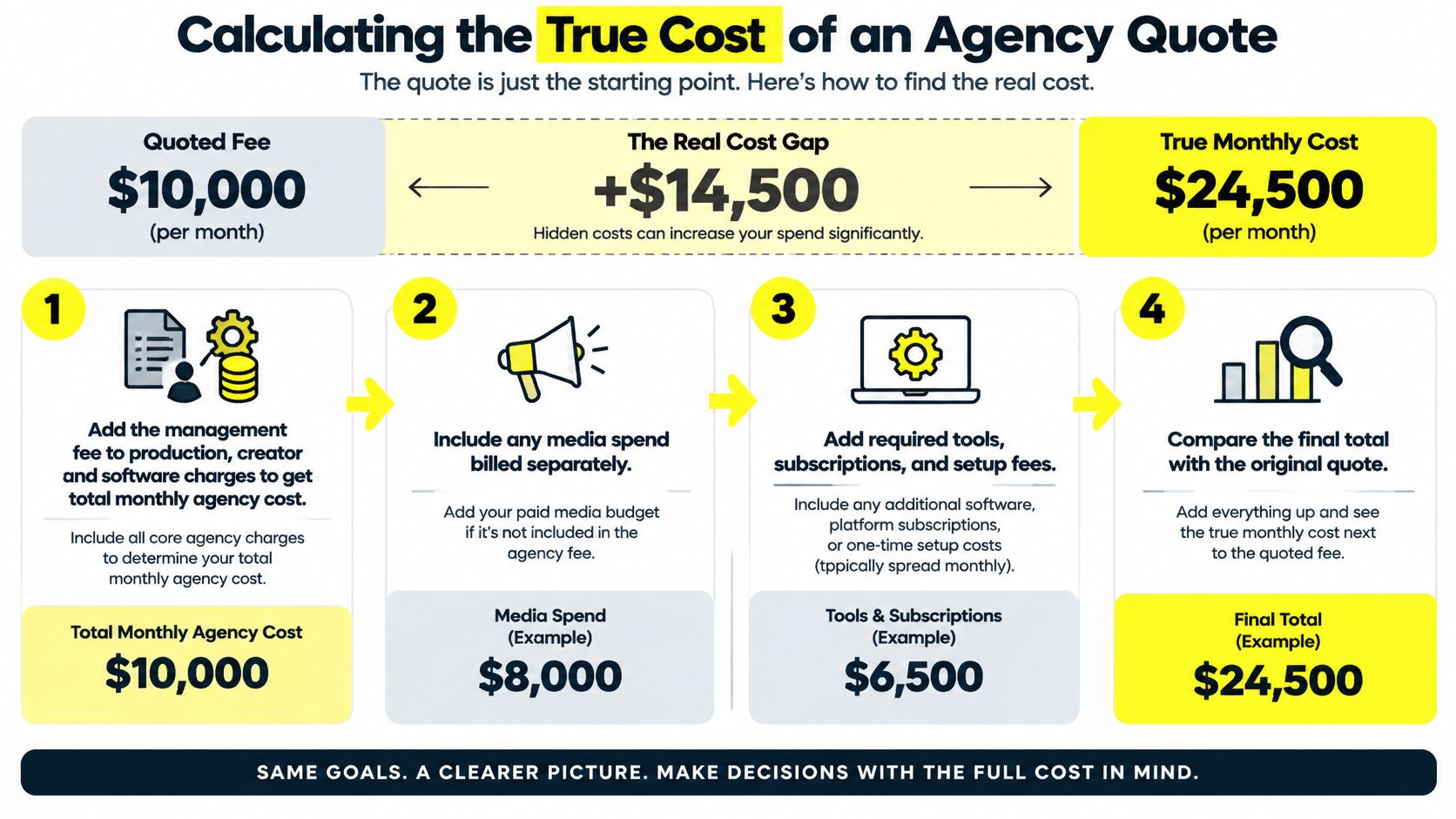
A $6,000 monthly fee on $60,000 of media spend works out to a 10% effective burden before creative or platform costs enter the picture. Run that same division on every proposal you receive, because the number on the first page rarely equals the number that leaves your account. Four steps close the gap.
Total the whole engagement. Add the management fee to production, creator and software charges. That sum is your total monthly agency cost, not the headline figure.
Convert it to an effective burden. Divide total cost by gross media spend. The ANA's 2022 compensation study identifies labor-based fees as the dominant model, with fixed or output-based fees becoming more common among large advertisers, and this calculation is the only way to compare unlike fee structures on equal terms.
Compare against incremental contribution profit. Measure the profit the agency is expected to add after fulfillment, discounts and customer acquisition payback. Revenue overstates the gain whenever margins run thin.
Check that the gain clears the fee. A $6,000 fee only pays off when optimization adds more than $6,000 in contribution profit each month. Below that line, you're buying activity.
The sanity check most buyers skip
Thin margins break the math fast. If you keep $12 per order after fulfillment and the agency's fee works out to $6 per order, the fee consumes half your profit and the campaign has to double volume just to stand still. Run this calculation per unit, not per month, because monthly totals hide the orders where the fee eats the entire margin. E-commerce and lead-generation businesses buying full-funnel services feel this hardest, since they pay for strategy, creative and media management at once.
A low percentage-of-spend quote misleads when it excludes creative, conversion-rate optimization, analytics or a minimum monthly fee. Those exclusions surface as separate invoices after the contract is signed, which is why step two belongs on the all-in number rather than the quoted one.
Decision rule: Sign when the projected gain clearly exceeds total cost. Negotiate scope or rate when the two are close. Walk away when the numbers only work on the agency's slide.
Real Pricing Examples for Three Business Types
Same market, three different verdicts on the same quote. Work each example through your own margins before borrowing its conclusion.
The e-commerce brand. Say an apparel brand spends $40,000 a month across Meta and Google and is quoted 12% of spend, or $4,800 a month. That fee is only justified if contribution profit, after fulfillment and returns, rises by more than $4,800. Judge the proposal on ROAS trend and margin per order, never on impressions. Movement of that size is achievable: an e-commerce client went from 0.8x ROAS to 3.52x ROAS on Facebook ads after our team took over the account.
The local service business. A barbershop buying Google Ads for booked appointments should be quoted a retainer plus a lead bonus, and judged on cost per qualified call and cost per booked chair. We ran Google Ads for a barbershop in Orlando, Florida at $3 per qualified call, with more than 500 calls generated locally. Three dollars a call sounds unbeatable until you count no-shows, which is why the booked-chair number decides whether the retainer is cheap or expensive.
The course creator. A $5,000 funnel build plus a $2,000 monthly retainer costs $17,000 across six months. Divide that by enrolled students, not by leads. If the funnel enrolls 40 students at $2,000, the agency cost is roughly $425 per enrollment, which is trivial against margin. If it enrolls six, the same quote is a disaster.
Business type | Common fee model | Typical monthly spend | Metric to judge the fee |
|---|---|---|---|
E-commerce brand | Percentage of spend or hybrid | $10,000-$100,000+ | ROAS and contribution profit |
Local service business | Retainer plus lead bonus | $1,500-$10,000 | Cost per qualified lead and booked calls |
Course creator or coach | Retainer or project fee | $3,000-$20,000 | Cost per enrolled student or booked call |
The quote doesn't change across those three columns. The margin and the sales cycle do, and that's what turns an identical percentage into a bargain for one business and an anchor for another.
Confirm the Scope Before You Sign
Six actions turn a proposal into something you can compare and enforce.
Demand a line-item scope. Deliverables, resource commitments and explicit exclusions, in writing.
Lock the fee schedule into the contract. Three spend levels, so a budget increase can't reprice the relationship.
Name every pass-through charge. Platform, data, production and software costs, each one listed.
Confirm ownership. The ad account, the tracking setup and the creative files stay yours.
Write the KPI definitions. Attribution window, lead-quality rules and the exact threshold that triggers a bonus.
Set exit terms. Cancellation notice, wind-down period and what happens when campaigns pause.
Then test the proposal against those six points with a real conversation rather than a PDF. Our first step with a new client is a free demo call with Jason or a growth manager to build a custom paid ad strategy, which is the cheapest way to find out whether an agency can answer these questions before money changes hands.
Compare the finalists on total monthly cost and total scope. A 9% quote with creative billed separately is not cheaper than a 14% quote that includes production, and once both are written down, the comparison takes ten minutes instead of a week.
If you want a quote built on scope rather than a headline percentage, Wojo Media runs paid campaigns across Facebook, Instagram, TikTok, Google and YouTube, and we onboard every client with Jason directly to shape the offer, the landing page and the creative before a dollar of media goes live. You'll see the fee structure, the deliverables and the KPI definitions in the same document. Book a free demo call through Wojo Media and bring your current proposal to the conversation.
Comments