
Paid Search Marketing Services Explained: Costs and KPIs

Your ad report looks encouraging, but your bank balance tells a less convincing story. Calls are coming in, yet some callers want services you don't offer. The agency points to return on ad spend, while you're trying to work out whether the new customers cover fulfillment, management fees, and the time your team spends chasing leads.
That's the right question to bring to a provider comparison. Paid search marketing services should help you acquire profitable business you wouldn't otherwise have won, not just produce attractive numbers inside Google Ads. The difference comes down to what the provider manages, what you pay for, and which outcomes they're willing to measure.
What Paid Search Marketing Services Include
Paid search marketing services cover the planning, buying, writing, testing, and measurement of ads that appear when someone searches on Google. Think of it as renting a shop window on a street where people are already looking for what you sell. With conventional pay-per-click Search campaigns, you pay for clicks rather than paying whenever someone sees the window.
You buy the advertising space from Google. The provider supplies the management layer, deciding which searches deserve your money and how to turn those visits into qualified customers.
Paid search accounted for 13.9% of total digital marketing spend among surveyed marketing leaders in 2025, up from 13.6% the previous year, according to Gartner's CMO Spend Survey of 402 leaders.
Paid search service components and what they deliver
Component | What the Provider Does | What Good Reporting Shows |
|---|---|---|
Google Search campaigns | Writes text ads eligible for relevant searches | Clicks, conversions, and cost per conversion by query group |
Google Shopping campaigns | Shows product listings using prices and images from your feed | Revenue, ROAS, and feed errors by product group |
PPC management | Sets budgets, bids, schedules, and campaign structure | Spend pacing and a dated change log |
Keyword research | Groups searches by intent and sets match types and negatives | Search terms reviewed and irrelevant spending identified |
Bidding | Chooses manual or automated strategies tied to business goals | Target versus actual acquisition cost or ROAS |
Ad creative | Writes and tests headlines, descriptions, and assets | Asset diagnostics and performance of tested messaging |
Landing page optimization | Aligns the page, offer, and form with the search | Conversion rate by landing page and device |
Tracking and analytics | Configures conversion tags, CRM imports, and attribution | Qualified leads and revenue, not just form submissions |
Say you sell outdoor furniture. A useful engagement might include Search campaigns for category demand, Shopping campaigns for individual products, and landing-page work for seasonal collections. If your internal team already maintains the product feed, paying another team to duplicate that work won't help.
Check the boundaries of the package
Ad creative isn't automatically included in every management agreement. At Wojo Media, we offer ad creative packages, so creative scope belongs in the commercial discussion rather than being assumed.
Ask whether the fee covers new landing pages, page edits, call tracking, CRM integration, and product-feed fixes. A proposal can list optimization without assigning anyone responsibility for implementing the changes.
Mark each component as needed, handled in-house, or outside scope before comparing quotes. Also request placement-level reporting wherever the platform makes it available, rather than accepting a blended result that conceals where your budget went.
How Bids, Keywords and Ad Rank Decide Who Sees You
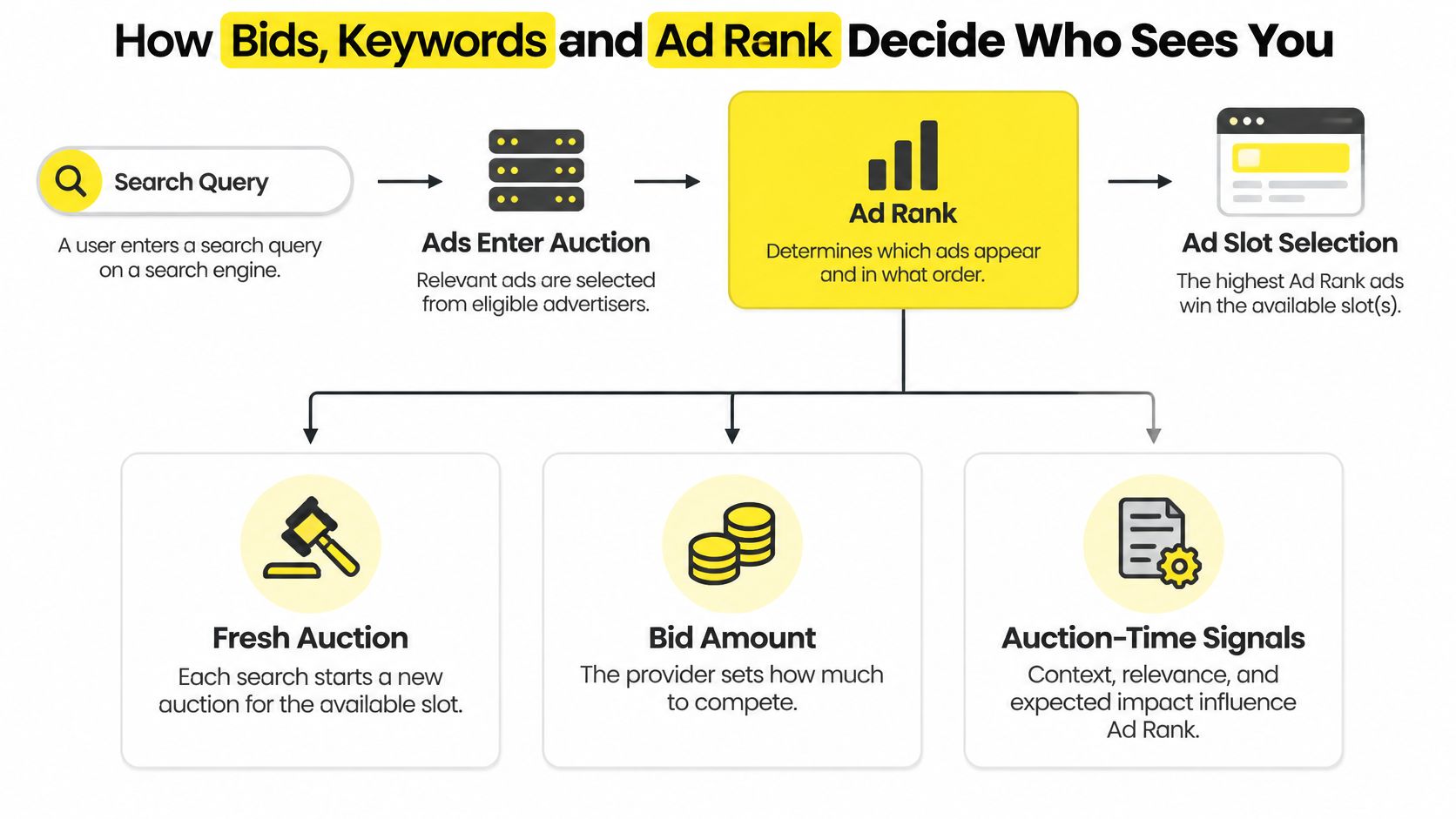
Each eligible search starts a fresh auction. Your provider isn't buying a permanent position; they're competing for an opportunity to show an ad in that moment.
The highest bid doesn't automatically win. The U.S. Department of Justice's description of Google's auction identifies bid amount, expected click-through rate, ad relevance, landing-page experience, and other signals as inputs to Ad Rank, with thresholds that can prevent an ad from appearing at all.
The auction works through several connected decisions.
Intent comes before keyword volume
Separate branded, non-branded, product, and high-intent category searches. Someone searching for your store by name presents a different acquisition opportunity from someone discovering furniture retailers for the first time.
For a furniture store, leather sofa sale near me suggests shopping intent. What is a sofa suggests an information need. Giving both searches the same budget and destination makes it harder to understand what the campaign is accomplishing.
For retailers, product information matters alongside search intent. Grumspot's guide to optimising Shopping ads for Shopify stores is a useful companion when reviewing product-feed and Shopping campaign work.
Match types trade reach for control
Broad match can reach searches related to the keyword's meaning. A keyword such as leather sofas could potentially reach comfortable living room couch, making conversion quality and search-term reviews especially important.
Phrase match gives more direction around the keyword's meaning, while exact match focuses more narrowly on the same meaning or intent. Neither should be treated as a literal character-by-character restriction. A search such as leather couches can still express the same intent as leather sofas.
Use examples from the actual search terms report to judge the provider's choices. A match type isn't good or bad independently of the traffic it brings.
Exclusions and bids need business rules
Negative keywords exclude unwanted searches. A furniture retailer might exclude jobs or free, but DIY isn't automatically wasteful for a business selling repair supplies. Apply exclusions according to the offer, not a copied universal list.
Bid strategies need equally clear reasoning:
Manual CPC: The manager sets click bids, accepting more hands-on control and maintenance.
Maximize conversions: The platform seeks more recorded conversions within the budget, making the conversion definition critical.
Target CPA: The provider sets an acquisition-cost objective informed by reliable conversion history.
Target ROAS: The platform needs meaningful conversion values, not identical placeholder values assigned to every lead.
There's no responsible universal conversion-volume promise for every account. Ask what signal volume, reporting delay, and budget the proposed strategy needs.
Practical rule: Diagnose relevance before assuming that a higher bid is the cheapest fix.
Competitors with different bids can occupy different positions because their auction-time quality signals differ. Treat Quality Score as a diagnostic, not a customer-acquisition goal, and expect reporting to connect the query, ad, and destination page rather than stopping at cost per click.
Landing Pages and Tracking That Make Bids Smart
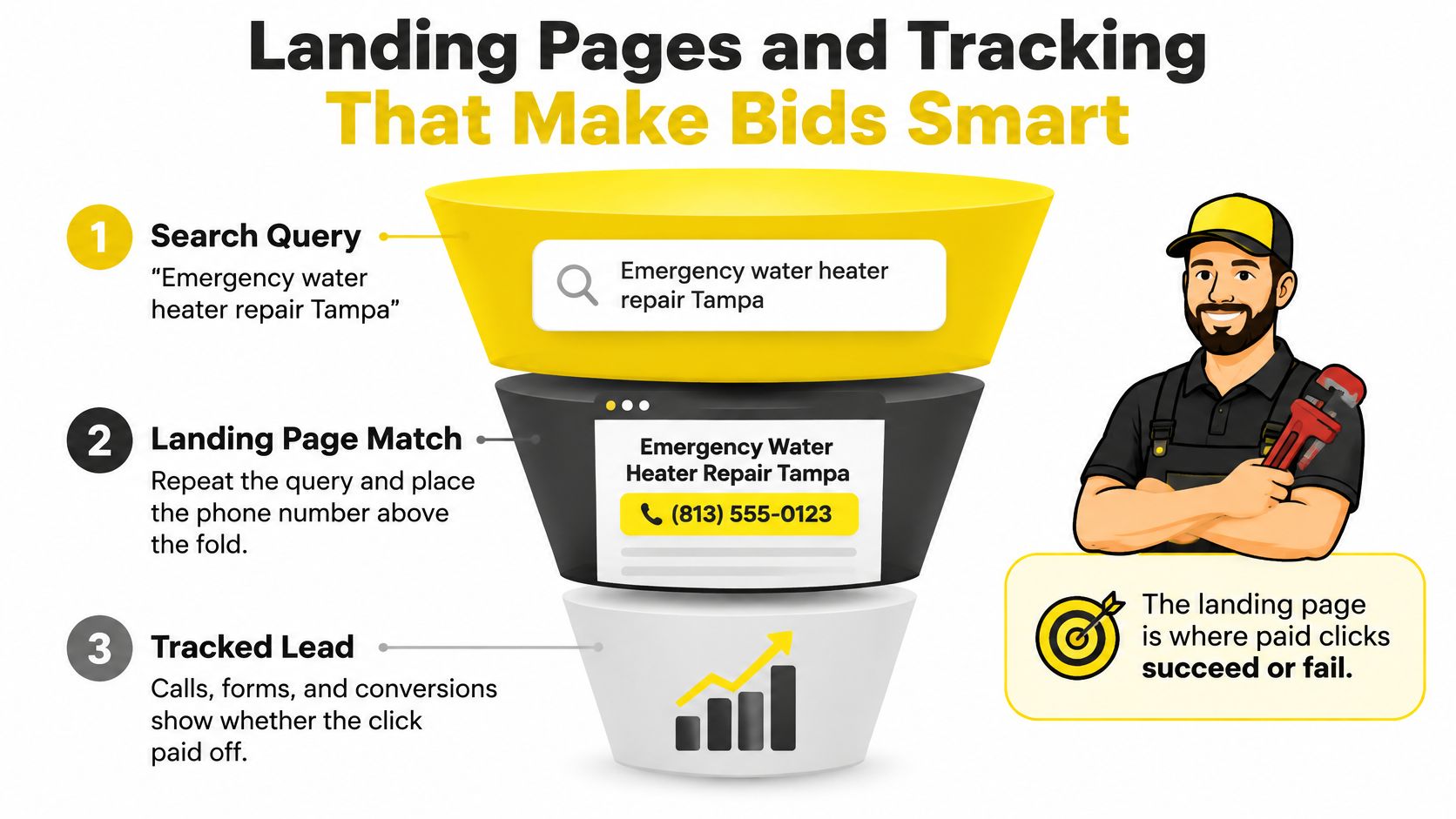
The landing page is where a paid click either becomes useful or gets wasted. For a plumber targeting emergency water heater repair Tampa, the page should immediately confirm that service and location, show a tappable phone number above the fold, and make the next action obvious.
Don't send that visitor to a general homepage with unrelated services and a buried contact form. Check the mobile experience yourself, including loading, form completion, and what happens after tapping the call button.
The path from search to contact should be easy to inspect.
Connect the page to the offer
A better button won't rescue an unclear service or an unbelievable promise. Our team optimizes the client's offer and guarantee, then builds a matching landing page and ad copy. The guarantee must reflect what the business can deliver.
Test meaningful alternatives, such as the offer, proof, form length, or booking process. CartBoss's guide to A/B testing for landing pages provides useful context for planning controlled page comparisons instead of changing everything at once.
Send customer quality back to bidding
Define a conversion hierarchy in the CRM: lead, qualified lead, booked appointment, opportunity, and closed revenue. Keep those stages distinct so a form submission doesn't get mistaken for a sale.
According to Google's enhanced conversions documentation, enhanced conversions use first-party information hashed with SHA-256 before transmission, match it with signed-in users who interacted with ads, and may require up to 30 days of training before reporting impact becomes visible.
For offline outcomes, connect CRM updates to Google Ads using supported first-party identifiers and stable event IDs. Use consistent timestamps and deduplication so repeat imports don't create extra conversions.
Reliable downstream signals let the bidding system distinguish inexpensive inquiries from people who become valuable customers. We use tracking and AI technology to shift ad spend toward the best areas and platforms, making signal quality a practical management concern.
Before increasing spend, test the complete chain:
Consent: Confirm that collection and transmission follow the consent choices recorded.
Hashing: Verify the implementation handles customer identifiers correctly.
Event quality: Submit a test lead and confirm it appears once.
CRM mapping: Check that qualified, booked, and closed statuses trigger the intended events.
Reconciliation: Investigate gaps between analytics, Google Ads, and revenue records.
Pricing Models and What Each One Costs
Keep media spend and management fees separate. Google receives the advertising budget; the provider receives payment for managing the work. Landing pages, creative production, software, and implementation can add separate charges.
There isn't a defensible universal monthly price without knowing the scope. Compare the billing rules and request a written quote with inclusions, exclusions, and minimum commitments.
Paid search pricing models compared
Model | How You Are Billed | Typical Monthly Cost | Best Fit | Watch Out For |
|---|---|---|---|---|
Percentage of ad spend | A share of managed media spend | Agreed percentage multiplied by spend, subject to any minimum | Accounts where management scope grows with budget | Fees increase even when results don't |
Flat monthly retainer | Fixed payment for defined work | Contracted retainer for the stated scope | Predictable budgets and deliverables | Extra charges when scope expands |
Performance-based | Payment per agreed outcome or revenue share | Qualified outcomes multiplied by the agreed rate | Businesses with reliable CRM records | Paying for weak or disputed conversions |
Hybrid | Base fee plus a variable charge | Retainer plus the contracted spend share or bonus | Accounts seeking shared incentives | Unclear bonus calculations |
One-time audit | Fixed-price account review | Scope-based project fee, not recurring management | Teams implementing recommendations internally | Recommendations without implementation |
Compare the total bill, not the headline fee
Consider a hypothetical quote, not a market benchmark. A monthly media budget of $5,000 with a 15% management fee produces a $750 fee. A $1,500 flat retainer on that same budget equals 30% of media spend.
Under those hypothetical terms, the fees become equal at $10,000 of monthly media spend. The flat retainer becomes cheaper only above that point, assuming neither provider changes scope or applies other charges.
The cheaper quote still isn't necessarily better value. It might exclude landing-page edits, CRM integration, or the search-term reviews needed to keep the account useful.
Inspect incentives and extras
A percentage fee rewards higher spending unless the agreement also defines management responsibilities. Performance billing can reward low-quality volume unless qualified leads, duplicates, existing customers, cancellations, and disputed outcomes are explicitly addressed.
For hybrid arrangements, name the bonus metric and the system used to calculate it. Prefer an agreed business outcome over a platform metric that the provider can improve without increasing profit.
Software also deserves a separate line. Docket's breakdown of Semrush costs for demand generation teams can help you evaluate a proposed research-tool expense rather than assuming every subscription belongs on your bill.
Discuss minimum spend, notice periods, and contract length before signing. Ask the provider to explain whether your budget can support the proposed campaign structure and enough useful conversion signals, rather than spreading limited spend across too many tests.
A low fee is only a saving when the work left out doesn't cost you more elsewhere.
Realistic ROI and What Results Look Like
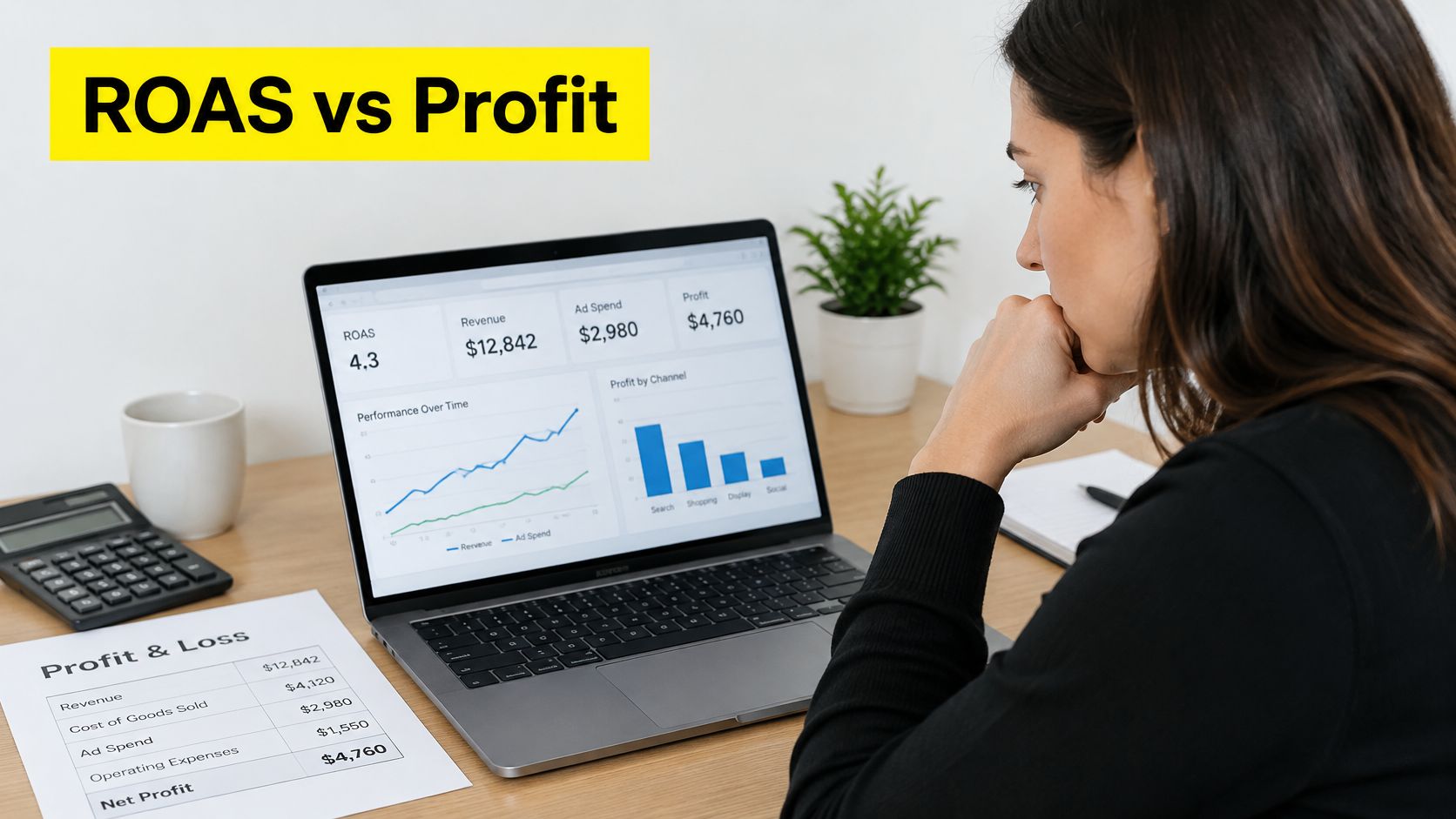
ROAS measures attributed revenue per advertising dollar. It doesn't measure profit. Product costs, fulfillment, management fees, refunds, and sales effort can turn an attractive revenue ratio into a disappointing business result.
Review advertising performance alongside the financial records, not in isolation.
There's another distinction: attributed revenue isn't necessarily incremental revenue. Branded searches and repeat buyers can receive advertising credit even when those customers would have purchased without the ad. Google's measurement updates promote incrementality experiments, marketing-mix modeling, attribution, and first-party data as complementary ways to assess marketing impact.
Chasing the lowest reported acquisition cost can therefore work against growth. A provider might concentrate on customers already close to buying while cutting discovery campaigns that introduce new customers.
Incrementality test methods compared
Method | What It Measures | Typical Duration | Needs |
|---|---|---|---|
Geo experiment | Difference between comparable regions with and without advertising | Set before launch using expected volume and sales lag | Comparable regions, sufficient spend, and controlled changes |
Conversion-lift test | Additional conversions caused by advertising within the platform's experiment | Platform eligibility and statistical requirements determine the window | Sufficient eligible conversion volume |
Holdout | Difference between exposed and deliberately unexposed groups | Long enough to observe the relevant buying cycle | A stable audience and enforceable exclusion |
Marketing-mix model | Estimated channel contribution using aggregated historical records | Long-term analysis | Consistent historical data and meaningful variation in spending |
Choose the method that the account can realistically support. A small local business shouldn't pay for a complex model when it lacks enough reliable history, and an uncontrolled pause isn't automatically a valid experiment.
Define the decision before testing: whether to increase non-branded spend, reduce brand coverage, or change the channel mix. Account for promotions, seasonality, capacity limits, and conversion delays so those changes don't get mistaken for advertising effects.
Read call costs through customer economics
Our custom LED landscaping business client received $35 per qualified call through Google Ads. An Orlando, Florida barbershop client received qualified calls at $3 each, with more than 500 calls generated locally.
Those figures describe acquisition activity, not the full profit calculation. The following client-results video offers additional context for evaluating provider examples.
For a hypothetical calculation using the landscaping call cost, suppose one in four qualified calls becomes a customer. That makes advertising cost per customer $140. If that customer contributes $240 after direct delivery costs, $100 remains after media cost, before management fees and other overhead.
Change the close rate or customer contribution and the conclusion changes. A qualified call is only commercially useful if the business answers it, follows up, and can profitably deliver the work.
These are client results reported by one provider, not category-wide benchmarks or guarantees. Request comparable measures for your own business, including the qualification definition, closed sales, contribution after direct costs, and whether management fees are included.
KPI Benchmarks to Judge Performance
Separate activity metrics from efficiency metrics and business outcomes. Click-through rate and click cost describe traffic; acquisition cost and ROAS describe reported efficiency; qualified revenue, gross profit, and new-customer share describe commercial performance.
Universal numerical benchmarks can conceal more than they reveal. Use the account's comparable history and customer economics as the reference, separating campaign types and conversion definitions.
Paid search KPIs with reference ranges and red flags
KPI | What It Tells You | Rough Reference Range | Red Flag |
|---|---|---|---|
Click-through rate | Share of impressions producing clicks | Compare equivalent branded or non-branded query groups | More clicks without more qualified demand |
Conversion rate | Share of visits producing the defined action | Use the same event, page type, and device as the baseline | A sharp decline after page or offer changes |
Average cost per click | Advertising cost per click | Compare similar intent, location, and competition | Click costs rise while qualified outcomes stay flat |
Cost per acquisition | Ad cost per customer or qualified lead | Stay within an allowable cost derived from contribution | Acquisition cost exceeds the customer's economic value |
Return on ad spend | Attributed revenue per ad dollar | Exceed the account's fully costed break-even requirement | Reported ROAS rises while profit falls |
Impression share | Share of eligible impressions won | Set coverage goals according to profitable demand | Rank losses on valuable searches despite available budget |
Quality Score | Keyword-level diagnostic of expected performance | Investigate weaker high-spend keywords against their components | Chasing the score instead of fixing commercial results |
Calculate the business threshold
For a simplified media-only calculation, break-even ROAS equals one divided by gross margin, when gross margin is expressed as a decimal. This leaves out management fees, overhead, and any costs not already captured in that margin.
As a hypothetical example, a 40% gross margin gives a media-only break-even ROAS of 2.5. That isn't a recommended target; it's the point at which the stated margin would cover media spend before the excluded costs.
For lead generation, work backward from customer contribution and close rate instead. Keep estimates conservative until the CRM shows what qualified leads become.
Read the metrics together
A rising click-through rate alongside a falling conversion rate can indicate broader, less useful traffic. It can also reflect a broken form, changed offer, or misleading headline, so check the underlying cause before rewriting the ads.
Use a short investigation sequence:
Segment first: Separate brand, non-brand, Shopping, device, and location.
Verify the event: Confirm that tracking hasn't changed or failed.
Inspect customer quality: Check qualification, booking, close rate, and cancellations.
Choose the response: Adjust targeting, page experience, follow-up, or budget according to the problem.
Better-looking averages aren't progress if the business keeps less money from the customers acquired.
Review trends over a window that accommodates your buying cycle and reporting lag. Comparing incomplete recent sales with mature historical results can make a healthy campaign look weak, or hide deteriorating lead quality.
Choosing a Provider and Answering Buyer Questions
Choose a provider by the decisions they can explain and the work they'll own. A polished dashboard matters less than a clear answer to what happens when leads look inexpensive but don't close.
Your comparison should cover access, evidence, responsibilities, and exit terms. Use the same checklist with each candidate so presentation quality doesn't substitute for substance.
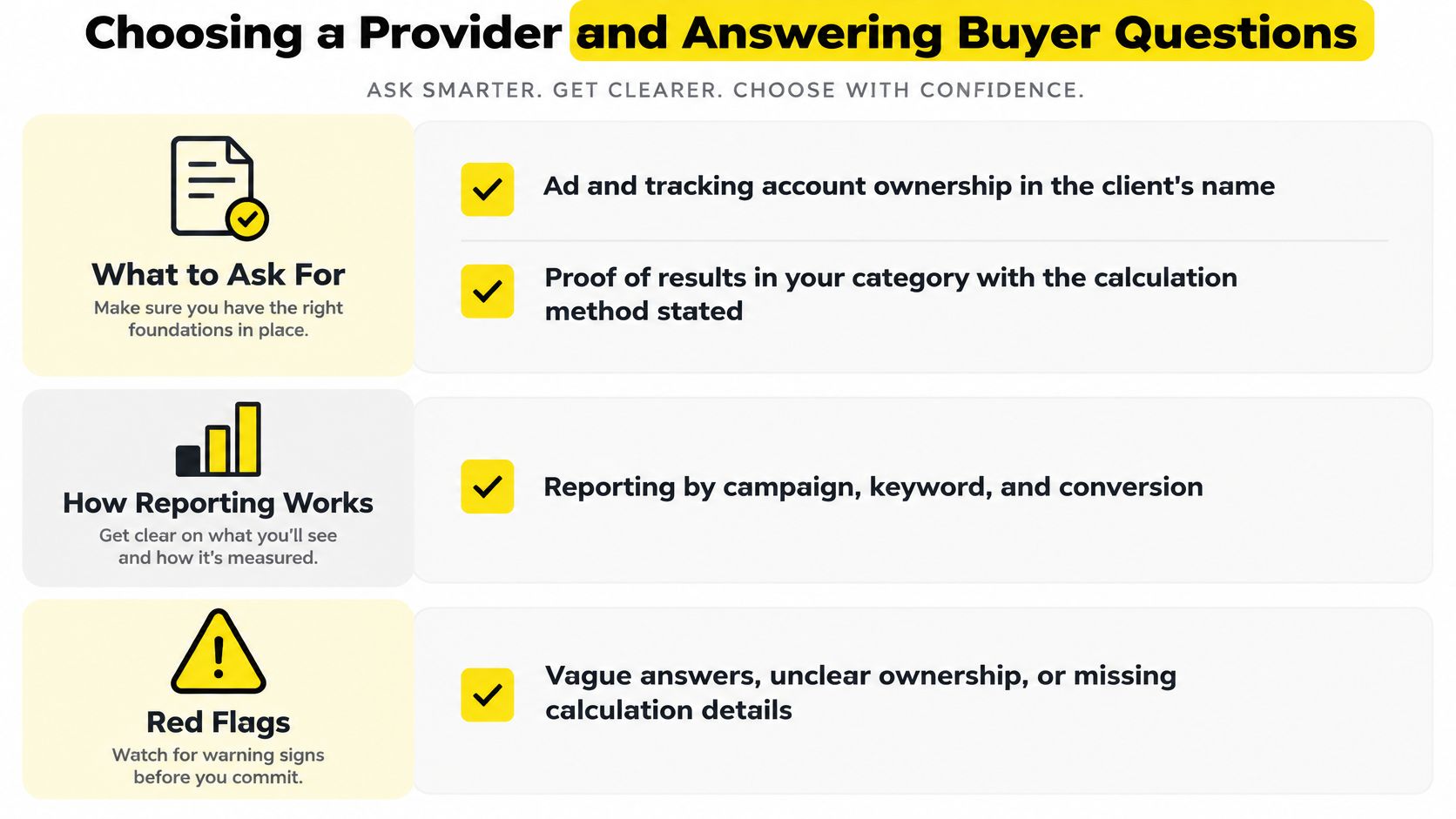
What to request before signing
The strongest proposals identify deliverables and owners, not just services.
Client-owned accounts: Keep advertising and tracking accounts in your business's name, with appropriate administrative access.
Comparable evidence: Request results from a relevant business model, with the calculation method and conversion definition stated.
Reporting detail: Require campaign-type reporting and placement or surface detail where available.
Search-term maintenance: Agree on a recurring review cadence and how negative-keyword decisions are documented.
Tracking validation: Make an early conversion audit a written deliverable, with a named owner and completion date.
Incrementality planning: Specify a feasible test, its limitations, and the budget decision it should inform.
Implementation ownership: Name the person responsible for landing-page edits, approvals, and technical changes.
Search placements also need current scrutiny. Google's guidance on advertising in AI-driven search experiences describes expanded ads in AI Overviews and testing in AI Mode, with eligible Search, Shopping, and Performance Max campaigns participating in these surfaces.
Broader intent matching makes destination relevance and post-click qualification important. Ask which surface-level results are available, which are unavailable, and how the provider will avoid presenting blended performance as precise placement evidence.
What to check in the contract
Read the notice period, initial commitment, renewal language, and handover obligations. A longer commitment should have a clear operational reason, not just make it difficult to leave.
For performance billing, specify the exact chargeable event and the authoritative record. Include how duplicates, spam, existing customers, refunds, cancellations, and attribution disputes are handled.
Also document who owns landing pages, creative files, tracking configurations, and reporting assets. Account ownership alone doesn't guarantee that every asset used in the campaign transfers at exit.
Red flags deserve direct answers:
Guaranteed rankings: No provider controls every auction or competitor.
Activity-only reporting: Clicks and impressions don't establish profitable acquisition.
Restricted access: You shouldn't need permission to inspect an account funded by your business.
Unexplained fee increases: Higher spend should come with a clear account-management scope.
Unassigned work: Recommendations aren't deliverables when nobody is responsible for implementing them.
Managed service, coaching, or in-house
A managed provider operates the account and performs the agreed work. A coach advises your team, leaving your staff responsible for implementation, monitoring, and follow-through.
Our services are done for the client and bolted onto the client's existing brand and business. That operating model differs from purchasing advice that your employees must turn into campaigns.
In-house management offers closer access to sales and operations, but the workload doesn't disappear. Someone still needs tracking skills, time for search-term reviews, authority to change pages, and a testing budget.
Answers to common buyer questions
Should you use an agency or hire in-house?
Choose according to the work you can reliably staff. An agency can provide specialist execution without a dedicated internal team, while an in-house operator may fit a business with enough ongoing complexity and internal support. Include engineering, design, analytics, and sales coordination in the comparison, not just the campaign manager's cost.
Does paid search replace SEO?
No. Paid search provides controllable access to eligible advertising opportunities while spending continues; SEO develops organic visibility. Search-term and customer-language insights can inform both, but buying ads doesn't remove the need for useful website content.
How long should you allow before judging results?
Agree on a baseline, learning allowance, and sales-cycle-aware review window before launch. Judge qualified outcomes only after the relevant cohorts have had time to mature, while investigating broken tracking, irrelevant traffic, or missed calls immediately. A learning period isn't an excuse to leave preventable problems untouched.
How do you exit without losing the work?
Review ownership and export permissions before giving notice. Preserve accessible search-term reports, campaign settings, conversion reports, creative files, and documentation, then verify that tracking and CRM integrations will continue functioning. Historical reports can be exported, but not every platform history or learning signal can be transferred into a different account.
Shortlist providers using the same written requirements. Compare their proposed reporting with your economic thresholds, review a sample report, and book a discussion about the actual account before committing budget.
Wojo Media offers done-for-you paid advertising support that connects your offer, landing pages, ad copy, and backend KPIs. Visit Wojo Media to book a free demo call with Jason or a growth manager and start building a custom paid ad strategy around qualified customers and profitable acquisition.
Comments