
Real Estate Marketing for Agents That Close

Social media was named one of the top lead-producing tools by 52% of REALTORS® in the NAR 2024 Technology Survey, ahead of CRM systems at 32% and local MLS tools at 26%. That ranking doesn't show which campaigns lead to signed agreements. Judge each channel by closings, factoring in lead quality, response time, and sales-cycle length, rather than popularity, likes, or cheap form fills.
Why Buyers Still Hire the Agent They Find Online
88% of home buyers purchased through an agent or broker, and 91% of sellers used an agent, according to the National Association of REALTORS® 2025 Profile of Home Buyers and Sellers. Only 5% of sellers sold without representation, a record-low share for for-sale-by-owner transactions. Online search helps people find properties and professionals. An agent still helps them price, negotiate, and manage risk.
People do check listings on their own, then ask an agent what those listings mean. A home's asking price, photos, and description show only part of the decision. Buyers need help interpreting the trade-offs and deciding what to do next.
Two Jobs, Not One
Your marketing works like a shop window followed by a conversation. Listings, photos, video, and educational posts make your work visible and show that you know the local market. The consultation is where you explain what a price may conceal, what an inspection could reveal, and where negotiation room may sit.
Start with visibility. Searchable listings, short video answers, reviews that name the town, and strong listing images help people find you. If your photos look flat, advice on lighting, lenses, and angles can improve the presentation. These equipment tips for property photography can help you strengthen that part of your marketing before spending on ads.
Then turn attention into a conversation. Someone who liked a reel still needs a clear reason to contact you, proof that you can help, and a specific, timely reply. The goal is a useful discussion that can lead to a signed agreement, not an anonymous traffic count.
A listing proves a house exists. Your marketing has to prove why you're the person to interpret it.
Where Agent Leads Actually Come From
The 2024 National Association of REALTORS® Technology Survey ranked social media first as a technology source of quality leads, followed by customer relationship management systems and local multiple listing services. The survey was conducted in May 2024 from a random sample of 46,625 active REALTORS®, producing 1,007 usable responses, with a margin of error of plus or minus 3.05 percentage points at a 95% confidence level.
Channel | Survey figure | Job in the system | KPI to keep |
|---|---|---|---|
Social media overall | Ranked first as a technology source of quality leads | Discovery, not the whole pipeline | Lead-to-appointment rate |
87% of agents use it | Broad local discovery and paid social | Cost per booked consult | |
62% of agents use it | Visual proof and retargeting | Lead-to-appointment rate | |
48% of agents use it | Investors and relocation outreach | Qualified conversations | |
YouTube | 25% of agents use it | Education and remarketing | View-to-consultation rate |
TikTok | 15% of agents use it | Attention with newer buyers | Cost per qualified lead |
CRM | Ranked second as a technology source of quality leads | Organize and nurture a long cycle | Speed to contact and stage conversion |
Local MLS | Ranked third as a technology source of quality leads | High-intent listing visibility | Inquiry-to-appointment rate |
What Each Row Is Really Telling You
Facebook and Instagram can introduce your name to local buyers and sellers through a just-sold post, a price explainer, or a home tour. That attention becomes a lead only when someone takes a next step, such as requesting information or booking a conversation.
LinkedIn serves a narrower audience, including relocating professionals, lenders, and investors. YouTube gives you room to explain a neighborhood or a buying decision in more detail, while TikTok can attract attention from newer buyers. For any of these channels, the key question is whether the people who respond fit your business and are likely to move forward.
A CRM is not a source of attention. It keeps a prospect's details and follow-up history organized while they consider a move. An MLS inquiry often signals more immediate interest, so a slow reply can mean losing the chance to speak with that prospect.
Stop Scoring Channels by Volume
Practical rule: A channel with many inquiries can still underperform if few prospects book, sign, or close.
Compare sources by lead quality, response time, sales-cycle length, and eventual closings. Track lead-to-appointment rate, appointment-to-client rate, and cost per closing. Likes show that someone engaged with a post. A form fill shows that someone submitted a form. Neither proves the prospect is ready to work with you.
For example, Instagram might bring many low-cost valuation requests from people who rarely answer follow-up calls. MLS inquiries may take more time to handle, but if more of those prospects book a conversation and become clients, MLS is producing stronger results despite a lower lead count.
Start with one discovery channel you already use, one higher-intent source such as MLS visibility or search, and a CRM stage for every new contact. If sellers are your priority, build your real estate seller pipeline around the sources and follow-up steps that lead to signed agreements. Give each channel a clear job, then judge it by the closings it helps produce.
Offers and Pages That Turn Clicks into Consults
A weak offer asks a stranger to "contact us." A strong offer promises a specific answer. The agent in the image below is doing the unglamorous work prospects value, reviewing numbers and turning them into a decision.

Make the promise concrete. Offer a pricing consult with a written range, a buyer short list for one neighborhood, or a seller net sheet before a listing appointment. Each one tells the visitor what they'll receive, how long it takes, and why it's worth a phone number.
Build the Page Around One Action
Name the area in the headline. Show one proof point near the top, such as a recent sale, a review that mentions the town, or a credential the reader can verify. Say exactly what happens on the call, in plain order, so there's no mystery about pressure or obligation.
Keep the form honest. Ask only for fields you'll use in the first reply. Name, phone, email, town, and timeline usually beat a long questionnaire that feels like a loan application. Every extra field is a small tax on a mobile visitor who's already comparing you with two other agents.
Use this checklist before you send traffic anywhere.
One offer: A written range, a short list, or a net sheet, not a generic consultation.
One action: Book, request, or receive. Don't offer three buttons with equal weight.
One proof point: A sale, review, or credential placed where a skimmer sees it.
One location: The town or neighborhood in the headline, proof, and form confirmation.
No unused fields: If you won't read it before calling, remove it.
Separate buyer and seller pages. A seller who clicked "what's my home worth" shouldn't land on a buyer guide with a contact box. That mismatch is where paid clicks and organic visitors die. The headline must repeat the promise that earned the click.
The short video below is a useful prompt for checking whether your own page explains the process as clearly as you'd explain it across a kitchen table.
Pair the page with local search basics. Complete your Google Business Profile, keep the same name, address, and phone everywhere, build a page for each neighborhood you serve, and ask for reviews that naturally mention those places. SEO isn't a separate business. It's the same specific promise, made findable. Rewrite the weakest page today using the checklist, then test it on your own phone before you buy another click.
A Mobile Funnel Built for a Ten Week Search
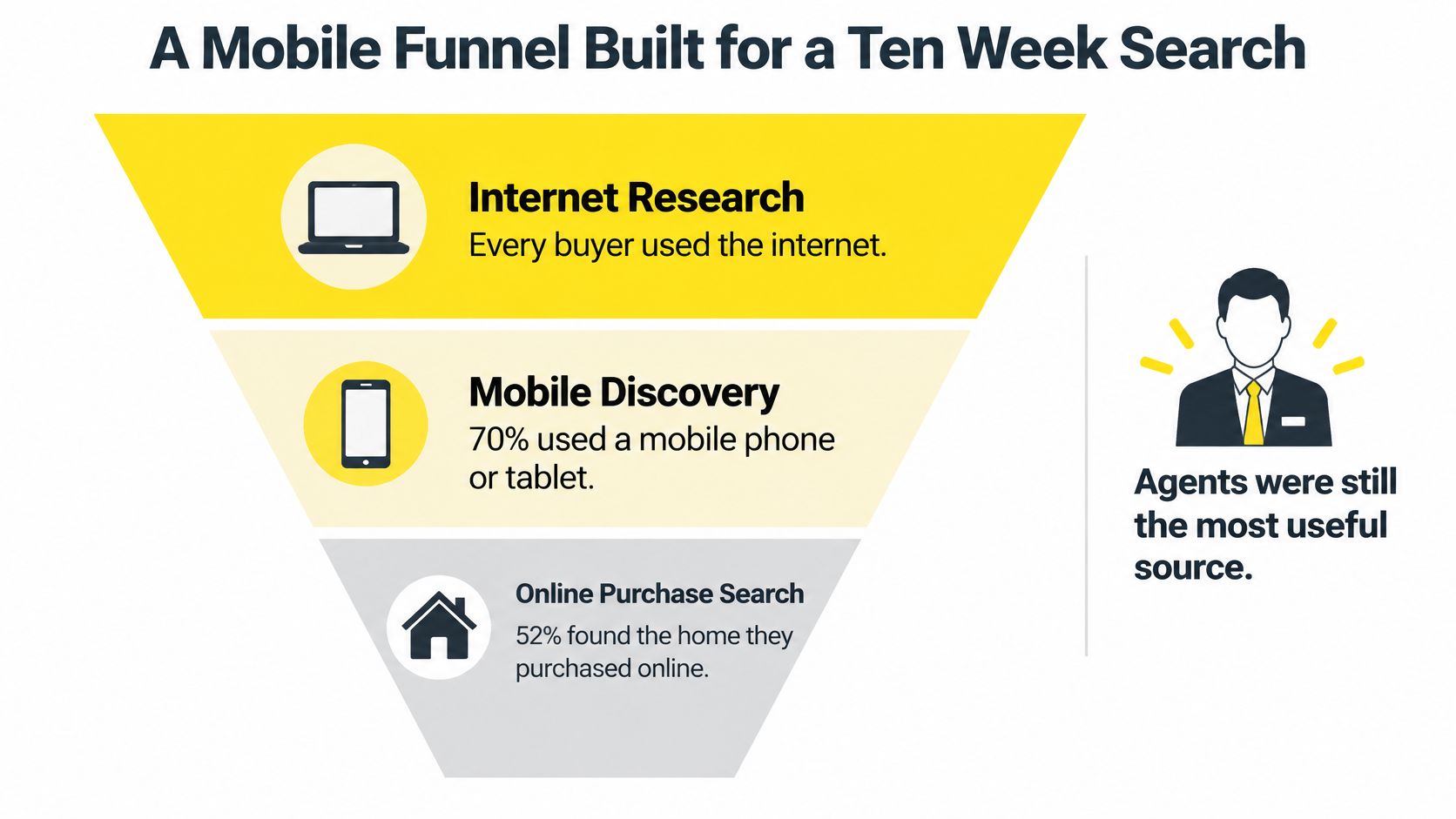
Design for the phone in the buyer's hand, not the desktop in your office. NAR's 2025 buyer research reports that every buyer used the internet during the search process, 70% used a mobile phone or tablet, and 52% found the home they purchased online, while buyers rated agents as the most useful information source overall. The roughly 10-week median search period in that research changes how you should read a click. Most clicks are visits, not decisions.
Start With a Searchable Local Question
Your ad or post should answer something a person would type or tap. Neighborhood-level pricing works because it's specific. So does an inspection risk common in older homes in one town, a financing scenario at a stated price point, or what a comparative market analysis shows beyond an automated estimate.
Don't lead with a listing dump. Property access is easy to copy. Interpretation isn't. A short creative that says, in effect, this is what this price band buys in this neighborhood and here's the catch, gives the viewer a reason to want your judgment.
Think of the ad as a doorbell. It gets attention at the front step. The page and follow-up are the conversation inside, where trust is built or lost.
Send that click to a fast mobile page with one measurable next step. Schedule a consultation, request a valuation, or receive a curated listing set. If the page loads slowly, hides the button, or asks for a long form on a small screen, the doorbell rang and nobody answered.
Connect Every Field Before You Judge the Campaign
In your CRM, connect campaign, keyword, device, landing-page conversion, booked consultation, signed representation agreement, and closed volume on the same record. Without that chain, you'll optimize for whatever the ad platform can see, which is usually the cheapest early action.
Campaign and keyword: Which promise attracted this person.
Device and page: Whether mobile visitors converted or bounced.
Consultation and agreement: Whether attention became a working relationship.
Closed volume: Whether the budget produced revenue, not just appointments.
Use retargeting across the search to answer the next question, not to repeat the same house photo. Week one might explain price bands. A later touch can show a review from the same town, clarify inspection timelines, or invite the viewer to compare two neighborhoods on a call. Each retargeting message should move the conversation one step forward.
Then apply the budget rule. Move money toward audiences and messages that produce qualified conversations, appointments, and signed agreements. Cut the creative that wins cheap form fills but never reaches a consultation. A ten week search rewards agents who stay useful, trackable, and patient, not agents who shout the same listing the loudest.
The Five Minute Follow Up System
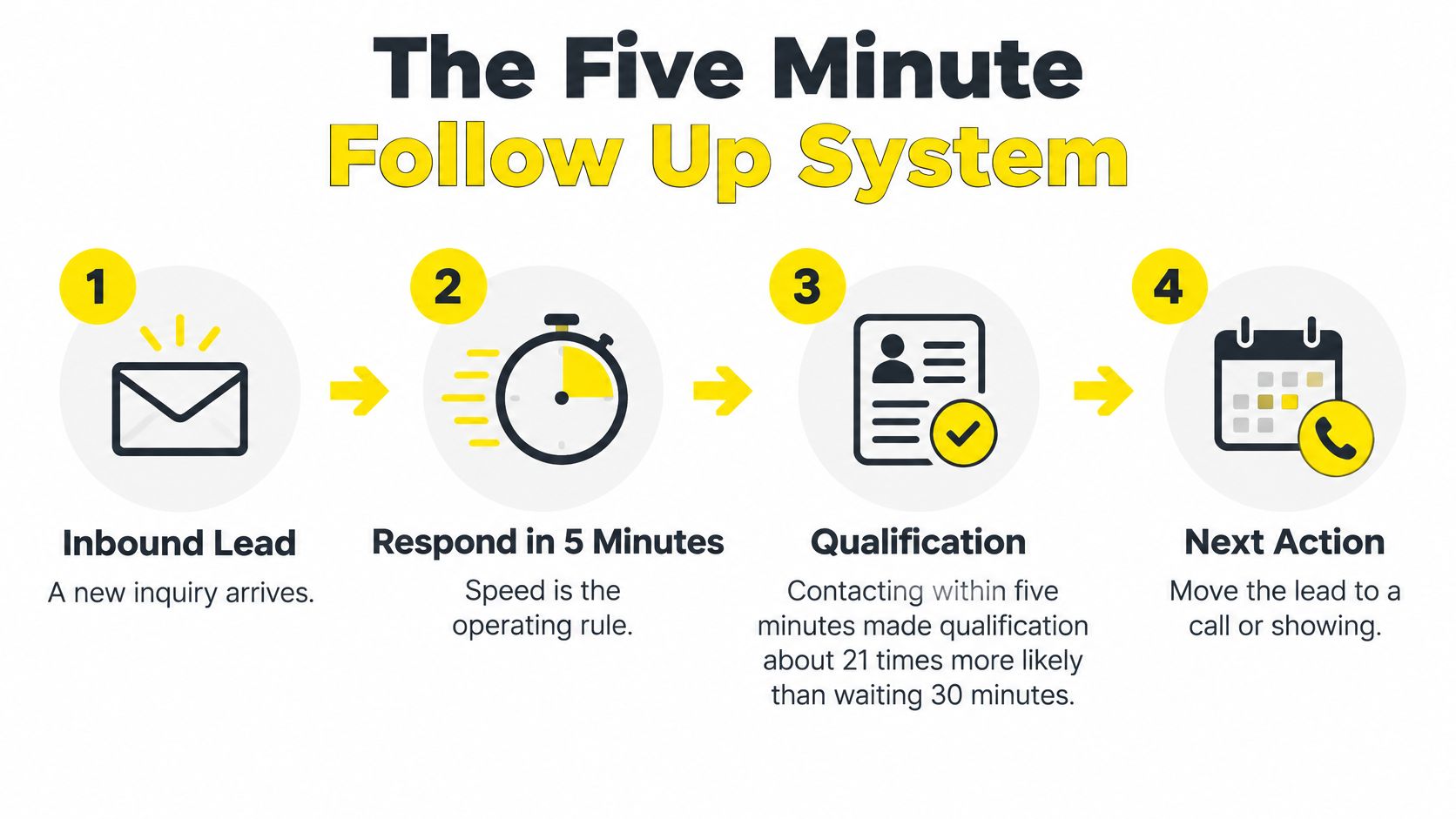
An online inquiry can cool while an agent is showing a home. A quick, relevant response gives the prospect a chance to speak with you while their question is still top of mind. A lead-response analysis comparing contact within five minutes with a 30-minute wait found that contacting an inbound lead within five minutes made qualification approximately 21 times more likely. The same source reports that 43% of buyers found their agent through a friend, neighbor, or relative. A prompt reply should still give prospects a clear reason to trust you, such as local knowledge or client reviews.
Run the Sequence the Same Way Every Time
Log the inquiry: Send the form to your CRM with its source and campaign tags, and assign a call task.
Confirm receipt: Send an SMS or email acknowledging the request and offering two appointment times.
Call with context: Use the details in the form to open a relevant conversation rather than making a generic check-in.
Try again promptly: If the prospect misses your call, make another attempt and send a short text.
Record response time: Log whether the first attempt took 0–5 minutes, 5–30 minutes, 30–120 minutes, or longer.
Automation can confirm receipt, while a person handles the conversation. If you're at a showing, an AI phone answering service can help keep an inquiry from sitting unanswered until you are free to respond.
Response band | What the data implies | First action | Metric to log |
|---|---|---|---|
0–5 minutes | Contact within five minutes made qualification about 21 times more likely than waiting 30 minutes | Confirm the request, offer two times, then call | Contact rate |
5–30 minutes | Still much faster than a 30-minute wait, but qualification odds keep falling as the gap grows. | Call immediately using the form details | Qualification rate |
30–120 minutes | The prospect may be less ready to talk, but a follow-up can still start a conversation | Call with a short script, then send an SMS | Appointment rate |
Later the same day or after | Follow up with useful information, then track whether the prospect engages | Send a relevant update with local proof | Representation agreements |
Compare each response band by contact rate, qualification rate, appointments, signed representation agreements, and closed gross commission income. A lead source that produces inexpensive forms may still be a poor investment if few prospects answer, book, or sign. Judge it by closings, while accounting for lead quality, your response time, and the length of the sales cycle.
Nurture After the First Call
Send the promised item on the same day: a written price range, a short list of homes in one neighborhood, or a seller net sheet. On day three, follow up with a relevant local proof point. In week two, share a market note tied to the prospect's original question. After that, check in every two weeks with one clear next step until the person books, asks to stop, or is marked closed-lost.
Keep the source and campaign tags on each follow-up, and stop the sequence when a consultation is booked. Review the response times for your latest inquiries to see where delays are costing you conversations.
Campaign Patterns for Buyers Sellers and Investors
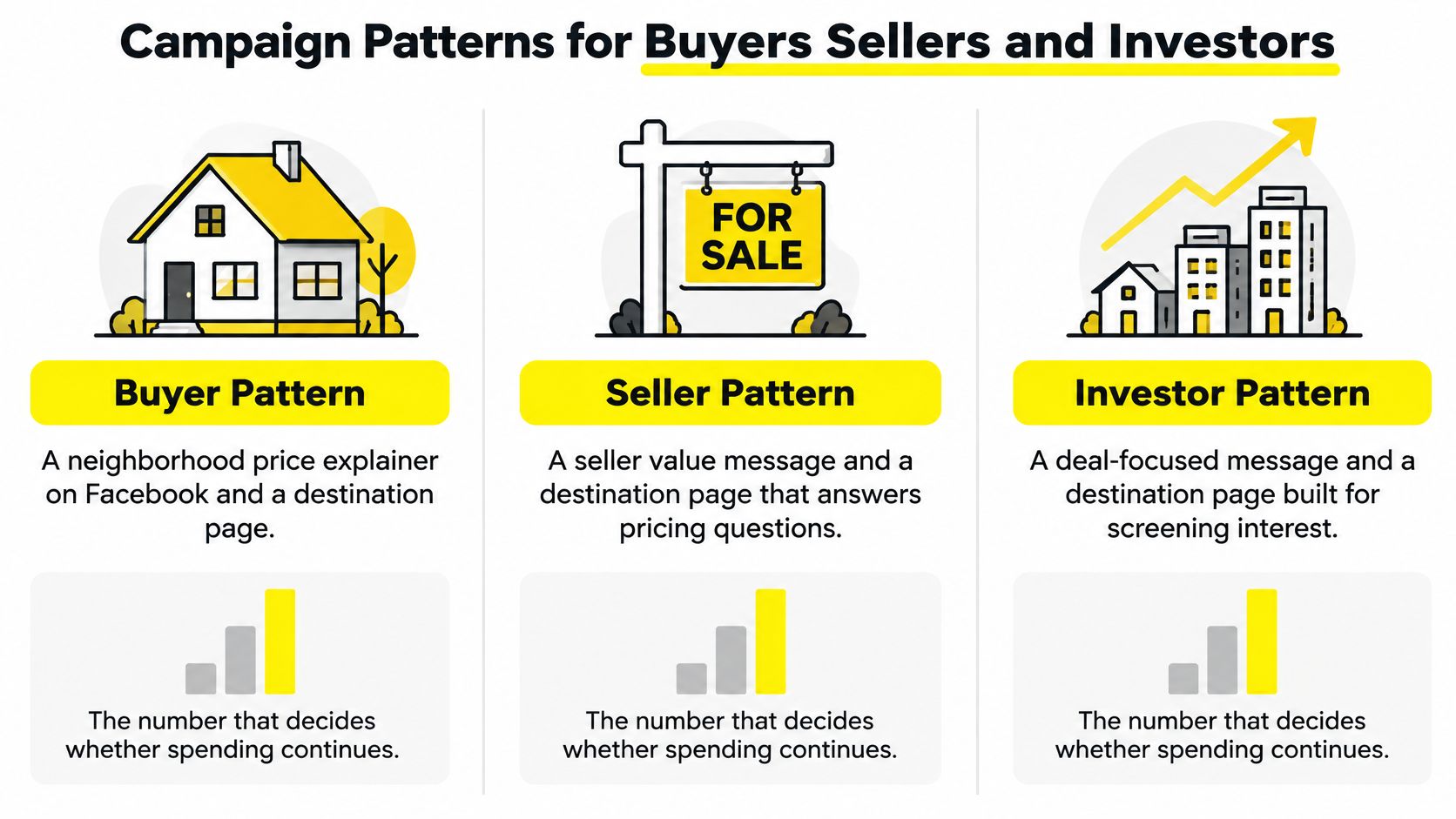
Copy the pattern, not another agent's post. Each sketch below has an audience, a hook, a destination, and one number that decides whether spending continues.
Buyer Pattern
Say you serve one suburb where buyers keep asking why similar homes sell at different prices. Run a neighborhood price explainer on Facebook and Instagram. Keep it plain. Show two recent sales, name the street-level reason for the gap, and invite viewers to receive a short list that matches a stated budget.
The destination page asks for the neighborhood, price range, and timeline, then offers a consultation. Retarget viewers on YouTube with a longer walkthrough of what that budget buys, plus a review from a buyer in the same town. The search can stretch for weeks, so the second video should answer a deeper question, not repeat the first hook.
Keep metric: booked consultations. Views don't pay for the campaign. This pattern fails when the creative only shows a pretty house and attracts people who enjoy looking but won't answer a call. If watch time is high and consultations are flat, the page promise is too vague or the audience is too broad.
Seller Pattern
A seller pattern starts closer to intent. Search ads around what a home is worth in a named town should send the visitor to a valuation page for that town. The page offers a written range and explains, in two or three sentences, what you'll check before you give it, such as condition, recent comparable sales, and likely buyer demand.
Put referral proof in the creative. Many clients still choose an agent a friend named, so a review that mentions the neighborhood and the result does more work than a slogan about service. Show your face, your name, and your local record where the homeowner is deciding whether to trust the form.
Keep metric: qualified valuation calls that become listing appointments. This pattern fails when the seller lands on a generic contact form. Intent dies in the gap between "tell me what it's worth" and "leave a message." If clicks are strong but calls aren't qualified, tighten the town, the price band, or the promised deliverable.
Investor and Relocation Pattern
For investors or relocation buyers, use LinkedIn or search around one submarket. Offer a short market note that covers rents, vacancy pressure in plain language, typical buyer competition, and the property type that fits the stated budget. Don't promise returns. Promise a clear screening conversation.
The page should ask for budget, target area, and timeline before it offers a call. That small friction is useful here because an unqualified download teaches you nothing. A person with a budget and a date is a conversation you can plan around.
Keep metric: conversations with a budget and a timeline. This pattern fails when the lead is saved with a blank source tag. Months later, a closing can't be credited to the campaign, so you cut the very channel that worked. Tag the record at entry, every time.
Limit the test. Run one pattern for 30 days, read appointment rate and cost per signed agreement, and only then add another audience. Three half-measured patterns teach you less than one pattern with clean tagging.
Audit Your Pipeline Before You Scale Spend
Before you raise spend, score the last 30 days on four CRM fields. Check source, response band, appointment rate, and whether the lead reached a signed representation agreement. Then pull your last three closings or listing appointments and write down the channel, the minutes until the first human call, and whether the page offer matched the ad.
If those leads sit in the 30 to 120 minute band or later, fix the instant call task and the two-time text before buying more clicks. If inquiries arrive but appointments don't, replace the offer with one specific promise and remove every form field you won't use. If appointments happen but a closing can't be tied to a campaign, require source and campaign tags on every new name.
Add budget only after source, speed, page, and the path to a signed agreement are visible, and only on the one pattern whose cost per signed agreement is already known. Repair the slowest band, the mismatched page, or the blank source tag, then run that same pattern for another 30 days.
If your audit shows the offer, page, ads, and follow-up aren't connected, book a free demo call with Jason or a growth manager at Wojo Media to build a custom paid ad strategy for your market. On that call, Jason discusses your business, what's working, what could be improved, and best practices for scaling, drawing on a team that has scaled 1,320+ businesses over the past 6-7 years and generated over $145M online with paid advertising and sales systems.
Comments