.png)
How to Improve Lead Quality for Paid Ads

Most advice on lead quality starts in the wrong place. It tells you to change the audience, rewrite the ad, or lower cost per lead. Those adjustments can improve the dashboard while making the business less profitable.
A cheap form submission isn't the outcome you need. You need a prospect who fits your offer, can be reached, has a real reason to buy, and progresses toward revenue without consuming disproportionate sales time. That requires a system connecting offer, landing page, CRM, routing, qualification, and closed-won data. Ads create demand, but the backend teaches platforms which demand is worth buying.
Redefining Lead Quality Beyond the Form Fill
A campaign can produce an impressive volume of leads and still fail commercially. Sales representatives know this quickly. Their calendars fill with people outside the service area, shoppers without a realistic budget, contacts who didn't understand the offer, and submissions with no urgency. Marketing reports a healthy cost per lead, while sales absorbs the cost of sorting through records that never had a credible path to purchase.
The problem isn't always poor advertising. Often, the business has defined success too early in the funnel. A form completion proves that someone submitted information. It doesn't prove fit, intent, timing, accuracy, or buying authority.
Available benchmark research reports that 79% of marketing leads never convert into sales, while only about 13% of marketing-qualified leads advance to the sales-qualified stage (benchmark research on lead quality). Those figures explain why a low CPL can conceal weak economics. If the sales team must process a large volume of records to find a small number of viable opportunities, the apparent efficiency is incomplete.
Define quality before buying traffic
Start with the commercial definition of a good lead, not the form builder. A local service business may require a valid service area, the right job type, a usable phone number, and an appointment time the customer can attend. A B2B company may care more about company fit, role relevance, business need, and a credible purchasing timeframe.
Write objective rules for each stage:
Lead: A valid record with consent and usable contact information.
Marketing-qualified lead: A record that matches basic fit and shows relevant intent.
Sales-qualified lead: A prospect who meets the agreed criteria and warrants active sales attention.
Opportunity: A real commercial conversation with a defined next step.
Customer: A closed transaction recorded against the original source.
The labels matter less than consistency. Marketing and sales should agree on what moves a record forward, what sends it into nurture, and what disqualifies it. A practical qualification model often includes budget, need, timing, location, product or service fit, and purchasing authority.
Practical rule: If a qualification field doesn't change routing, follow-up, scoring, or reporting, question whether it belongs in the form.
This is also where stop weak-fit leads reaching sales becomes an operational objective rather than a slogan. Qualification should protect sales capacity while preserving viable prospects that aren't ready to buy today.
Measure the economics sales actually creates
Replace CPL-only reporting with a funnel view. Track the rate at which each source progresses from raw lead to qualified lead, opportunity, and customer. Then add cost per qualified opportunity, revenue per lead, sales effort, time to close, deal size, and lifetime value where the business can support those calculations.
A campaign producing fewer leads at a higher acquisition cost may still be the stronger campaign if its prospects close more often, require less follow-up, or produce more valuable customers. Conversely, adding form friction may reduce the front-end conversion rate and still improve profit. The correct question isn't, “Which campaign generated the cheapest submission?” It's, “Which campaign generated the most valuable outcome for the available sales and advertising capacity?”
Build reporting by campaign, creative, offer, landing page, audience, query, and first-touch source. Keep the original source attached to the CRM record even when a prospect later returns through another channel. Without that history, teams end up rewarding the last interaction and missing the acquisition conditions that created the opportunity.
Building a Revenue-Driven Data Architecture
Cheap form fills are not a growth signal. Ad platforms optimize toward the events they receive, so a Google Ads account that sees only submissions cannot separate profitable demand from low-intent curiosity.
Revenue feedback requires a connected system. Preserve identity and stage changes from the first click through the sale, then return meaningful outcomes to the ad platform.
Connect the click to the CRM record
Capture the advertising click identifier when someone visits the landing page and store it with the form submission. Preserve first-party identifiers, including email and phone, in the CRM according to consent and privacy requirements. Carry the source, campaign, ad, keyword or audience, landing-page variant, timestamp, and form context into the same record.
Define CRM stages with objective entry rules:
Lead: The submission passes basic validation.
Marketing-qualified lead: The record meets fit and intent requirements.
Sales-qualified lead: Sales confirms that active pursuit is appropriate.
Opportunity: A commercial opportunity exists with a defined next action.
Closed customer: The sale is recorded with its source and value.
Return qualified-lead, booked-appointment, opportunity, and closed-sale events to Google Ads as offline conversions. Google documents offline conversion imports for outcomes such as qualified phone or in-office leads and recommends Enhanced Conversions for Leads using first-party data in its offline conversion documentation. The documentation also describes the 90-day submission window for associated last-click conversions.
Keep the pipeline clean
No bidding strategy can compensate for unreliable conversion data. Normalize identifiers before upload, hash first-party data as required by the platform, and deduplicate events with stable event identifiers. Keep qualification definitions consistent during a test. If “qualified” means one thing in the CRM and another in the ad account, bidding reports point in the wrong direction.
Upload cadence matters. Conversions submitted more than 90 days after the associated last click will not be imported into conversion statistics. Delayed feedback leaves the algorithm optimizing against incomplete evidence, particularly when sales cycles are long. Set a regular upload process and monitor failures rather than treating imports as a one-time implementation task.
The communication layer can distort the same dataset. If lead notifications, confirmations, or nurture emails affect conversion, test deliverability with a free inbox placement test before blaming the audience or creative. A message that never reaches the prospect creates a delivery failure that can look like poor lead quality.
Start with a baseline comparing qualified-lead rate and cost per qualified lead by campaign, ad set, query, and landing-page variant. Shift budget only after identity matching is stable and sales confirms that the imported event represents a meaningful commercial outcome. That feedback loop lets bidding pursue customer value instead of submission volume.
Engineering Friction into Landing Pages and Forms
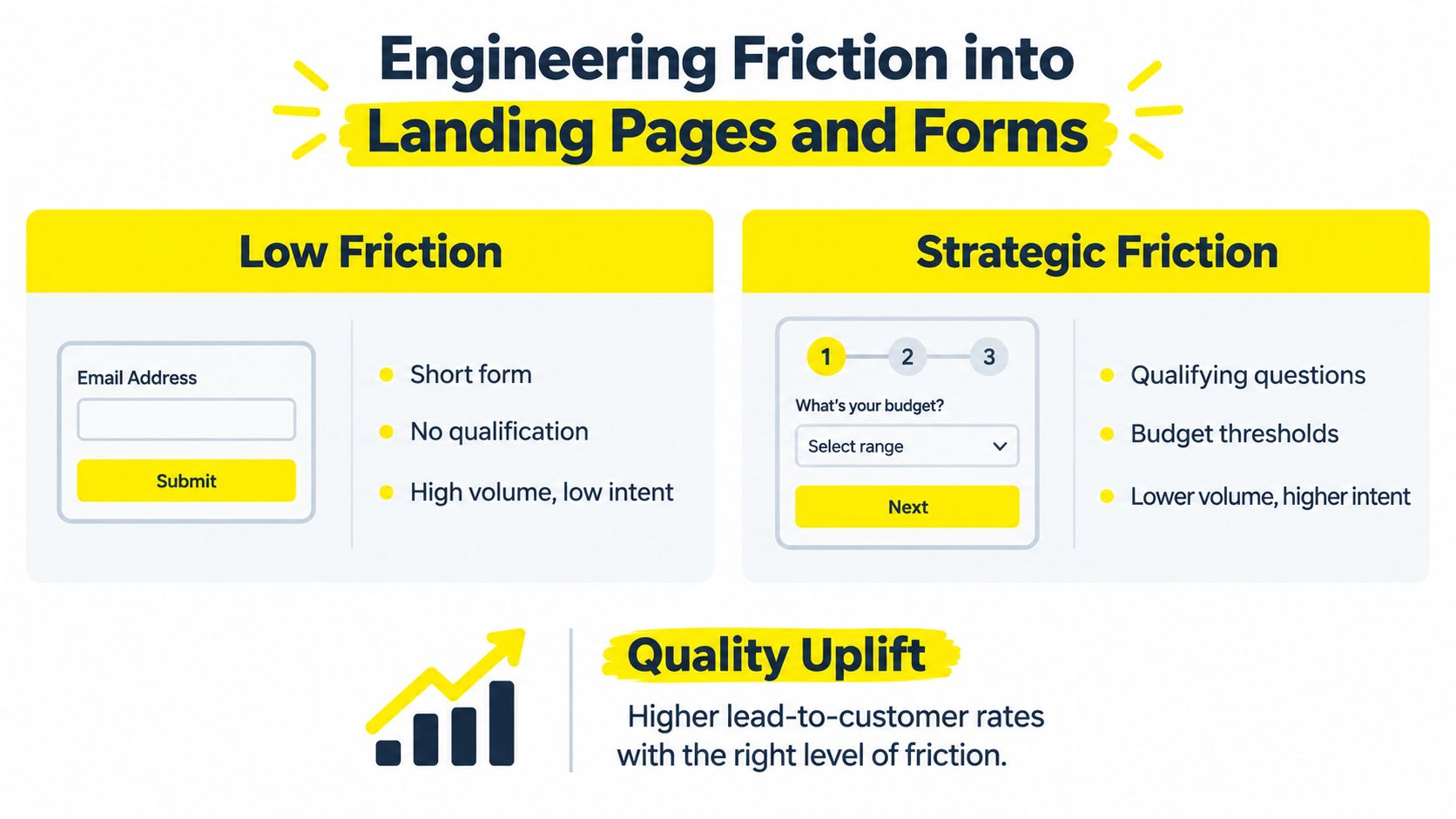
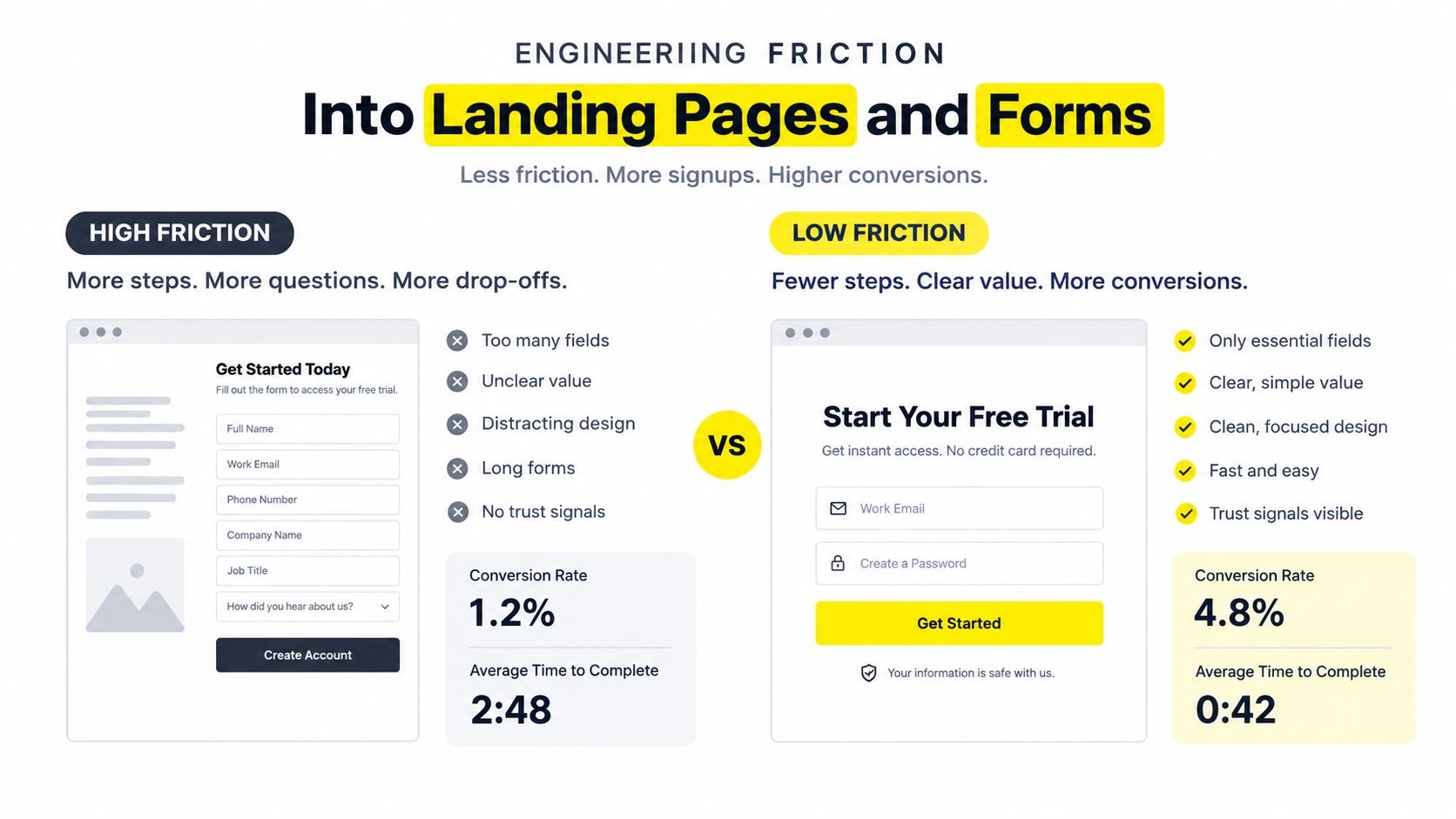
The shortest form isn't automatically the most profitable form. It removes effort for everyone, including people who aren't a fit, aren't ready, or entered information casually. Strategic friction asks a prospect to provide information that improves the next business decision.
That doesn't mean making every form long. It means adding only the questions that change qualification, routing, pricing, or follow-up.
Match friction to sales capacity
A high-ticket service with limited appointment capacity can usually justify more qualification than a low-consideration product. A business that needs a customer's location, project type, timing, and budget to quote accurately should collect those details before sending the record to a representative. An e-commerce brand may use product-selection behavior, quiz answers, or purchase events instead of a conventional sales form.
Use a simple decision test:
Question | If the answer is yes | If the answer is no |
|---|---|---|
Does the field determine service eligibility? | Make it required or use conditional logic | Leave it out |
Does the answer change routing or offer presentation? | Capture it early | Consider collecting it later |
Can sales act on the answer immediately? | Map it to the CRM | Remove or simplify it |
Does the question create unnecessary privacy or compliance risk? | Rework the field | Keep it only with a clear purpose |
Multi-step forms can make a demanding intake feel manageable. The first step can establish the visitor's need, while later steps ask for contact details and qualification information. Conditional logic keeps the experience relevant. Someone requesting a commercial service shouldn't see the same questions as someone asking for a residential appointment.
Test profit, not completion rate
Adding friction to forms may reduce the overall conversion rate while improving profitability. The appropriate test metric is cost per qualified opportunity or customer revenue, not the cheapest lead (analysis of lead quality and form friction).
That trade-off is easy to mishandle. A marketer sees fewer submissions and declares the variant a failure before checking whether sales accepted more of the records. The right comparison includes:
Qualified-lead rate: How many submissions meet the agreed criteria?
Cost per qualified lead: What did it cost to acquire an accepted lead?
Appointment attendance: Did the prospect show up or complete the next step?
Opportunity rate: Did the conversation become a genuine commercial opportunity?
Revenue per advertising dollar: Did the campaign create economic value?
Use budget ranges instead of asking prospects to type an exact figure when precision creates discomfort. Ask for project timing in clear categories. Confirm location with a service-area field. Include a phone number when immediate human contact is central to the offer, but explain why the business needs it.
The strongest form is the one that balances user effort with the sales team's ability to respond well. A form that filters too aggressively can exclude good prospects. A form that filters nothing can turn sales into a manual screening department.
Operationalizing Speed to Lead and Routing
Lead quality deteriorates when the business waits to act. A person who submits a form while actively comparing providers has a live commercial need. Hours later, the same person may be harder to reach, less motivated, or already speaking with a competitor.
Speed-to-lead belongs in marketing operations because advertising creates the expectation of a timely response. The workflow should begin at submission, not when a salesperson eventually notices a CRM notification.
Build the routing sequence
Capture the exact form-submission timestamp and source. Validate the email, phone, consent status, and service-area fields before assigning ownership. Then route the record according to geography, product, language, account type, or representative availability.
A practical workflow has several coordinated actions:
Record the event: Store the submission time, click identifier, campaign context, and qualification answers.
Validate the record: Reject obvious junk, duplicates, unusable contact information, or out-of-area requests.
Assign ownership: Send the lead to the correct representative or queue.
Confirm receipt: Deliver an immediate, accurate acknowledgment that sets expectations.
Trigger human outreach: Notify the representative through the channel they actively monitor.
Escalate missed handoffs: Reassign or alert a manager when the assigned owner doesn't act.
Automated acknowledgment isn't the same as human contact. Report both separately. If after-hours coverage matters, an option such as AI answering that books jobs can support intake and appointment handling, but the CRM still needs to distinguish automated assistance from a completed human conversation.
Measure response quality, not just response speed
A Harvard Business Review study analyzed approximately 15,000 leads and 100,000 call attempts and found that contacting a lead within 5 minutes, rather than waiting 30 minutes, made the company 21 times more likely to qualify the lead. The same body of research reported that companies responding within that initial window were 100 times more likely to make contact, while separate B2B benchmarking found an average response time of about 47 hours (speed-to-lead benchmark summary).
Treat those findings as directional benchmarks, not guarantees. Measure your own median and 90th-percentile response time, contact rate, qualification rate, booked-meeting rate, and revenue per lead by response-time bucket. Start the clock at form submission, not CRM creation. Remove duplicates. Don't count an automated email as a completed sales contact.
Run the workflow across comparable campaigns while holding the offer, audience, budget, and qualification rules steady. The goal isn't to make the dashboard show faster activity. It's to determine whether faster routing creates more qualified opportunities and more revenue from the same acquisition system.
Vertical Playbooks for Targeted Acquisition
Lead quality has no universal shape. A med spa needs people within a workable radius who want a relevant treatment and will attend an appointment. A coach needs a prospect with a suitable problem, financial readiness, and willingness to follow a process. An e-commerce brand needs a shopper whose product interest and behavior support a purchase, not necessarily a sales-qualified conversation.
The same four pillars apply across markets, but the signals change: offer, landing page, ads, and data.

Local services
Lead quality starts with eligibility. Put the service area, job category, availability expectations, and next step directly into the ad and landing page. A home-services campaign can ask what type of work the visitor needs, where the property is located, and when the project should begin. A med spa can separate treatment interest from consultation intent and make the appointment process explicit.
The offer should discourage unrealistic expectations before the form. Clear pricing context, service boundaries, before-and-after standards where appropriate, and appointment policies reduce misunderstandings that later appear as “bad leads.”
Route by geography and service type. Track booked appointments, attendance, accepted jobs, and revenue, not just inquiry volume. A campaign that attracts many distant or low-value requests can look efficient until travel, scheduling, and follow-up costs are included.
Coaching and professional services
The landing page should qualify the problem and the commitment required to solve it. Use copy that names the client profile, desired outcome, process, and constraints. A short application can ask what the prospect wants to change, why now, what they've tried, and whether they're prepared to invest time and money in the work.
Avoid vague promises that attract people looking for free advice. An educational webinar may be appropriate for early-stage prospects, while a strategy call should reserve sales attention for people who understand the offer and are ready for a conversation.
Nurture is important here. A prospect who has strong fit but weak timing shouldn't be treated the same as someone outside the market. Separate those records by readiness and give each group a relevant next action.
A vertical-specific playbook can turn the same platform into a different acquisition system:
Business model | Strong fit signal | Useful landing-page action | Downstream event |
|---|---|---|---|
Local service | Area, job type, timing | Request a qualified appointment | Attended appointment or accepted job |
Coaching | Problem, readiness, commitment | Complete an application | Qualified consultation |
E-commerce | Product intent and behavior | Choose or buy the right product | Purchase and customer value |
E-commerce usually has a shorter path from product interest to transaction, so the CRM and advertising account should prioritize purchase and customer-value signals. Product quizzes, category engagement, cart behavior, and post-purchase data can improve segmentation, but the commercial definition remains the same: optimize toward customers, not merely interactions.
Wojo Media is one example of an agency model that combines offer refinement, conversion-focused landing pages, omnipresent paid campaigns, and backend KPI tracking across sectors such as local services, e-commerce, real estate, and coaching. Whatever partner or internal team you use, require the same discipline: connect the creative promise to the qualification rules and connect those rules to closed revenue.
Executing a Controlled Testing Framework
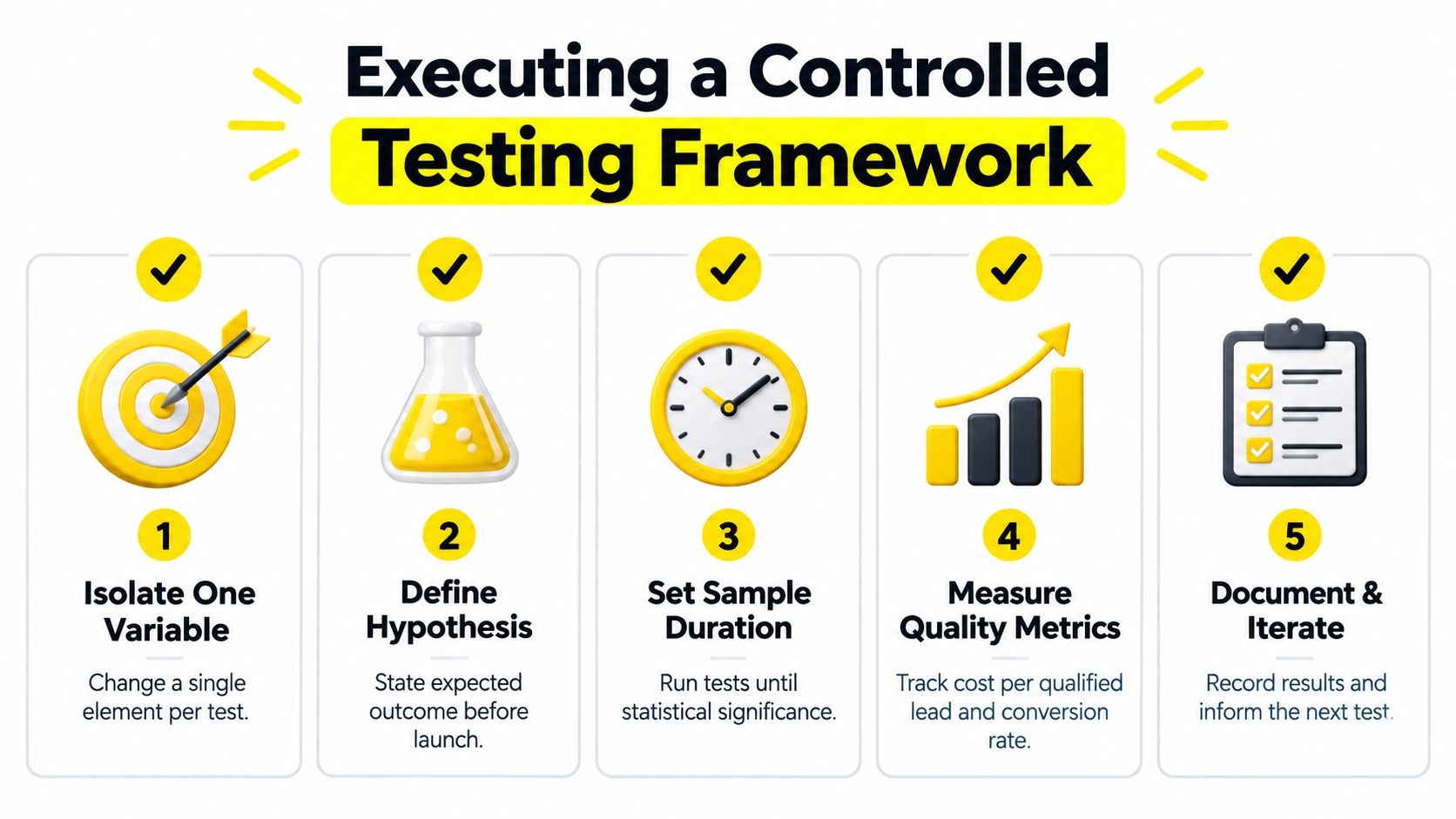
Random changes create random explanations. If you alter the audience, form, offer, follow-up script, and CRM definition together, you may see movement without knowing which lever caused it. Controlled testing protects the integrity of the decision.
Begin with a 2-to-4-week baseline, then calculate qualified-lead rate and cost per qualified lead by campaign, ad set, query, creative, landing-page variant, and source. The duration is a practical starting point from the verified benchmark, not a guarantee that every account will produce a conclusive result during that window.
Isolate the variable
Choose one question. Does a budget-range field improve qualified opportunity rate? Does a service-area selector reduce out-of-market submissions? Does a different offer attract customers with stronger purchase intent? Keep the audience, spend, creative context, qualification rules, and routing process stable while the test runs.
Write the hypothesis before launch. For example: “Adding a service-area question will reduce raw submissions but increase the share of leads accepted by sales.” That statement tells you what to measure and prevents a lower form conversion rate from becoming an automatic failure.
Use a fixed measurement contract
Define the primary outcome before looking at the results. A useful hierarchy is:
Primary: Cost per qualified opportunity or customer revenue.
Secondary: Qualified-lead rate, opportunity rate, booked-meeting rate, and sales acceptance.
Diagnostic: Contact rate, invalid rate, duplicate rate, response time, and form completion.
Guardrail: Sales capacity, compliance quality, and customer value.
Don't change the qualification definition halfway through the test. Don't compare one variant's raw submissions with another variant's closed customers. Keep event naming, attribution, deduplication, and upload timing consistent.
Leads contacted within five minutes are 21 times more likely to qualify than those contacted after 30 minutes, while another cited study reports a 48% contact rate when called within one minute versus 28% after three minutes (speed-to-lead response benchmark). Use response-time bands as a diagnostic dimension, then test routing independently from landing-page changes.
After the test, document the result, decision, and limitation. Increase budget only when the CRM data matches reliably, sales agrees that the quality definition still reflects commercial value, and the winning signal holds across relevant segments. A profitable acquisition system is built through repeated, controlled learning, not a single low-CPL win.
Wojo Media can help connect offer strategy, landing pages, paid acquisition, and backend revenue tracking so campaigns optimize for qualified opportunities rather than cheap form fills. Visit Wojo Media to request a strategy conversation focused on improving lead quality and building a more profitable path from ad click to closed customer.
Comments