
Lead Generation for Service Business: A Practical Playbook

The most repeated advice on lead generation for service business is simple: buy cheaper leads. Drop the cost per lead, pile up form fills, and the calendar is supposed to fill itself. That advice collapses the moment the phone goes unanswered.
A $12 inquiry that sits in a shared inbox until tomorrow costs more than a $40 call that gets answered, qualified, and booked before lunch. The ad didn't fail. The work after the click did. I would only trust a channel after three numbers sit beside cost per lead: answer rate, minutes to first contact, and booked jobs.
Say a med spa and a roofing crew both celebrate a $15 lead. The spa's front desk calls in four minutes and books a consult. The roofer's owner sees the form at 7 p.m. and leaves one voicemail. Same cost per lead. Completely different revenue.
The Lead System Stages and Where Leads Die
A cheap lead that never gets a call back is a loss, not a bargain. A 2011 Harvard Business Review study audited 2,241 U.S. companies by submitting web-generated test leads. Only 37% replied within one hour, and 23% never responded at all. Among companies that replied within 30 days, the average response time was 42 hours. On a separate set of 1.25 million sales leads, businesses that contacted a lead within one hour were nearly seven times as likely to qualify it as those that waited another hour.
The inquiry is not the finish line. Map the chain, and treat each stage as part of lead generation for service business.
Offer and guarantee. The job is a promise specific enough to act on. It moves click-through and form rate. It fails when the promise is vague and gives no reason to act today.
Landing page and form. The job is turning clicks into booked calls. It moves conversion rate per click. It fails with a long form and no proof above the fold.
Paid channels. The job is reaching people close to hiring. It moves cost per lead and cost per booked call. It fails when the only goal is a cheap lead.
Response and follow-up. The job is qualifying while intent is still high. It moves answer rate and speed to first contact. It fails with slow routing and a single attempt.
Booking and revenue. The job is turning a qualified call into a paid job. It moves show rate, close rate, and revenue per lead. It fails when ad source never ties to revenue.
An uncontacted, unbooked lead returns nothing on ad spend. Judge every channel on booked calls and revenue per lead, not on cost per lead alone.
Crafting an Offer and Guarantee That Pulls Buyers
An offer is three things: the outcome the buyer gets, the price logic, and the next step. Paid traffic exposes a weak offer within days, so test the offer before you polish the page.
Four checks before you spend
Run the offer through these checks before any redesign.
Specific outcome. Name a booked consult, a written quote, or a seat in a class. "Learn more" is not an outcome.
Price filter. Show a price or a clear range so people who can't pay leave before they fill the form. A $4,000 treatment and a $149 facial shouldn't share one vague "ask us" button.
Fast next step. The action should take under a minute: tap to call, pick a time, or submit three fields.
Named risk. Say what happens if the result is missed, the quote is wrong, or the callback is late. Silence on risk makes buyers assume the worst.
Practical rule: If you can't state the outcome, the price logic, and the next step in one sentence, the ad has nothing solid to sell.
Which guarantee fits the job
A guarantee pulls serious buyers and also creates a way to lose money. Match the type to the job, then cap it.
Guarantee type | Works best when | Risk to watch | Protective limit |
|---|---|---|---|
Money-back on first service | High price and results visible within days | Refund requests from no-shows | Refund only for a missed agreed result, once per client |
Free re-service if result missed | Result is measurable, such as a cleaning checklist or treatment outcome | Repeat visits that cost labour | One free redo, booked within 30 days |
Free estimate credited to job | Large ticket work that needs an on-site visit | Time spent on people who never intended to buy | Estimate fee credited only if hired within 14 days |
Response-time promise | Speed matters, as with emergency repair or urgent consultations | Staff capacity at peak hours | Callback within 15 minutes during business hours, diagnostic fee waived otherwise |
Fixed-price quote | Competitive local market where buyers compare quotes | Margin erosion on hard jobs | Fixed price for defined scope, change orders priced separately |
A money-back promise suits a med spa treatment the client can judge within days. A credited estimate suits a roof or a remodel, where the visit itself has a cost. A 15-minute callback suits an emergency plumber or a tax adviser during filing season, and only during staffed hours. A fixed quote suits a barbershop package or a defined home-service scope, with extras written as change orders.
Run two offers against the same audience for a week before you rewrite the landing page. Keep the audience, the budget, and the page layout steady. Change only the promise. The winner is the offer that produces more qualified bookings, not the one with the prettier headline.
Landing Pages and Funnel Steps That Turn Clicks Into Bookings
The page has one job: one service, one city, one action. A homepage that lists every service in three counties makes the visitor choose, and most of them leave.
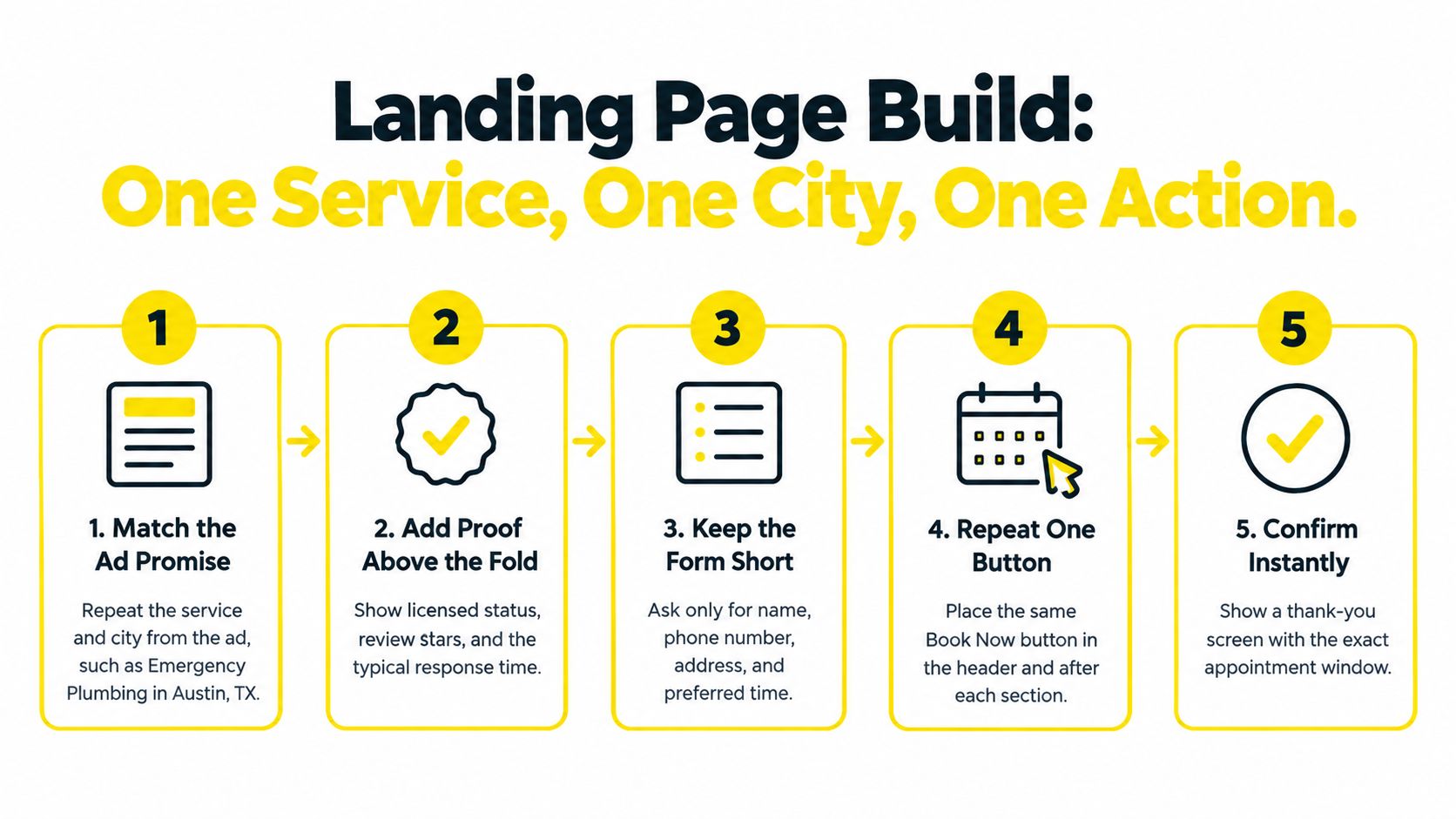
Build the page in this order
Write a headline that repeats the ad promise with the service and the city. "Same-day drain repair in Tampa" or "Flat-rate Botox consult in Austin" beats a brand slogan.
Place proof above the fold. Use a review count, a star rating, and one named before-and-after you have consent to show.
Add the offer and guarantee block you already tested. Don't invent a new promise on the page.
Use a form of three or four fields: name, phone, service, and ZIP or postcode. Put a tap-to-call button on mobile.
On the confirmation page, show a booking calendar or a plain promise, such as a call within 15 minutes.
Fire the conversion event on the thank-you page to both the ad platform and the CRM, so the lead isn't a pixel with no owner.
Short fields beat clever questions. If you want a tighter improve your lead capture workflow, start by cutting every field that a human can ask on the first call.
Three funnels, three first steps
Not every service should open with the same action.
Direct booking fits high-intent local work. Someone searching for an emergency electrician already knows the job. The first step is a call or a same-day slot, not a quiz.
A short qualifying quiz fits home services with several job types. A roofer might ask leak, full replacement, or inspection, then the ZIP. The first step is two or three questions that route the lead to the right crew, not a 12-screen survey.
A webinar funnel fits tax advisers, coaches, and real estate investors, where the decision takes longer. The first step is registration for a specific session, with a calendar reminder, not a generic "contact us" form.
High-ticket offers need a longer page: one case study, one qualifying question, then the form. Putting the form first on a $15,000 remodel just collects people who aren't ready to buy.
Operators that connect the page to booked jobs, including Wojo Media's lead campaigns for home services and local practices, treat the thank-you page as the start of follow-up, not the end of the ad.
Where Each Ad Platform Fits in Your Lead Mix
Google Search catches people who are already looking for a service in a city. Meta and TikTok create demand among people who haven't searched yet. Mixing those jobs in one campaign is how budgets get blamed for a targeting mistake.
A Google-commissioned study with Ipsos MediaCT and Purchased found that 4 in 5 consumers use search engines to find local information such as addresses, hours, and directions. 50% of consumers who did a local search on a smartphone visited a store within one day, compared with 34% who searched on a computer or tablet. 18% of smartphone local searches led to a purchase within one day, versus 7% of non-local smartphone searches. City and ZIP messaging isn't a nice extra. It's what those searchers already expect.
Match the platform to the service and the lever you can realistically control.
Google Search suits home services, med spas, and tax advisers who win on named searches. The levers are keyword intent and location settings, including "near me" and the city name.
Facebook suits considered offers such as real estate investing and coaching. Use custom audiences to retarget visitors who didn't book, and lead forms only when the page can't load fast enough.
Instagram runs on the same Meta system. Reels plus a local radius suit barbershops and neighborhood med spas better than a broad national interest stack.
TikTok suits creator-led discovery for home services and course creators. Reach can be cheaper, but you need a steady supply of video and tight interest audiences.
YouTube suits education and webinars on longer decision cycles. Topic audiences and remarketing to viewers do more than a one-off skippable ad.
Start with two platforms that match how the buyer decides. Add a third only after tracking shows which source produces qualified leads, not just cheap clicks.
Creative and Copy Rules for Each Platform
Most of the attention on video is won or lost in the first seconds. A polished middle doesn't rescue a hook that never stopped the scroll.
Platform | Format and ratio | Hook window | Copy length |
|---|---|---|---|
Facebook feed | Video or image at 4:5 or 1:1 | First 3 seconds | One headline and one proof line |
Instagram Reels and Stories | Vertical video at 9:16 | First 2 seconds with on-screen text | Short caption, local reference |
TikTok | Vertical video at 9:16 with a native look | First 1-2 seconds | Creator voice, one spoken offer |
YouTube in-stream | Horizontal video at 16:9 | First 5 seconds before skip | Problem and result, then the webinar or quote step |
Google Search | Responsive text ads | Keyword match in the first headline | Headlines up to 30 characters, descriptions up to 90 characters, with service and city |
One structure, one test
Across those placements, the copy order stays the same: the problem the buyer recognizes, the outcome they want, the offer with its guarantee, and one action. Use one headline and one call to action per ad so the test stays clean. Two buttons in one creative tell you nothing about which promise worked.
Proof that converts for a service business is specific. Put a real technician or client on camera with permission. Name the neighborhood or city in the script. Show a before-and-after only with consent. Stock smiles and unnamed "local experts" read as ads, and people scroll past them.
Test three to five hooks per ad set against the same body, then reuse the winning hook in a new format. Fatigue shows up as rising frequency with a falling click-through rate. When that pair moves together, retire the hook instead of raising the budget.
Never promise a result in the ad that the offer can't honour on the landing page. If the page can't waive the diagnostic fee, the ad shouldn't say it will.
Response Speed and Follow-Up Cadence That Save Leads
Treat a five-minute maximum first response as an operating standard, not a preference the sales team keeps when the day is quiet.
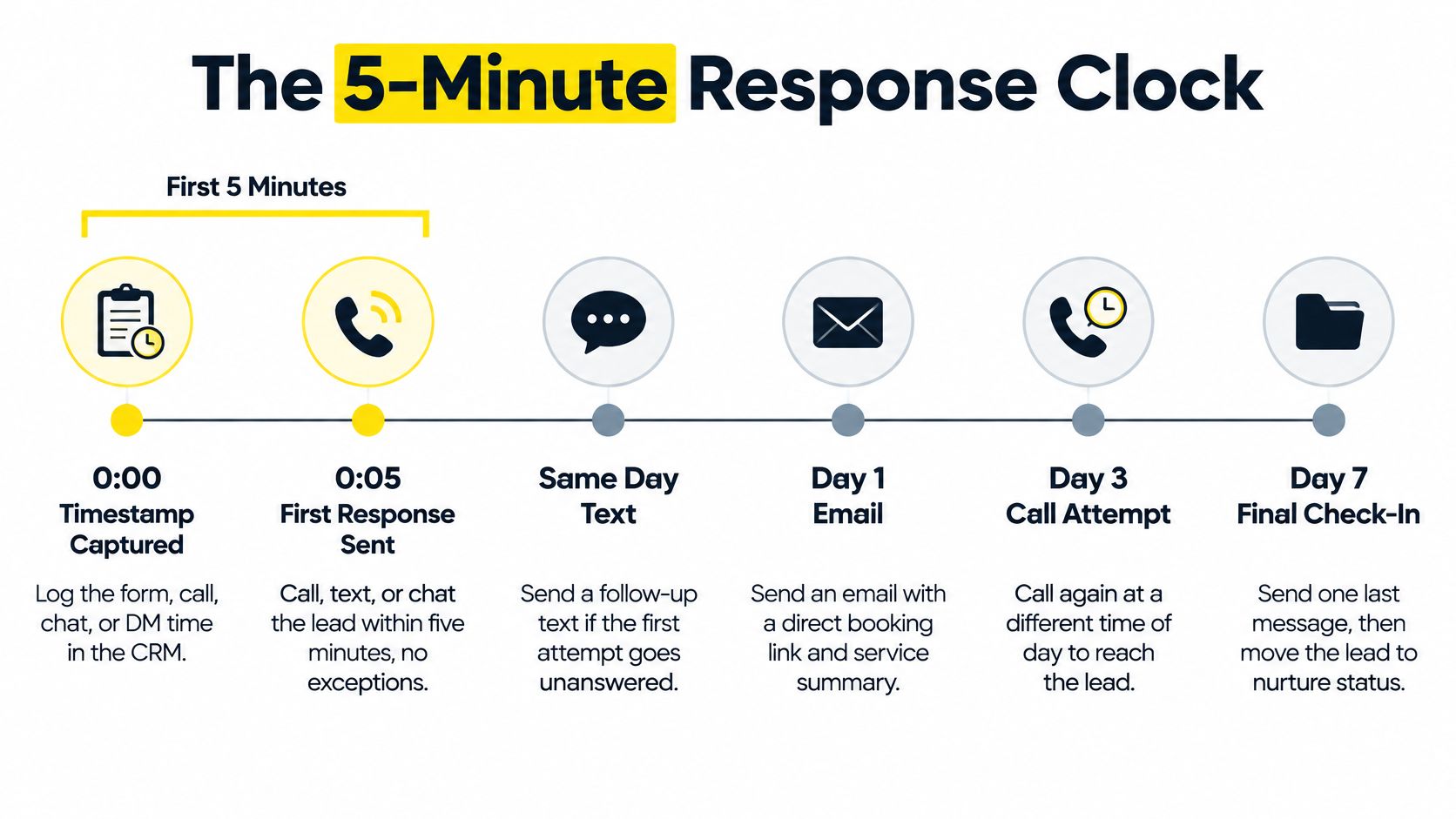
Build the clock in five moves. Capture the form, call, chat, or DM timestamp in the CRM. Send an immediate acknowledgement that confirms the request and sets expectations. Route the lead to a person or a call queue with that five-minute cap. Log disposition, qualification, and booking. Report qualification and booked-appointment rates in buckets of 0–5, 5–30, and 30+ minutes.
Cleaning crews and other field businesses lose the same race when the owner is on a job. A practical way to improve your cleaning business response time is the same clock: an instant text, then a human call, not a voicemail checked at dinner.
The call sequence
Velocify's analysis of nearly 3.5 million leads from more than 400 companies found that over half of converted leads were first reached on the initial call, while 93% of converted leads had been reached by the sixth attempt. Leads that needed seven or more calls were 45% less likely to convert. Leads that received emails between calls had a 16% higher chance of phone contact. Sending more than five emails before contact reduced conversion by 36%.
Step | Timing | Channel | Purpose |
|---|---|---|---|
1 | Within 5 minutes of capture | Call, plus SMS confirmation where permitted | Reach the lead while intent is high |
2 | 5 to 60 minutes after capture | Second call at a different time | Catch people between tasks |
3 | 2 to 24 hours | Email with one qualifying question or a booking link | Give a useful next step without repeating the call |
4 | Day 2, over the first 48 hours | Call at a different time of day, plus email | Recover contacts who missed earlier calls |
5 | Day 3 to day 14 | Lower-frequency nurture by email and retargeting | Stay available without over-contacting |
The pattern in that table is persistence with a point, not a pile of identical voicemails.
On the first live contact, ask four things: the service needed, the address or ZIP and whether it sits inside the service area, the timing of the job, and whether the caller makes the decision or needs a partner. Mark the lead qualified only when it passes the service-area check and at least two of the other three answers are a clear yes. Send qualified leads straight to the calendar. Send the rest to nurture instead of holding a slot.
Stop after two attempts and you leave most of the convertible leads untouched. Email without a new fact, a question, or a booking link, and you train people to ignore you. Failing to suppress people who already booked or opted out wastes the relationship you just earned. A short walkthrough of the same first-hour habit is here:
Track These KPIs Before You Scale Spend
A channel with a low cost per lead can lose money if calls go unanswered. A higher cost per lead can win if those calls are answered and closed. Volume without capacity is how a "winning" campaign quietly burns the week.
Metric | Formula | What it reveals | Review cadence |
|---|---|---|---|
Cost per lead | Ad spend divided by leads | Cheapness of traffic, not profit | Daily |
Answer rate | Answered calls divided by total calls | Whether phones are staffed and routed | Weekly |
Speed to first contact | Median minutes from capture to first attempt | Adherence to the response standard | Weekly |
Qualified lead rate | Qualified leads divided by total leads | Lead quality by source | Weekly |
Booking rate | Booked appointments divided by qualified leads | Fit of script and offer | Weekly |
Show rate | Attended appointments divided by booked | Reminder and deposit effectiveness | Weekly |
Close rate | Sold divided by attended | Strength of the sales process | Monthly |
Revenue per lead | Revenue divided by leads, by channel | Profit-based comparison across channels | Monthly |
Read the phone as a conversion stage, not a tracking endpoint. The Invoca business services lead conversion benchmarks report that 38% of answered business-service calls are qualified leads, and 44% of those qualified calls convert during the call. Separate 2026 benchmark reporting in the same source found that 40% of qualified consumer-service calls converted on the call. A missed ring is a lost close, not a reporting gap.
The scale-or-cut rule
Scale a channel only when revenue per lead, split by service line and location, exceeds its cost per lead after a sample of at least 30 qualified leads. If answer rate or speed is weak, fix the phones and the routing before you blame the ad or cut the budget. A cheaper source that nobody works is not the efficient one.
Wojo Media builds paid lead systems for home services, med spas, advisers, and similar service businesses, tying the offer, the landing page, and ads on Google, Meta, TikTok, and YouTube to calls, CRM outcomes, and booked jobs. If you want that chain judged on revenue per lead rather than a cheap form fill, book a strategy conversation and see how your current funnel would be rebuilt. Visit Wojo Media to get started.
Comments