.png)
Paid Ads Strategy That Scales Profitably Across Channels

You launch a campaign with a polished video, a carefully chosen audience, and a budget that feels large enough to generate answers. A few days later, clicks are coming in, the platform reports look encouraging, but sales, booked appointments, or qualified conversations haven't followed. The usual response is to change the bid, duplicate the ad set, or blame the channel.
That diagnosis is often wrong. A profitable paid ads strategy starts before media buying and continues after the platform reports a conversion. It connects the offer, landing page, creative system, and backend measurement so every dollar has a job and every performance problem has a logical next step.
Why Most Paid Ads Strategies Stall Before They Scale
A business can waste budget with excellent targeting. A med spa can advertise to people in the right location and still attract low-intent leads if the ad promotes a vague “special offer.” An e-commerce brand can generate inexpensive traffic while sending visitors to a generic collection page. A coach can collect leads that never book because the promise in the ad doesn't match the sales conversation.
Those failures look like advertising problems because the spend happens inside Google, Meta, TikTok, or YouTube. In practice, the media account is often only exposing weaknesses in the commercial system around it. Boosting a post may create attention, and copying a competitor may produce a familiar-looking ad, but neither approach answers the questions that determine profitability: What exactly is being sold, to whom, through which message, and at what backend value?
The market has also moved beyond a single-channel view. U.S. digital ad revenue reached $294.6 billion in 2025, including $117.7 billion in social advertising and $114.2 billion in search advertising, according to the 2025 U.S. digital advertising revenue analysis. Social grew 32.6% year over year and represented 40% of total digital ad revenue, while search represented 38.8%, which shows why a modern system must capture existing demand and create new demand.
The four pillars behind profitable campaigns
Offer. The offer gives the audience a reason to act now. It should define the result, the mechanism, the next step, and the risk reversal. A low-friction consultation, a product bundle, or a webinar registration can each work, but only when the promise matches the buyer's urgency.
Landing page. The page converts attention into action. It must continue the argument made by the ad, remove unnecessary choices, show credible proof, and make the next step obvious.
Omnipresent creative. Prospects rarely convert after one impression. A useful creative system gives them different reasons to trust, consider, and act across Facebook, Instagram, TikTok, Google, and YouTube. Tools such as an AI video generator for ads can help teams explore more visual concepts, but automation doesn't replace positioning or judgment.
Data. The account needs signals that connect media to revenue. That means tracking lead quality, appointments, purchases, margins, and sales outcomes instead of celebrating cheap clicks.
Practical rule: If you can't identify whether the offer, page, creative, or measurement is responsible for weak performance, increasing spend only makes the uncertainty more expensive.
A complete strategy gives an e-commerce team a way to scale profitable purchases, a local business a way to distinguish inquiries from booked customers, and a coach or real estate professional a way to connect lead generation with closed revenue. The objective isn't more activity inside an ad account. It's a repeatable system that tells you what to fix before you spend more.
Clarify Your Offer Audience and Guarantee First
Media buying can't rescue an offer that sounds interchangeable. Before opening Ads Manager or building a Google Ads campaign, write the commercial promise in language a prospect would use when describing the problem.
Start with three decisions.
Define the offer as an outcome
“Book a consultation” describes an action, not a benefit. A stronger med spa offer might frame the consultation around a specific treatment concern and explain what the visitor will receive during the appointment. A coach selling a webinar should connect the session to a concrete business decision, not promise “valuable training.” A real estate investor can make the next step clearer by naming the type of property problem discussed and the evaluation the seller receives.
The offer should answer:
Desired result: What does the buyer want to improve, obtain, avoid, or understand?
Mechanism: Why does your process make that result plausible?
Action: What should the prospect do immediately?
Reason to act: Why should they do it now rather than postpone the decision?
E-commerce brands should also check the economics behind the promise. A discount, bundle, free shipping message, or subscription offer must leave room for product cost, fulfillment, refunds, and advertising. Lead-generation businesses should define what a lead is worth after qualification and sales follow-up, not at the form submission.
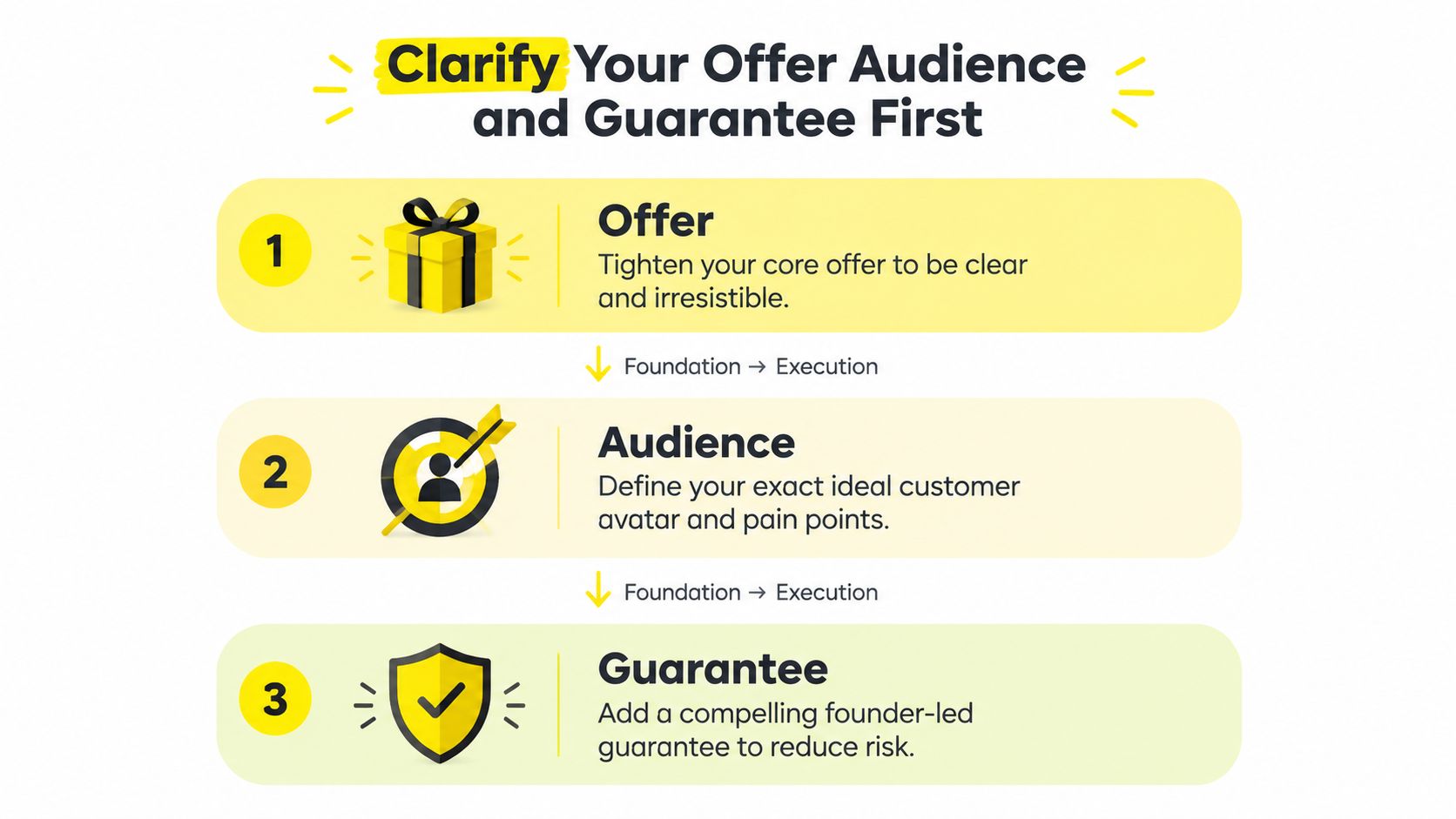
Describe the buyer narrowly enough to write relevant ads
“Adults interested in wellness” isn't an audience. A useful avatar includes the trigger that creates urgency, the failed alternatives they've tried, the language they use, and the objection that delays action.
A med spa may need separate messaging for someone comparing treatment options and someone who already knows the procedure they want. A tax advisor promoting a webinar may need different ads for a business owner facing a complex filing issue and a professional seeking a planning process. Those people may share demographics, but their intent and objections differ.
Segment by pain point and intent, not only by age, location, or interest. Search terms can reveal active demand, while social creative can introduce a problem to people who haven't searched for a solution yet. The message should change with that awareness level.
Use a guarantee that reduces believable risk
A guarantee doesn't mean promising an outcome you can't control. It can clarify what your team will do, what the customer will receive, or how you'll handle a defined service failure. A founder-led review of the guarantee often exposes weak positioning because the business owner must decide which part of the experience they can confidently stand behind.
Ask whether the guarantee is specific, easy to understand, and operationally honest. If the sales team can't explain it without qualification, the ad audience won't understand it either.
The strongest pre-campaign work often feels less glamorous than launching ads, but it gives every headline, page section, and follow-up message a sharper job.
Choose Channels and Allocate Budget by Intent
Channel selection should follow buyer intent, business economics, and creative capacity. Google Search captures demand from people already expressing a need. Meta, TikTok, and YouTube can create demand by interrupting attention with a problem, demonstration, testimonial, or new point of view.
That distinction changes the campaign structure. A home services company with strong local search demand may begin with Google Search, then use Meta to build familiarity and retarget engaged visitors. A new e-commerce product with little branded demand may need social video and creator-style demonstrations before search becomes a meaningful acquisition channel. A webinar funnel may use social and YouTube to develop interest, with search capturing people actively researching the topic.
Worldwide search ad spending was projected at about $218.3 billion for 2026, while global digital advertising spend was estimated at about $835.82 billion for 2026, according to the paid media forecast overview. These projections indicate scale, but they don't determine the right mix for an individual business.
Channel Mix by Business Model and Intent Stage
Business Model | Primary Channel | Support Channels | Budget Split Guidance |
|---|---|---|---|
E-commerce | Meta or TikTok for visual demand creation, Google Search and Shopping for active demand | YouTube, creator content, retargeting | Fund the channel that proves creative and margin fit first. Add support channels when the brand can produce enough distinct assets and interpret incomplete attribution. |
Local services | Google Search for high-intent local demand | Meta retargeting, local social creative, YouTube | Prioritize qualified calls and booked appointments. Expand beyond search when follow-up capacity and proof assets can support additional volume. |
Coaching and webinars | Meta or YouTube for problem-aware audiences | Google Search, email, retargeting | Separate registration volume from attendance, sales conversations, and collected revenue. Consolidate when the funnel can't distinguish those outcomes. |
Real estate | Google Search for explicit seller, buyer, or financing intent | Meta, YouTube, retargeting | Match channel spend to the transaction stage and sales team's response speed. Expand only when lead quality is stable. |
Sequence channels instead of forcing omnipresence
A prospect might see a short problem-focused video on Instagram, watch a longer explanation on YouTube, search for a solution on Google, and return through a retargeting ad before converting. That sequence is useful only when each touchpoint adds something new. Showing the same weak ad everywhere creates omnipresent waste.
Start with the channel that best matches the strongest available intent signal. Build a second channel around the next friction point, such as trust, education, or comparison. Add a third only when the team can create platform-native creative and measure the downstream outcome.
Consolidate when conversion volume is thin, creative production is inconsistent, or sales follow-up can't handle more inquiries. Expand when the offer is clear, the landing page is converting, and backend data shows that additional sources produce valuable customers rather than merely more leads.
Build Creatives and Landing Pages That Convert
Creative earns the click, but the landing page earns the action. Treating them as separate projects creates message gaps that make qualified prospects hesitate.
A strong ad usually makes one clear argument. It can expose an expensive mistake, demonstrate a product, answer an objection, show a customer experience, or present a specific opportunity. The first visual and spoken line should communicate that argument quickly, especially in vertical video feeds where the viewer can leave without reading the caption.
Use multiple angles rather than minor variations of one idea:
Problem angle: Name the frustrating situation and show why common fixes fail.
Proof angle: Use a testimonial, demonstration, review, or process explanation that makes the claim more credible.
Mechanism angle: Explain how the product or service produces the promised result.
Objection angle: Address price, complexity, timing, trust, or perceived risk directly.
Identity angle: Speak to the buyer's situation, such as a busy homeowner, a growing store, or a professional planning a difficult transition.
Creator-style footage and UGC can make the message feel more native to social feeds. Motion-led explainers can help with product education, offers that require visual proof, or retargeting sequences. When a project needs polished animation rather than basic edits, researching specialized motion graphics studios can help the team evaluate production options without confusing visual polish with conversion strategy.
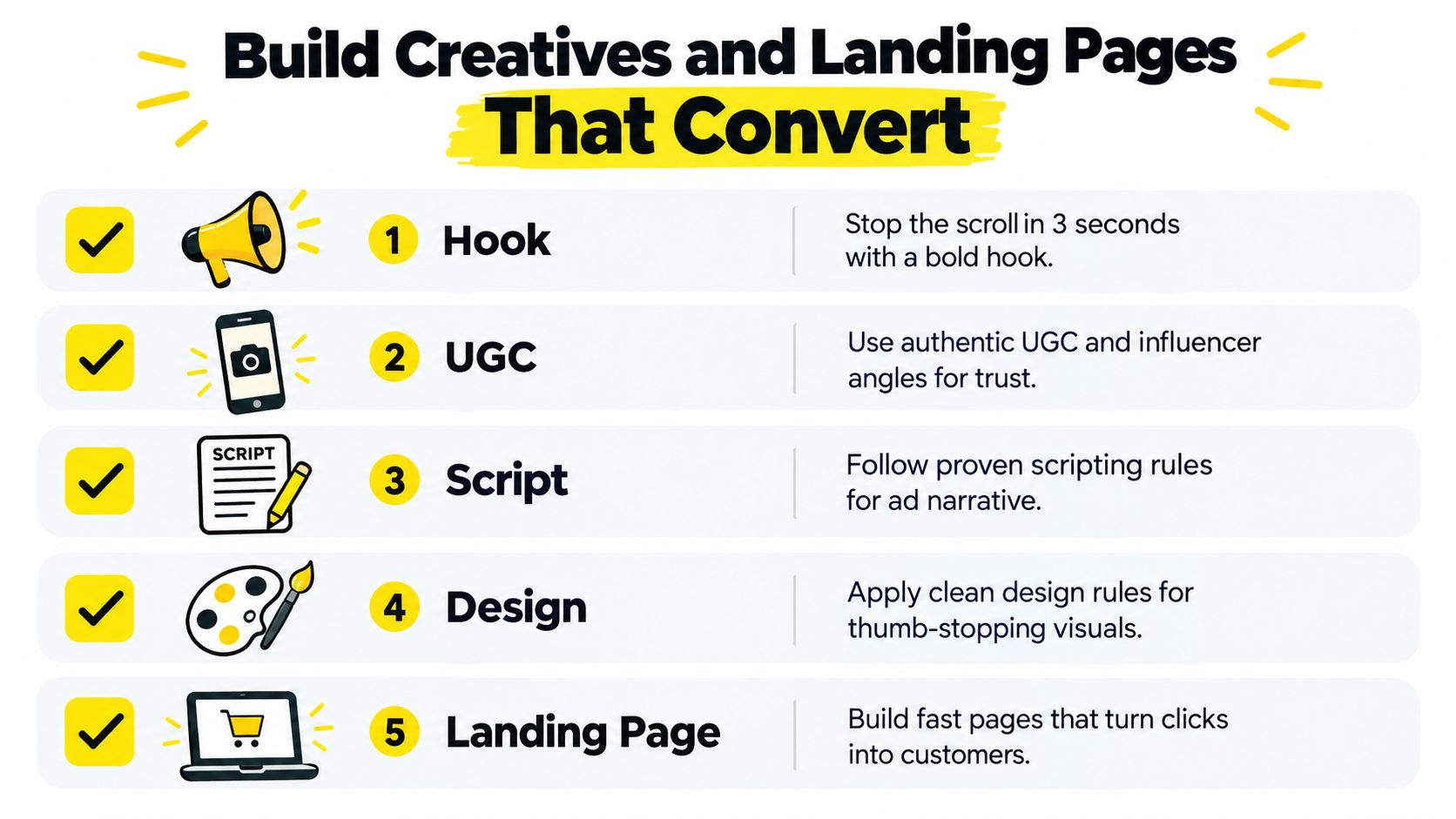
Make the page continue the ad's argument
The headline should reflect the promise the visitor just clicked. A product ad demonstrating a use case should land on the relevant product or bundle, not a broad homepage. A local lead ad promising a consultation should make the booking process, service area, qualification, and next step immediately visible.
Remove competing actions. A conversion page needs a dominant goal, a clear form or checkout path, proof placed near moments of doubt, and enough detail to support a decision without burying the call to action. Check the experience on a phone, because a beautiful desktop layout can still produce awkward scrolling, small tap targets, or a slow first interaction.
Test angles before production fatigue sets in
For lead generation, test the hook, offer framing, qualification language, and form experience. For e-commerce, test product demonstration, bundle logic, price framing, creator identity, and the landing page destination. Keep the audience and conversion event stable while testing a meaningful variable, otherwise the account can't tell you why performance changed.
The benchmark context for Meta shows traffic campaigns around 1.71% CTR and $0.70 CPC, while lead campaigns are closer to $1.92 CPC, based on paid advertising benchmark data. Those figures are reference points, not targets. A cheaper click isn't valuable if the page attracts the wrong person or the sales team can't convert the lead.
Set Up Tracking KPIs and Diagnostics That Survive Privacy Changes
Last-click reporting is no longer a complete operating system. Browser restrictions, consent choices, platform modeling, and incomplete customer journeys mean an ad account can report useful signals while still missing part of the path to revenue.
Build measurement in layers. Collect consented first-party data through your CRM, email system, checkout, booking software, and call records. Use server-side tracking where appropriate to reduce dependence on browser-only signals, then add contextual information such as landing page, search intent, creative theme, geography, device, and sales-stage outcomes.
Privacy isn't a reason to collect everything. Teams should understand your rights regarding data and define what information they need, why they need it, how long they retain it, and who can access it. A smaller, reliable dataset is more useful than a large collection with unclear consent or inconsistent definitions.
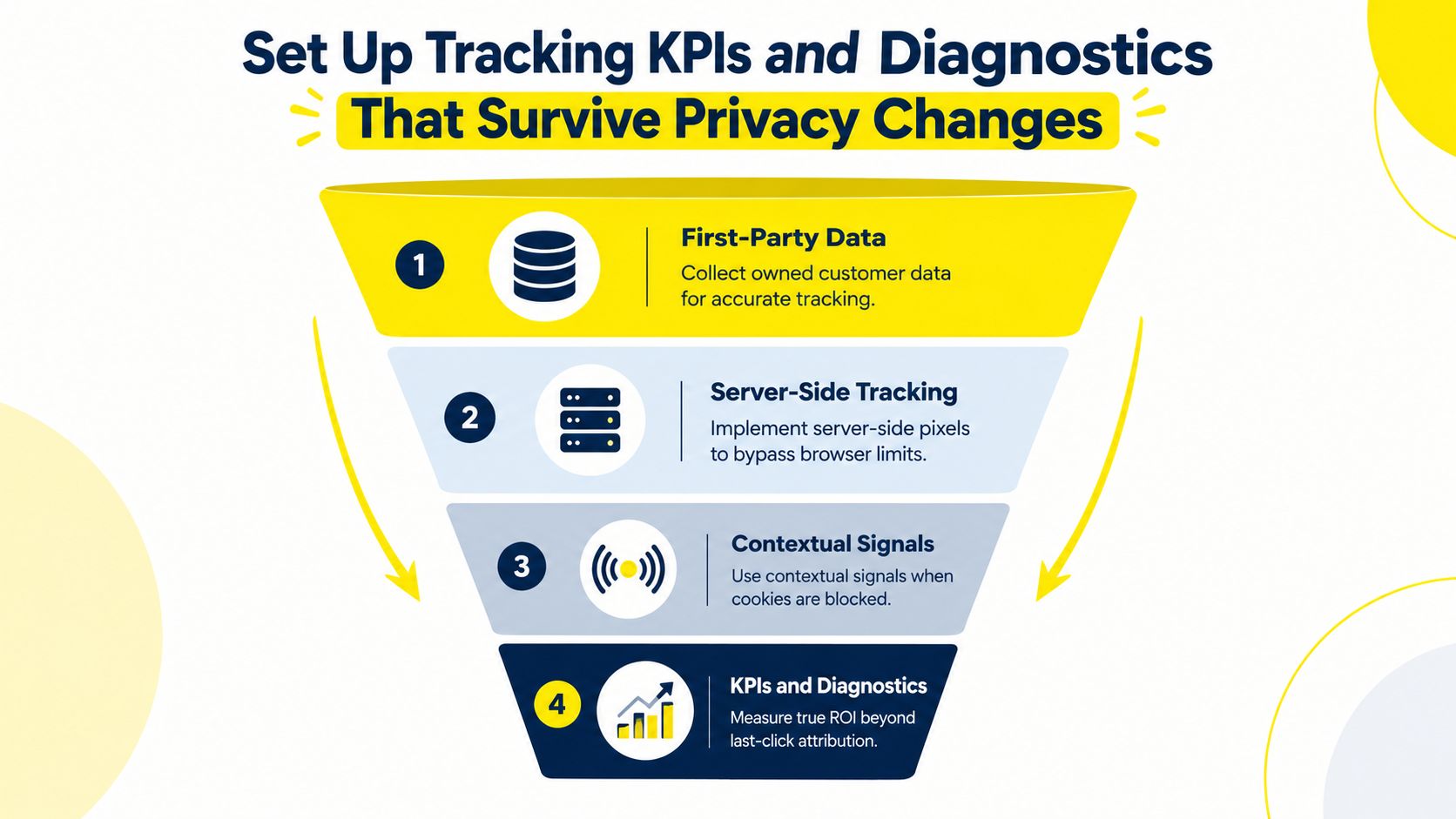
Measure the business event, not the platform event
A lead is not the same as a qualified lead. A booked appointment is not the same as a completed sale. A purchase is not the same as profitable revenue after product cost, fulfillment, refunds, discounts, and agency or production expenses.
Define the event hierarchy before launching:
Acquisition signal: impression, click, landing page visit, form start.
Conversion signal: purchase, completed form, call, or registration.
Quality signal: qualified lead, attended appointment, sales-qualified conversation.
Revenue signal: collected revenue, gross margin, repeat purchase, or closed transaction.
Decision metric: contribution margin, qualified acquisition cost, or margin-adjusted ROAS.
This hierarchy protects the account from optimizing toward a cheap event that has little commercial value. Lead-generation campaigns should send qualified outcomes back into the CRM when the integration supports it. E-commerce teams should compare platform-reported revenue with margin and repeat-purchase behavior instead of treating reported ROAS as the final answer.
Use benchmarks as a diagnostic ladder
Recent all-industry Google Ads search benchmarks cluster around 3% to 5% CTR, $2 to $4 CPC, 3% to 5% conversion rate, and $50 to $80 CPA, according to Google Ads benchmark guidance. More granular 2026 data in the same source suggests top-performing search accounts can reach about 6.64% CTR, $5.42 CPC, and 8.18% conversion rate.
Don't compare every campaign to one average. Brand and non-brand search, industry economics, average order value, and funnel depth can produce very different results.
Use the numbers to locate the bottleneck:
CTR below the relevant range: Rework keyword alignment, headline, offer framing, or intent selection.
CPC within range but conversion rate weak: Inspect the landing page, promise, trust elements, form friction, and offer match.
CPA high across segments: Review audience structure, search terms, negative keyword hygiene, qualification, and backend close rate.
Platform conversions strong but revenue weak: Repair event definitions, CRM feedback, attribution, or sales follow-up.
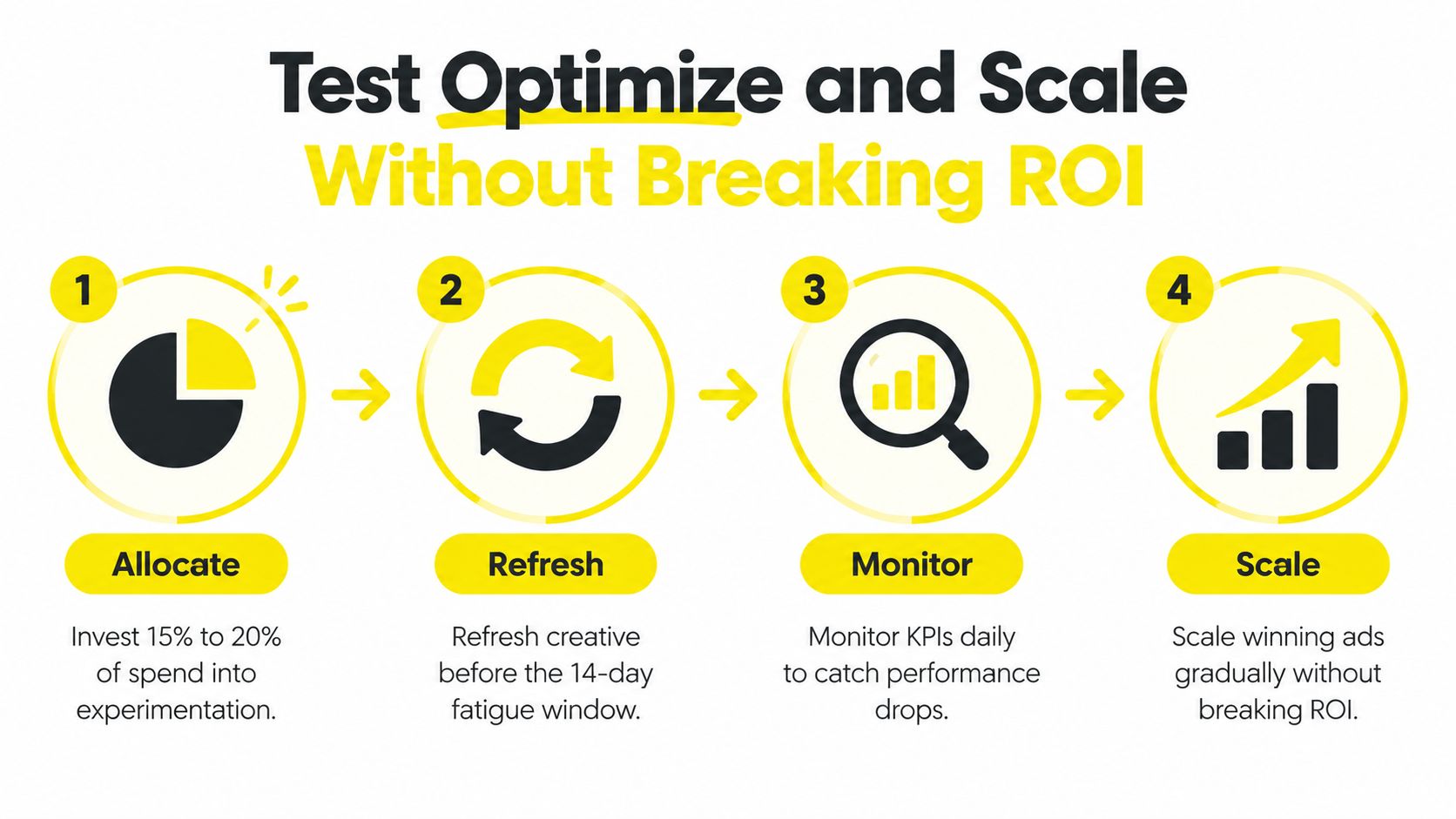
Test Optimize and Scale Without Breaking ROI
Scaling should be a controlled operating rhythm, not a reaction to one attractive day in the dashboard. The team needs a testing budget, a creative refresh process, and a decision rule that protects margin when platform attribution becomes noisy.
Current trend guidance recommends allocating 15% to 20% of spend to experimentation, as discussed in paid advertising trend coverage. Use that test allocation for new hooks, offers, creators, audiences, landing page structures, or channel placements. Keep the core campaign stable enough that the test has a meaningful comparison.
Run the weekly loop
Monday, inspect the funnel. Review spend, delivery, CTR, CPC, conversion rate, qualified lead rate, booked appointments, purchases, revenue, and margin. Separate tracking failures from genuine performance changes before making edits.
Midweek, evaluate new creative. Meta lead-generation modeling places a local-services creative lifespan near 14 days, with early monitoring of CTR and CPC during the first 3 to 7 days, according to the benchmark source cited earlier. Use that guidance as a planning signal, not an automatic expiration date. Refresh the angle when people stop responding, frequency rises without quality, or the same asset keeps attracting weaker traffic.
Thursday, make one meaningful decision. Kill an ad when it fails the agreed quality threshold after enough qualified delivery. Keep it when the downstream economics work, even if the click metric looks ordinary. Promote a winner when it produces valuable outcomes consistently across the measurement layers.
Friday, scale cautiously. Increase budget gradually, expand a proven audience, or introduce a support channel only when the offer, page, creative, and sales process can handle the added demand. Don't add YouTube, TikTok, or another campaign type because the current channel feels boring. New inventory creates new operational work and can make attribution harder.
Margin is the guardrail. A campaign can show attractive ROAS and still lose money if the reported revenue ignores fulfillment, refunds, sales commissions, production, or the cost of serving the customer.
A practical scale decision uses three questions: Are qualified outcomes improving, is the sales team converting them, and does the resulting contribution margin justify more acquisition? If the answer to any question is unclear, invest in measurement or offer refinement before investing in reach.
This is the operating logic behind a resilient paid ads strategy. Test the commercial promise, improve the page, produce fresh creative, and judge the system by the customer value it creates. Wojo Media applies this kind of full-funnel work across offer refinement, conversion-focused pages, omnipresent campaigns, and backend KPI tracking, with more than 17,000 campaigns launched as stated in its publisher information.
Wojo Media can audit your offer, landing pages, creative system, channel mix, and backend tracking, then build a paid ads strategy around profitable growth rather than platform-reported clicks. Visit Wojo Media to request a custom strategy demo and identify the bottleneck worth fixing first.
Comments