.png)
Real Estate Investor Lead Generation: 2026 Playbook

Social media was identified as the leading source of quality real estate leads by 52% of respondents, with CRM systems second at 32%, while raw internet-lead-to-client conversion sits around 0.4% to 1.2%. That means paid acquisition should be optimized for qualified appointments and contracts, not merely for the lowest cost per lead.
Real estate investor lead generation fails when the campaign stops at the form submission. A seller who requests information but never speaks with acquisitions, never receives a credible offer, or doesn't fit the buy box isn't a deal opportunity yet. The critical work begins after the click, when marketing data meets local property conditions, seller motivation, response speed, and a specific exit strategy.
The National Association of REALTORS® 2024 Technology Survey reinforces that digital distribution matters. Social media was the most frequently identified source of quality real estate leads, while CRM infrastructure ranked second, showing that acquisition and follow-up belong in the same operating system, not in separate departments (2024 Technology Survey).
Why Cheapest Leads Are Costing Investors Deals
Cheap leads look efficient because the dashboard records a low-cost form submission first. Investors make money later, through a qualified conversation, a workable offer, a signed contract, and a transaction that survives due diligence.
Raw internet-lead-to-client conversion is commonly estimated at 0.4% to 1.2%, according to real estate lead response data. At that range, a large contact list can still lose money if inquiries arrive from outside the buy box, responses are slow, or follow-up lacks a defined path.
Practical rule: Judge a channel by the financeable opportunities it creates for your strategy, not by its lowest cost per lead.
Replace the first metric with the final business question
A wholesaler, flipper, small landlord, and institutional buyer may target the same neighborhood but value different property conditions and seller situations. Deferred maintenance may suit a cash flipper, while a landlord may prioritize occupancy, rent potential, and financing terms. Campaign creative and form questions should reflect that distinction before the seller submits details.
Track each source through the acquisition path:
Cost per qualified seller: What did it cost to identify someone who fits the market and buy box?
Cost per appointment: How much spend produced a completed acquisitions conversation?
Cost per offer: Which channel supplies enough information for pricing and negotiation?
Cost per contract: What did it cost to reach an agreement?
Closed-deal rate: Which source produces outcomes after title, inspection, financing, and disposition risks?
A CRM earns its keep here: it preserves source, campaign, seller situation, follow-up history, and outcome so the team can compare channels on economics rather than impressions. Require fields for property address, occupancy, condition, motivation, timeline, assigned buyer, offer status, and final disposition. Without those fields, the team cannot tell whether a cheap source creates contracts or merely creates more work.
Speed and qualification are part of acquisition cost
A delayed response creates hidden waste. MIT and InsideSales research found that contacting a lead within five minutes made it 21 times more likely to be qualified than contacting it after 30 minutes, a cross-industry finding but directionally relevant to investor follow-up (lead response time research).
The operating response does not require a large call center. It requires a promise the team can keep. For overnight inquiries, an immediate acknowledgment can confirm receipt, collect missing property details, and offer the next available call window. During business hours, route leads by market and strategy, then record every call attempt and outcome in the CRM.
Investors comparing property intelligence, acquisition software, or data providers should weigh recurring costs against the qualified opportunities the system can support. If you are reviewing infrastructure rather than ad spend, you can check the pricing tiers from RealtyAPI.io during vendor evaluation.
The cheapest source often stops looking cheap after labor, repeated contact, poor data, and failed offers enter the calculation. Campaigns tied to local distress signals, a defined deal strategy, fast response, and contract attribution give investors a clearer path to financeable opportunities.
Building Offers That Attract Motivated Sellers
A seller responds to a clear solution, not to a generic promise that an investor can “help.” The offer should explain what happens next, what type of transaction the investor can support, and which property details are needed to evaluate it.
Start with the buyer model. A flipper may emphasize an as-is purchase and a defined closing timeline. A small landlord may offer a purchase structure that accounts for occupancy or a transition period. A wholesaler needs enough margin and assignment flexibility to make the opportunity work. An institutional buyer may require standardized property data, title clarity, and repeatable underwriting.
Build the message around the seller's situation
Use a specific angle, but don't imply certainty the business can't deliver. A few practical examples:
Inherited property: “Need to sell an inherited house with contents, repairs, or multiple heirs involved? Share the address and your preferred timeline so we can review the next steps.”
Rental fatigue: “Tired of managing repairs, vacancies, or difficult tenants? Tell us about the property and whether it's occupied.”
Foreclosure pressure: “Facing a deadline? Submit the property details early so the team can explain available options and identify what must happen next.”
Major repairs: “If the property needs substantial work, describe the condition and upload photos if available. The review should focus on an as-is path, not a promise of a retail price.”
Transparent copy improves qualification. The seller understands why the investor needs information, and the investor avoids attracting people who expect a retail listing experience.

Ask questions that change the underwriting decision
A short form should gather the details that determine whether a human call is worthwhile. Request only information the team will use:
Property address and contact details, including phone and email.
Occupancy status, whether the owner lives there, a tenant occupies it, or it is vacant.
Condition, with prompts for roof, foundation, mechanical systems, water damage, fire damage, and major deferred maintenance.
Liens and mortgage balance, when the seller knows the information.
Desired price and timeline, including whether there is a deadline.
Motivation, such as inheritance, relocation, repairs, rental fatigue, financial pressure, or an unwanted vacant property.
Transaction preference, including a cash sale, flexible terms, or a creative-finance discussion.
Permission for contact, with clear consent language for phone, text, and email.
Don't use the form to make the seller complete an underwriting package. Use it to distinguish a conversation worth prioritizing from an inquiry that belongs in a slower education sequence.
The offer should also match the economics. A cash buyer may provide certainty and convenience in exchange for a price that reflects speed, condition, and risk. A creative structure may solve a seller's timing or financing problem, but it requires careful qualification, legal review, and clear documentation. Marketing can open the conversation, but acquisitions still has to price the property accurately.
Choosing the Right Lead Generation Channels
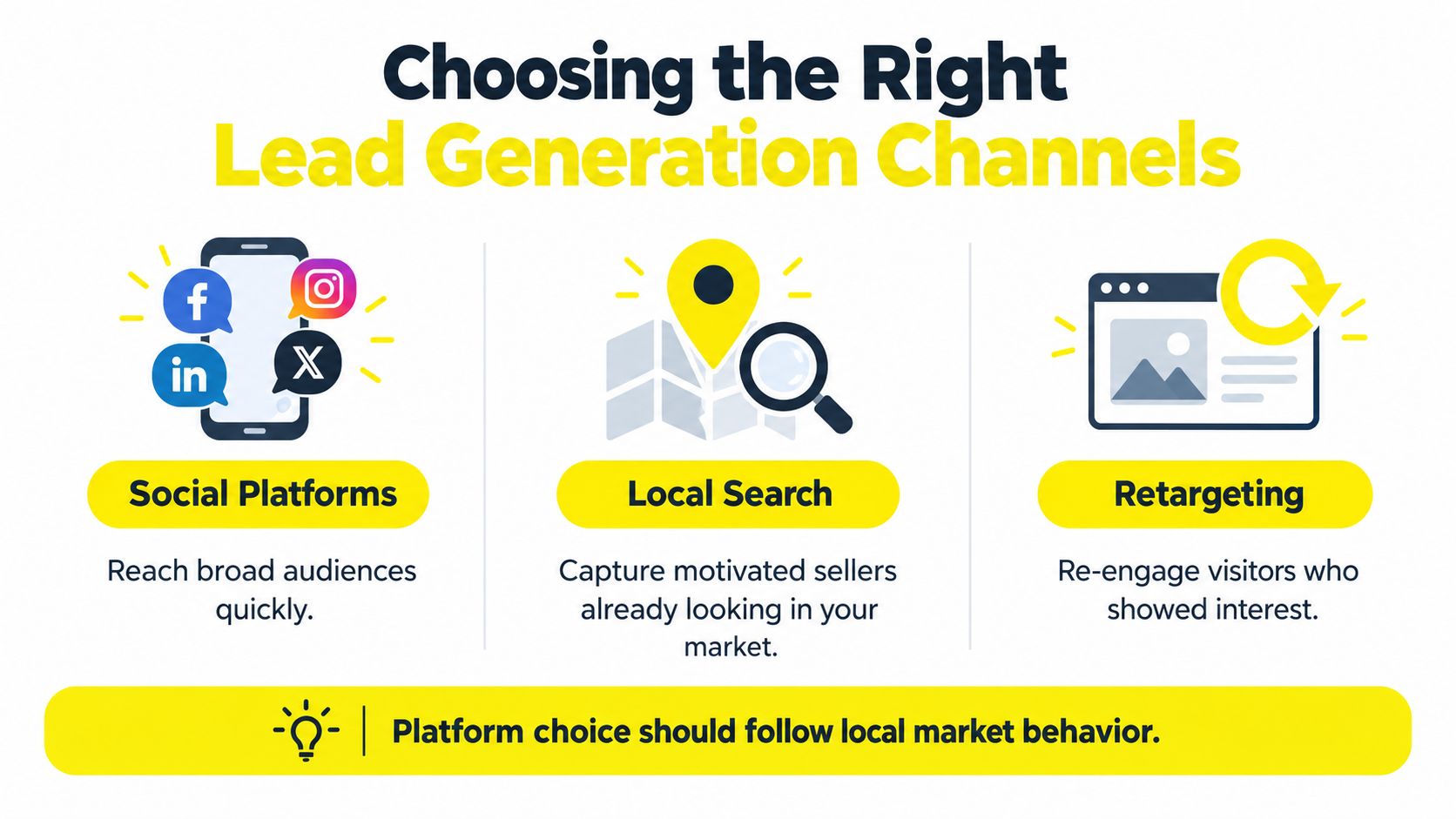
No single channel consistently produces the best investor leads. Social platforms create reach and let teams test motivations, creative angles, and neighborhood-specific messages quickly. Local search captures owners already seeking a solution. Retargeting keeps the offer visible after a visitor leaves without submitting details.
The 2024 NAR survey reported broad use of major social platforms among respondents, with 87% using Facebook, 62% Instagram, 48% LinkedIn, and 25% YouTube for their real estate business (NAR technology survey findings). The figures describe REALTOR® usage rather than investor-only campaigns, but they support a practical conclusion: social distribution is established infrastructure. The core question is whether the campaign reaches owners whose property and situation fit the acquisition strategy.
Match the channel to intent
Social platforms work when the seller may not be searching yet. A short video about inherited homes, vacant properties, or landlord fatigue can create recognition before an owner types a query. The trade-off is qualification. Broad targeting often attracts curiosity rather than a financeable opportunity, so the ad should name the situation, market, and transaction path clearly. Route responses into the CRM with source, campaign, property type, and motivation fields intact.
Local search captures existing demand. The same NAR survey found that 69% of users who acted on a real estate brand website began with a local search term, such as a city paired with a property phrase (NAR technology survey coverage). Build pages around situations the investor handles, such as inherited property, vacancy, or deferred maintenance. Repeating “cash home buyers” across every suburb may create impressions, but it does little to qualify a seller or explain the offer.
Retargeting supports longer decisions. An owner may read about selling an inherited property, compare alternatives, and return after speaking with family. Use follow-up ads to answer objections, clarify the next step, and send the visitor to a focused form. Exclude converted leads and suppress anyone already in a human sales process. Frequency limits also protect the brand from appearing intrusive.
Let the market and strategy decide
In Q2 2025, investors purchased 10.8% of U.S. homes, with high investor shares reported in Missouri, Mississippi, Nevada, Indiana, and Alabama. Memphis, St. Louis, and Oklahoma City were among the leading investor metros (investor market report). Those findings do not make every listed market attractive. Local distress signals, financing conditions, inventory, repair costs, and exit demand still determine whether a lead can become a deal.
A small-landlord campaign should emphasize occupancy, rents, and manageable property types. A flip campaign should lead with condition, repair scope, and resale assumptions. A wholesaler may prioritize speed and assignability. Channel selection follows those economics, while CRM stages should connect the original campaign to appointments, offers, contracts, and closed transactions.
Investors adding outbound prospecting to inbound campaigns can use PropLab's guide to outbound lead gen when building lists and coordinating outreach with paid acquisition.
Setting Up Landing Pages and Funnels That Convert
The landing page has one job: move a motivated visitor into a qualified, consent-aware conversation without adding unnecessary friction. It shouldn't look like a general corporate homepage with every service, neighborhood, and navigation link competing for attention.
Lead with the situation and the next step. “Sell a vacant house in [market]” is clearer than “Your trusted real estate solution.” The supporting copy should explain whether the investor buys as-is, what information the team needs, and what happens after submission.
Keep the first interaction focused
Build the form for mobile first. A seller may arrive from a social ad on a phone, so the address field, contact fields, and consent language should be easy to complete without zooming or hunting through the page.
A practical first-screen structure includes:
Specific headline: Name the property situation and service area.
Short explanation: Clarify the review process without promising a price or closing result.
Essential fields: Capture contact details, address, occupancy, condition, motivation, and timeline.
Consent language: Explain how the team may contact the seller by phone, text, or email.
Proof of local competence: Use real team information, market knowledge, completed work, or clearly documented experience.
Single next action: Ask for the property review or seller conversation, not several unrelated actions.
The form can use progressive profiling. Ask the most important qualification questions first, then gather photos, liens, mortgage details, or documentation during the follow-up process.

Preserve the source through the funnel
Every campaign should carry source information from the first click into the CRM. Use UTM parameters for platform, campaign, ad group, creative, and audience. Store those values in hidden form fields, and preserve them when the seller moves through a multi-step form.
Deduplication matters because one seller may submit a form, call the tracking number, and return through a retargeting ad. Match records using contact details and property address, then keep the earliest source and later touchpoints visible rather than creating separate sales tasks for the same person.
The thank-you page should set expectations. Tell the seller when someone will respond, what information to prepare, and how to reach the team if the matter is urgent. A confirmation email or SMS should acknowledge the submission without making an offer automatically.
Fast loading, readable typography, accessible content, and simple tracking are more valuable than elaborate animation. If the page makes the visitor work to understand the offer, the ad has already paid for attention that the funnel failed to convert.
Budgeting, Bidding, and Managing Acquisition Costs
Budgeting should begin with the deal model, not with a platform recommendation. An investor can tolerate a higher acquisition cost for a seller who fits the buy box, has a workable timeline, and reaches an offer conversation. A lower-cost inquiry can be unprofitable when the team spends time chasing incomplete information or low-intent responses.
Create a separate view for each market and strategy. Don't combine a flip campaign, a landlord campaign, and a wholesale campaign into one average. Each has a different acceptable acquisition cost because the expected margin, holding period, financing exposure, and disposition path differ.
Use cohorts instead of snapshots
A campaign may look weak during its first few days because many leads are still in qualification. Another may look efficient because it generated easy forms that later fail to produce appointments. Review cohorts by:
Market: City, county, neighborhood, or service area.
Strategy: Flip, rental, wholesale, creative finance, or another defined model.
Source: Social, search, referral, direct outreach, or retargeting.
Response time: How quickly the team acknowledged and called.
Outcome stage: Contacted, qualified, appointment, offer, contract, and closed.
Time to close: The delay between acquisition and final outcome.
This view prevents premature decisions. A campaign with higher cost per lead can remain viable if its qualified-seller and offer rates are strong. A campaign with inexpensive leads deserves a cut when the records repeatedly fail on contactability, property fit, or motivation.
Bid for the next valuable event
Optimize toward the deepest event the platform can receive reliably. If the advertising system only sees form submissions, it will favor the cheapest submissions. If the CRM can send back qualified appointments or other consented conversion events, bidding can move closer to the business outcome.
That setup requires clean records and enough volume for the platform to learn. Don't upload vague outcomes or mark every contact as qualified. A false conversion signal trains the campaign to find more of the wrong people.
Seasonality, local competition, creative fatigue, and response capacity all affect spending decisions. Increase budget only when the acquisitions team can handle the resulting conversations and when quality remains stable. A campaign that overwhelms follow-up can reduce its own return.
For a broader explanation of acquisition-cost controls and lead economics, learn how to reduce cost per lead. The important distinction is that reducing the visible lead price isn't the same as reducing the cost of a contract.
Tracking Leads and Scaling What Closes
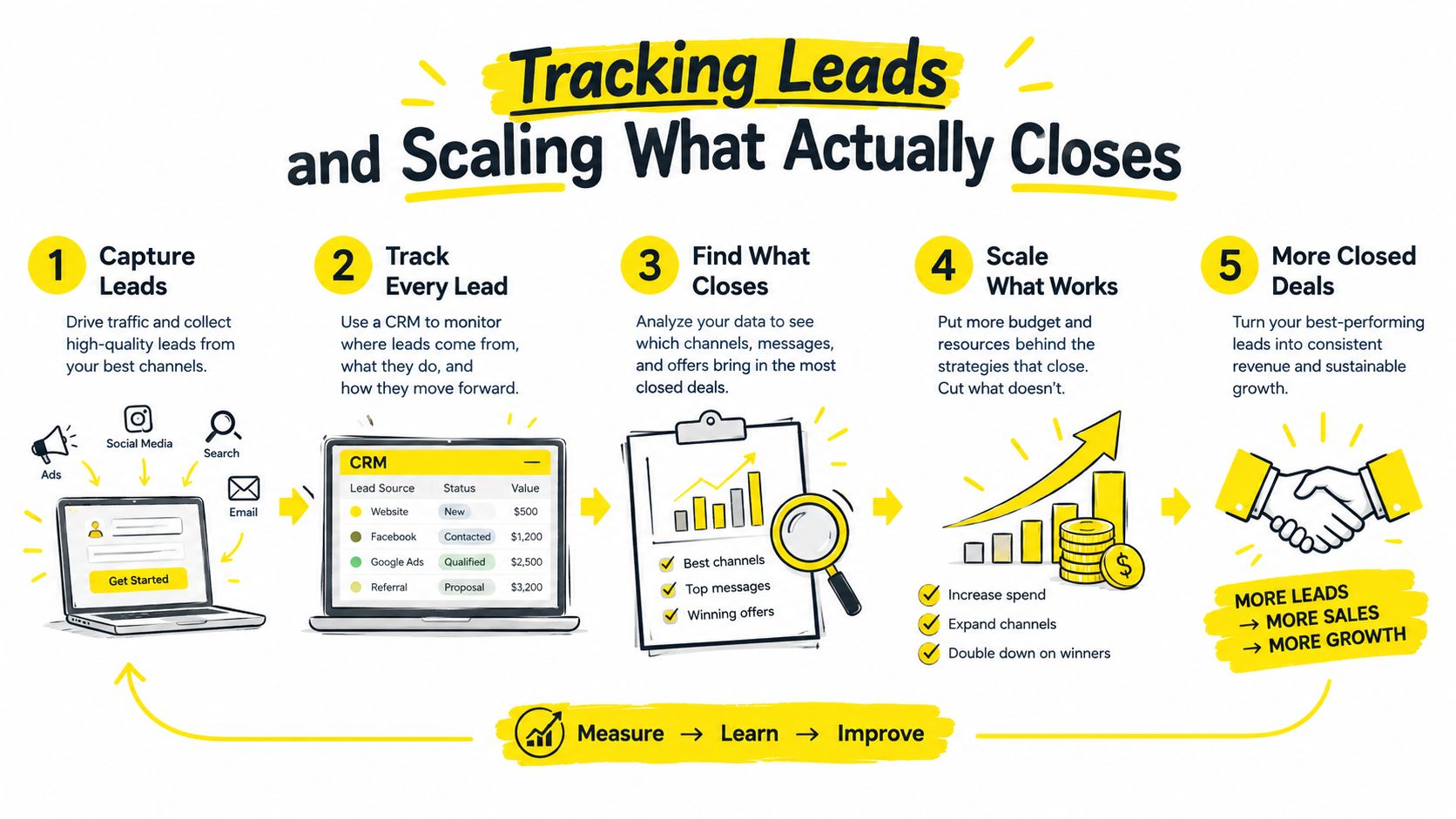
Backend discipline determines whether real estate investor lead generation becomes an asset or a recurring expense. Connect the advertisement, form, first response, acquisitions call, CRM sequence, and final deal record so every inquiry can be judged by its path to revenue.
Put every lead through the same operating path
Capture the seller record. Store phone, email, property address, motivation, occupancy, timeline, consent, source, campaign, and creative when available. Include the fields that help the acquisitions team decide whether the opportunity fits the intended deal strategy.
Acknowledge immediately. Send an SMS or email confirming receipt, explaining the next step, and providing a simple way to reply.
Route to a human caller. Route qualified inbound records to a caller within five minutes whenever staffing allows. A seller's attention can shift to another buyer or priority, so response speed affects contact and appointment rates.
Qualify consistently. Ask about condition, liens, mortgage balance, desired price, urgency, occupancy, and willingness to consider cash or creative finance. These answers help separate financeable opportunities from inquiries that only create activity.
Start the right CRM sequence. A qualified seller may need scheduled calls, texts, educational emails, appointment reminders, and clear task ownership. A poor-fit record should receive a different sequence rather than consume acquisitions time.
Report by source and outcome. Track contact rate, qualified-lead rate, appointment rate, offer rate, contract rate, and closed-deal rate alongside cost.
A CRM should make the next action obvious. If a lead has no owner, task, or next contact date, the system has stored information without creating follow-up.
Make attribution useful, not perfect
Seller journeys rarely follow one click. A prospect may discover an investor through a social video, search the company later, call from a local page, and negotiate offline. Last-click reporting assigns credit to the final interaction and hides the earlier work that created demand.
Use first-party CRM records, unique source fields, call tracking, consent-aware capture, and duplicate matching. Preserve the original source alongside later touchpoints. When a qualified appointment, offer, contract, or closed outcome occurs, record it against the same lead and property.
The useful question isn't “Which ad got the lead?” It's “Which combination of source, response speed, qualification, and follow-up produced the contract?”
Review performance by market and deal strategy. One source may produce many seller conversations but few offers. Another may produce fewer inquiries and more contracts because its creative prequalifies condition and timeline. A third may look weak until the team improves response speed or adjusts its follow-up sequence.
Use automation without outsourcing judgment
Automation can acknowledge submissions, assign owners, create tasks, summarize calls, and flag missing fields. It should not decide property value, promise a closing date, interpret sensitive financial circumstances, or replace a qualified acquisitions conversation.
Keep the reporting cadence operational. Review uncontacted leads, overdue tasks, response-time buckets, duplicate records, and stalled appointments before broad channel metrics. Then compare cost per qualified seller, cost per offer, cost per contract, and closed-deal performance by cohort.
Google and NAR research on real estate shoppers found an average of 11 searches before taking action on a real estate website, supporting a persistent, full-funnel approach rather than one advertisement and one follow-up attempt. For investors, persistence still needs to stay relevant. A seller researching probate, repairs, foreclosure pressure, or rental fatigue needs useful answers, not repeated generic reminders.
Wojo Media offers real estate investor campaigns that combine offer refinement, conversion-focused landing pages, Google and social advertising, and backend KPI tracking. This service can suit teams that want acquisition, funnel, creative, and downstream measurement managed as one performance system instead of treating paid traffic as a standalone activity.
The scalable playbook is direct: define the seller and deal strategy, build a message around a local problem, capture useful information, respond quickly, qualify with consistent fields, and measure through the contract. Investors can then spend with more confidence because they know which campaigns create conversations, which conversations create offers, and which offers become deals.
Wojo Media can help refine your investor offer, build conversion-focused landing pages, run Google and social campaigns, and connect acquisition reporting to backend outcomes. Visit Wojo Media to explore a lead-generation strategy built around qualified opportunities and contracts, not cheap form fills.
Comments