.png)
Social Proof in Advertising: The Ultimate Guide

Most advertisers treat social proof as a finishing touch, a few stars beneath the headline or a testimonial near the checkout button. The evidence points to a more consequential role. Showing five or more customer reviews has been associated with a 270% higher likelihood of purchase compared with showing no reviews, according to a widely cited analysis of social proof in advertising (Shno's review statistics summary).
That doesn't mean every testimonial will improve performance. Weak, generic, or poorly placed proof can waste creative inventory and even increase skepticism. The performance marketer's job is to match the right evidence to the right objection, carry it from the first impression through the landing page, and measure its effect on qualified revenue rather than likes or comment volume.
Understanding Social Proof in Advertising
Social proof in advertising is conversion infrastructure, not decoration. It gives prospects evidence that people facing a similar problem have considered, trusted, or used an offer. For cold traffic, the execution matters. A first-time supplement buyer seeing a verified review beside the price receives context that a brand claim alone cannot provide.
Advertising has used this mechanism for over 100 years, including early testimonial-led Ivory Soap advertising in the 1910s. Digital campaigns now turn print endorsements into review platforms, creator videos, customer screenshots, ratings, comments, client logos, and case studies. Advertisers can place those assets across paid social, search, video, email, and landing pages. (ProveSource's history and review statistics)
Digital proof matters because it can appear at the moment uncertainty surfaces. A prospect may see a product demonstration in a Meta ad, inspect reviews on a product page, watch a longer testimonial on YouTube, then encounter a retargeting ad that addresses the unanswered objection. That sequence makes social proof a full-funnel trust system, with different assets supporting different decisions.
Why proof changes performance
Paid media amplifies the message and the friction around it. An ad can promise a result, but without external validation, the prospect must judge the claim alone. A credible customer voice, relevant rating, or specific usage story gives the buyer a faster way to assess whether the promise deserves attention.
Review behavior shows why missing proof can restrict performance. Consumers commonly read reviews, and many avoid products with no reviews, according to the reported review-behavior findings (review behavior findings). The finding does not identify a winning format for every account. It does show why advertisers should treat proof as part of the buying environment, not an optional creative extra.
Practical rule: Treat social proof like an offer component. It should support the promise, address a known objection, and sit close to the next decision.
The operational implication
A performance team should ask four questions:
Which audience needs proof? A first-time buyer needs reassurance that a returning customer may not.
Which objection is active? Price, quality, complexity, legitimacy, and outcome risk require different evidence.
Where does doubt appear? The answer determines whether proof belongs in the hook, product gallery, form, sales page, or checkout.
Can the claim be verified? Unsupported evidence can create compliance and credibility problems.
For e-commerce, local services, and coaching offers, build a proof library and tag every asset by audience, objection, format, and funnel stage. Then distribute those assets across ads and conversion surfaces. Test qualified leads, purchases, booked calls, and backend revenue, not only clicks, likes, or comment volume. This turns trust signals into reusable campaign inputs with measurable commercial value.
The Psychology and Core Types of Social Proof
Buyers rarely have complete information. They can't fully test a supplement before ordering it, evaluate a coach before hiring them, or inspect a contractor's workmanship before booking. Under that uncertainty, people look for signals that indicate what a reasonable customer might do.
A 2025 study of 253 participants found that 88.5% rated reviews and ratings as moderately to very important in purchase decisions, while 90% said higher ratings and positive feedback increased trust (the 2025 study on reviews and ratings). The useful takeaway isn't that ratings replace persuasion. They make the persuasion easier to accept when the evidence is relevant to the buyer's situation.
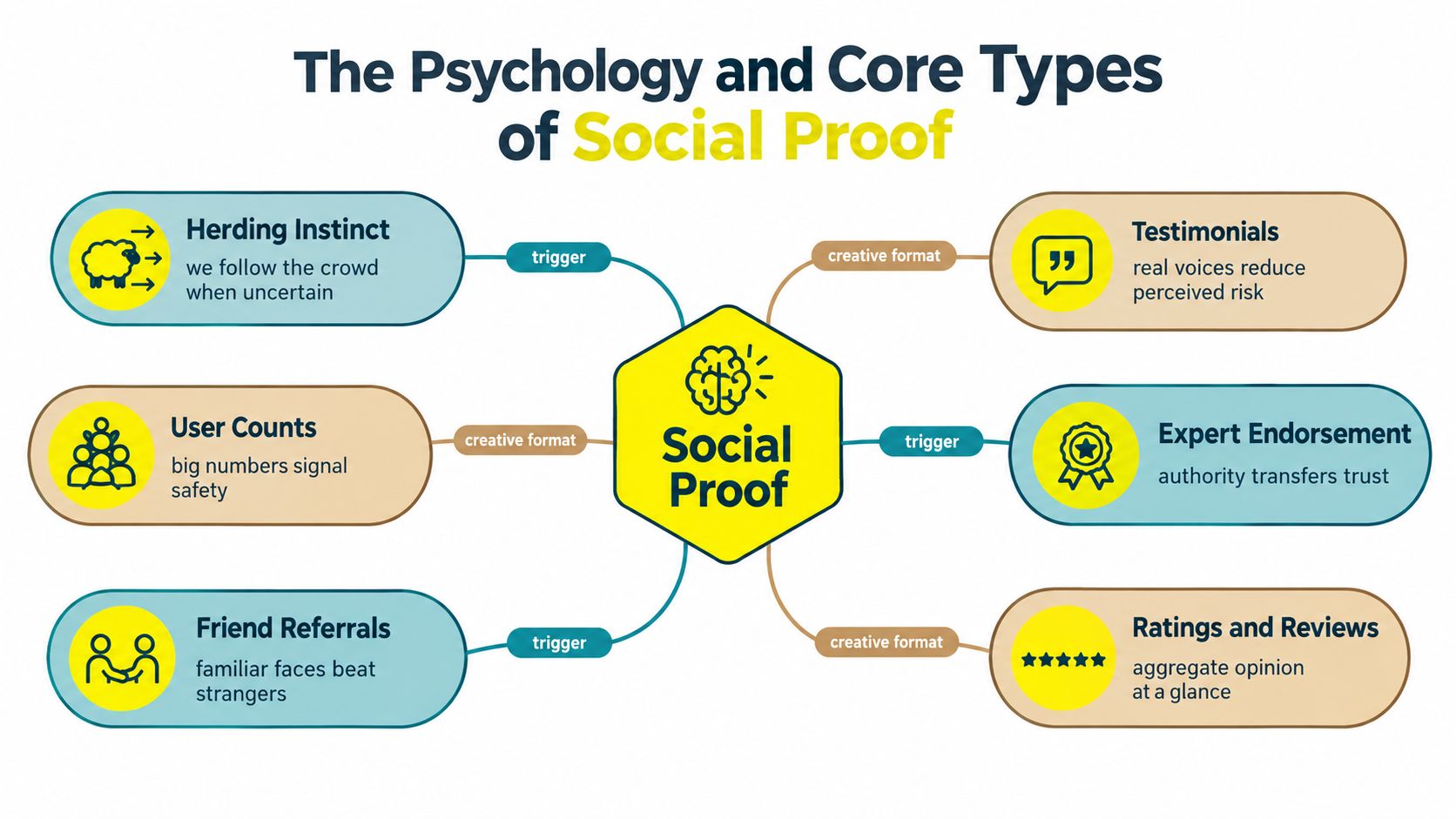
Match the format to the barrier
Testimonials reduce perceived outcome risk when the customer describes the problem, decision, and experience in concrete language. A selfie video can work particularly well in a feed because the imperfect setting signals a customer voice rather than a polished brand claim. The strongest version names the starting point and the specific change, without making an unsupported promise.
Ratings and written reviews compress many opinions into a quick scan. They're useful beside a product title, price, booking form, or checkout control, where the prospect wants reassurance without reading a full story. Make the review text searchable and visible, not trapped behind an interaction that adds friction.
User-generated content demonstrates real-world use. An unboxing, product routine, screen recording, or before-and-after process can answer questions that studio photography leaves open. It works best when the creator behaves like the target customer, not like a hired presenter reading a script.
Expert endorsements and creator partnerships transfer authority, but only when the source has a credible relationship to the problem. A recognized practitioner can reduce technical uncertainty. A creator with audience relevance can make a product feel socially familiar. Fame alone doesn't guarantee trust.
User counts and engagement signals communicate adoption, while referral proof connects the offer to a familiar person or community. Trust badges, certifications, and recognizable client logos help with transactional or institutional anxiety, but they need context. A badge without an explanation can look like decoration.
For brands managing large comment volumes, a workflow for comment automation for DTC brands can help surface recurring questions and credible customer interactions. Automation should organize and route genuine conversations, not manufacture consensus.
The practical test is simple. If the proof doesn't answer a question the buyer already has, it probably doesn't belong in that placement.
Deploying Social Proof Across the Full Funnel
A prospect shouldn't encounter the same testimonial at every stage. Cold traffic needs recognition and relevance. Consideration needs evidence. Conversion needs reassurance at the point of action. Treating those stages separately prevents a common mistake, using a detailed case study as a scroll-stopping hook or a vague influencer clip to close a high-friction purchase.
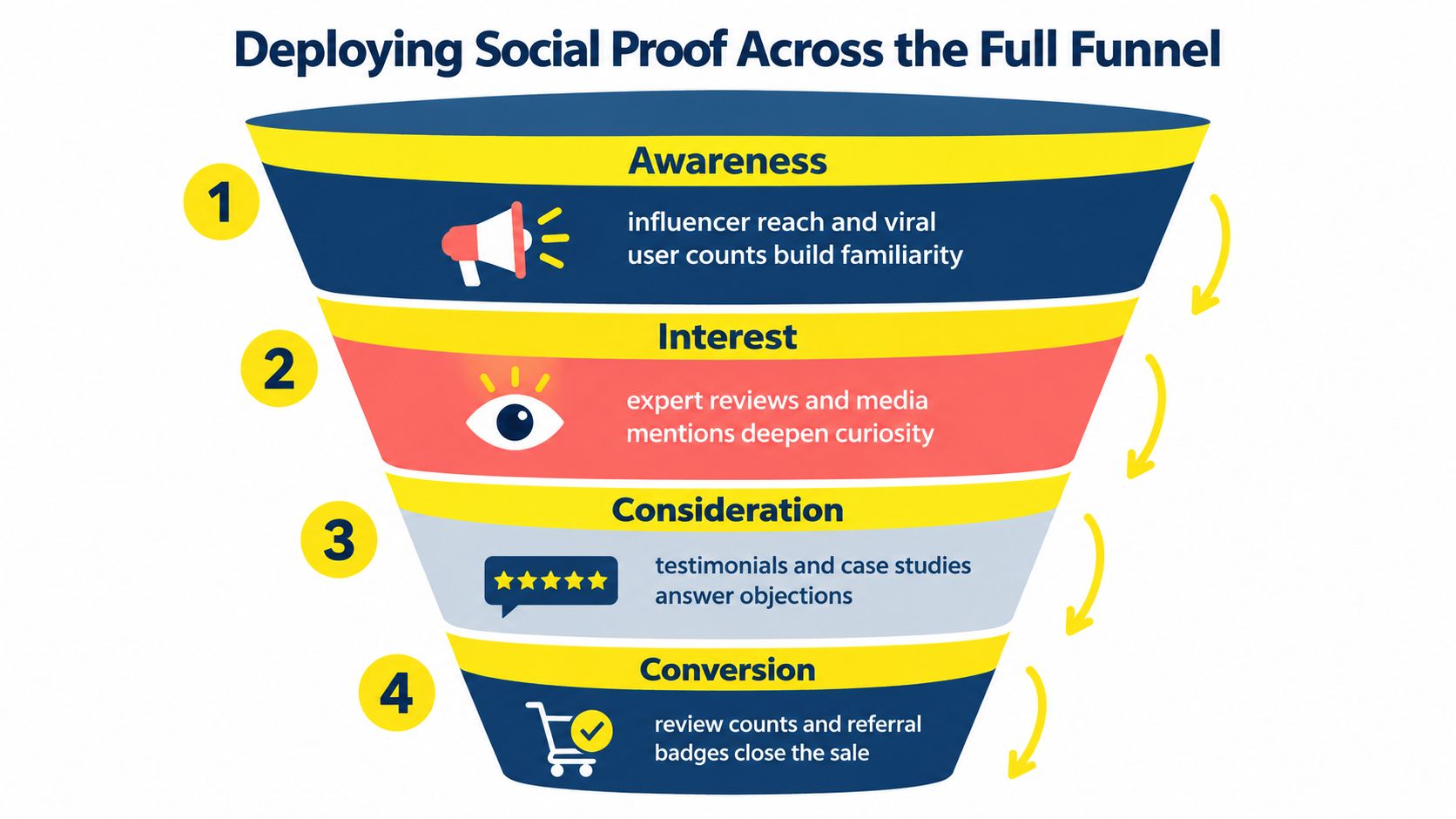
Top of funnel
Prospecting ads must earn attention before they can explain everything. Use relatable UGC, creator demonstrations, customer language, and visible signs of real usage. The opening should identify the problem quickly, then let a credible person show how the product or service fits into their life.
On TikTok, Instagram Reels, YouTube Shorts, and Meta feeds, a raw customer-style video often gives the viewer a reason to keep watching. The proof doesn't need to explain the entire offer. It needs to establish, “People like me use this for the problem I recognize.”
Middle of funnel
Consideration audiences need specificity. They may have watched an ad, visited a product page, opened a lead form, or engaged with content without taking the next step. Give them comparison-friendly evidence:
Detailed testimonials: Address the objection that stopped the first action.
Case studies: Show the customer context, process, and outcome without hiding the conditions.
Review excerpts: Place relevant comments beside features, pricing, or guarantees.
Expert content: Explain why the method or product works, especially for technical offers.
Maintain message continuity. If the ad promotes convenience, the landing page should feature proof about convenience near the next action. Sending the click to a page dominated by unrelated praise forces the buyer to restart their evaluation.
Bottom of funnel
Retargeting should remove the final reason for hesitation. Product advertisers can use verified reviews, customer photos, delivery reassurance, and answers to common objections. Local businesses can show location-specific testimonials, appointment expectations, and evidence of professional standards. Coaches can use a structured client story that clarifies who the program suits and what participation requires.
Use search ads and landing pages to reinforce intent rather than repeat awareness creative. A retargeted message such as “See how customers solved this specific problem” is more useful than another broad brand statement.
A short video can also explain the sequencing principle:
Track the handoff from ad to page. If click-through improves but qualified conversion doesn't, the proof may be attracting curiosity without resolving purchase risk.
Industry-Specific Applications and Examples
The same five-star graphic won't carry equal weight across business models. A skincare buyer wants to see texture, routine, and real usage. A local service prospect wants confidence that the provider operates nearby and delivers a professional experience. A coaching buyer wants evidence that the method applies to someone with a comparable starting point.
Industry | Primary Trust Barrier | Best Ad Creative Proof | Best Landing Page Proof |
|---|---|---|---|
E-commerce | Product quality, fit, performance, and delivery risk | UGC demonstrations, unboxings, customer routines, review excerpts | Verified reviews near product details, customer photos, product-specific objections, usage demonstrations |
Local services | Provider legitimacy, local reputation, appointment confidence | Geo-specific video testimonials, customer visits, staff introductions, neighborhood references | Reviews tied to the service and location, credentials, process explanation, booking reassurance |
Coaching and consulting | Whether the method fits the prospect and can produce a meaningful outcome | Client story videos, objection-led testimonials, expert teaching clips | Detailed case studies, client context, program process, expectations, relevant authority signals |
Real estate | Transaction risk, expertise, market judgment, and responsiveness | Client transaction stories, property walkthroughs, market commentary, referral evidence | Closing-process proof, client testimonials, credentials, local expertise, clear next steps |
E-commerce
Lead with observable use. A creator showing how a product behaves in a real routine can outperform a polished feature montage because the viewer sees context, friction, and application. On the product page, keep proof adjacent to the claims it supports. A review about fit belongs near sizing information, while a review about durability belongs near materials or construction.
Avoid using a large review total as a substitute for substance. Volume can attract attention, but a specific review helps the buyer decide.
Local services
Local proof should feel local. A med spa can use a testimonial that explains the consultation experience and customer expectations, while a home service company can show the technician's process and communication. The landing page should make the next step concrete, including what happens after the form or booking request.
A generic national influencer may create awareness but won't necessarily answer, “Will this provider treat me well in my area?”
Coaching and consulting
Transformation claims need context. Show the client's situation before engagement, the work involved, and the type of support provided. Avoid presenting an exceptional outcome as a typical guarantee. The page should explain the mechanism, participation requirements, and who shouldn't enroll.
Real estate
Real estate proof must demonstrate judgment, not just happiness. Use client stories that clarify the transaction, the communication standard, and the expertise involved. For investors, lenders, and agents, local market knowledge and process transparency can be more persuasive than broad popularity signals.
Tactical Implementation and A/B Testing
Social proof becomes a performance asset only when you test it like any other conversion input. Change one evidence variable at a time, hold the commercial conditions steady, and judge the result by qualified revenue rather than engagement alone.
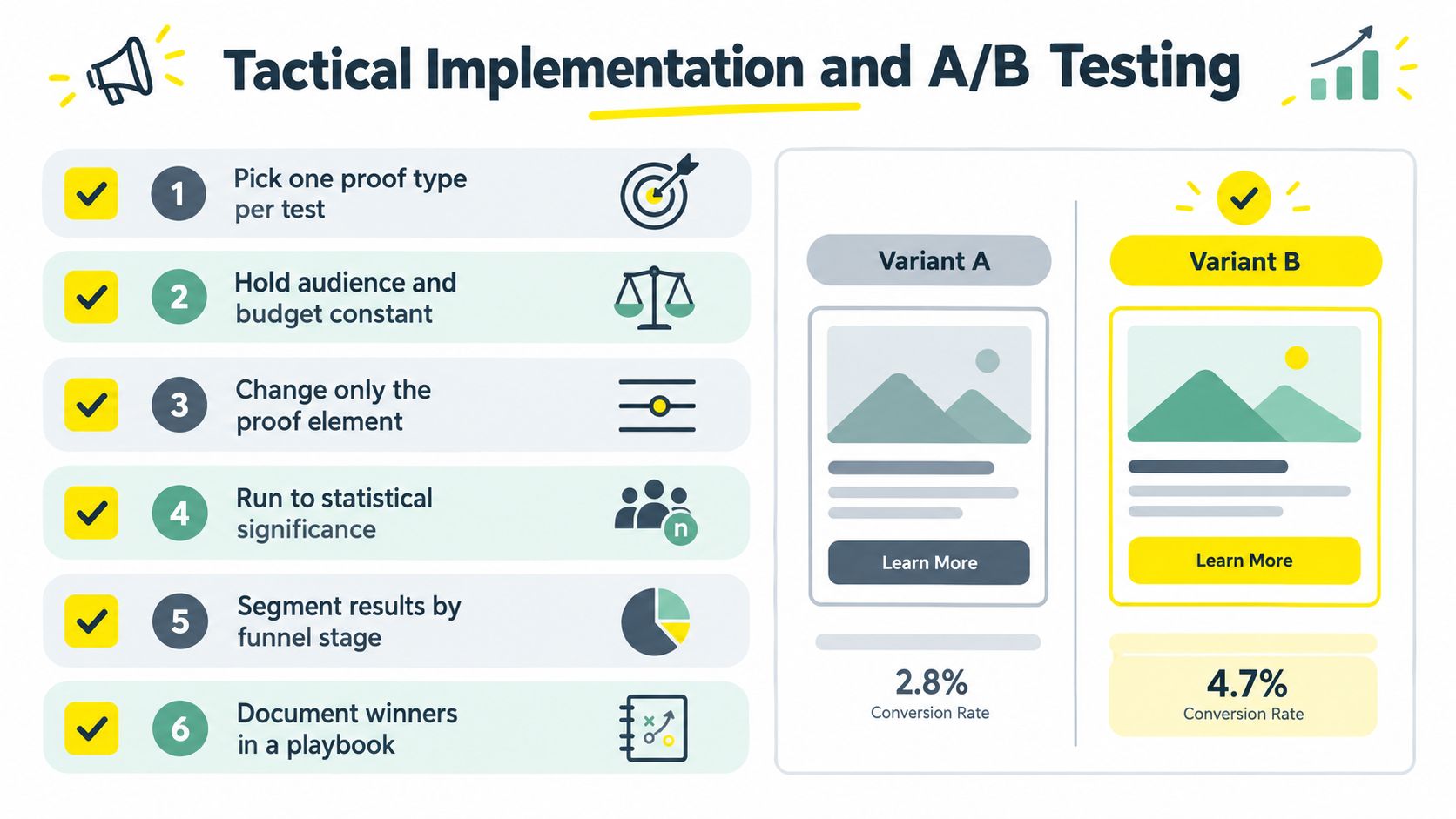
Build a controlled test
Start with one decision. Does a selfie testimonial generate more qualified demand than a polished brand video for the same audience and offer? Keep the audience, budget conditions, offer, destination, and primary message consistent. Change the proof format, then monitor what happens after the click.
Useful test variables include:
Source: Customer, creator, expert, or employee.
Presentation: Selfie video, edited interview, screenshot, written quote, or rating module.
Specificity: General praise versus a story addressing a defined objection.
Placement: Opening hook, mid-video evidence, headline support, form-side testimonial, or checkout reassurance.
Context: Similar customer profile, location, use case, or business model.
Set a minimum decision sample before reading the result. For most accounts, that means at least 30 conversions per variant or a full week of spend at a steady budget. Record the sample size beside the winner in the creative playbook. A short engagement spike can identify an attention-grabbing asset, but it cannot establish which proof converts the right prospects.
Measure the revenue path
Use one measurement chain across the funnel:
Thumb-stop ratio: Does the proof keep the intended audience watching?
Click-through rate: Does the evidence create enough interest to continue?
Landing-page conversion rate: Does the page preserve trust from the ad?
Lead quality or purchase behavior: Do resulting prospects fit the commercial objective?
Return on ad spend: Does added revenue justify media and production cost?
For e-commerce, connect creative variants to product-level revenue and refund behavior. For lead generation, track booked appointments, attended consultations, qualified opportunities, and closed sales. A testimonial can lower cost per lead while attracting prospects who never progress, so lead volume alone cannot decide the test.
Test review visibility, placement, specificity, and audience context rather than treating review count as a standalone answer. Genuine, relevant evidence should sit close to the objection it resolves, and the same review may perform differently in an ad, product page, booking flow, or checkout.
Document every result in a creative playbook. Record the objection, proof source, format, placement, audience, funnel stage, sample size, and backend outcome. Over time, the account builds a repeatable evidence system instead of a random testimonial archive. That system gives e-commerce teams, local-service operators, and coaching businesses a clearer basis for scaling trust signals with spend.
Common Pitfalls and How to Avoid Them
More proof isn't automatically better. A page overloaded with badges, logos, ratings, and testimonials can make the buyer search for the actual decision instead of helping them make it.
A 2025 study of social video feed advertisements found that both the number and quality of social proof affected impulse buying, with product type influencing the size of the effect (the study on social proof in video feeds). That distinction matters. Raw interaction counts may indicate attention, but detailed and credible evidence does more to reduce uncertainty.
Four failure patterns
Fake-looking reviews: Vague praise, repeated phrasing, missing context, and stock-photo identities trigger doubt. Use permission-based customer feedback with relevant details and clear attribution.
Proof fatigue: Showing the same creator clip across every placement weakens its impact and accelerates creative wear. Rotate customer stories, formats, and objections while preserving the core promise.
Badge clutter: Security seals, awards, certifications, and partner logos should support a specific concern. Remove any badge that doesn't help the buyer understand quality, safety, legitimacy, or process.
Audience mismatch: A celebrity or large creator may bring reach without transferring relevant trust. Choose a voice whose experience resembles the buyer's situation or whose expertise directly relates to the problem.
Protect credibility while scaling
Never edit a testimonial until it changes the customer's meaning. Don't turn a nuanced experience into an absolute claim, and don't imply a typical result from an isolated story. Keep documentation for permissions, claims, and the context in which the proof was collected.
The strongest proof is not the loudest proof. It is the evidence that makes the buyer's unanswered question easier to resolve.
Platform policies and customer expectations also make authenticity operationally important. Moderate comments for safety and relevance, but don't erase reasonable criticism just because it complicates the narrative. A thoughtful response to a concern can build more trust than a feed containing only perfect praise.
Scaling Your Campaigns with Proven Trust Signals
Profitable scaling requires more than adding budget to a winning ad. It requires a connected system in which the offer, landing page, omnipresent creative, and data reinforce one another. Social proof belongs in every part of that system, but each placement should perform a distinct job.
Audit the account and website with four questions:
Does cold creative show a credible customer or use case?
Does the landing page answer the objection implied by the ad?
Does retargeting introduce new evidence rather than repeat the same asset?
Does reporting connect proof exposure to qualified revenue?
Preserve the trust signals that already exist when campaigns or ad structures change. This AdManage.ai guide to social proof scaling offers useful operational context for maintaining accumulated engagement during Facebook ad scaling.
Wojo Media is one option for teams that want an agency to connect testimonial-led creative, conversion-focused landing pages, omnipresent paid campaigns, and backend KPI tracking across e-commerce, local services, coaching, and real estate. Audit your proof library this week, identify the largest trust gap in your funnel, and test one specific evidence variable against a controlled baseline.
If you need help turning customer feedback into full-funnel paid creative, landing pages, and measurable campaigns, Wojo Media can review your current setup and build a practical growth plan around the proof you already have. Visit the site to request a free demo call and discuss where stronger social proof could improve qualified conversions.
Comments