.png)
TikTok Ads for Ecommerce: The Scaling Playbook

The most popular advice about TikTok ads for ecommerce is incomplete: launch broad, let the algorithm optimize, and scale the moment Ads Manager reports an attractive ROAS. That workflow can produce a polished dashboard and disappointing business results. TikTok Shop has become a serious commerce channel, with global GMV reaching $64.3 billion in 2025, nearly doubling from $32.6 billion in 2024, according to an independent industry report from Webtonic's TikTok ecommerce statistics report. Scale is available, but only for brands that separate credited revenue from incremental revenue, choose the right checkout surface, and keep fresh UGC entering the account.
The 2026 battleground isn't basic campaign setup. It's the interaction between TikTok's blended attribution, native Shop behavior, off-platform measurement, and creative fatigue. A video can earn cheap attention while the landing page loses the sale. A Shop campaign can convert efficiently while giving you less control over customer data and post-purchase economics. The operator's job is to connect those decisions to contribution margin, repeat purchase behavior, and total backend revenue.
Rethinking Attribution and True Incrementality
A strong ROAS in TikTok Ads Manager does not establish that TikTok created the sale. It shows that TikTok received credit under its measurement rules. The default attribution window is 7-day click and 1-day view, and reporting can include click-through, view-through, and engaged view-through credit, as explained in this analysis of TikTok attribution for ecommerce.
That distinction becomes important for products with longer consideration cycles, established branded search, repeat customers, or active Meta and email programs. A shopper might watch a TikTok ad, search for the brand later, click an email, and purchase through a direct visit. TikTok can still receive partial credit, even when the ad's incremental contribution remains unclear.
Practical rule: Use platform ROAS as a directional optimization signal, not as the final profitability statement.
What blended reporting can hide
View-through attribution is not automatically invalid. An impression can influence a purchase without producing a click. The problem starts when a brand treats every credited conversion as fully incremental, then raises spend while total revenue and contribution margin barely improve.
This attribution gap is especially relevant in 2026 because TikTok's reporting blends several paths into one platform result. Shop orders, off-platform purchases, branded search, email-assisted orders, and returning-customer demand can all appear more efficient inside Ads Manager than they are in the company's financial results.
Use a diagnostic sequence that connects ad reporting to backend economics:
Start with total business performance: Compare TikTok spend with overall new-customer revenue, blended MER, contribution margin, and cash collected.
Separate conversion paths: Report TikTok Shop purchases, off-platform purchases, branded search revenue, email-assisted orders, and direct orders independently.
Compare measurement systems: Review ecommerce-platform data, server-side events, post-purchase surveys, and finance reporting alongside Ads Manager.
Test holdouts where possible: Restrict TikTok exposure for a comparable audience, geography, or time period, then compare total demand rather than attributed conversions alone.
How to test incrementality
A useful incrementality test begins with a specific hypothesis. For example, ask whether TikTok prospecting increases first-time customer revenue beyond demand that would have arrived through search, email, direct traffic, or existing remarketing.
Keep the test controlled. Do not change the offer, landing page, email calendar, and Meta budgets at the same time. Track total orders, new customers, gross profit, branded search behavior, and repeat-purchase quality. A campaign can report attractive attributed ROAS while failing to increase total contribution margin.
The test design should also reflect the checkout decision. Native TikTok Shop may shorten the path to purchase and generate stronger platform-reported efficiency, while off-platform checkout can provide more control over customer data, merchandising, and post-purchase measurement. Compare the complete economics of each route, not only the attributed order value.
Perfect causal measurement is rarely available. A consistent framework still improves budget decisions by asking whether TikTok is creating demand, accelerating existing demand, or harvesting demand that already existed. Each role requires a different efficiency threshold and a different scaling decision.
Tracking Setup and the Native Checkout Decision
Tracking should be configured before creative testing, not repaired after the first spend. The basic setup combines the TikTok Pixel for browser events with Conversions API for server-side event transmission. Browser tracking captures behavior on the site, while server-side signals help preserve event delivery when browsers, consent choices, and privacy controls limit what the pixel can observe.
Start by mapping the customer journey to distinct events. A typical ecommerce implementation should distinguish product views, add-to-cart actions, checkout starts, and completed purchases. The event names matter less than the discipline of firing each event once, passing accurate value and currency, and ensuring that the purchase event reflects the actual transaction rather than a page refresh.
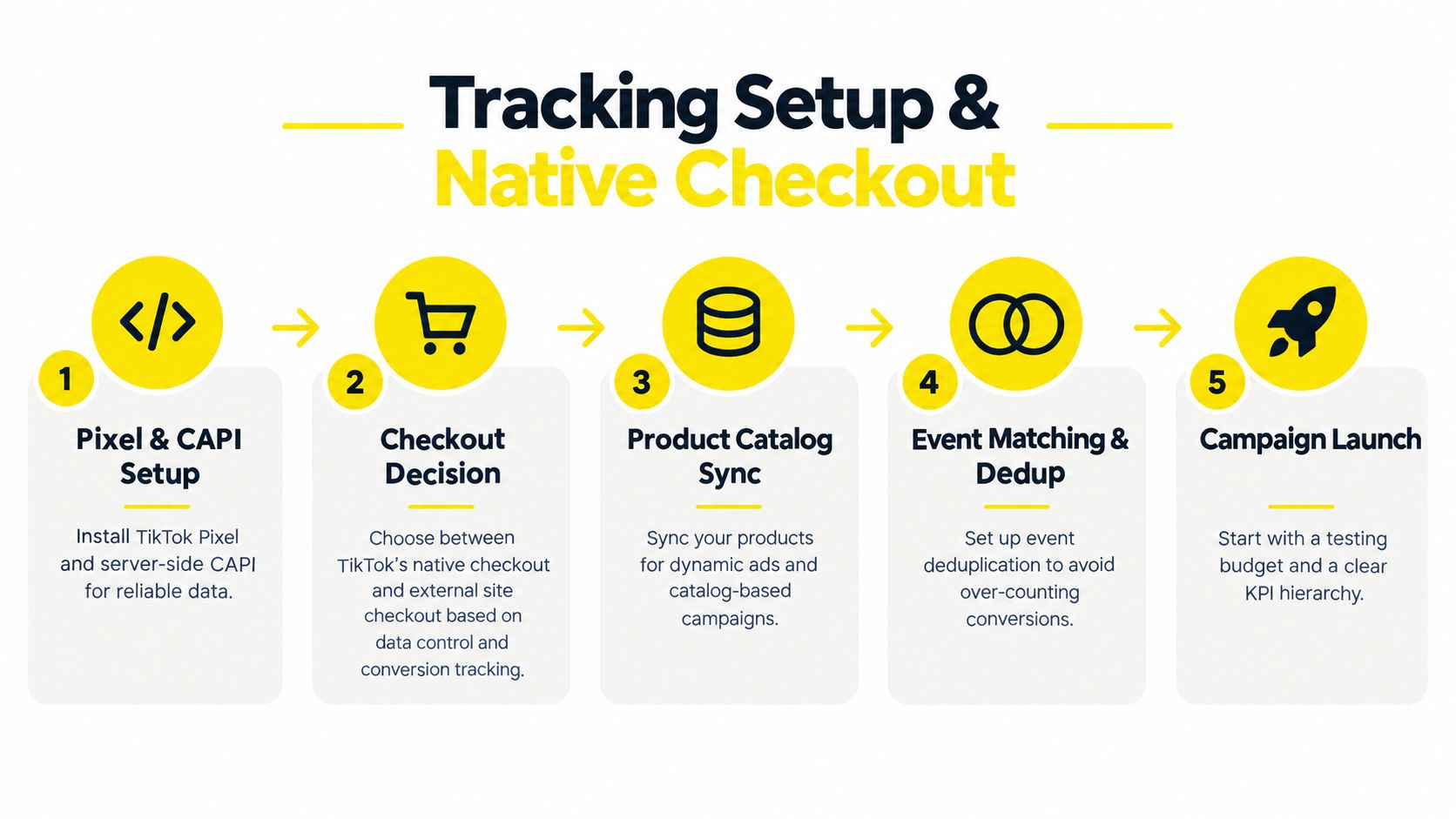
A practical tracking checklist
Install the Pixel: Place the TikTok Pixel through your ecommerce integration or tag manager, then verify that core events fire on the intended actions.
Add Conversions API: Send purchase and key funnel events from the server, using the same event identifiers required for deduplication.
Validate event matching: Check that browser and server events resolve to the same user action. Duplicate purchases can make performance appear stronger than it is.
Sync the catalog: Keep product names, prices, availability, images, and variants aligned between your store and TikTok Shop.
Reconcile revenue: Compare TikTok reporting with Shopify or your commerce platform, payment processor records, and finance data.
The strategic decision is whether the ad should send the buyer to an external store or complete the transaction inside TikTok. Native checkout removes a redirect and keeps more of the journey within the platform. TikTok's 2025 Q5 Commerce Playbook says nearly 70% of users are likely to purchase after Video Shopping Ads and Shop Ads, as reported in the official TikTok commerce playbook.
Native Shop versus external checkout
TikTok Shop is usually attractive when the product is easy to understand, the catalog is accurate, fulfillment is reliable, and the team can manage reviews, returns, creator commissions, and platform operations. It can reduce friction for impulse-friendly products and gives TikTok a clearer native conversion signal.
An external Shopify or headless checkout gives you more control over merchandising, bundles, subscription flows, first-party customer data, upsells, analytics, and post-purchase journeys. It may be the better surface when average order value depends on education, when the offer requires a complex landing page, or when backend lifetime value matters more than the first transaction.
Since GMV Max became the default and only supported format for TikTok Shop ads in July 2025, brands shouldn't evaluate Shop campaigns using the same assumptions as classic off-platform prospecting. The question is no longer which ad format has the lowest CPA. It's whether TikTok-native conversion behavior or onsite revenue produces better contribution margin, customer quality, and data control.
Engineering High-Converting UGC Creatives
Creative does the targeting work on TikTok. A narrow audience with a strong video can find buyers, while a carefully selected audience with a weak opening will still be skipped. The most useful UGC ads don't merely look casual. They make a specific promise, demonstrate the product quickly, and answer the objection that would otherwise stop the click.

Start with the first spoken line or visual action. Don't open with a logo, a slow product beauty shot, or a brand introduction. Open with the buyer's problem, a surprising demonstration, a clear comparison, or a result the viewer wants to understand.
The anatomy of a durable UGC ad
A practical script usually has five moving parts:
Pattern interrupt: Show the product in use, reveal the problem, or state a pointed claim immediately.
Specific context: Explain who the product is for and when the problem occurs.
Proof through demonstration: Let the viewer see texture, fit, setup, transformation, packaging, or usage rather than relying on adjectives.
Objection handling: Address price, comfort, durability, ingredients, sizing, shipping, or compatibility before the buyer has to ask.
Direct next step: Give one clear action, such as viewing the product, choosing a variant, or claiming the current offer.
The script should sound like a person with a reason to recommend the product, not a presenter reading a brochure. A skincare creator might begin with the mistake she made in her routine, show the application, explain what changed, and then answer whether the product works for sensitive skin. A home product creator might show the annoying task first, demonstrate the product solving it, and then reveal the details that justify the purchase.
Creative principle: Build around the buyer's tension, not the brand's feature list.
Use captions, but don't turn the screen into a paragraph. Keep the main phrase readable, place it away from interface elements, and let the spoken explanation carry nuance. Cut pauses aggressively, vary framing, and insert close-ups when the viewer needs proof. A handheld shot can feel native, but poor lighting, muffled audio, or confusing edits reduce trust rather than increasing authenticity.
The ContentBuck library to browse our ad creatives can help teams study different visual treatments and hook structures before briefing creators. Use references as a starting point, not as templates to copy. Your product, buyer, proof, and offer still need their own angle.
Designing for fatigue
One winning video won't carry a scaling account indefinitely. Build modular assets where the hook, creator, demonstration, objection, and call to action can be recombined without repeating the same message word for word.
Brief several creators around the same customer problem, then request different openings and demonstrations. Keep a library of raw footage, alternate hooks, product close-ups, testimonial lines, objection responses, and end cards. When performance softens, replace the fatigued component first instead of discarding the entire concept.
A strong creative system also protects the media team from false diagnoses. If CTR falls while the offer and landing page remain stable, the opening or visual treatment may need replacement. If CTR remains healthy but purchases weaken, new hooks won't solve a checkout or offer problem.
Campaign Architecture and Bidding Strategies
A reliable TikTok account is usually simpler than a nervous advertiser expects. Too many campaigns, ad groups, interests, and exclusions divide conversion signals before the system has enough evidence to identify profitable buyers. Start with a clear prospecting campaign, a separate retargeting path when audience volume supports it, and a creative set built around distinct angles rather than tiny edits.
Broad targeting is often the sensible starting point for ecommerce because the creative gives TikTok useful information about who responds. Add exclusions for existing purchasers when the objective is new-customer acquisition, but don't stack so many interests and behaviors that delivery becomes artificially narrow.
Match the bid strategy to the evidence
Lowest Cost is the practical entry point when the account lacks stable conversion history. It gives the system room to find available buyers without forcing delivery into an unrealistic efficiency constraint.
Cost Cap becomes more useful after you understand the account's actual acquisition economics. Set it near a sustainable CPA, not an aspirational number copied from a spreadsheet. If the cap is too restrictive, delivery may collapse or concentrate in low-volume pockets.
A ROAS target can help mature campaigns where purchase values are reliable and the catalog has enough conversion variation for the system to optimize against revenue quality. It isn't a substitute for clean event values, accurate margins, or incrementality analysis.
The learning phase deserves restraint. Large changes to budget, bid, audience, or creative can disrupt delivery and make the data harder to interpret. Consolidate where possible, allow enough spend for meaningful signal, and judge performance against a pre-defined decision window rather than reacting to every hourly fluctuation.
A workable launch structure
Prospecting: Broad audience, conversion objective, strongest UGC angles, and a bid strategy that prioritizes learning.
Retargeting: Recent product viewers, cart users, or engaged viewers, with proof and objection-handling creative.
Catalog or Shop activity: Product-level delivery when native commerce is part of the strategy.
Creative rotation: Several distinct concepts, not multiple color grades of the same opening.
Measurement layer: Platform reporting paired with store revenue, blended acquisition cost, and contribution margin.
For production guidance on create converting TikTok ads, focus on the principles that affect delivery, especially native framing, fast context, clear demonstrations, and a direct CTA. The account structure should serve the creative system, not compensate for weak creative.
Testing Frameworks and Scaling Winners
Testing earns its place when every experiment answers a defined business question. Weak click-through usually points to the hook, opening visual, or audience problem. Strong clicks followed by weak purchases shift attention to offer clarity, landing-page continuity, product proof, checkout friction, or traffic quality. Expensive delivery with weak engagement calls for a review of audience limits, creative relevance, placements, and auction conditions.
Benchmark figures are directional because format, checkout surface, attribution window, and product consideration change the denominator. The Redclawey's ecommerce benchmark compilation provides a useful comparison point, but the account's own funnel and backend margin should determine decisions. Native Shop conversions and external-site purchases should stay separate in reporting, especially when TikTok's blended attribution can assign credit across different customer paths.
TikTok Ecommerce Benchmark Diagnostics
Signal | What it may indicate | Next diagnostic action |
|---|---|---|
Weak CTR | The opening fails to earn attention, or the problem is unclear | Replace the first visual, sharpen the buyer problem, and test a different creator or hook. |
Strong CTR, weak purchase rate | The ad promise is not being fulfilled after the click | Check page continuity, price, proof, shipping, checkout friction, and offer strength. |
High CPM with weak engagement | Audience limits, creative mismatch, placement mix, or auction pressure | Broaden restrictions where appropriate, refresh the concept, and compare delivery by placement. |
Strong Shop conversion, weaker site conversion | Native checkout reduces friction, or the external page loses intent | Compare product, offer, proof, and checkout behavior without combining the two surfaces. |
Reported ROAS without margin support | Attributed revenue may overstate profitable demand | Reconcile platform revenue with blended acquisition cost, first-order contribution margin, refunds, repeat quality, and incrementality. |
Use these signals to locate the bottleneck, not to impose a universal target. A high-consideration product may require more education, while an impulse product may convert quickly. The first test should address the largest constraint that can be changed and measured.
A disciplined testing loop
A 3:2:2 structure works as a production system, not a guarantee. Start with three distinct concepts, create two meaningful variations of each, and place them in two audience or delivery contexts when volume supports a fair comparison. Hold the offer and destination steady while testing the creative question. If both checkout paths are under consideration, test them as separate experiments rather than mixing their conversion data.
Judge winners beyond CTR. Review qualified sessions, add-to-cart rate, checkout completion, first-order contribution, refund behavior, and post-purchase quality. Cheap clicks from poor-fit shoppers can make a creative look efficient while weakening the business.
Scale horizontally when one idea survives new creators, openings, demonstrations, or proof formats. Scale vertically only after increased spend preserves acceptable economics and operations can fulfill the added demand. Rising frequency and declining engagement usually call for a new hook, creator, setting, or proof angle before broad audience changes. Build a reusable UGC pipeline around those variables, so fatigue produces the next test instead of forcing an emergency reset.
Sustaining Profitable Growth Across Channels
TikTok should create discovery, but it shouldn't own the entire customer journey. A buyer may first encounter a product in a TikTok video, compare it through Google, revisit through Meta retargeting, and complete the purchase after an email reminder. Treating each platform's reported ROAS as an isolated truth encourages duplicated credit and poor budget decisions.
The sustainable model connects the offer, landing experience, creative output, and backend reporting. TikTok creative reveals which problems and demonstrations attract attention. Search captures explicit demand. Meta can re-engage known visitors. Email and push sequences recover abandoned carts and support repeat purchases. The measurement layer evaluates the combined result.
Four operating priorities
Offer alignment: Make the product, price, bundle, guarantee, and proof consistent from the TikTok video through checkout.
Landing-page continuity: Match the page headline and visual evidence to the promise made in the ad.
Creative throughput: Keep creators producing new hooks, demonstrations, testimonials, and objection responses before fatigue becomes an emergency.
Omnichannel economics: Track new-customer cost, contribution margin, refund behavior, repeat purchase quality, and total revenue alongside platform metrics.
Native Shop can be the right conversion surface for convenience and impulse. External checkout can be the right choice for data control, merchandising, and lifetime value. Neither deserves automatic priority. The profitable decision depends on product complexity, fulfillment, margin structure, customer retention, and how much control the brand needs after the first order.
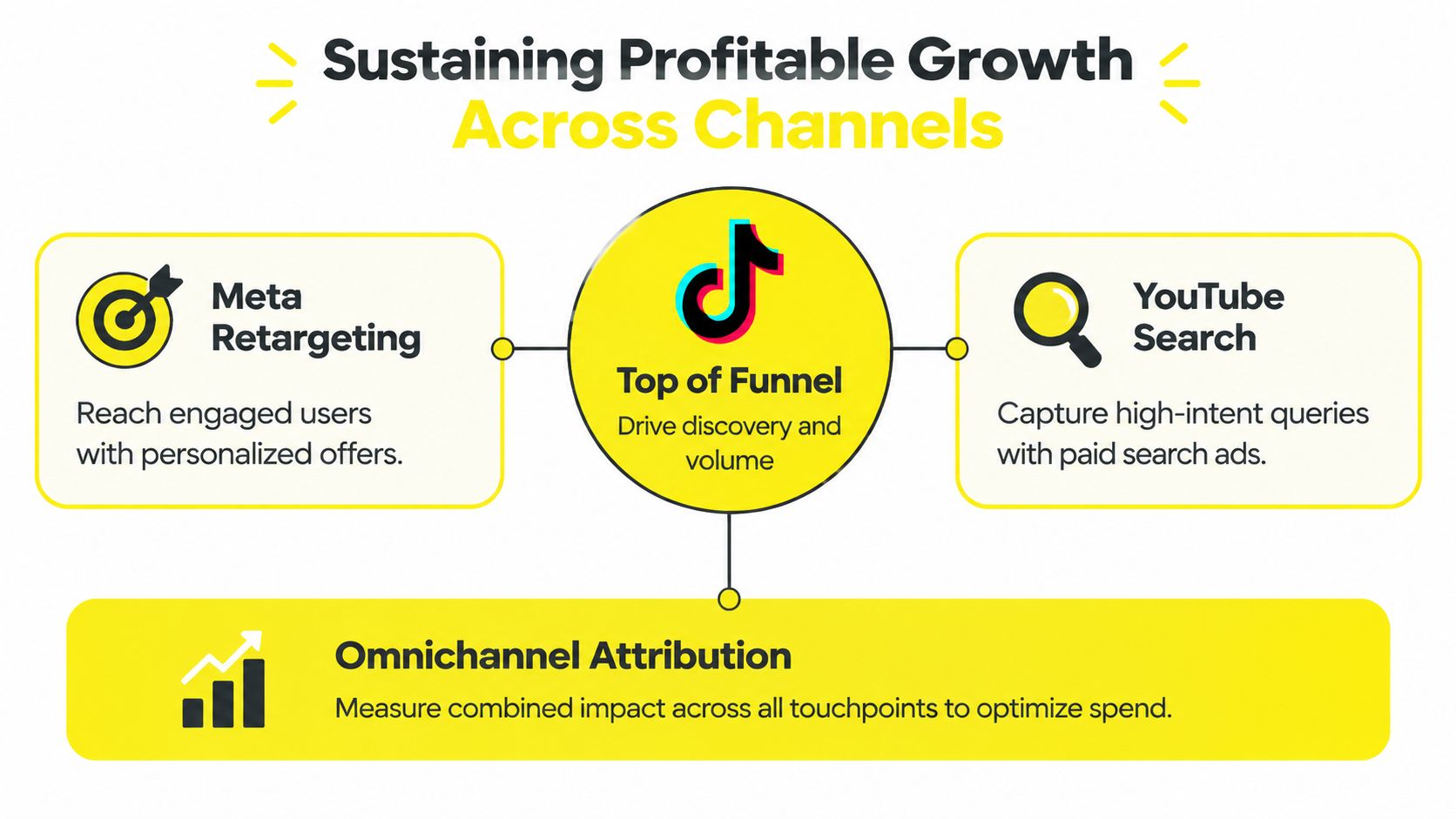
Use TikTok Ads Manager to find attention and creative signals, but use your store and finance data to decide whether that attention is worth buying. Wojo Media offers performance advertising, landing-page, creative, and omnichannel campaign support for brands that want TikTok connected with Facebook, Instagram, Google, and YouTube rather than managed as a separate silo.
If your ecommerce brand needs a clearer path from TikTok creative to profitable, measurable growth, visit Wojo Media to explore performance advertising, UGC production, conversion-focused landing pages, and cross-channel tracking. Bring your current attribution and backend numbers, and use the conversation to identify whether the next constraint is creative, checkout, offer, or measurement.
Comments