.png)
Touchpoint Optimization: A Practical Guide for Modern Brands

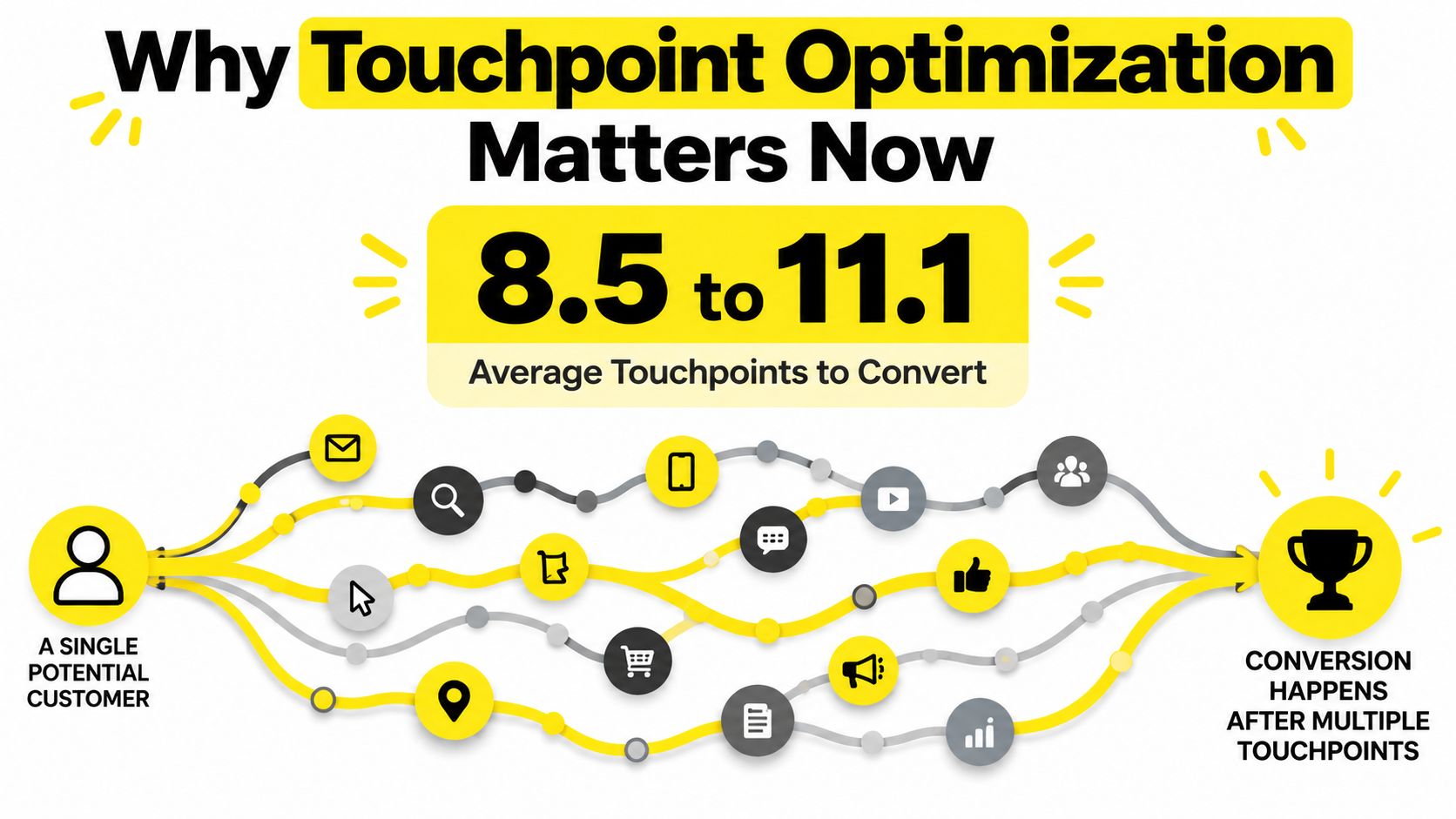
Consumers now need 11.1 touchpoints to buy in 2025, up from 8.5 in 2021, a 31% increase in just four years (industry summary on touchpoint growth). That change turns touchpoint optimization from a nice-to-have into a survival skill, because the buyer isn't moving through one clean funnel anymore, they're bouncing across ads, search, reviews, email, social, and landing pages before they ever convert.
The brands that win don't just run better ads. They make the handoffs between Meta, Google, TikTok, email, and the landing page feel like one coordinated system, so each interaction makes the next one easier to convert. The brands that lose often have strong individual campaigns but weak sequencing, so paid media creates attention, search captures it, and lifecycle never fully carries it forward.
A useful way to think about the problem is simple. If the ad promise, landing page message, and follow-up email don't feel like one story, ad spend leaks at the seams. For teams building ecommerce creative or UGC at speed, an ecommerce AI video tool like UGC Copilot's ecommerce video workflow can help generate more variations to test without changing the underlying sequencing strategy.
Why Touchpoint Optimization Matters Now
The jump from 8.5 to 11.1 average touchpoints has made the buyer journey harder to manage and easier to waste (industry summary on touchpoint growth). A prospect may see a paid social ad, search the brand, read reviews, return through retargeting, and convert after an email. Each handoff either preserves intent or forces the buyer to rebuild it.
The journey is longer, so the seams matter more
Touchpoint optimization cannot sit inside one channel dashboard. A strong Meta ad still loses value if its landing page offers a different promise. A Google search campaign can capture high intent and underperform when the page is vague or the follow-up email ignores the visitor's question. TikTok, email, search, and landing pages need clear ownership of what happens before and after each interaction.
Practical rule: If you cannot explain how the first touch leads to the second, and the second leads to the third, you are measuring media, not the journey.
The trade-off is straightforward. Channel teams prefer clean platform metrics, while customers experience one continuous decision process. Improving CTR on paid social may create more visits without improving conversion. Raising branded search volume may indicate interest without proving that the landing page or nurture sequence resolved objections. CAC rises when each team optimizes its own surface, and LTV suffers when onboarding, nurture, and support contradict the original promise.
Orchestration beats isolated fixes
Paid social, search, and email often have separate owners, targets, and reporting windows. That setup encourages local gains. One team improves CTR, another increases branded searches, and lifecycle raises open rates, yet no owner checks whether the sequence reduced friction from first impression to purchase.
The practical shift is to assign responsibility across the handoffs. The ad establishes context, the landing page answers the immediate concern, and email supports a delayed decision. An ecommerce AI video tool such as UGC Copilot's ecommerce video workflow can produce creative variations for testing, but more variations do not fix a broken sequence.
Ask which sequence reduced friction, not which channel won. That question keeps optimization focused on how interactions work together.
What Touchpoint Optimization Means
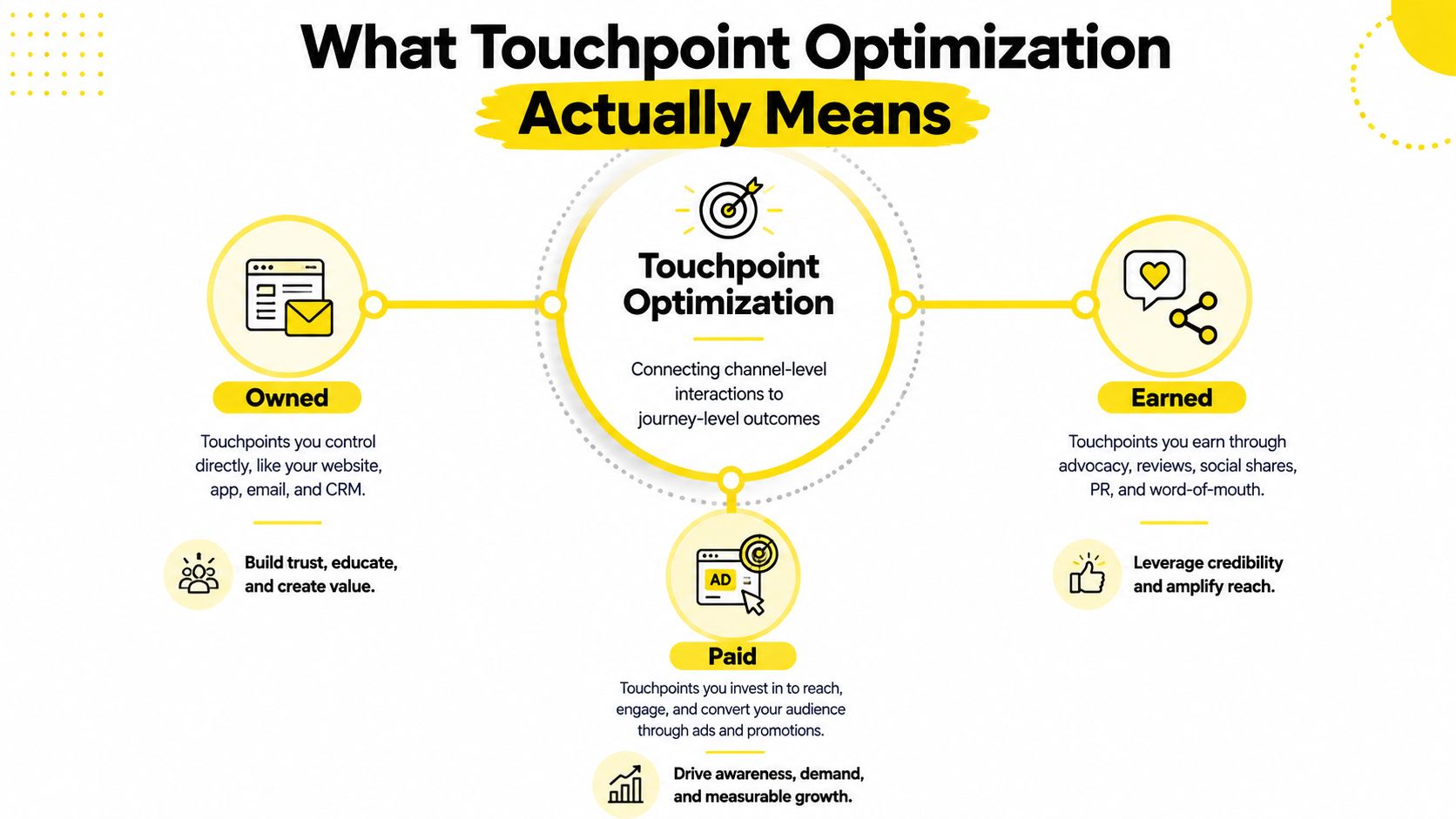
Touchpoint optimization connects channel-level interactions to journey-level outcomes. It examines what happens before, during, and after each click, then evaluates whether the sequence made conversion easier or introduced new friction. The working question is simple: did each handoff give the next touchpoint enough context to do its job?
Owned, earned, and paid have different jobs
Sort touchpoints into owned, earned, and paid to clarify responsibility. Owned touchpoints include your website, landing pages, and email. Earned touchpoints include reviews, shares, and word-of-mouth. Paid touchpoints include the ads and placements purchased to create demand or capture intent.
Each category contributes differently. Paid media often creates discovery and brings people back into the journey. Owned experiences turn attention into action and continue the conversation after the click. Earned proof reduces uncertainty by adding credibility from outside the brand.
The categories should not be treated as interchangeable traffic sources. A Meta creative may start a strong conversation while producing weak purchase intent. A landing page may load quickly and present a clear offer, yet still underperform because the ad promised something else. The failure sits between the touchpoints, not inside one platform report.
A click takes its value from the sequence
A click has no fixed value by itself. Its contribution depends on the context that preceded it and the experience that follows it. A prospect who watches a useful video, sees a relevant retargeting ad, reaches a page that restates the offer, and receives a follow-up email with the same promise has encountered a connected sequence.
The same click becomes wasteful when it leads to a generic page with a disconnected headline, followed by a newsletter that ignores the campaign. Teams that optimize only one surface can then mistake activity for progress. Better sequencing may reduce apparent efficiency in one channel while improving the conversion rate of the full journey.
A conversion is rarely won on the first interaction. It is usually won when the next interaction feels inevitable.
For a practical CRO perspective on owned experiences, ELECTE's guida CRO per PMI offers a useful reference. The page must answer the question created by the ad, and the follow-up must preserve that answer. Otherwise, paid spend creates interest that the rest of the journey fails to convert.
Mapping the Touchpoints That Drive Conversions
Paid search, paid social, landing pages, and email all do different work, so they need different KPIs, different creative briefs, and different expectations. The strongest journeys I've seen don't reuse one message everywhere. They translate the core promise into a new job at each step.
The data supports that split. Published attribution work reports paid search appears in 67% of journeys, paid social in 45%, and email in 34%, which tells you these aren't optional surfaces, they're recurring ones in real paths to purchase (multi-touch attribution research). A separate conversion-rate resource is useful here too, because once you see the path, the landing page becomes less of a design asset and more of a journey gate.
Each surface earns a different job
Paid search usually captures high intent and branded defense. Paid social often seeds demand, creates retargeting pools, and nudges mid-funnel prospects. Landing pages convert interest into a decision. Email handles nurture, reassurance, and post-click reinforcement.
The point isn't to make each channel “better” in isolation. The point is to make each one consistent with its role. If search is doing cleanup work for weak prospecting, or email is forced to re-explain a promise that the ad should've made, the sequence is broken.
Surface | Role in Journey | Primary KPI |
|---|---|---|
Paid search | Capture existing intent and protect branded demand | Qualified clicks and conversion efficiency |
Paid social | Create and warm demand, then retarget engaged users | Engaged traffic and assisted conversions |
Landing page | Resolve objections and convert the click | Conversion rate |
Nurture, reinforce, and recover hesitant buyers | Reply rate, conversion from nurture |
Ask whether the story changes from one surface to the next
A quick audit usually tells the truth. If the paid social ad sounds like one brand, the search ad sounds like another, and the email sounds like a third, sequencing has already failed. The buyer is being asked to re-orient at every step, and every re-orientation costs momentum.
The strongest stacks keep the message coherent while changing the job. Social can introduce the angle, search can capture the demand, and email can answer the final objection. That's not repetition, it's reinforcement.
Measurement Frameworks That Reveal True Performance
Measurement determines what gets funded, so touchpoint optimization fails fast when attribution is too narrow. Last-click makes the final interaction look heroic. Multi-touch spreads credit across the journey. Lift-based measurement asks the harder question: which interactions changed behavior?
Google's mid-funnel analysis found multi-touch attribution credited mid-funnel channels with 16× more sales than last-click attribution, while lift studies reported incremental phone-sales increases of 12.5% from mid-funnel display and 31.5% from YouTube exposure (Google mid-funnel marketing analysis). Those numbers don't mean every brand should copy the same allocation. They do mean mid-funnel touchpoints can disappear under last-click models even when they're doing real work.
Compare the frameworks before moving budget
Last-click is easy to read and easy to defend, which is why it survives in so many accounts. It also over-rewards branded search and direct traffic while undercounting demand creation. Multi-touch gives a fuller view, but it depends on path integrity, and that gets messy when identity is incomplete or journeys cross devices.
Lift-based measurement is closer to the truth when budget gets serious. It isolates incremental impact through holdouts or exposure tests, so you can see whether a touchpoint changed conversions instead of just showing up near them.
Framework | Data Requirement | Best Use Case | Limitation |
|---|---|---|---|
Last-click attribution | Basic conversion tracking | Fast read on closing activity | Overvalues the final touch |
Multi-touch attribution | Observable journey paths | Comparing channel roles across the funnel | Breaks when paths are incomplete |
Lift-based measurement | Holdouts, experiments, or exposure tests | Budget decisions and incrementality | Slower and harder to run |
Budget decisions change depending on the model
A brand using last-click might slash prospecting because it “doesn't convert.” A brand using lift data might protect that same spend because it creates demand that search later captures. That's the trap. You can cut the top of the funnel to make reporting cleaner, then spend more later to replace the demand you just removed.
Practical rule: If a channel only looks weak after you removed its influence from the rest of the journey, the measurement model, not the channel, is the problem.
For teams that need a practical social ROI lens, PostSyncer's ROI measurement guide is a helpful companion because it forces the question of what the channel contributed, not just what it closed.
The Hidden Failure Point Most Brands Miss
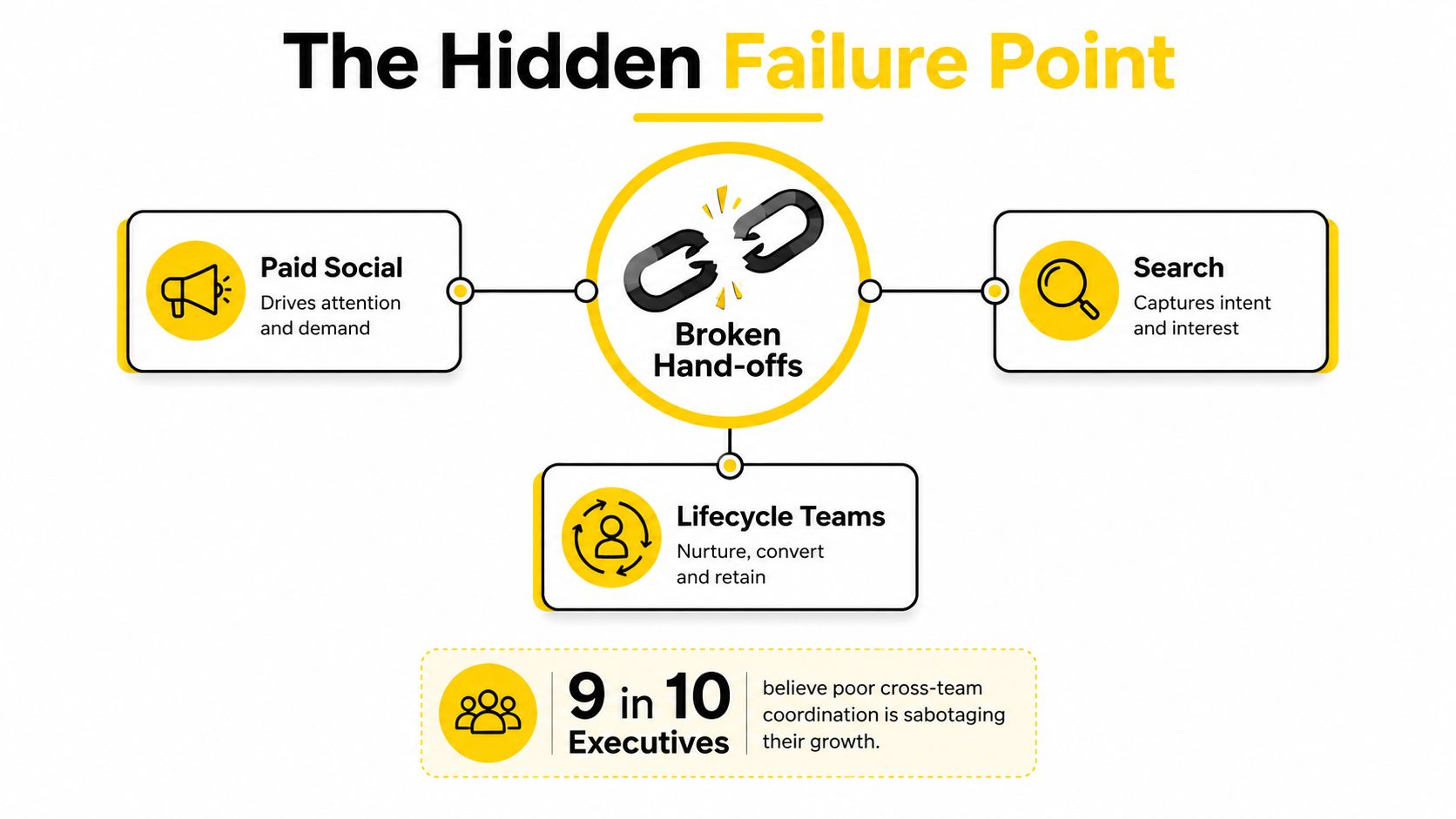
Most touchpoint programs fail at the seams between teams, not because the ads are weak. Paid social, search, email, onboarding, and support often optimize in silos, so each department can hit its own KPI while the customer still experiences a disconnected journey.
The perception gap is real. Independent coverage citing a 2025 PwC survey said nearly 9 in 10 executives believed loyalty was growing, while about 4 in 10 consumers felt the same (CMSWire coverage of the loyalty gap). That's the kind of disconnect that shows up when teams read their own dashboards but don't share ownership of the customer's experience.
The symptoms show up in familiar places
Paid social often drives branded search, which then gets credited as the winner. Lifecycle email may fire before the lead has enough context, so the message feels premature. Landing pages can also drift away from the campaign they were built to support, especially when another team owns the page and no one owns the transition.
Those aren't creative problems in the narrow sense. They're ownership problems. The ad may be good, the search keyword may be strong, and the email may be well-written, but the handoff still breaks the chain.
Use the org chart as a diagnostic tool
Start by asking who owns the sequence, not just the channel. Who owns the promise from ad to page? Who owns the transition from trial to nurture? Who owns messaging consistency when sales gets involved?
If nobody can answer those questions cleanly, the journey is already fragmented. The fastest fix is usually not more creative production, it's clearer ownership and a shared brief across the surfaces that matter.
A Practical Playbook for Omnipresent Sequencing
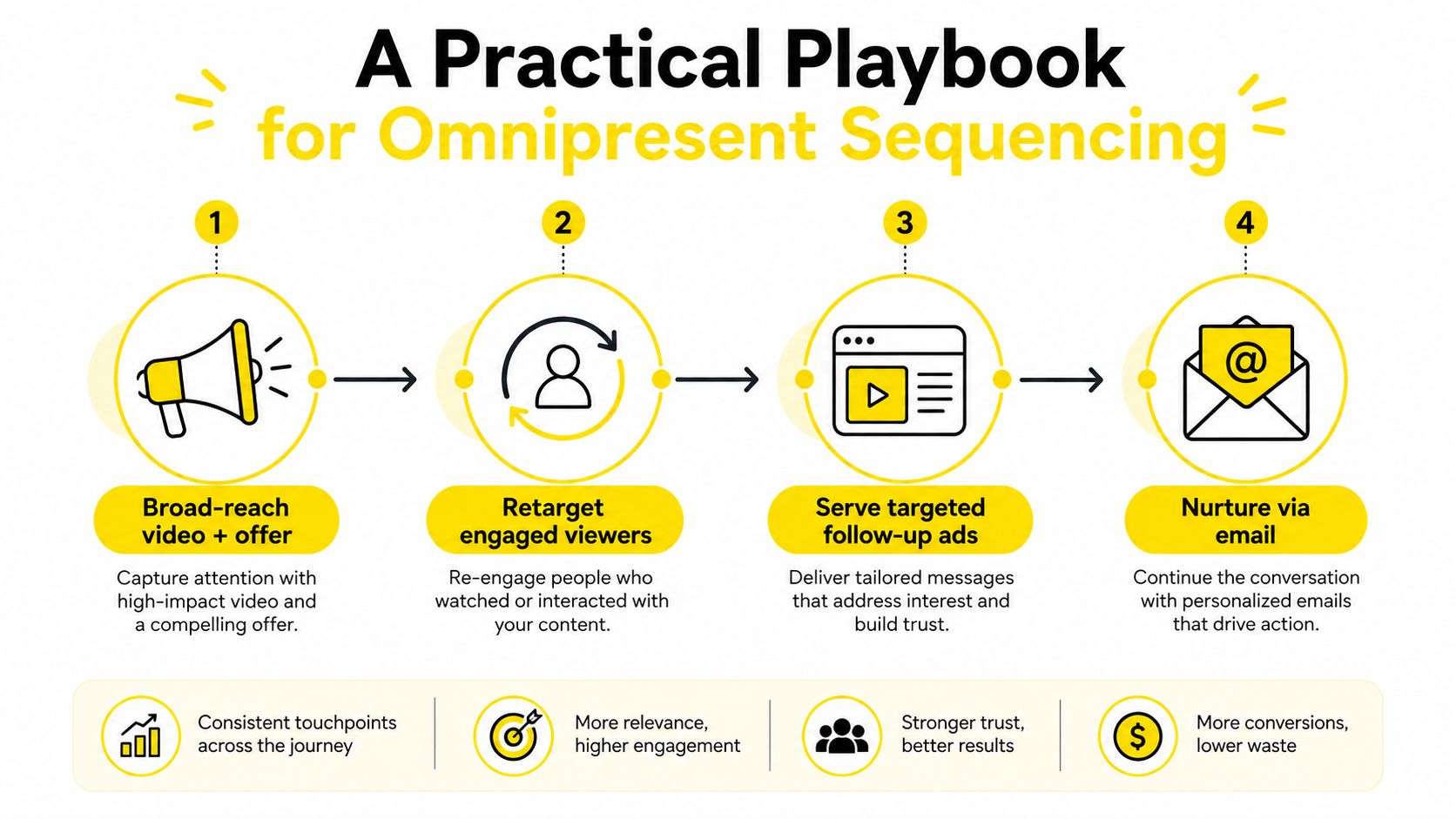
The best sequencing systems don't try to convert everyone immediately. They move people forward with a series of aligned offers that match attention level, intent level, and trust level. That means the creative changes shape, but not direction.
Stage one starts with education
Broad-reach video should introduce the problem and the category without asking for a hard conversion. The offer here is usually educational, not transactional. That could be a guide, a demo of the framework, or a proof point that helps the buyer understand why the category matters.
The mistake at this stage is over-asking. If the audience is still cold, a direct sell usually raises friction instead of reducing it. The goal is to create enough relevance that the next touchpoint doesn't feel random.
Stage two rewards engagement
Once someone has watched, clicked, or visited, retargeting should shift to proof. Meta and TikTok work well here when the creative shows outcomes, objections, or social proof, while search captures category keywords from people already leaning in.
Sequencing earns its keep. The audience has seen the problem already, so the next message should move from “what is this?” to “why this over the alternatives?” If the retargeting ad repeats the opening pitch without adding proof, you're wasting a warm audience.
Stage three closes intent
Branded search is where warm prospects often return on their own terms. The offer can be more direct now because the audience has already done the mental work. The landing page should mirror the promise they've seen before, then remove the last bit of uncertainty.
That's also where many stacks break. A strong ad can be undone by a weak page, and a strong page can be undercut by an email sequence that drifts into generic content. Consistency matters more than cleverness at this stage.
Stage four carries the promise forward
Email should mirror the ad promise, not send a generic newsletter that changes the subject. If the click came from a specific angle, the follow-up needs to respect that context. Otherwise the user has to re-learn the offer, and the sequence loses momentum.
I've seen this exact problem inside accounts that looked healthy on the surface. The media team was producing demand, but the lifecycle team was speaking in a different voice, so the system kept restarting itself. One owner, one message architecture, and one transition plan usually fix more than another round of creative swaps.
Putting It All Together and What Comes Next
The first fixes are usually the simplest. Replace last-click-only thinking with multi-touch attribution where possible. Align the creative, offer, and landing page sequence across paid social, search, and email under one owner. Audit the handoffs for message consistency, pricing consistency, and timing so the journey doesn't reset every time it changes hands.
That's a workable 30-day sprint, not a full rebuild. You don't need to redesign the entire growth engine to get better outcomes. You need to stop leaking intent between the moments that already exist.
The next wave is already changing the pace
AI is starting to push journey orchestration closer to the response itself. Generative creative variants, predictive send-time optimization, and real-time bid changes are collapsing the gap between touchpoint and reaction. That creates more speed, but it also raises the bar for control.
The risks are real. Attribution is getting harder to see. Platforms keep changing which signals are available. Creative fatigue also cycles faster, which means what worked for weeks can lose edge in days. Teams that treat touchpoint optimization as a static checklist are going to fall behind.
The playbook is changing, but the principle isn't. Every touchpoint still has to make the next one easier.
Brands that win here will keep one eye on measurement and one eye on sequence. That means protecting the touchpoints that create demand, tightening the ones that convert it, and building ownership across the seams that usually get ignored. The work is less about tweaking one ad and more about making the full journey feel intentional.
If you want a team that builds paid media around sequencing instead of isolated channel wins, Wojo Media works on omnipresent ad systems, conversion-focused landing pages, and full-funnel optimization across Meta, Google, TikTok, and YouTube. Visit Wojo Media to see how that approach can be applied to your own customer journey.
Comments