.png)
What Is First Party Data

You've probably seen this pattern already. Ad spend rises, CPMs get more expensive, reported conversions become harder to reconcile, and the ad platforms seem less certain about who bought. Your website, CRM, email platform, booking system, and customer support team still know what happened, but that information often stays trapped in separate systems.
That's the practical answer to what is first-party data. It's information your company collects directly from people through channels you own or control. The value isn't that the data belongs to you. It's that you can connect a customer's consent, behavior, purchase, and lifecycle stage to a real business outcome, then send the right signal back into Meta, Google, YouTube, or TikTok.
Why First-Party Data Matters More Than Ever
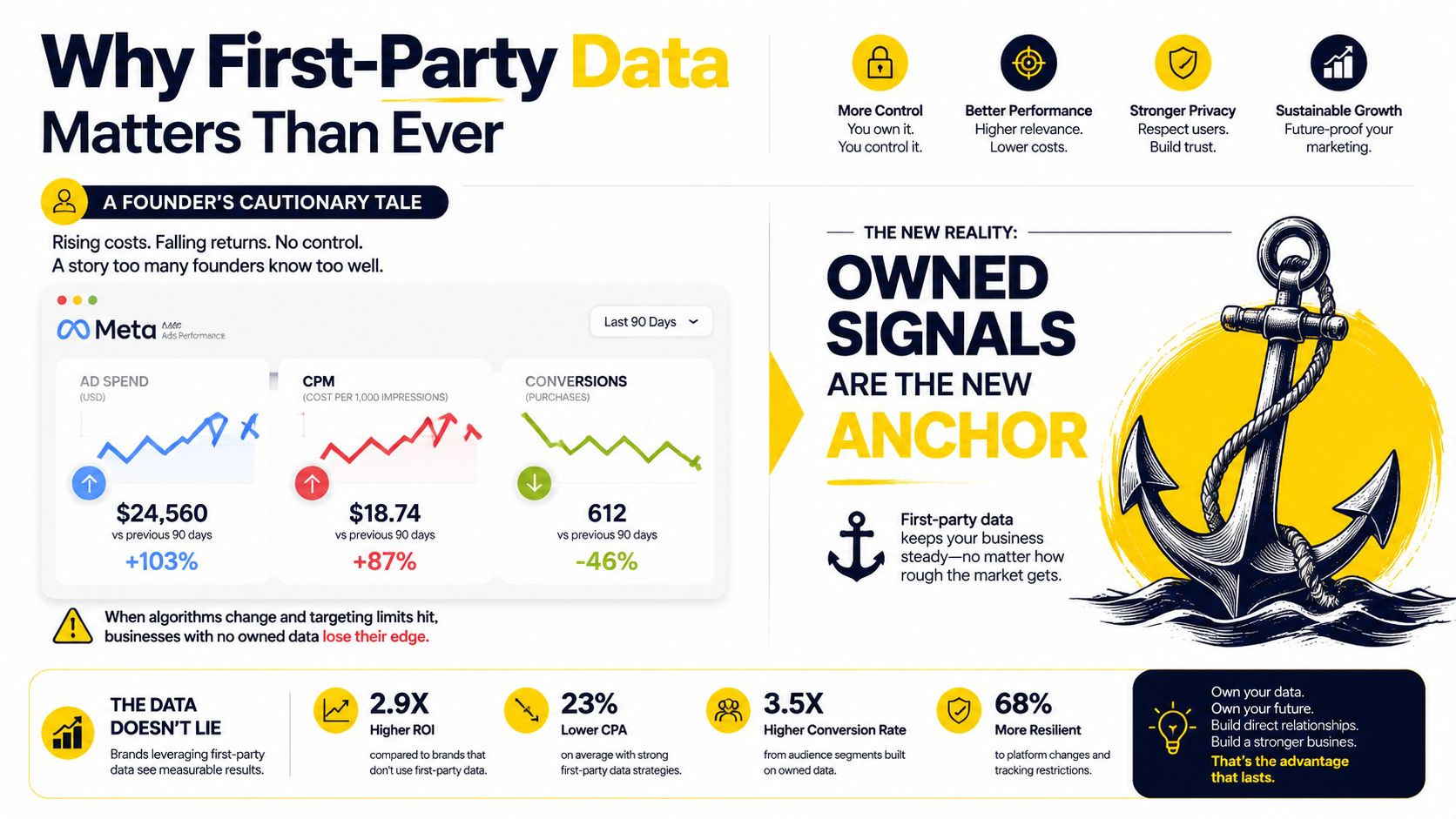
A founder increases Meta spend and expects sales to scale with it. Instead, CPMs rise, conversion volume weakens, and the platform's reporting no longer lines up cleanly with orders in Shopify. The first reaction is usually to blame the creative or the offer. Sometimes that's right. Often, the quieter problem is that the ad account has lost access to reliable customer signals.
First-party data gives paid media a stronger reference point. It includes email addresses, phone numbers, purchase history, page activity, declared preferences, booked appointments, support interactions, and subscription status collected through your website, app, CRM, email program, point-of-sale system, or community.
The shift toward owned data isn't theoretical. Businesses personalizing experiences with only first-party data rose from 31% in 2021 to 37% in 2022, according to first-party data adoption figures. In 2024, 71% of brands, agencies, and publishers were growing or planning to grow their first-party datasets, compared with 41% two years earlier, as reported in Omnibound's first-party data statistics.
Owned signals improve the handoff
A customer list can help Meta find comparable prospects, but the useful asset isn't the list alone. It's the quality of the underlying records, the consent status, the event names, and the distinction between a first-time buyer, a repeat customer, and someone who only downloaded a guide.
That distinction improves practical decisions:
Targeting: Build audiences from buyers, qualified leads, booked appointments, or high-value customers instead of treating every lead as equal.
Suppression: Stop showing acquisition ads to recent purchasers or exclude leads already moved into a sales pipeline.
Bidding: Feed purchase value, qualified lead status, or offline outcomes into platform optimization where the integration supports it.
Measurement: Compare platform reports with orders, CRM stages, revenue, and retention rather than accepting one dashboard as the complete truth.
Privacy changes accelerated this need. GDPR took effect in the European Union on 25 May 2018, and the California Consumer Privacy Act began enforcement on 1 July 2020, creating greater value for consented data collected through owned interactions, as documented in the verified first-party data overview.
First-party data isn't a compliance checkbox added after the campaign launches. It's the foundation for a paid growth system that can learn from real customers instead of relying entirely on rented audience estimates.
First-Party Versus Second-Party and Third-Party Data
The simplest way to separate these categories is to ask one question: whose direct relationship produced the data?
First-party data comes from your own interactions. Second-party data is another organization's first-party data shared with you through a partnership. Third-party data is collected and aggregated by external providers across multiple sources, then licensed or sold to advertisers.
Dimension | First-Party | Second-Party | Third-Party |
|---|---|---|---|
Source | Your website, app, CRM, purchases, support, email, or POS system | A partner's owned customer interactions | Aggregated records from external providers |
Ownership | Your organization controls collection and use | The partner controls the original relationship | The provider controls the dataset |
Consent quality | You can inspect the collection context and consent state | Depends on the partner's permissions and transfer process | Often harder to trace at the individual interaction level |
Durability | Strong when the customer relationship continues and records remain governed | Depends on the partnership and data-sharing terms | Vulnerable to browser restrictions, platform policy, and provider changes |
Cost structure | Internal collection and management costs | Partnership, integration, or clean-room costs | Licensing and audience-access costs |
Best use case | Retargeting, suppression, lifecycle segmentation, measurement, and value-based activation | Enrichment, joint campaigns, and privacy-safe audience overlap | Broad prospecting where the provider offers relevant reach |
First-party data
A customer who submits a quote request on your site, buys from your store, or joins your email list has interacted directly with your business. You can connect that action to the form, timestamp, consent choice, order status, and later outcome.
That provenance makes first-party data the strongest foundation for identity resolution and closed-loop measurement. It still needs cleaning and permission controls, but you're not asking a broker to explain where a segment came from.
Second-party data
Second-party data can be useful when two companies serve adjacent audiences. A gym might collaborate with a nutrition brand, or a mortgage broker might partner with a real estate educator. The benefit is access to a relevant audience you haven't built yourself.
The trade-off is governance. You need to understand what the partner collected, what people agreed to, how the data may be transferred, and whether the intended activation matches that permission.
Third-party data
Third-party data can provide scale, especially when you need broad prospecting. It's also the least direct relationship. External aggregation can obscure recency, collection context, identity quality, and audience fit.
That doesn't make every third-party segment useless. It means it should support testing and reach expansion, not replace the customer records and conversion events your own business can verify.
Where First-Party Data Actually Comes From
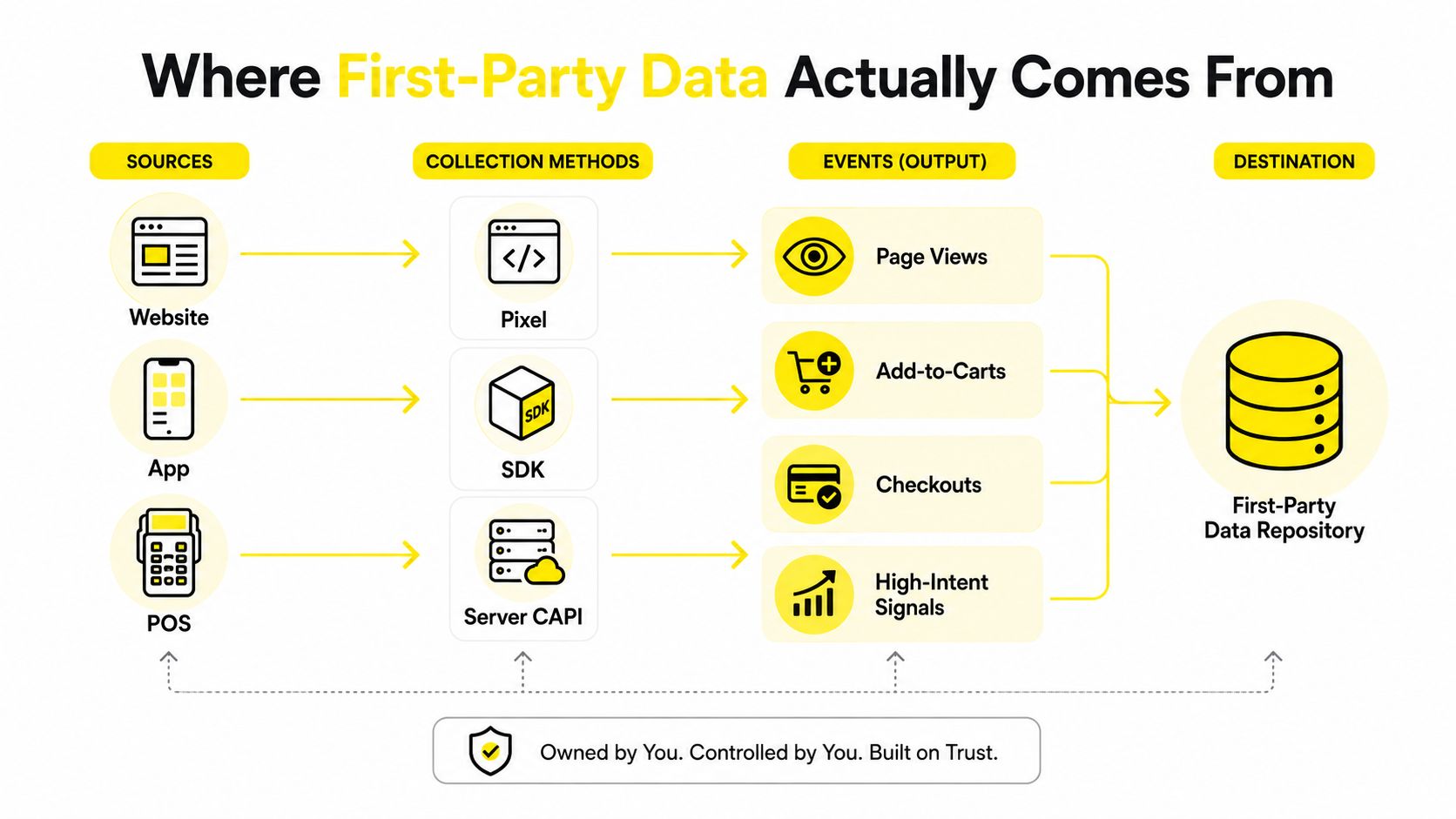
Most businesses already have more first-party data than they realize. The problem is usually fragmentation. A pixel knows that someone viewed a pricing page, the CRM knows that person requested a quote, and the sales team knows whether the conversation became revenue. Those signals become valuable when the systems share consistent identifiers and event definitions.
Start with digital behavior
Your website and app capture the earliest observable intent. Browser-side pixels, mobile SDKs, and server events can record page views, product views, searches, add-to-carts, checkout starts, purchases, form submissions, and appointment requests.
Not every event deserves equal weight. A pricing-page visit, repeated product view, webinar registration, or return to a booking page may be more useful for segmentation than a generic page view. Define the event, identify the source, attach the available consent state, and record the identifier used to connect it later.
Add CRM, email, and transaction context
Your CRM and email system contain the signals ad platforms usually can't infer reliably:
Lifecycle stage: Lead, qualified lead, opportunity, customer, repeat customer, or churn risk.
Commercial value: Order value, purchase frequency, subscription status, or internal value tier.
Engagement: Email clicks, webinar attendance, booked calls, and responses to sales outreach.
Identifiers: Email, phone number, customer ID, order ID, and booking reference.
A lead who filled out a form isn't necessarily equivalent to a customer who purchased twice. Pass those distinctions into audience rules and conversion imports.
Point-of-sale and offline systems matter just as much for local businesses. A med spa, home-services company, or retail store can connect transactions to digital records through loyalty enrollment, customer phone numbers, appointment IDs, receipts, or CRM matchbacks.
The final layer is qualitative input. Quiz answers, survey responses, support tickets, reviews, community participation, and sales notes can reveal objections and preferences that transactional data misses. Use that information to improve segmentation and creative, while limiting activation to data collected for an appropriate purpose.
This collection flow is easier to audit when every event has a source, timestamp, identifier, consent state, and downstream destination.
Storing and Governing First-Party Data the Right Way
Raw events don't become an audience just because they landed in a spreadsheet. You need a storage layer, a consistent schema, identity rules, and permission controls that determine what each team and platform can use.
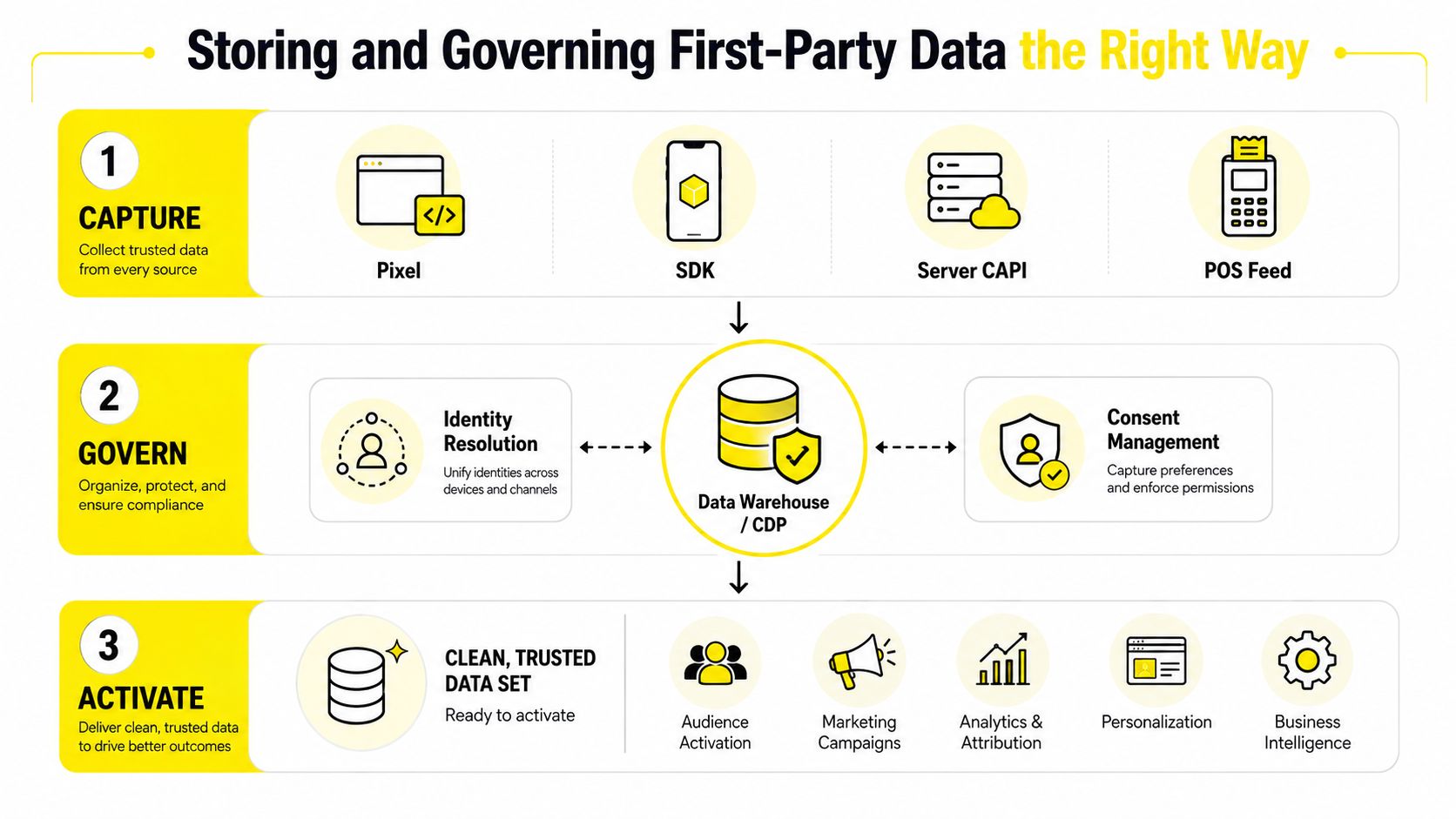
A practical stack usually has three layers:
Capture: Website pixels, app SDKs, server-side events, CRM updates, email activity, and POS feeds collect actions and attributes.
Govern: A warehouse or CDP standardizes fields, resolves identities, applies consent rules, and records data lineage.
Activate: Approved segments and conversion events move into Meta, Google, YouTube, TikTok, email, analytics, or sales workflows.
Make identity resolution explicit
A visitor may start anonymously, subscribe with an email address, and later purchase using a phone number. Your systems need rules for deciding when those records represent the same person. Use stable customer IDs where possible, preserve order IDs for transaction joins, and document how email and phone identifiers are normalized before hashing or matching.
For a small e-commerce brand, Shopify and Klaviyo might feed a warehouse such as BigQuery. A local service business might connect HubSpot, CallTrackingMetrics, booking records, and offline outcomes. A coach could combine email engagement, webinar registrations, and Stripe transactions in a structured Airtable workflow before sending qualified events into ad platforms.
Governance covers more than access passwords. Record the purpose attached to each field, the consent choice at collection, retention rules, user deletion requests, and which destinations receive the data. Role-based access prevents a contractor from seeing fields they don't need, while audit trails show who changed a segment or exported an audience.
Practical rule: If you can't explain where an audience field came from, when it was collected, and whether the customer permitted its use, don't upload it yet.
Consent deserves special attention because direct collection doesn't automatically make activation lawful. The UK ICO guidance on online advertising storage and access technologies states that advertising-related storage and access technologies require consent, and that measurement sits within the consented advertising purpose. Google's Consent Mode also changes tag behavior according to consent status.
A clear privacy operating model should cover how your data is protected, including access controls, encryption practices, deletion handling, and auditability. The objective isn't to build an enterprise architecture for its own sake. It's to make your customer data usable, explainable, and less likely to be rejected by platforms or mishandled by staff.
Activating First-Party Data Across Meta, Google, YouTube, and TikTok
Activation starts with a business question, not an upload button. Do you want to suppress recent purchasers, find customers similar to high-value buyers, recover incomplete checkouts, improve qualified-lead bidding, or re-engage people who attended a webinar?
Channel | Activation Feature | Primary Use Case |
|---|---|---|
Meta | Customer lists, Conversions API, offline events, value-based audiences, and lookalike audiences | Retargeting, suppression, purchase-value modeling, and prospecting from quality customer signals |
Customer Match, Enhanced Conversions, offline conversion imports, and audience signals | Search, Performance Max, and YouTube optimization using consented customer and conversion data | |
YouTube | Google Ads audience and conversion infrastructure | Re-engaging known users with longer-form education, testimonials, or product demonstrations |
TikTok | Pixel, Events API, and commerce or shop integrations | Capturing richer behavioral signals and building retargeting or prospecting audiences |
Meta
For an e-commerce brand, a consented, hashed customer list can separate repeat buyers from first-time purchasers and inform value-based prospecting. Conversions API can send server-side purchase events alongside browser events, provided the implementation handles deduplication, event quality, and permission signals correctly.
Use the data operationally. Exclude recent purchasers from acquisition campaigns, create a cart-abandoner segment with a suitable recency rule, and build prospecting audiences from customers who generated meaningful revenue rather than every email subscriber. Advantage+ Shopping can still make its own delivery decisions, so the account's creative, offer, product feed, and event quality remain important.
Google and YouTube
Google Enhanced Conversions can supplement conversion measurement with consented, first-party customer information that's formatted and sent according to Google's requirements. Customer Match can support audience use cases across Google properties, while offline conversion imports connect lead records or sales outcomes back to campaigns.
A local services company might upload qualified quote requests rather than raw form fills, then use a local awareness creative to re-engage people who asked for pricing but haven't booked. A coach might connect webinar attendance and CRM stage to a YouTube campaign featuring a long-form testimonial. The audience signal helps define relevance, but the video still has to address the prospect's objection.
TikTok
TikTok's Pixel and Events API can capture website and server-side events, while commerce integrations can provide additional purchase context where supported. Smaller, richer audiences often give the platform more useful intent than a large list built from low-value interactions.
Signal quality beats list size when the audience represents a real business outcome.
A coach could create a segment of webinar attendees who didn't purchase, then test a testimonial sequence against broad interest targeting. An e-commerce team could exclude customers who just bought and use product-view or checkout events for a separate recovery path.
Across every channel, first-party data can't rescue a weak landing page or an unconvincing offer. It tells the platform and the operator who matters, what happened, and which outcomes deserve more weight. The message and post-click experience still determine whether attention becomes revenue.
Measuring Campaign Performance and Proving ROI
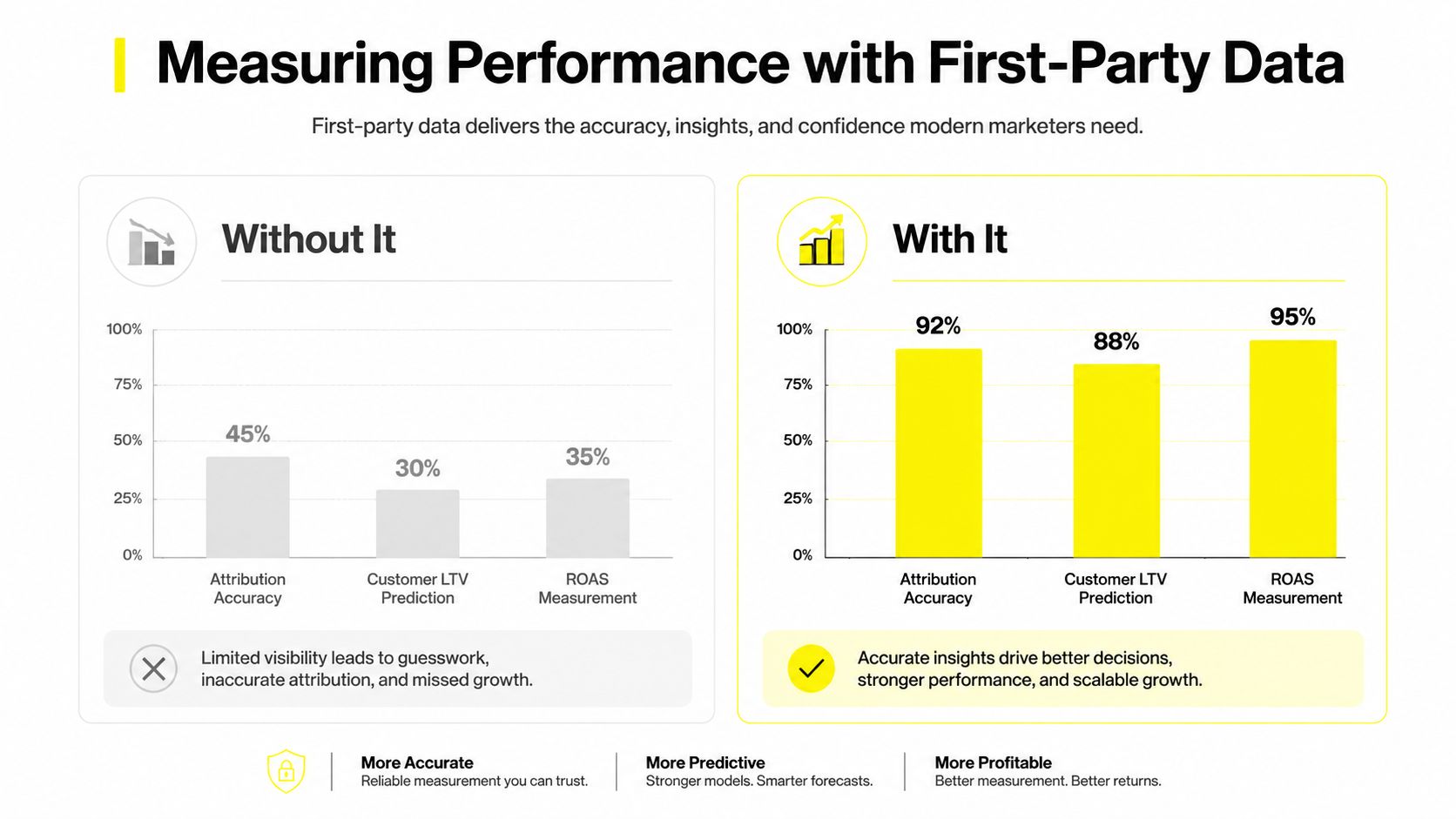
First-party data changes the question from “Which platform reported the conversion?” to “Which sources produced customers, qualified opportunities, and profitable repeat behavior?”
That requires a measurement layer built around business outcomes:
CAC by source: Compare acquisition cost by channel, campaign, offer, and customer type.
MER: Review total marketing efficiency against total revenue instead of optimizing every platform in isolation.
LTV cohorts: Track what customers acquired in a given period do after the first purchase or lead conversion.
Incrementality: Use controlled tests or geo-based comparisons to estimate what the advertising caused rather than what it merely touched.
Pipeline quality: For lead generation, connect the ad click to booked, attended, qualified, and closed stages.
Server-side measurement is now a practical requirement for continuity. Meta Conversions API, Google Enhanced Conversions, and TikTok Events API can help transmit customer actions from systems you control, but they don't remove the need for consent, accurate event mapping, deduplication, and reconciliation against source-of-truth records.
Build one decision view
A blended dashboard should pull Shopify or another commerce source, CRM stages, Google Ads, Meta, TikTok, and payment data into a common reporting model. Don't force every number to match perfectly. Define which system owns orders, which system owns spend, which system owns lead status, and how time zones, refunds, cancellations, and repeat purchases are treated.
Last-click reporting is especially weak for long consideration cycles. A prospect may see a TikTok video, search your brand, watch a YouTube testimonial, submit a form, and close after a sales call. A channel report may claim only one touch, while your CRM contains the actual path and outcome.
The verified operational picture is sobering: only 34% of collected first-party data is reportedly activated in campaigns, while 84% of marketers call it mission-critical and only 36% have a defined activation strategy, according to Experian's first-party data resource. Collection without activation doesn't improve decisions.
For example, a DTC brand might discover that new-customer CAC looks acceptable in platform reports but worsens after repeat purchasers are included in acquisition audiences. Tightening suppression, improving server events, and evaluating blended CAC against the store's order data may change budget allocation even if no individual platform reports a dramatic improvement.
A coach can apply the same principle with UTMs and CRM stages. Clicks are useful for diagnosing creative and landing-page behavior, but booked calls, attended calls, qualified opportunities, and collected revenue are the evidence needed to judge the funnel.
Where First-Party Data Fits in a Hybrid Privacy-Safe Stack
First-party data doesn't make every other data source irrelevant. It gives you the center of gravity, while partner data and clean rooms can add reach, overlap analysis, or measurement that your own records can't provide.
Your owned systems are best at answering:
Who has interacted with the business?
What did that person do?
Did the interaction become a qualified lead, purchase, renewal, or repeat order?
What consent and purpose applied to the record?
Partner and clean-room layers answer different questions. A partner may help you reach adjacent prospects, while a clean room can compare audiences or outcomes without exposing raw customer-level records to every participant. Platform analytics tools, cloud environments, and specialist providers each have different controls, integrations, and costs, so the choice should follow the business question.
A coach might use an email list as the seed for a Meta lookalike, then use broader platform delivery to find new prospects. A local service brand could combine its POS and booking data with a publisher audience through an approved partnership. An e-commerce team might use a clean-room study to investigate audience overlap or conversion lift before increasing TikTok investment.
The operating rule is straightforward:
Owned data runs always-on targeting and measurement. Partner data expands prospecting. Clean rooms help test overlap and incrementality.
The hybrid model still depends on governance. If a partner can't document consent, permitted use, retention, or transfer controls, the apparent reach isn't worth the operational risk. For teams working in the EU or serving European customers, Carti's GDPR compliance checklist can help organize questions around collection, processing, rights, and documentation.
Cloud collaboration doesn't replace customer knowledge. It extends what you can learn or reach while keeping the internal system of record under your control.
Your 90-Day First-Party Data Roadmap and Common Questions
A useful rollout starts with the data you already collect. Don't begin by buying a CDP or creating dozens of audiences. Begin by identifying the business outcomes your ad platforms need to understand.
Days 1 to 30, inventory and consent
Audit every pixel, SDK, server event, CRM field, email capture point, booking record, POS feed, and offline conversion import. Write down the source, identifier, event name, timestamp, consent state, destination, and owner for each important signal.
Then standardize the customer schema. Decide how the business names a lead, qualified lead, purchase, repeat purchase, cancellation, refund, booked appointment, and attended appointment. Deploy or review your consent management platform and make sure tags, SDKs, server workflows, and customer-match processes respond to consent status.
Days 31 to 60, activation
Connect meaningful CRM outcomes to Meta Conversions API and Google Enhanced Conversions where the use case and permission support it. Build a small set of high-intent audiences:
Cart abandoners: People who reached a meaningful checkout stage but didn't purchase.
Repeat buyers: Customers to suppress from acquisition or use as a value-based seed.
Booked but not attended: Leads who need a reminder or a different offer.
Qualified prospects: CRM records that passed your sales or booking threshold.
Launch suppression and retargeting before expanding into complex modeling. You'll learn more from a clean audience definition than from a large number of loosely defined segments.
Days 61 to 90, reach and measurement
Test TikTok Events API if the channel fits your audience and economics. Connect reporting across commerce, CRM, Meta, Google, TikTok, and payment systems. Use a clean-room or controlled audience-overlap study when you need to assess incremental reach or conversion contribution beyond platform-reported results.
Tie MER, CAC, LTV, pipeline quality, and incrementality back to the owned records. The goal is a repeatable feedback loop, not a perfect attribution story.
Questions founders usually ask
How small is too small to start?There's no universal minimum that makes the work worthwhile. Start with the events that already represent revenue or qualified demand, even if the audience is modest. A small, accurate buyer or qualified-lead segment is more useful than a large list with unclear intent.
Which CRM fields matter most?Prioritize lifecycle stage, customer or lead ID, purchase value, product or service, booking status, close status, and timestamps. Add email and phone only where collection and activation are properly permitted.
Does first-party data replace the pixel?No. Browser events, server events, CRM records, and offline outcomes serve different roles. A resilient setup uses the appropriate combination and reconciles the events rather than assuming one source can capture the entire journey.
How do you handle consent without destroying match rates?Make the value exchange clear, collect only what you need, document the purpose, and implement consent signals consistently across tags, SDKs, server events, and audience uploads. Better governance is more sustainable than collecting data people didn't authorize.
What payback window should paid media use?Set it from your cash flow, sales cycle, margin, refund behavior, and repeat-purchase pattern. A lead-generation business may need CRM pipeline milestones, while an e-commerce brand may judge first-order contribution and later cohort value separately.
Wojo Media helps brands connect offer strategy, landing pages, omnichannel paid campaigns, and backend conversion signals so first-party data informs real acquisition decisions. If you need help turning CRM, purchase, booking, or support data into a practical activation plan, visit Wojo Media to explore its paid advertising services and request a strategy conversation.
Comments